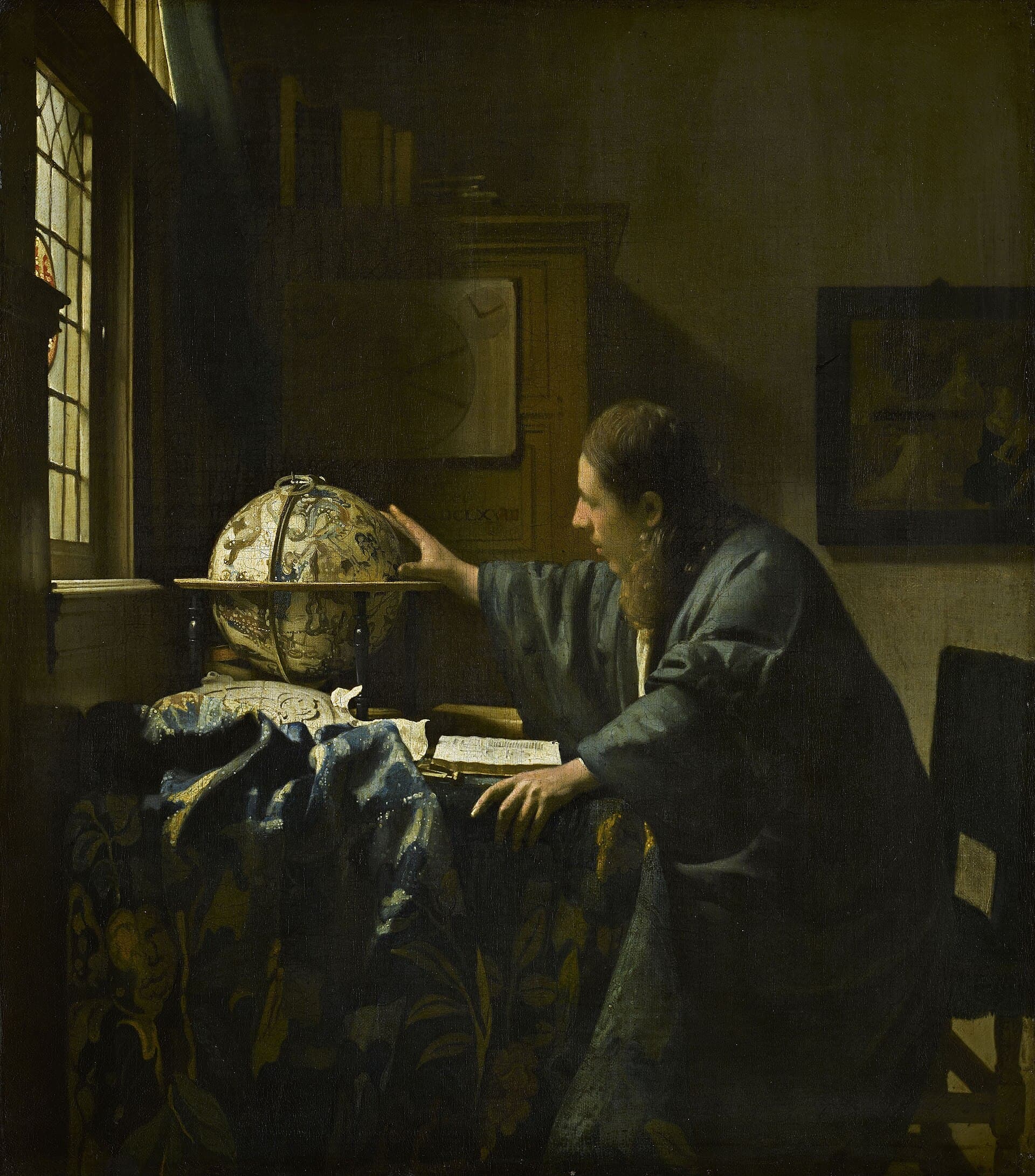
The Astronomer
A man with long hair, in a loose blue robe, leans across a table in a dim room and reaches for a globe of the stars, with an astronomy book open in front of him. Johannes Vermeer signed and dated the painting 1668. The painting belonged to the Rothschild family in Paris, was seized by the Nazis in 1940, and came to the Louvre in 1983, inventory number RF 1983-28.
- 1668
- Oil on canvas
- Musée du LouvreParis, France
About Johannes Vermeer
What the painting shows
A man sits at a table in a dim room, lit by a tall window on the left. He has long brown hair and wears a loose blue-green robe over a white shirt.
He leans forward and reaches out with his right hand, fingers spread, to touch a globe on a wooden stand. His other hand grips the edge of the table beside an open book.
The table is covered with a heavy cloth woven with large flowers, and a rumpled blue cloth is thrown over it. Behind the man stands a tall cupboard with books on top and a chart pinned to it. A dark framed painting hangs on the back wall.
Real objects on the table
The Louvre identifies the objects. The globe is a globe of the stars, not of the earth, made by Jodocus Hondius in 1600. The open book is the astronomy manual of Adriaan Metius, published in 1621, open at the chapter on the stars. The Louvre also lists a compass and an astrolabe, a round instrument for finding the positions of the stars.
Essential Vermeer adds that the scholar James Welu identified the book from the few strokes of text Vermeer painted, and that the chapter it is open at urges the reader to seek inspiration from God. There is no telescope in the room. Essential Vermeer takes this as a sign that the painting shows a man thinking about the heavens rather than observing them.
The painting on the wall shows the Finding of Moses, the baby found in the river. The Louvre says it is by Peter Lely, and may have belonged to Vermeer himself. The Louvre suggests it points to God's plan, as a counterweight to the man trying to measure the heavens.
The Geographer
Vermeer painted a second scholar a year later: The Geographer, dated 1669, now in the Städel Museum in Frankfurt. The two paintings were sold together again and again in the Netherlands from 1713 until the end of the 1790s, when they were separated.
The Louvre says they are not exactly a pair, and that the contrast often drawn between them, heaven against earth and thought against action, has probably been exaggerated. Essential Vermeer reports that the two canvases were cut from the same bolt of cloth.
The Astronomer and The Geographer were shown side by side for the first time in two centuries in 1997, at the Louvre and then at the Städel.
Who is the astronomer?
Nobody knows who posed. The Louvre says the man is sometimes identified with the Delft scientist Antoni van Leeuwenhoek, but without proof, and that Antoni van Leeuwenhoek was still little known in 1668. Antoni van Leeuwenhoek was later appointed to settle Vermeer's debts after the painter's death.
How it came to Paris
In 1785 the Paris dealer Alexandre Joseph Paillet offered the painting to King Louis XVI. The king did not buy it.
Later it passed through several English collections. At the end of 1866 or early in 1867 the French critic Théophile Thoré, who did more than anyone to revive Vermeer's reputation, bought it in Paris for the collector Léopold Double. After Léopold Double's death it was sold in Paris on 30 May 1881.
By 1888 it belonged to Baron Alphonse de Rothschild, who bought it through his art adviser Léon Gauchez. The painting passed to his son, Édouard de Rothschild.
Seized in 1940
In 1940 the German authorities in occupied Paris seized the painting from Édouard de Rothschild's collection. The Louvre says it was taken for the museum Adolf Hitler planned to build in Linz, in Austria.
The Allies recovered it in 1945, and it was returned to Édouard de Rothschild in 1946. The painting then passed to Édouard de Rothschild's son, Guy de Rothschild.
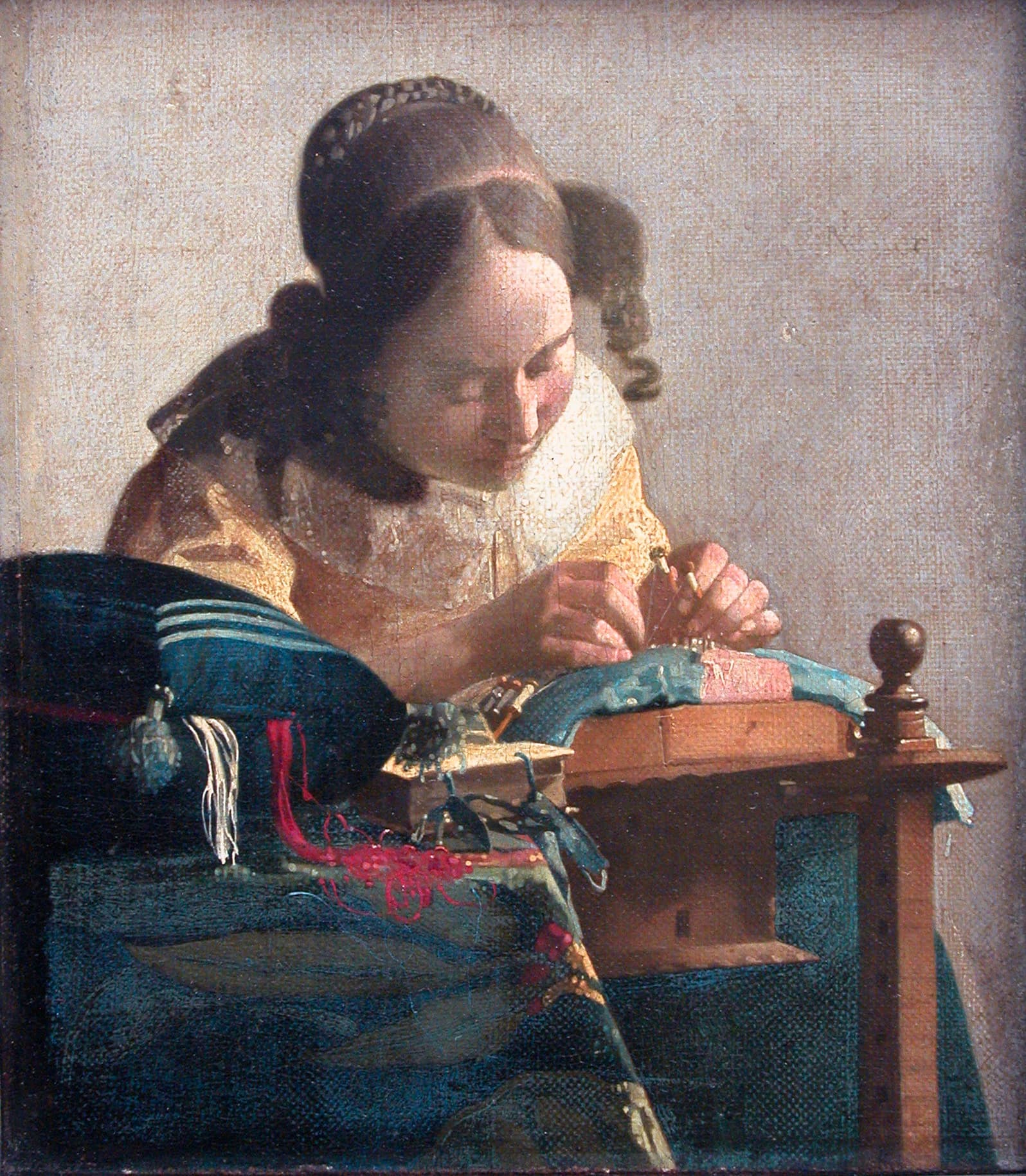
In 1982–1983 it came to the French state in payment of transfer taxes, by Guy de Rothschild's personal decision. The Astronomer now hangs in the Louvre, in the same room as The Lacemaker.
Close reading
Reading the work, detail by detail
The Astronomer is a man, a table and a globe in a dim room. Up close the objects can be named: a real star globe of 1600, a real astronomy book of 1621, a painting of Moses on the wall, and the date 1668 in Roman numerals on the cupboard.
1.A globe of the stars
The globe is a globe of the stars, not of the earth. Its surface is covered with the figures of the constellations. The Louvre identifies it as a star globe made by Jodocus Hondius in 1600. Essential Vermeer picks out the Great Bear, the Dragon, Hercules and Lyra among the figures.
2.A hand turning the globe
The astronomer reaches out with his fingers spread and touches the side of the globe, as if about to turn it. Light from the window falls across his hand and his sleeve.
3.1668, in Roman numerals
On the cupboard door, just past the astronomer's fingertips, dark Roman numerals end in LXVIII. The numerals are part of MDCLXVIII, 1668. The Louvre records Vermeer's signature, IVMeer, with the date here, though the name cannot be made out in this photograph. Very few Vermeers carry a date, and tests published in 1997 showed that this signature and date are genuine.
4.The scholar's profile
The astronomer is seen in profile, leaning forward, with long hair falling to his shoulders. His face is lit from the window. The Louvre says he is sometimes identified with the Delft scientist Antoni van Leeuwenhoek, but without proof. Antoni van Leeuwenhoek was still little known in 1668.
5.Adriaan Metius's astronomy book
An open book lies on the table, its text suggested by a few quick strokes. The Louvre identifies it as the 1621 astronomy manual of Adriaan Metius, open at the chapter on the stars. Essential Vermeer adds that this chapter urges the reader to seek inspiration from God. The small metal instrument beside the book may be the compass the Louvre lists, but it is hard to make out.
6.The other hand, holding the table
The astronomer's other hand grips the edge of the table while he leans toward the globe. Where the light catches his fingers they are pale. The rest of the hand sinks into shadow.
7.A painting of Moses on the wall
On the back wall hangs a dark framed picture with a few faint figures. The Louvre identifies it as the Finding of Moses, the baby found in the river, by Peter Lely, and says it may have belonged to Vermeer. The Louvre suggests the picture points to God's plan, next to a man trying to measure the heavens.
8.The window with a coloured pane
The only light comes from this tall window at the left, made of small leaded panes. One round pane near the top is stained red and yellow. Essential Vermeer notes that the other half of the window is closed, which keeps the room dim and throws the light onto the globe and the man.
9.A chart pinned to the cupboard
A pale sheet hangs on the cupboard, with curved lines and part of a large circle on it. The lines are too faint to read here. Essential Vermeer reports that the scholar James Welu identified the sheet as a star chart, a flat map of the sky with a disc that turns.
10.Books on top of the cupboard
On top of the cupboard stand a few books, only just visible in the gloom. Their titles cannot be read. Essential Vermeer notes that Vermeer's own estate included twenty-five books, whose titles are unknown.
11.An instrument at the foot of the globe
At the foot of the globe a pale, flat object engraved with circles leans among the folds of the blue tablecloth. The Louvre lists an astrolabe on the table, a round instrument for finding the positions of the stars, and Essential Vermeer says the astrolabe is propped against the globe. The pale object is probably the astrolabe, but in the photograph it is hard to tell where the instrument ends and the cloth begins.
12.The flowered cloth over the table
A heavy cloth woven with large olive-yellow flowers and leaves hangs from the table to the floor, with a rumpled blue cloth thrown over the top. Essential Vermeer says a similar flowered cloth appears in The Geographer and The Lacemaker, and that it was probably woven in Delft.
13.A long blue-green robe
The astronomer wears a loose blue-green robe with wide sleeves over a white shirt. Essential Vermeer says robes like this, cut in a Japanese style, were costly and fashionable in the Netherlands, and that scholars were often painted wearing them.
Timeline
1668
Johannes Vermeer signs and dates the painting.
The Astronomer, signed and dated 1668, oil on canvas, 51 by 45 cm (Musée du Louvre, Paris). Seized from the Rothschild collection in 1940, recovered in 1945, and transferred to the French state in 1983 in payment of inheritance duties. 1713
Sold in Rotterdam, probably together with The Geographer. The two are sold as a pair until the end of the 1790s.
1785
Offered to King Louis XVI of France, who does not buy it.
1866–1867
Théophile Thoré buys it in Paris for the collector Léopold Double.
c. 1888
Baron Alphonse de Rothschild owns the painting in Paris.
1940
Seized by the German authorities from Édouard de Rothschild for Adolf Hitler's planned museum in Linz.
1945–1946
Recovered by the Allies and returned to Édouard de Rothschild.
1983
Enters the Louvre, accepted by the French state in payment of transfer taxes.
1997
Shown with The Geographer at the Louvre and the Städel, reunited after two centuries.
Where to see it
Musée du Louvre
Paris, France
A public viewing address has not yet been confirmed for this holding.
The Louvre listed the painting in the Richelieu wing, level 2, Room 837, in September 2026. Displays change, so check the museum's page before a special visit.
Frequently asked questions
Where is The Astronomer?
In the Louvre in Paris, inventory number RF 1983-28. In September 2026 the Louvre listed it in the Richelieu wing, level 2, Room 837, next to The Lacemaker.
Is The Astronomer dated?
Yes. The cupboard behind the globe carries Vermeer's signature and the date 1668 in Roman numerals. The Astronomer is one of very few Vermeers with a date. The Louvre says the date has sometimes been misread as 1673.
What is on the table?
A globe of the stars made by Jodocus Hondius in 1600, Adriaan Metius's astronomy book of 1621, and, according to the Louvre, a compass and an astrolabe.
Who is the man?
Nobody knows. He is sometimes said to be the Delft scientist Antoni van Leeuwenhoek, but the Louvre says there is no proof.
Is it a pair with The Geographer?
The two paintings were sold together for most of the eighteenth century, and their canvases come from the same bolt of cloth. The Louvre says they are not exactly a pair. The Geographer is in the Städel Museum in Frankfurt.
What happened to it in the Second World War?
The Germans seized it from Édouard de Rothschild in Paris in 1940 for Adolf Hitler's planned museum in Linz. The Allies recovered it in 1945, and it was returned to the Rothschild family in 1946.
More by Johannes Vermeer
If you like Johannes Vermeer
Explore painters from the same movements and circles.
Caravaggio
Italian painter who worked from live models straight onto the canvas, without preparatory drawings, and lit them with a single hard light against a dark ground. He killed a man in Rome in May 1606, spent his last four years as a fugitive in Naples, Malta and Sicily, and died at thirty-eight.
View artist
Rembrandt van Rijn
Dutch painter and etcher who worked in Leiden and Amsterdam and never traveled outside the Dutch Republic. He made about 300 etchings and roughly eighty self-portraits, trained some twenty-five painters, and was declared insolvent in 1656.
View artist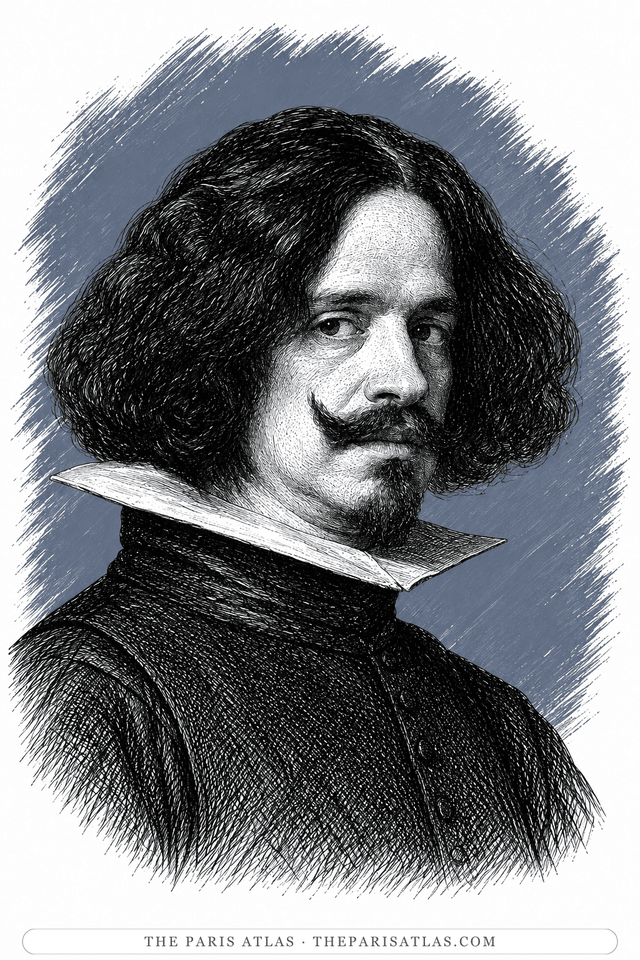
Diego Velázquez
Spanish painter who spent thirty-seven years in the household of Philip IV, painting the king, his family and the dwarfs and jesters of the palace, and who ended his career as the official responsible for housing and moving the court.
View artist
In images
References
The sources below include collection records, catalogues, scholarly research, and primary materials that informed this page. They document The Astronomer, its making, and its place in cultural history.


1L'Astronome — Louvre site des collections
WebsiteMusée du LouvreUsed forThe holding museum's record: the globe, the book, the instruments, the Moses painting, the signature and date, the Geographer, the full provenance, the seizure and the 1983 acquisition.
2The Astronomer by Johannes Vermeer — Collections Rothschild
WebsiteInstitut national d'histoire de l'art (INHA)Used forThe Institut national d'histoire de l'art on the Rothschild ownership, Léon Gauchez, the 1940 seizure, the 1983 gift in lieu of taxes and the pairing with The Geographer.
3The Astronomer by Johannes Vermeer — catalogue entry
WebsiteEssential VermeerUsed forSpecialist catalogue entry: the book and chart identified by James Welu, the window, the robe, the tablecloth, the astrolabe, the shared canvas with The Geographer and the 1997 findings on the signature.
4Johannes Vermeer (Delft 1632 – 1675 Delft)
WebsiteThe Leiden Collection Catalogue, 3rd ed., ed. Arthur K. Wheelock Jr. and Lara Yeager-Crasselt, 2017Used forAntoni van Leeuwenhoek's appointment to settle Vermeer's estate.
These references provide the documented foundation for this work's history and interpretation. Claim-level citations remain attached to the specific claims they support.
 Explore more resources