Girl with a Pearl Earring
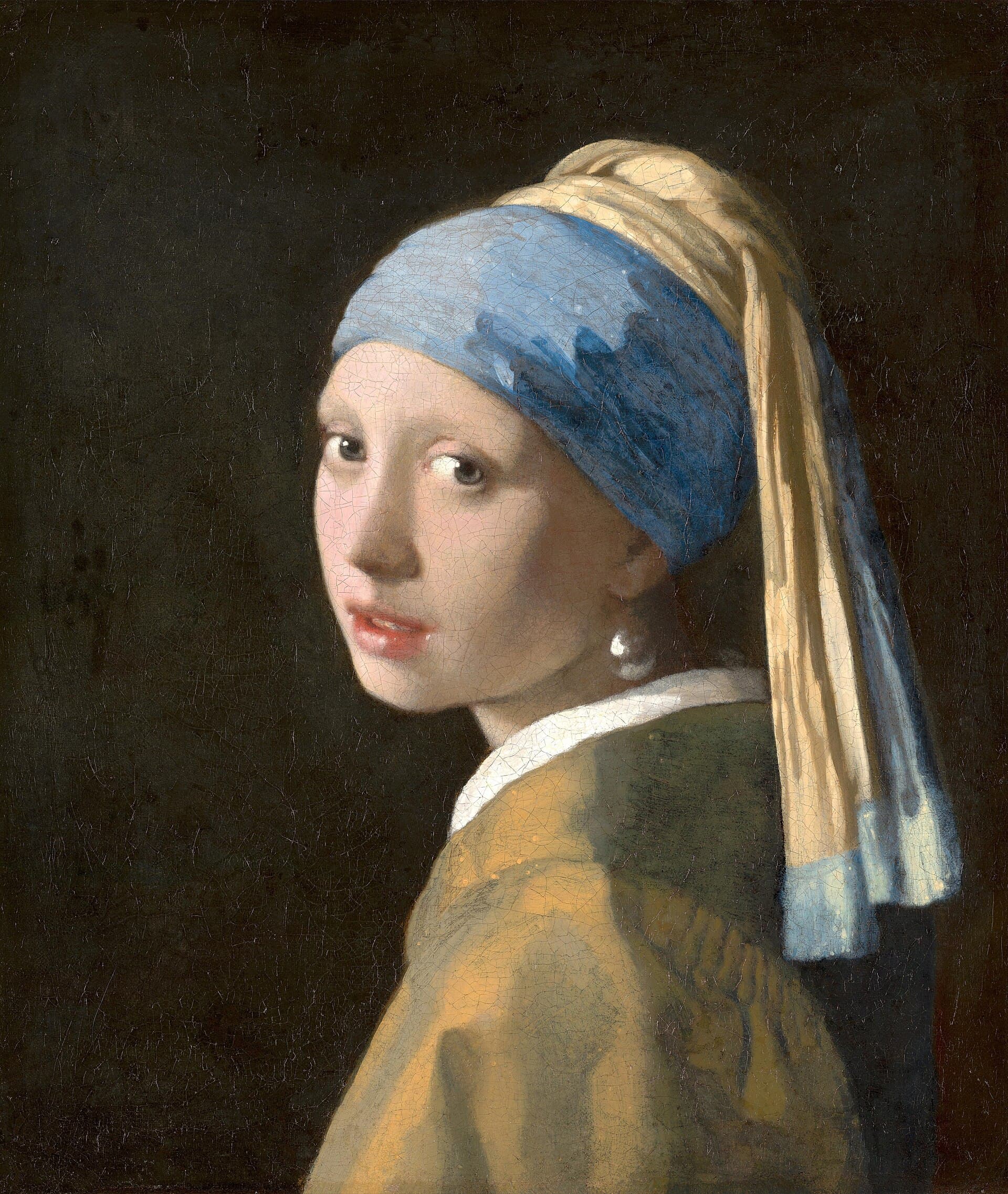
A girl in a blue and yellow turban turns to look over her shoulder, lips parted, a large pearl hanging from her ear. Johannes Vermeer painted her around 1665. She is not a portrait of a named sitter but a study of a face in foreign dress. The painting sold for two guilders and thirty cents in 1881 and has belonged to the Mauritshuis in The Hague since 1903.
- c. 1665
- Oil on canvas
- MauritshuisThe Hague, Netherlands
About Johannes Vermeer
What the painting shows
A girl turns her head toward us over her left shoulder, against a dark background. Her grey-blue eyes are on us, and her lips are slightly open and wet.
She wears a turban made from two pieces of cloth. A blue cloth is wrapped around her head, and a pale yellow one is piled on top and falls down her back in a long tail. Her jacket is a rough yellow-brown, and a white collar shows at her neck.
A large pearl hangs from her ear. The pearl catches the light from the left and also picks up the white of her collar below it.
Not a portrait
The Mauritshuis calls the painting a tronie. In seventeenth-century Holland a tronie was a painted head that showed a type or a character, often in unusual clothes. A tronie was not a likeness that someone had paid for. Rembrandt van Rijn had made tronies popular around 1630, often using himself as the model.
Dutch girls of the time did not wear turbans, so the costume was meant to look foreign. Essential Vermeer notes that critics now link the turban to a painting by Michael Sweerts of a boy in a turban, made about ten years earlier.
Nobody knows who sat for it. Some writers have suggested Vermeer's eldest daughter, Maria, but no document says so. The Mauritshuis says the question of who the girl was is still a mystery.
A pearl made of two strokes
The Mauritshuis says the pearl is too large to be real. The pearl was probably an imitation, perhaps a drop of glass, or Vermeer may simply have made it up.
Vermeer painted the pearl with two strokes of white. There is a thick dab at the top where the light hits it, and a soft reflection of the white collar at the bottom. There is no hook to hang it from her ear.
Pearls, real and imitation, were in fashion from about 1650 to 1680. The Mauritshuis points out that Frans van Mieris, Gabriel Metsu and Gerard ter Borch painted them too.
What the 2018 research found
In February and March 2018 a team led by the Mauritshuis conservator Abbie Vandivere examined the painting in a glass studio inside the museum, while visitors watched. The museum announced the results in April 2020.
Vermeer began with broad strokes of brown and black, and outlined the girl with thin black lines. Then he painted the background, her skin, the jacket, the collar, the turban and, last of all, the pearl. Along the way he moved her ear, the top of the turban and the back of her neck.
Two findings changed how the picture is understood. Vermeer had painted tiny eyelashes around both eyes, too faint to see with the naked eye. And the dark background was once a green curtain, with its folds in the upper right corner. The green paint has changed over the centuries, and the curtain has faded into darkness.
The blue of the turban is ultramarine, made from the stone lapis lazuli, which came from what is now Afghanistan. The team thinks the stone may have been heated before it was ground, which makes it easier to grind and gives a deeper blue. Other colours came from what is now Mexico and Central America, from England, and possibly from Asia or the West Indies.
Two guilders and thirty cents
The painting may be one of the heads sold at the auction of Jacob Dissius's collection in Amsterdam on 16 May 1696, which went for 36 or 17 guilders. After that it disappears for almost two centuries.
In 1881 it came up at an auction in The Hague. Victor de Stuers, a government official, noticed it on the viewing day with his friend and neighbour, the collector Arnoldus Andries des Tombe. The two men agreed not to bid against each other, and Arnoldus Andries des Tombe bought it for two guilders plus thirty cents.
The Mauritshuis tells the story two ways. In one, Victor de Stuers knew at once that it was a Vermeer. In the other, the painting was too dirty to judge, and the painter's name only became clear when cleaning uncovered the signature.
Abraham Bredius, later director of the Mauritshuis, saw it at Arnoldus Andries des Tombe's house in 1885. He wrote that the girl's head, and that single gleam of light, would alone hold your attention. Arnoldus Andries des Tombe died on 16 December 1902. He had secretly left twelve paintings to the Mauritshuis, and Girl with a Pearl Earring was one of them.
In Paris
The painting has been shown in Paris three times. In the spring of 1921 it hung in the exhibition of Dutch art at the Jeu de Paume in the Tuileries garden, the same show where Marcel Proust went to see View of Delft. The painting came back in 1966 for Dans la lumière de Vermeer at the Orangerie, and in 1986 for De Rembrandt à Vermeer at the Grand Palais.
Much of its fame today comes from fiction. Tracy Chevalier's novel Girl with a Pearl Earring, published in 1999, imagines the girl as a sixteen-year-old maid named Griet. The novel was made into an Oscar-nominated film with Scarlett Johansson and Colin Firth.
Close reading
Reading the work, detail by detail
Girl with a Pearl Earring is only 44.5 centimetres tall, and much of it is built from a handful of strokes. Up close the pearl turns out to be two touches of white, the blue turban is painted in broad flat patches, and the dark background hides a green curtain that has faded away.
1.The pearl is two touches of white
Seen close, the pearl is hardly there. A bright white dab sits at its upper left, and a soft pale smudge along the bottom picks up the white collar below. The Mauritshuis says Vermeer painted it with just those two strokes and nothing else, not even the hook that would hold it to her ear. The museum also says a pearl this big is too large to be real, so it was probably glass, or made up.
2.Her eyes, turned toward us
The girl's eyes slide toward us from their corners. Each eye has one small square of white where the light catches it. The eyes look bare, but the Mauritshuis found in 2018 that Vermeer did paint tiny eyelashes around both of them. The eyelashes are too faint to see with the naked eye, and they do not show at this size either.
3.Wet lips, slightly open
The girl's lips are parted, as if she is about to speak. Small pale highlights sit on her lower lip and at the right-hand corner of her mouth, and they are what make the lips look wet. Essential Vermeer notes that the highlight at the corner is two tiny dots of pale pink, one on top of the other, and that it came to light when the painting was cleaned in 1994.
4.A nose with no outline
The girl's nose has no line down its lit side. The bridge of the nose melts into the pale cheek beside it, and only the shadow underneath gives it shape. Some writers have taken this softness as a sign that Vermeer used a lens. Others see a painter blending his colours very smoothly. Nobody has settled it.
5.The blue of the turban, in broad patches
The blue cloth of the turban is painted in two flat colours, a pale blue above and a deep blue below. The two blues meet in a ragged row of loose brushstrokes rather than neat folds. The Mauritshuis says this blue is ultramarine, a costly pigment ground from the stone lapis lazuli, which came from what is now Afghanistan.
6.The yellow cloth piled on top
At the top of the girl's head the pale yellow cloth of the turban is bunched into a rounded knot, with a bright highlight where the light hits it hardest. The Mauritshuis found that Vermeer moved the top of the headscarf while he was painting, so the outline you see is his second thought.
7.The long tail of the turban
The yellow cloth of the turban hangs down behind the girl's neck in a long band, streaked with darker yellow where it folds. A strip of blue runs down its right edge, so this may be the end of the blue cloth showing behind the yellow. It is not easy to say where one piece of cloth ends and the other begins.
8.Where the turban cloth ends
At its lowest point the hanging cloth turns pale blue and then almost white, like a folded hem catching the light. The paint here is thick and cracked with age. Behind it the background is so dark that the end of the cloth seems to float.
9.One thick stroke for the collar
The white collar is one curving band of thick paint that stands up from the surface. The Mauritshuis contrasts it with the drier paint of the turban. The lower half of the pearl, just above the collar, is lit by this same white.
10.The rough yellow jacket
The girl's jacket is a dull yellow-brown, painted with broad brushstrokes that show the shape of her shoulder and a few deep folds at the back. A few small dots of light sit near the neckline. The fabric is hard to name, and Essential Vermeer says no one has identified it. The jacket may be a cape or a loose, rough garment.
11.An ear moved while painting
The girl's ear is almost lost in the shadow under the blue turban. Only its lower rim picks up a little light. The Mauritshuis research found that Vermeer changed the position of the ear while he was working. What you see is where he finally put it.
12.A green curtain that has faded away
The background looks like plain darkness. The Mauritshuis found in 2018 that it was once a green curtain, with folds running diagonally in this upper right corner. The green was a see-through paint that has changed over the centuries, so the curtain has faded into the dark. In this photograph no folds can be made out at all.
13.The signature you cannot see
The Mauritshuis records Vermeer's signature up here in the top left corner: IVMeer, with the first three letters joined together. The signature was painted in a slightly lighter tone on the dark background and is very hard to see. In this photograph no letters can be made out. Scans made in 2018 show it clearly.
14.Dark marks at the left
In the dark area to the left of the girl's face there are a few blotchy darker marks. It is not clear what they are. They might be old damage, earlier retouching, or changes in the faded background paint, but none of the sources consulted explains them. Fine cracks from age run across the whole area.
Timeline
c. 1665
Johannes Vermeer paints the girl in the turban.
Girl with a Pearl Earring, c. 1665, oil on canvas, 44.5 by 39 cm (Mauritshuis, The Hague). A tronie, a painted head of a type rather than a named sitter, bought at auction in 1881 for two guilders and thirty cents and bequeathed to the museum in 1903. 1696
The painting may be one of the heads sold at the Dissius auction in Amsterdam on 16 May.
1881
Arnoldus Andries des Tombe buys it at auction in The Hague for two guilders and thirty cents, and lends it to the Mauritshuis.
1885
Abraham Bredius sees it at Arnoldus Andries des Tombe's house and praises it.
1902–1903
Arnoldus Andries des Tombe dies on 16 December 1902. His secret bequest brings the painting to the Mauritshuis in 1903.
1921
Shown in Paris in the exhibition of Dutch art at the Jeu de Paume.
1966
Shown in Paris at the Orangerie in Dans la lumière de Vermeer.
1999
Tracy Chevalier publishes her novel about the girl.
2018
The Girl in the Spotlight examination finds the faded green curtain and the tiny eyelashes. The results are announced in April 2020.
Where to see it
Mauritshuis
The Hague, Netherlands
A public viewing address has not yet been confirmed for this holding.
The Mauritshuis said the painting would not be on display from 15 August to 4 October 2026. Check the museum's page before a special visit.
Frequently asked questions
Where is Girl with a Pearl Earring?
In the Mauritshuis in The Hague, inventory number 670. The museum said it would be off display from 15 August to 4 October 2026, so check the museum's page before a visit.
Is the pearl real?
Probably not. The Mauritshuis says it is too large to be real and was probably an imitation, perhaps glass, or imagined. Johannes Vermeer painted it with two strokes of white and no hook.
Who is the girl?
Nobody knows. The painting is a tronie, a study of a face in costume, not a portrait of a named person. Some writers have suggested Vermeer's eldest daughter, Maria, but there is no evidence.
Why is the background black?
The background was once a green curtain. Research in 2018 found folds in the upper right corner. The see-through green paint has changed over the centuries, so the curtain has faded into darkness.
How much was it bought for?
Arnoldus Andries des Tombe bought it at auction in The Hague in 1881 for two guilders plus thirty cents. He left it to the Mauritshuis, which received it in 1903.
How big is it?
44.5 by 39 centimetres, oil on canvas. The painting is signed IVMeer in the upper left corner, but the signature is very hard to see.
More by Johannes Vermeer
If you like Johannes Vermeer
Explore painters from the same movements and circles.
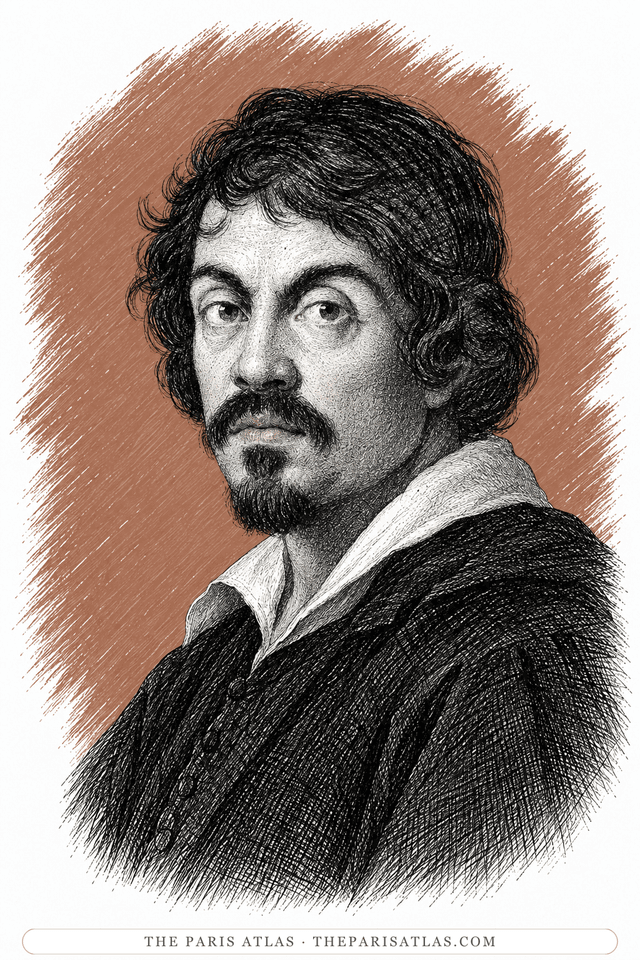
Caravaggio
Italian painter who worked from live models straight onto the canvas, without preparatory drawings, and lit them with a single hard light against a dark ground. He killed a man in Rome in May 1606, spent his last four years as a fugitive in Naples, Malta and Sicily, and died at thirty-eight.
View artist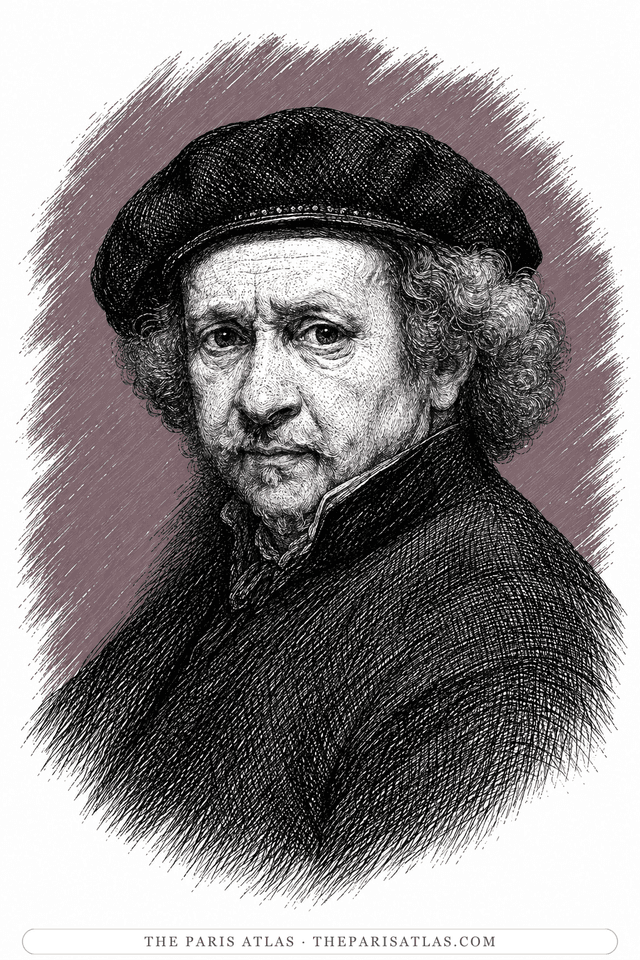
Rembrandt van Rijn
Dutch painter and etcher who worked in Leiden and Amsterdam and never traveled outside the Dutch Republic. He made about 300 etchings and roughly eighty self-portraits, trained some twenty-five painters, and was declared insolvent in 1656.
View artist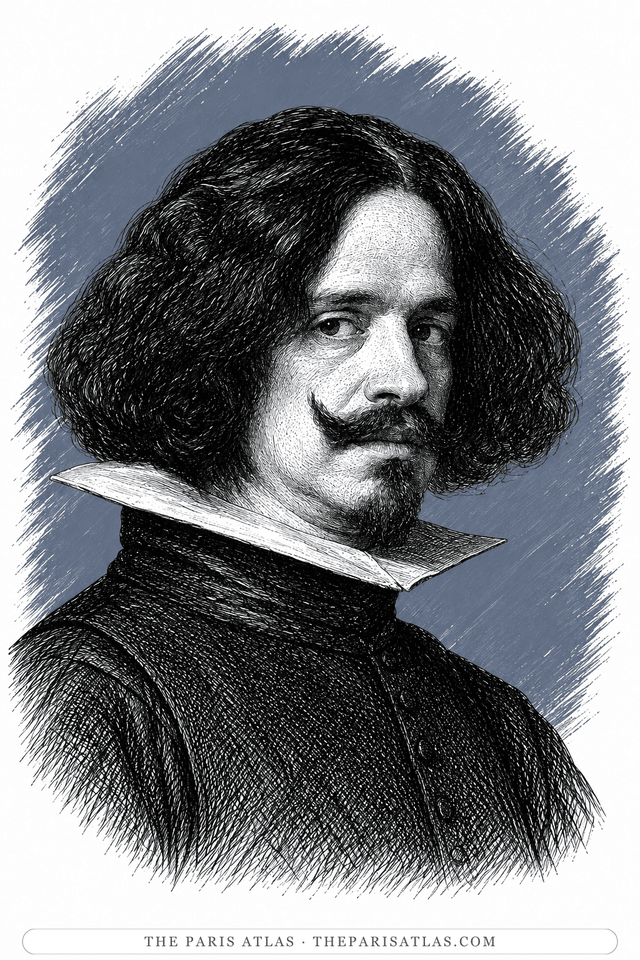
Diego Velázquez
Spanish painter who spent thirty-seven years in the household of Philip IV, painting the king, his family and the dwarfs and jesters of the palace, and who ended his career as the official responsible for housing and moving the court.
View artist
In images
References
The sources below include collection records, catalogues, scholarly research, and primary materials that informed this page. They document Girl with a Pearl Earring, its making, and its place in cultural history.


1Johannes Vermeer, Girl with a Pearl Earring, c. 1665 — collection record 670
WebsiteMauritshuis, The HagueUsed forThe holding museum's record: the tronie, the pearl, the 1881 sale, Abraham Bredius, the bequest and the provenance.
2Closer to Vermeer and the Girl: new discoveries and insights from the international scientific examination of Vermeer's Girl with a Pearl Earring
WebsiteMauritshuis, The Hague, 2020Used forThe Mauritshuis on the 2018 examination: the green curtain, the eyelashes, the order of painting, the changes and the pigments.

3Revealing the painterly technique beneath the surface of Vermeer's Girl with a Pearl Earring using macro- and microscale imaging
PeriodicalHeritage Science, volume 7, 2019Used forThe peer-reviewed study of how Vermeer built up the painting.
4Fading into the background: the dark space surrounding Vermeer's Girl with a Pearl Earring
PeriodicalHeritage Science, volume 7, 2019Used forThe peer-reviewed study of the background and its faded green glaze.
5Girl with a Pearl Earring by Johannes Vermeer — catalogue entry
WebsiteEssential VermeerUsed forSpecialist catalogue entry: the scholars' dates, the 1994 restoration, the Sweerts turban, the signature and the exhibition history, including Paris in 1921, 1966 and 1986.
6Girl with a Pearl Earring — Johannes Vermeer (Mauritshuis)
WebsiteMauritshuis, via Google Arts & CultureUsed forThe Mauritshuis's zoomable image of the painting.
7Girl with a Pearl Earring by Tracy Chevalier
WebsitePenguin Random HouseUsed forThe publisher's page for Tracy Chevalier's novel and the film made from it.
These references provide the documented foundation for this work's history and interpretation. Claim-level citations remain attached to the specific claims they support.
 Explore more resources