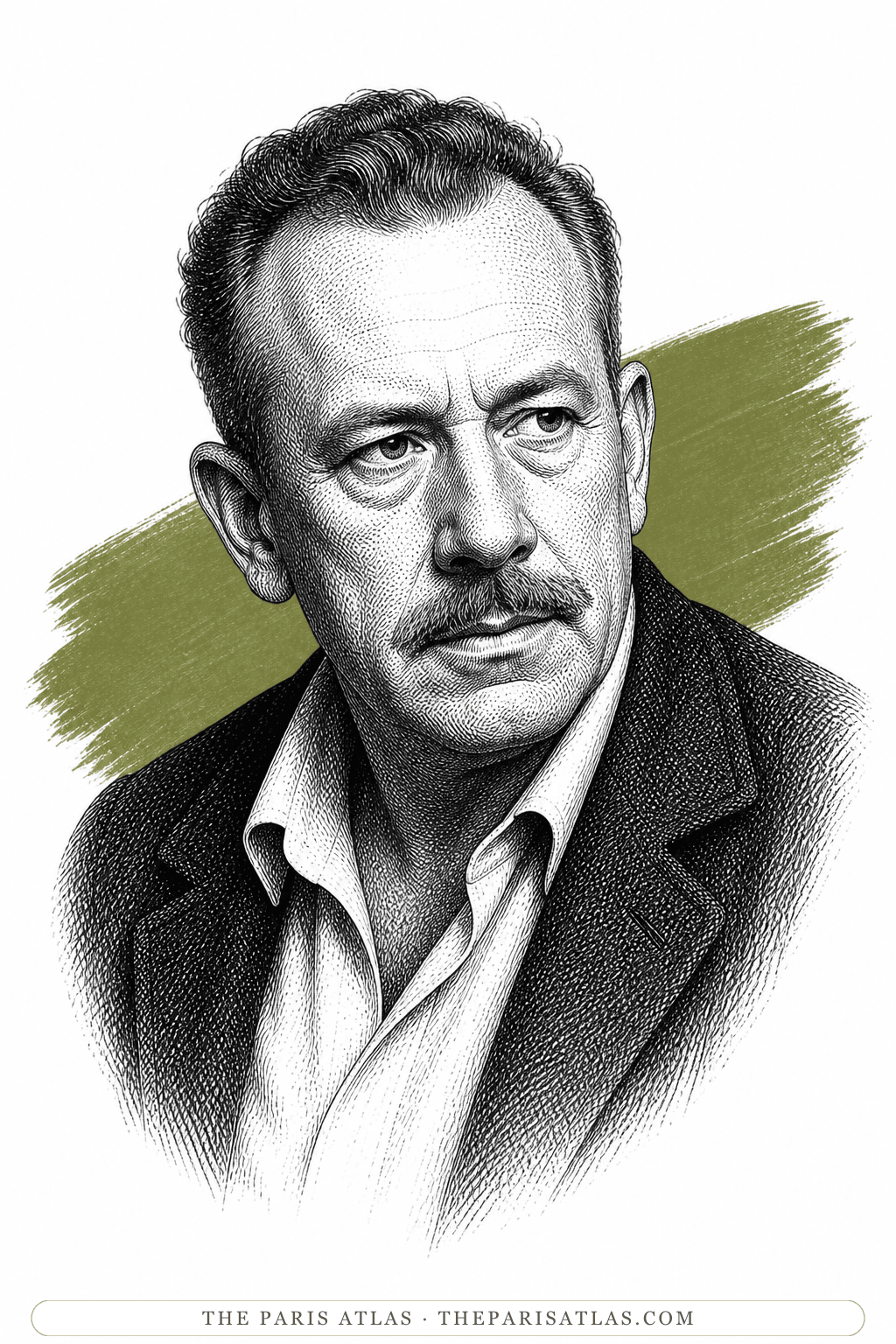
Of Mice and Men
John Steinbeck
Of Mice and Men
Steinbeck's 1937 short novel about two migrant ranch hands in the same California farm country.
Read our takeThe Grapes of Wrath
John Steinbeck
An Oklahoma farm family loses its land in the Dust Bowl and drives west to California, where the work it was promised is not there.
The Grapes of Wrath is John Steinbeck's 1939 novel about the Joads, a family of Oklahoma tenant farmers pushed off their land in the 1930s.[1] They load everything onto a converted car and drive Route 66 to California, where they find too many workers, low wages and hostile police.[2] The Viking Press published it in April 1939, and it won the Pulitzer Prize the next year.[3][4] Short chapters about the migrants as a whole alternate with the longer chapters about the Joads.[5] The novel was banned and burned in places, and it has sold more than fifteen million copies.[1][5]
The novel opens with drought. Dust storms in 1930s Oklahoma block out the sun and ruin the crops, and the families who farm the land wait to see what they have lost.[6]
Tom Joad is walking home. He has served four years in prison for killing a man in a fight at a dance, and he is out on parole. A truck driver who gives him a lift tells him how things have changed: the banks and landowners are using tractors to push small farmers off the land.[6]
On the road Tom meets Jim Casy, a preacher who has given up preaching because he no longer believes what he preached. Casy now thinks that maybe all people share one big soul.[6] Together they reach the Joad farm and find it empty.
A neighbor, Muley Graves, tells them what happened. The Joads have been evicted and are staying with Tom's Uncle John while they raise money to go to California, where people say there is work. The next morning Tom finds his family packing.[6]
The family is large. Besides Ma and Pa there are Grampa and Granma, Tom's brothers Noah and Al, his pregnant sister Rose of Sharon and her husband Connie, and the two youngest, Ruthie and Winfield. Casy comes too.[6] Their car is an old Hudson Super-Six cut down into a truck.[5]
The Joads leave Oklahoma with Casy. Their dog is killed on the highway. Near Oklahoma City they camp with Ivy and Sairy Wilson, a couple also heading west, and Grampa has a stroke and dies. The family buries him themselves, although the law forbids it.[6]
At the California border, men coming back the other way warn them there is no living to be made. Noah leaves the family to live by a river. Granma dies in the truck while they cross the desert. Ma keeps it to herself until they are safely across.[6]
In a Hooverville, a deputy tries to arrest a man called Floyd Knowles on a false charge. Tom trips the deputy, and Casy knocks him out. Casy takes the blame and is arrested to protect Tom. Connie disappears.[6]
At the Weedpatch government camp the family is treated decently, but none of the men can find steady work. After a month they move on to the Hooper Ranch to pick peaches, for five cents a box.[6]
Tom slips out at night and finds Casy, out of jail, leading strikers outside the ranch. Two men arrive. One calls Casy a communist and kills him with a pick handle. Tom kills the attacker and escapes with a broken nose.[6]
The Joads find work picking cotton and live in an old boxcar, while Tom hides in the brush nearby. When Ruthie lets slip that her brother has killed a man, Tom decides to leave. He tells Ma he will carry on Casy's work for people's rights.
The rains come and the boxcar camp floods. Rose of Sharon goes into labor and gives birth to a stillborn baby. Uncle John is sent to bury the baby and instead sets the little box adrift on the floodwater.
The family, without Al, who stays behind with his new fiancée, looks for dry ground and finds a barn. Inside are a boy and his father, who is starving because he gave all his food to his son. Rose of Sharon asks to be left alone with the man and feeds him from her breast.
By 1936, families driven out of the Dust Bowl were arriving in the Salinas and Monterey area, where Steinbeck lived. He began reporting on them. In 1936 he wrote a series of articles called "The Harvest Gypsies" for the San Francisco News about migrant farm workers. In 1938 some of that reporting came out as a pamphlet, Their Blood Is Strong.
He toured labor camps and interviewed migrant families. In the winter of 1938 he saw for himself the misery that floods at Visalia, California, brought to migrant families. He also wrote a satire called "L'Affaire Lettuceberg" and then destroyed it.
Robert DeMott, who edited Steinbeck's working journal, dates the writing of the novel from late May to late October 1938. Steinbeck told a friend that he had never worked so hard in his life. His wife, Carol Henning Steinbeck, typed and edited the manuscript as he went. The journal was published in 1989 as Working Days.
The title comes from Julia Ward Howe's song "The Battle Hymn of the Republic." Steinbeck liked it because the song is a march and the book is a kind of march. Carol found it. Writing to his editor, Pascal Covici, in September 1938, Steinbeck said the title was "Carol's again."
The novel has thirty chapters, and they come in two kinds. The long chapters follow the Joads. The short ones between them, most of the odd-numbered chapters, step back to show the migrants as a whole: the dust, the tractors, the used-car lots, the road. Scholars call these the intercalary chapters, meaning chapters inserted between the others. Steinbeck called them pace changers.
Chapter 12 is about Route 66 itself, the highway the migrants take west. Steinbeck calls it the path of a people in flight. Another short chapter shows a waitress at a hamburger stand being kind to a stranger and his two small children.
Steinbeck said what he wanted from these chapters. In 1953 he told a Columbia University student that they were designed to hit the reader below the belt. With the rhythms of poetry, he said, a writer could open a reader up and then get ideas in.
In January 1939 he wrote to Pascal Covici that he was not writing a satisfying story. He had tried to write the book the way lives are being lived, not the way books are written.
The Joads reach California having lost Grampa and Granma on the way. Noah has walked off along a river, and Connie soon deserts Rose of Sharon. Their first stop is a Hooverville, the name for the squatters' camps on the edge of towns, after President Herbert Hoover.
Then comes Weedpatch, a government camp run by a committee of the people living there. The camp has proper sanitary facilities, and the ground between the tents is swept and watered. The camp holds a dance every Saturday night. Steven Smith, writing for EBSCO, calls it a model of democracy and cooperation in the book.
None of the men can find work there, so after a month the Joads leave for the Hooper Ranch to pick peaches. There they earn five cents a box and spend the day's pay on dinner at the company store. Outside the gates, Casy is leading a strike.
Steinbeck based the government camp on real ones. The Center for Steinbeck Studies notes that the novel is dedicated to Tom Collins, who worked at the Weedpatch camp.
The book was a bestseller for most of 1939. The novel sold 428,900 hardcover copies that year at $2.75 each. Steinbeck became the most talked-about novelist in the United States.
Many people hated it. Farm owners' groups and some newspapers called Steinbeck a liar, and Collier's magazine called the book propaganda. School boards and libraries banned it, and copies were burned. Most bans were over the characters' rough talk and the mentions of sex.
Others stood up for it. Visiting migrant camps in 1940, Eleanor Roosevelt said she had never thought the book was exaggerated. Senator Robert M. La Follette Jr. held an official inquiry into working conditions on California farms.
The novel won the Pulitzer Prize in 1940, and Steinbeck gave the $1,000 prize money to his friend Ritch Lovejoy. When he received the Nobel Prize in 1962, the Swedish Academy's presentation called The Grapes of Wrath the great work principally associated with his name.
French readers waited eight years. Gallimard published Les Raisins de la colère in Paris in 1947, translated by Marcel Duhamel and Maurice-Edgar Coindreau. The book ran to 495 pages, with a cover by the painter Mario Prassinos.
The translation sold fast. The copy the French national library holds from 1948 is marked the fifty-seventh edition. Its copy from 1956 is marked the hundred and seventy-fifth.
Maurice-Edgar Coindreau had already translated Of Mice and Men for Gallimard in 1939. Steinbeck himself spent the summer of 1954 living in Paris and writing for the newspaper Le Figaro.
She seemed to know, to accept, to welcome her position, the citadel of the family, the strong place that could not be taken.
66 is the path of a people in flight, refugees from dust and shrinking land, from the thunder of tractors and shrinking ownership
For man, unlike any other thing organic or inorganic in the universe, grows beyond his work, walks up the stairs of his concepts, emerges ahead of his accomplishments.
The Joads lose the farm, the grandparents, a son and a son-in-law on the way west. The book stays close enough to feel each loss.
Between the Joad chapters, short chapters show the migrants as a whole: the dust, the tractors, the used-car lots and Route 66. Steinbeck called them pace changers.
Steinbeck chose her portrait when he recorded a reading from the book for United Nations radio in 1954. She holds the family together as it breaks apart.
Eleanor Roosevelt defended it, and a senator opened an official inquiry into California farm conditions. Farm owners called Steinbeck a liar, and school boards banned the book.
The Joads' son, out on parole after four years in prison for killing a man in a fight. He leaves the family at the end to carry on Casy's work.
Tom's mother, who holds the family together on the road and in the camps.
A former preacher who travels west with the Joads and is killed leading a strike.
Tom's pregnant younger sister, deserted by her husband, Connie, in California.
Tom's father, a tenant farmer pushed off his land by the bank and the tractors.
Pa's brother, who still blames himself for his wife's death years before and keeps money hidden for drink.
Tom's teenage brother, who looks up to him and keeps the truck running.
1936
Steinbeck writes "The Harvest Gypsies," a series of articles about migrant farm workers, for the San Francisco News.
1938
He writes the novel between late May and late October, keeping a daily journal as he goes.
1939
The Viking Press publishes The Grapes of Wrath in New York on 14 April. The novel sells 428,900 hardcover copies that year and is banned and burned in places.
1940
John Ford's film, starring Henry Fonda as Tom Joad, is released in January. In the spring the novel wins the Pulitzer Prize and the National Book Award.
1947
Gallimard publishes Les Raisins de la colère in Paris, translated by Marcel Duhamel and Maurice-Edgar Coindreau.
1954
On 16 June Steinbeck records a reading of the Ma Joad passage from Chapter 8 for the United Nations Radio Division.
1962
The Swedish Academy's Nobel Prize presentation names the novel as the great work most associated with Steinbeck.
1989
Working Days, the journal Steinbeck kept while writing the novel, is published for its fiftieth anniversary.
1991
Frank Galati's stage version for Chicago's Steppenwolf Theatre Company wins the New York Drama Critics' Circle Award.


Of Mice and Men
John Steinbeck
Steinbeck's 1937 short novel about two migrant ranch hands in the same California farm country.
Read our takeEast of Eden
John Steinbeck
Steinbeck's other long California novel, set a generation earlier in the Salinas Valley where he grew up.
Read our takeUncle Tom's Cabin
Harriet Beecher Stowe
Harriet Beecher Stowe's 1852 novel. Robert DeMott and EBSCO's history of The Grapes of Wrath both compare the two as novels that stirred political argument.
Read our take
George Orwell's 1937 report on unemployed and poor families in the north of England, written in the same Depression.
Read our takeThe Joads, a family of Oklahoma tenant farmers who lose their land during the Dust Bowl years of the 1930s. They drive Route 66 to California hoping for work. There they find too many workers, low pay and hostility.
From Julia Ward Howe's "The Battle Hymn of the Republic." Steinbeck's wife, Carol Henning Steinbeck, suggested it. He liked the title because the song is a march, and he thought of the book as a kind of march.
In April 1939, by the Viking Press in New York. Robert DeMott, who edited Steinbeck's journal of the writing, gives the official date as 14 April 1939.
Yes. The Grapes of Wrath won the Pulitzer Prize for the novel in 1940, and the National Book Award the same spring. Steinbeck gave the $1,000 Pulitzer prize money to a friend, Ritch Lovejoy.
Some objected to its politics: farm owners and some newspapers called it lies and propaganda. More bans were over the characters' rough language and the mentions of sex. School boards and libraries removed it, and copies were burned.
Yes. John Ford directed it for 20th Century Fox in 1940, with Henry Fonda as Tom Joad and Jane Darwell as Ma Joad. The film won two Academy Awards, for John Ford as director and for Jane Darwell.
In 1947, when Gallimard published Les Raisins de la colère in Paris. Marcel Duhamel and Maurice-Edgar Coindreau translated it.
Explore authors with a similar voice, perspective, and influence.
The doctor of the Paris slums who wrote the century's blackest, funniest novel — and changed the sound of French prose.
View author
French writer and philosopher whose novels, memoirs, and social analysis examined freedom, gender, responsibility, aging, and the material conditions that shape a life.
View author
American novelist and composer whose expatriate fiction explores dislocation, unstable intimacy, fatalism, and North Africa.
View authorThe sources below include the primary text, editions, scholarship, archival materials, and other records that informed this page. They document The Grapes of Wrath, its publication, and its place in literary history.


The Center for Steinbeck Studies guide to the settings: Oklahoma, Route 66 and the California camps.

Library of Congress record for the Viking first edition: 619 pages, April 1939, songs with music on the endpapers.
Their Blood Is Strong, the 1940 prizes and film, Working Days and the Steppenwolf adaptation.
The Center for Steinbeck Studies overview: sources and composition.
Critical reception, Eleanor Roosevelt's remark and the bans.
Transcript of Steinbeck's 1954 United Nations radio reading of the Ma Joad passage.

The Harvest Gypsies articles of 1936.
Donald R. Gallo's Penguin teacher's guide: the Dust Bowl background and the parts of the novel.
Quotes Steinbeck's September 1938 letter crediting Carol with the title.
Anders Österling's Nobel presentation speech.
The first French edition.
The 1948 printing marked fifty-seventh edition.
The 1956 printing marked 175th edition.
Maurice-Edgar Coindreau's earlier Steinbeck translation.
Steinbeck's 1954 season in Paris.
Open Library edition records, used to confirm that each ISBN listed resolves to this book.
The primary text is the baseline reference for every book page. Additional references document publication history, interpretation, and historical context where that evidence is available.
 Explore more resources