

Stand Still Like the Hummingbird
The major late collection that best contextualizes these shorter reflections.
Read our take
by Henry Miller
Seven short works—essay, letter, memory, fiction, and meditation—issued as the eleventh number of Irving Stettner’s Stroker.
The Theatre and Other Pieces is not a standalone Miller play. It is the thirty-two-page eleventh issue of Irving Stettner’s magazine Stroker, published in 1979 and devoted to seven Miller works: “The Theatre,” “A Letter to Gaston Criel,” “Melpo,” “The Painting Lesson,” “On Death,” “Letter to an Editor,” and “Memory and Forgettery.” Miller’s own lithographs and drawings accompany the prose. The issue was limited to five hundred copies, including a signed numbered group.
The contents resist a single genre. The title piece considers theatre; two pieces preserve correspondence; “Melpo” and “The Painting Lesson” move through more narrative or portrait-like territory; “On Death” and “Memory and Forgettery” turn toward late-life reflection. Treating the booklet as a play erases precisely the mixture Stroker assembled.
The Library of Congress-derived record supplies the contents, pagination, series number, and five-hundred-copy limit. Bibliographic descriptions also record Miller’s cover lithograph and interior illustrations. The issue is both a prose collection and a small art object.
The Theatre and Other Pieces contains seven prose works: The Theatre, A Letter to Gaston Criel, Melpo, The Painting Lesson, On Death, Letter to an Editor, and Memory and Forgettery. The title names the opening piece rather than describing the whole book as a play.
The contents move among recollection, letters, and short reflection. Theatre and painting sit beside death and the unreliability of memory. This mixed arrangement gives the book the character of a magazine issue devoted to one writer, which is precisely how it first appeared.
In the Melpo manuscript opening reproduced by RR Auction, Miller measures his watercolors against small sums, clothing and shoes. The list brings artistic ambition down to bodily necessities. Yet he describes continuing to write and paint rather than considering a job. The contrast gives the recollection its stubborn humor: the artist’s commitment remains absolute while the price of his work is negotiable.
The reproduced telephone-call passage changes that scale of value. Melpo’s reported praise makes Miller’s literary importance the reason his poverty is intolerable. He presents himself largely as the listener, but her generous judgment reaches us through his retelling. Read beside the barter list, this scene shows friendship supplying a valuation that his circumstances cannot: admiration and material need occupy the same conversation.
The collection was published in New York in 1979 as number eleven of Stroker, the magazine edited by Irving Stettner. It runs to thirty-two pages and was limited to five hundred copies. Miller’s own illustrations accompany the writing.
Stettner was an important outlet for Miller’s late work. Their association also produced the letters, drawings, and prose collected after Miller’s death in From Your Capricorn Friend. That later book is related, but it should not be treated as an identical reprint of this seven-piece issue.
A letter begins with a particular recipient and an occasion. A reflection on memory or death makes a more general address. Keeping those forms visible helps explain why a small book can change direction so often without developing a continuous story.
The Painting Lesson also belongs to a larger group of Miller publications about making pictures. Readers interested in that part of his work can place it beside To Paint Is to Love Again and The Waters Reglitterized. The individual piece remains part of this collection, even when its subject overlaps with those books.
Just Wild About Harry is Miller’s seven-scene play. Scenario is his experiment in a film scenario inspired by Anaïs Nin. Neither description fits The Theatre and Other Pieces, whose contents include letters and prose reflections rather than a single script.
For readers choosing an edition, the Stroker issue number and 1979 publication date identify this volume more reliably than the word theatre alone. Its small size suits reading the individual pieces separately, with their original forms and occasions in mind.
The compact issue shows Miller moving among criticism, correspondence, narrative, memory, and death.
Irving Stettner’s magazine gives the prose a deliberately handmade setting alongside Miller’s images.
Miller’s illustrations make the Stroker issue useful to readers interested in his visual art as well as his short prose.
1978
Miller begins the late period of contributions to Irving Stettner’s Stroker, the magazine that will publish this collection.
1979
Stroker devotes its eleventh issue to seven Miller pieces and his illustrations.
1984
From Your Capricorn Friend collects writing from the Stroker association, including Memory and Forgettery. It overlaps with this issue without reproducing its complete contents.
The major late collection that best contextualizes these shorter reflections.
Read our take

An earlier limited collection whose mixed form anticipates this one.
Read our takeNo. It is a mixed seven-piece collection; only the title may suggest drama, and the complete contents include essays, letters, narrative prose, and reflection.
“The Theatre,” “A Letter to Gaston Criel,” “Melpo,” “The Painting Lesson,” “On Death,” “Letter to an Editor,” and “Memory and Forgettery.”
As Stroker no. 11 in 1979, in a total edition of five hundred copies.
Yes. The Stroker issue includes Miller’s illustrations alongside the prose.
The printing comprised five hundred copies, including one hundred numbered copies signed by Miller.
Explore authors with a similar voice, perspective, and influence.

Miller's acknowledged master at making literature out of the gutter. Journey gave him permission; Cancer is what he did with it.
View author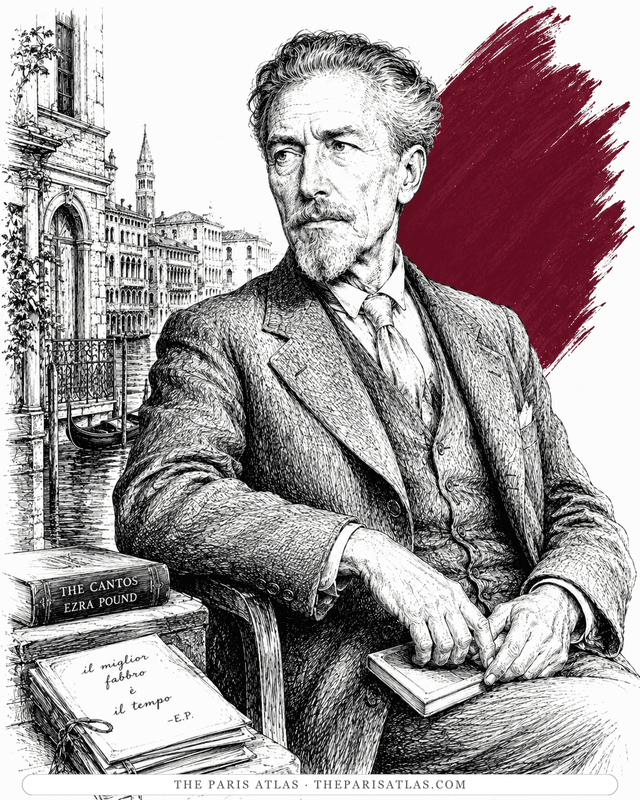
Pound read Cancer and sent Miller a famously backhanded postcard. Both believed literature's job was to wake the reader by any means necessary.
View author
French writer and philosopher whose novels, memoirs, and social analysis examined freedom, gender, responsibility, aging, and the material conditions that shape a life.
View authorThe sources below include the primary text, editions, scholarship, archival materials, and other records that informed this page. They document The Theatre and Other Pieces, its publication, and its place in literary history.


The primary text represented by this page, used for descriptions of the work’s contents and for any quoted passages shown here.

Web source consulted for documented facts and historical context presented on the The Theatre and Other Pieces page.
Official record used to verify names, dates, institutional details, or other factual information on this page.
Official record used to verify names, dates, institutional details, or other factual information on this page.
Biographical evidence used to verify chronology, relationships, and historical context connected to The Theatre and Other Pieces.
Biographical evidence used to verify chronology, relationships, and historical context connected to The Theatre and Other Pieces.
Web source consulted for documented facts and historical context presented on the The Theatre and Other Pieces page.
Web source consulted for documented facts and historical context presented on the The Theatre and Other Pieces page.
The primary text is the baseline reference for every book page. Additional references document publication history, interpretation, and historical context where that evidence is available.
 Explore more resources