The Paris AtlasCharting the artists, works, and places worth returning to.
  • Painter
  • Educator
· American · 1920–2021

Wayne Thiebaud

American painter known for cakes, pies and counter displays, who taught for decades at the University of California, Davis, and rejected the Pop art label critics gave him.

Details

Lived
1920–2021
Born
15 November 1920
Birthplace
Mesa, Arizona
Died
25 December 2021 · aged 101
Place of death
Sacramento, California
Nationality
American
Profession
Painter and teacher
Major works
Pies, Pies, Pies, Boston Cremes, Pie Counter, Ripley Ridge, Valley Streets
Roles
PainterEducator

About Wayne Thiebaud

American painter who made the bakery counter a subject and spent a working lifetime teaching

Wayne Thiebaud was an American painter. He was born in Mesa, Arizona, on 15 November 1920 and died in Sacramento, California, on 25 December 2021.

He is best known for the paintings of cakes, pies and counter displays he began in the early 1960s. He worked from memory rather than from life, laid the paint on thickly, and outlined each form in bright colour.

He came to painting from commercial art. He drew cartoons as a boy, painted signs, apprenticed as an animator at The Walt Disney Studios, and served as a cartoonist in the United States Army Air Forces. He studied fine art on the G.I. Bill after the war and began teaching while he was still a graduate student.

A 1962 exhibition at the Allan Stone Gallery in New York launched his career, and critics filed him with the Pop artists. He rejected the label and called himself a traditional painter of illusionistic forms. From the 1970s he painted the steep streets of San Francisco, and from the late 1990s the flat farmland of the Sacramento River Delta.

Mesa, Long Beach and the sign shops

Wayne Thiebaud was born in Mesa, Arizona, on 15 November 1920. He spent most of his childhood in Long Beach, California, and part of it in southern Utah. He liked cartoons and comic strips from an early age, and he was working as a commercial artist while still in his teens.

He painted signs and apprenticed as an animator at The Walt Disney Studios. During the Second World War he served in the United States Army Air Forces. He was stationed at Mather Field, outside Sacramento, from 1942, and drew cartoons for the service there.

After his discharge he worked in commercial art in Los Angeles, designing movie posters, drawing cartoons and taking advertising jobs. In the late 1940s he decided to study fine art instead.

Art school and the classroom

Wayne Thiebaud enrolled at San José State College in 1949 on the G.I. Bill and took both art and education courses. He transferred to Sacramento State College the following year. While he was working on his master's degree there he started teaching art and art history at Sacramento Junior College.

He taught at Sacramento Junior College for eight years. In 1960 he took a teaching job at the University of California, Davis, and he stayed on that faculty for the rest of his working life. He retired at seventy and went on giving classes as professor emeritus.

He spent a sabbatical year in New York in the late 1950s. Apart from that year he worked in California for his whole career, and he lived in Sacramento from the 1950s onwards.

The cakes and the counter displays

By the early 1960s Wayne Thiebaud was painting the food that made his name. Cakes and pies, hot dogs and hamburgers, gumballs, lollipops and jackpot machines all went into the work. He did not set the objects up in front of him. He painted them from memory, out of the bakeries and diners he remembered and out of the advertising around him.

The paint goes on thick. The San Francisco Museum of Modern Art credits much of the surface to the knife rather than the brush, and describes him spreading the pigment as if it were frosting on a cake. Each object stands in a hard shadow against a pale ground, lit the way goods are lit in an advertisement.

The edges are where the colour goes. The Wayne Thiebaud Foundation says he outlined his forms in radiant colours to achieve a halo-like effect, and that he did it to make the colour more intense. The San Francisco Museum of Modern Art describes the same habit as thick, saturated hues outlining the edges of his forms.

The 1962 exhibition in New York

In 1962 the Allan Stone Gallery in New York showed Wayne Thiebaud's still lifes of food and commonplace objects. The exhibition succeeded with critics and with buyers, and it made his reputation. A first solo museum show followed at the de Young Museum in San Francisco.

The Crocker Art Museum in Sacramento, which had given him his first solo exhibition in 1951, calls the New York show the watershed that launched his career. He had been teaching at the University of California, Davis, for two years when it opened.

Why he refused the Pop art label

Wayne Thiebaud was in two of the 1962 exhibitions that established Pop art, and writers have filed him under the movement ever since. He never accepted it. He preferred to describe himself as a traditional painter of illusionistic forms.

The critic Michael Kimmelman made the same separation in an audio commentary the San Francisco Museum of Modern Art publishes. He pointed to the blue halos around the forms and to the lush light in the paintings. Those qualities belong to memory rather than to the here and now that Pop was about.

The sources behind the work were not the sources of Pop. The Wayne Thiebaud Foundation names European and American painting, traditional Chinese landscapes and Japanese woodcuts. Michael Kimmelman names Claude Monet and Chinese painting as the interests he heard in the pictures.

San Francisco, the Delta and the mountains

In the early 1970s Wayne Thiebaud began painting San Francisco. The city pictures tip a street almost upright between two banks of buildings and drop it away down the canvas. Ripley Ridge of 1977 is one of them, and the Whitney Museum of American Art bought it in 2018.

In the late 1990s he turned to the Sacramento River Delta, the flat farmland around his own city. He painted it from above, largely without a sky or a horizon line, in pools of unexpected and vivid colour. Valley Streets of 2003 belongs to the San Francisco Museum of Modern Art.

From the early 2000s he painted mountains, seen close up and in cross-section, built partly from mountains he remembered from childhood. He kept returning to the food subjects all the while. His last body of work was a series of circus clowns.

Rosa Bonheur's The Horse Fair

The Metropolitan Museum of Art filmed Wayne Thiebaud in 2015 for its Artist Project series, talking about Rosa Bonheur's The Horse Fair. What he admired was the space the painting builds. "You really can identify and walk up to those horses because the space is so valid," he said.

Where to see the work

The Crocker Art Museum in Sacramento holds Pies, Pies, Pies of 1961 and Boston Cremes of 1962. The Whitney Museum of American Art in New York holds Pie Counter of 1963 and Ripley Ridge of 1977. Valley Streets of 2003 is at the San Francisco Museum of Modern Art.

Sacramento to the end

Wayne Thiebaud lived and worked in Sacramento from the 1950s until his death on 25 December 2021, at 101.

The Crocker Art Museum had opened a survey for his hundredth birthday in 2020 and closed it within weeks for the pandemic. After a national tour the exhibition came back to Sacramento in 2022, retitled Wayne Thiebaud: A Celebration, with 117 paintings, prints and drawings.

Why Wayne Thiebaud matters

Wayne Thiebaud took the counter of a bakery and treated it as a subject worth painting, at a moment when American painting was abstract. The pictures look plain and they are not. The Crocker Art Museum points out that long looking shows how little of the work is straight description, and how much is memory, art history and invention.

The teaching is the other half of the life. He taught from the early 1950s until long after his formal retirement at seventy, at Sacramento Junior College and then at the University of California, Davis.

Life events

  1. 1920

    Born in Mesa, Arizona, on 15 November.

    Wayne Thiebaud at the Crocker Art Museum; Wayne Thiebaud — biography and audio stories

  2. 1942

    Reaches the Sacramento region with the United States Army Air Forces, stationed at Mather Field, where he draws cartoons for the service.

    Wayne Thiebaud at the Crocker Art Museum; Wayne Thiebaud: A Celebration (1920–2021) (2022)

  3. 1949

    Enrols at San José State College on the G.I. Bill, taking art and education courses.

    Wayne Thiebaud at the Crocker Art Museum; Wayne Thiebaud — biography

  4. 1950

    Transfers to Sacramento State College and starts teaching art and art history at Sacramento Junior College while working on his master's degree.

    Wayne Thiebaud at the Crocker Art Museum

  5. 1951

    Holds his first solo exhibition, at the Crocker Art Museum in Sacramento.

    Wayne Thiebaud: A Celebration (1920–2021) (2022)

  6. 1960

    Joins the faculty of the University of California, Davis, and teaches there for the rest of his working life.

    Wayne Thiebaud at the Crocker Art Museum; Wayne Thiebaud — biography

  7. 1961

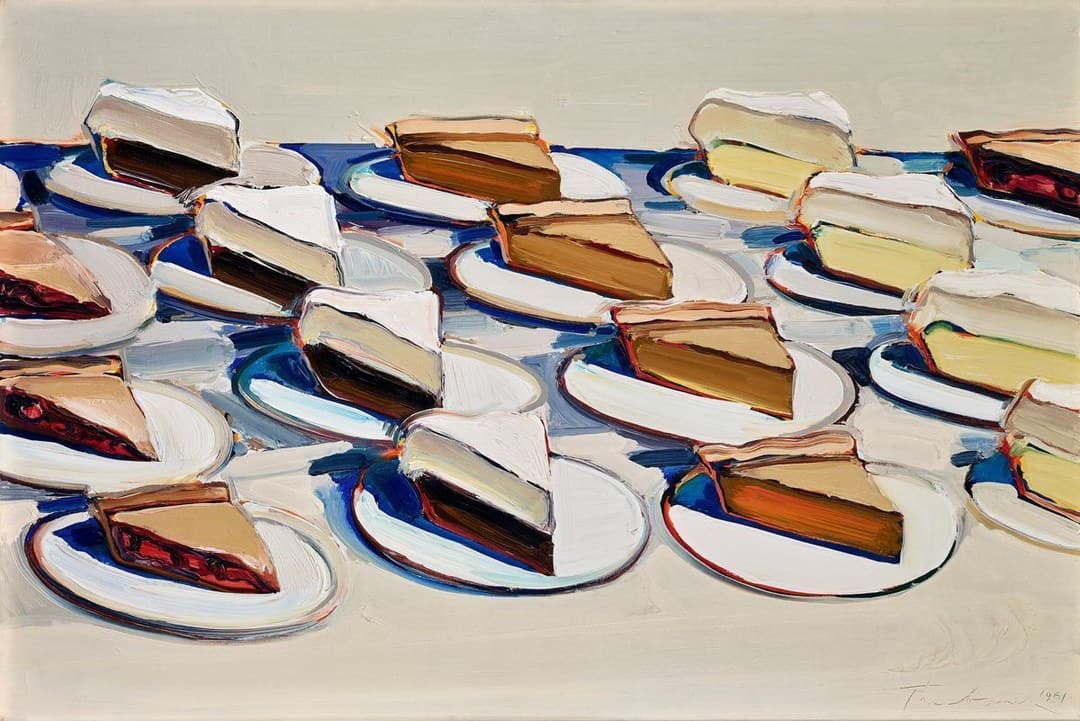
    Paints Pies, Pies, Pies, now at the Crocker Art Museum.

    Wedges of pie on white plates in four rows stepping up a pale sand counter towards a warm grey wall. The fillings are dark maroon cherry under tan custard, burnt orange pumpkin, pale lemon under white meringue, and a near-black filling under thick white cream. Every wedge stands with its tall crust end at the left and tapers to a point at the right, the cream tops are laid on in ridges of heavy paint, and cobalt shadow pools behind and between the platesPainting · in the catalogPies, Pies, Pies1961 · Oil on canvas

    Wayne Thiebaud, Pies, Pies, Pies 1961, accession 1974.12

  8. 1962

    The Allan Stone Gallery in New York shows his still lifes of food and commonplace objects, and the exhibition launches his career.

    Wayne Thiebaud at the Crocker Art Museum; Wayne Thiebaud — biography

  9. 1962

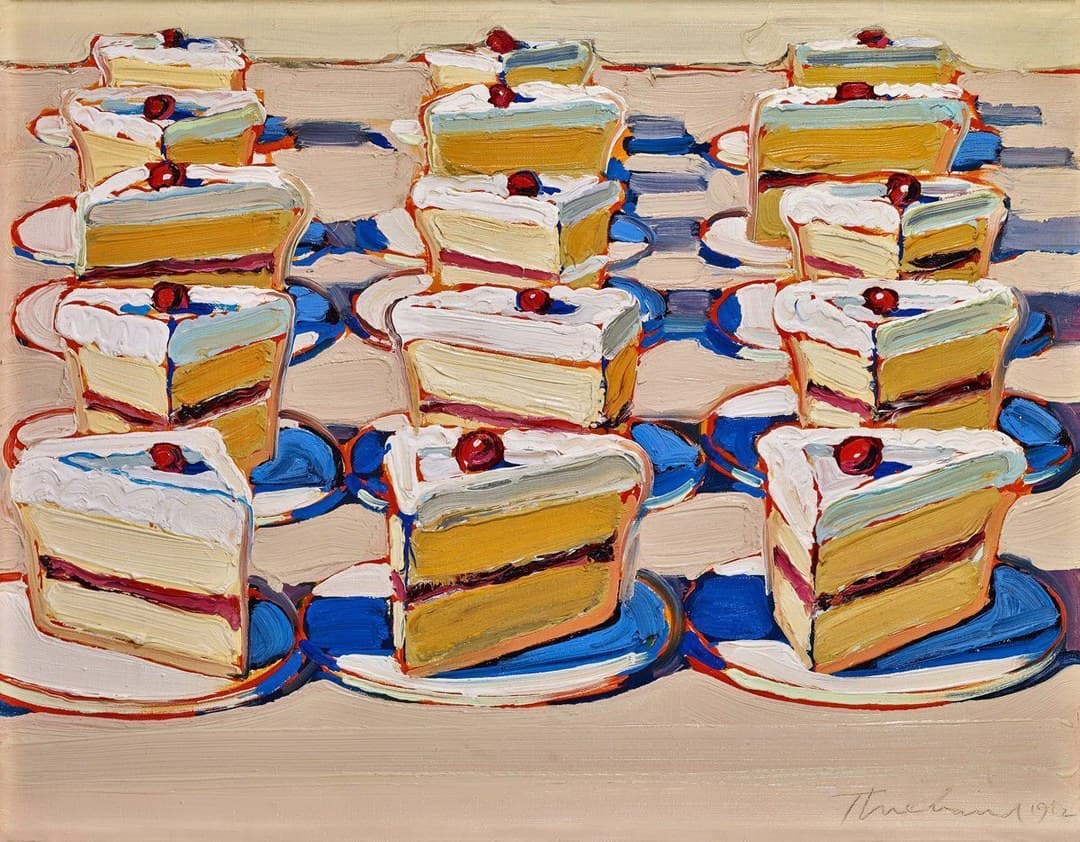
    Paints Boston Cremes, bought two years later by the Crocker Art Museum, and holds his first solo museum exhibition at the de Young Museum in San Francisco.

    Fifteen cake slices on white plates, ranged in three columns of five on a warm tan counter, growing larger towards the front. Each slice has a cap of white frosting worked in scalloped ridges, a single bright red cherry sitting in a dip in it, a thick pale cake layer, a band of rose-red and a second cake layer below. Orange-red lines run along the near edges and flat cobalt pools of shadow spread behind the platesPainting · in the catalogBoston Cremes1962 · Oil on canvas

    Wayne Thiebaud, Boston Cremes 1962, accession 1964.22; Wayne Thiebaud — biography

  10. 1963

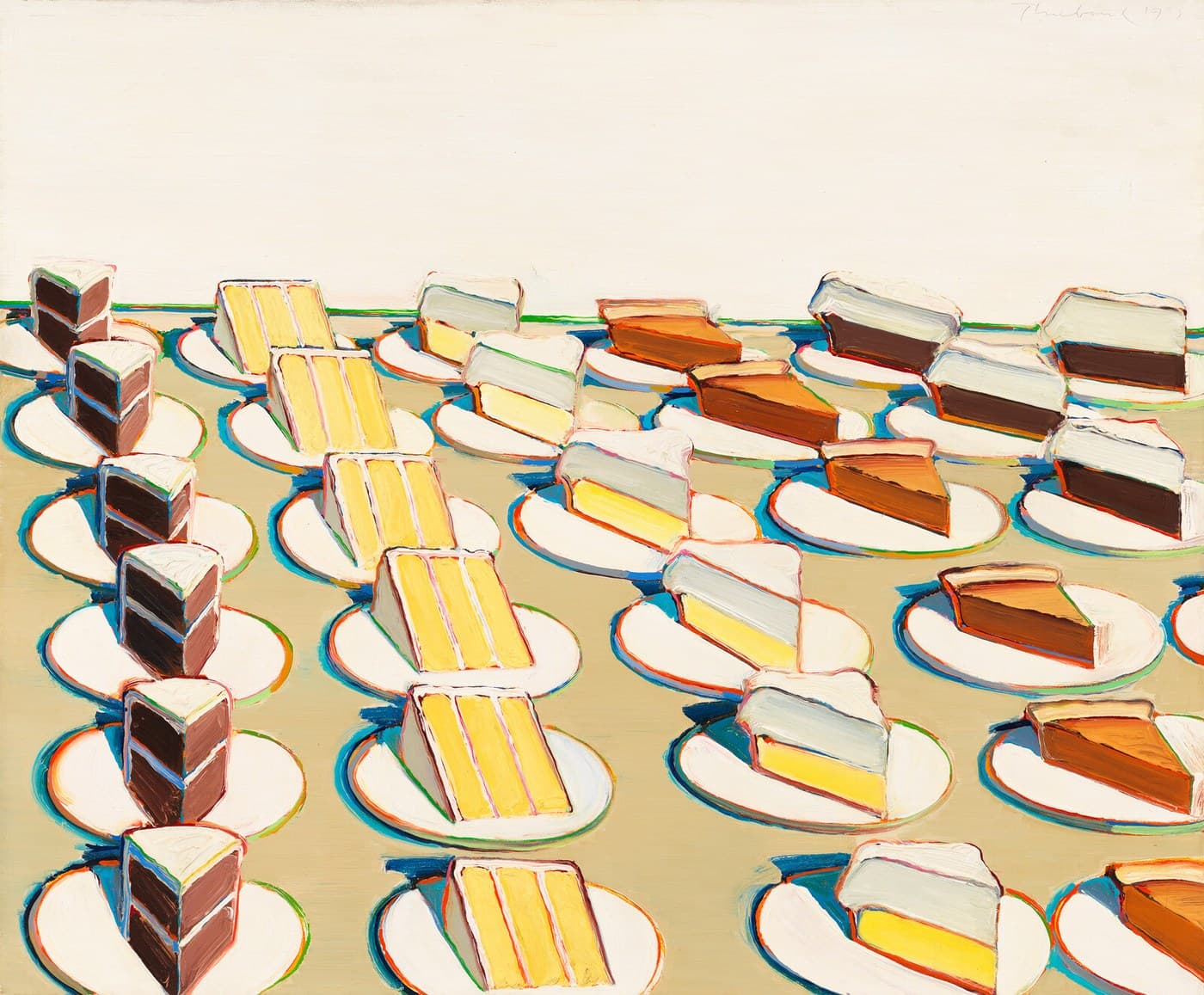
    Paints Pie Counter, bought the following year by the Whitney Museum of American Art.

    Plated slices of cake and pie in five files running back across a flat khaki counter under a warm off-white wall. The left file is chocolate layer cake with white frosting caps, the second yellow layer cake striped with pink and white seams, the third a thick grey-white meringue over lemon yellow. To the right lie flat wedges of bright orange pumpkin pie under pale crimped crusts. Every white plate sits in a pool of blue and teal shadow, and every slice is rimmed in separate lines of orange-red, blue and greenPainting · in the catalogPie Counter1963 · Oil on canvas

    Wayne Thiebaud, Pie Counter 1963, accession 64.11

  11. 1977

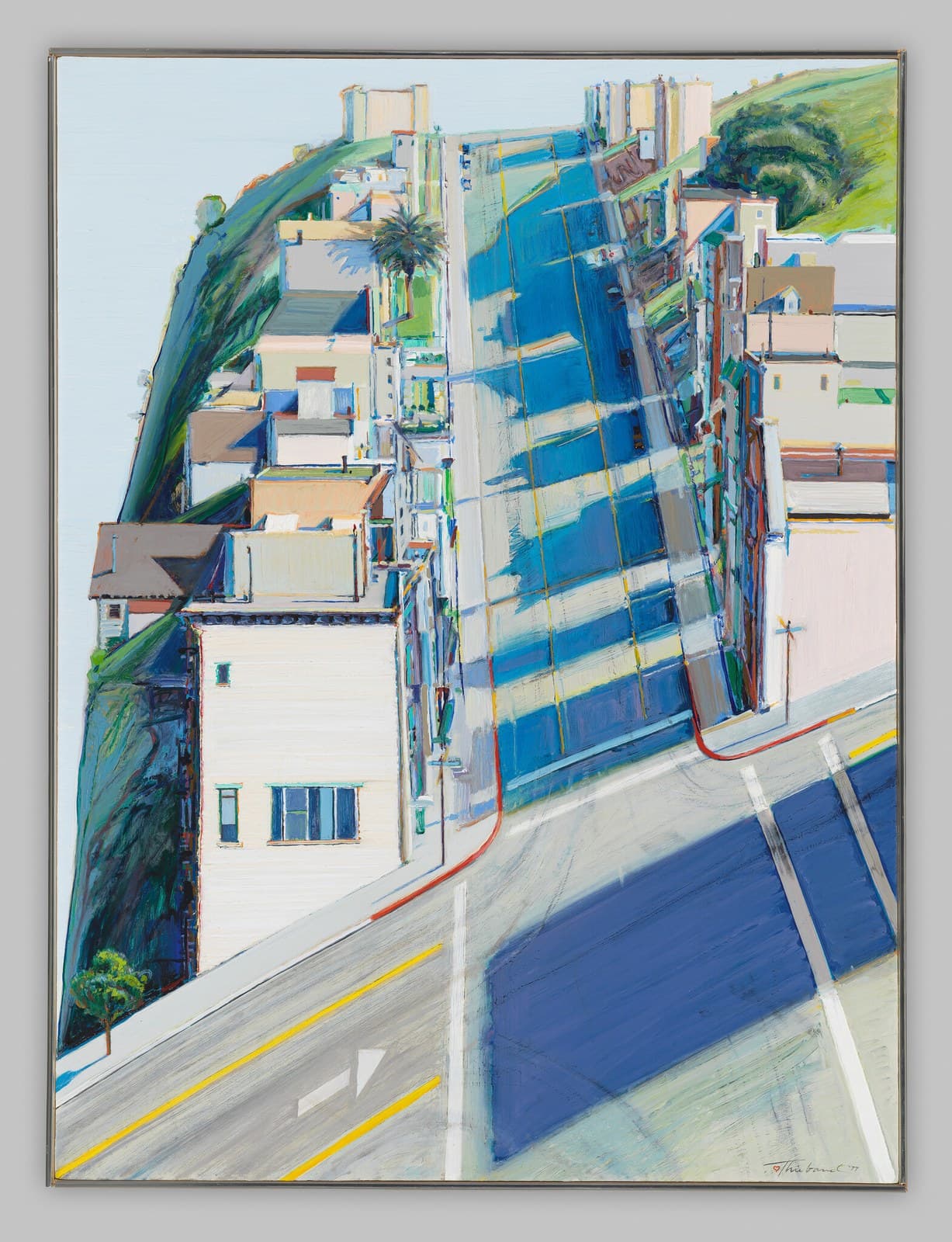
    Paints Ripley Ridge, one of the San Francisco street pictures he began in the early 1970s.

    A street rising almost vertically up the centre of a tall canvas, painted as a broad band of blue and grey-green with a thin yellow line up the middle and a red kerb line along its left side. In the foreground a wide crossing seen from above carries a flat ultramarine shadow. A cream clapboard building with green-framed windows stands at the left below a hillside painted in teal and violet, a palm tree rises halfway up, and pale tower blocks and a green hill close the top. The painting is photographed in its thin metal frame against a grey wallPainting · in the catalogRipley Ridge1977 · Oil on linen

    Wayne Thiebaud, Ripley Ridge 1977, accession 2018.98; Wayne Thiebaud — biography

  12. 1990

    Retires from teaching at seventy and carries on giving classes as professor emeritus.

    Wayne Thiebaud — biography

  13. 2003

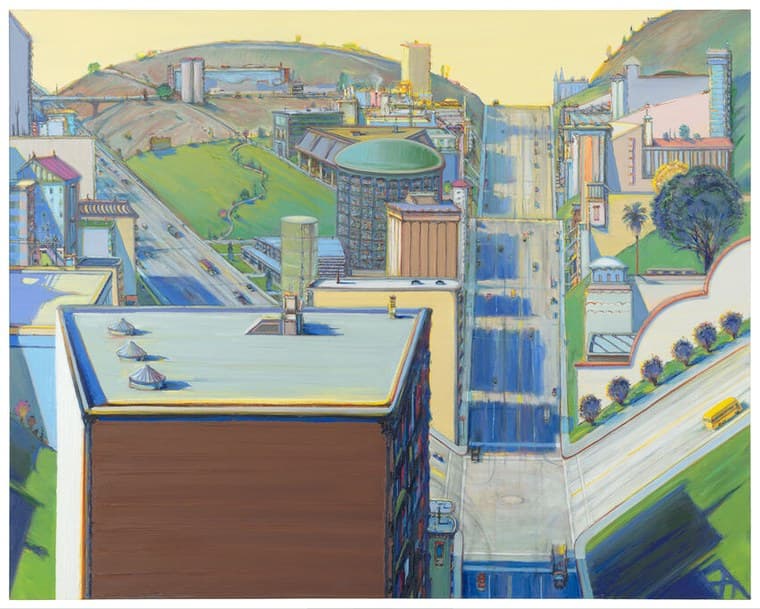
    Paints Valley Streets, from the Sacramento River Delta landscapes he began in the late 1990s.

    A city seen from above under a flat pale yellow sky, with bare hills meeting at the top. A flat-roofed block fills the lower left, its pale blue-green roof carrying three conical vents in a diagonal file that throw hard blue shadows to the right, above a flat brown facade. A cobalt street plunges down the centre, a multi-lane freeway curves through green lawn at the left, and at the right six violet-blue trees stand on a verge above a pale road carrying a single yellow school busPainting · in the catalogValley Streets2003 · Oil on canvas

    Wayne Thiebaud, Valley Streets 2003, accession FC.732; Wayne Thiebaud — biography

  14. 2015

    Talks about Rosa Bonheur's The Horse Fair for the Metropolitan Museum of Art's Artist Project series.

    Wayne Thiebaud on Rosa Bonheur’s The Horse Fair (2015)

  15. 2021

    Dies in Sacramento on 25 December, at 101.

    Wayne Thiebaud — biography; Wayne Thiebaud — biography and audio stories

Selected works

Cataloged from the holding institutions' records. Reproductions appear only where the rights are verified.

Paintings

Fifteen cake slices on white plates, ranged in three columns of five on a warm tan counter, growing larger towards the front. Each slice has a cap of white frosting worked in scalloped ridges, a single bright red cherry sitting in a dip in it, a thick pale cake layer, a band of rose-red and a second cake layer below. Orange-red lines run along the near edges and flat cobalt pools of shadow spread behind the plates

Artwork reproduction

Painting

Boston Cremes

1962 · Oil on canvas

Fifteen slices of cake stand in three columns of five on a warm tan counter, each capped with white frosting and a single red cherry. Wayne Thiebaud painted it in 1962, the year of the New York exhibition that made his name. The Crocker Art Museum in his own city bought it two years later and holds it as 1964.22.

Crocker Art Museum

Wayne Thiebaud, Boston Cremes, 1962. Crocker Art Museum. Image © the rights holder, shown under fair use.

Plated slices of cake and pie in five files running back across a flat khaki counter under a warm off-white wall. The left file is chocolate layer cake with white frosting caps, the second yellow layer cake striped with pink and white seams, the third a thick grey-white meringue over lemon yellow. To the right lie flat wedges of bright orange pumpkin pie under pale crimped crusts. Every white plate sits in a pool of blue and teal shadow, and every slice is rimmed in separate lines of orange-red, blue and green

Artwork reproduction

Painting

Pie Counter

1963 · Oil on canvas

Plated slices of cake and pie stand in files that run back across a khaki counter, under a warm off-white wall. Wayne Thiebaud painted it in 1963, the year after the Allan Stone Gallery show in New York that made his name. The Whitney Museum of American Art bought it the following year and holds it as 64.11.

Whitney Museum of American Art

Wayne Thiebaud, Pie Counter, 1963. Whitney Museum of American Art. Image © the rights holder, shown under fair use.

Wedges of pie on white plates in four rows stepping up a pale sand counter towards a warm grey wall. The fillings are dark maroon cherry under tan custard, burnt orange pumpkin, pale lemon under white meringue, and a near-black filling under thick white cream. Every wedge stands with its tall crust end at the left and tapers to a point at the right, the cream tops are laid on in ridges of heavy paint, and cobalt shadow pools behind and between the plates

Artwork reproduction

Painting

Pies, Pies, Pies

1961 · Oil on canvas

Wedges of pie stand on white plates in rows that climb the canvas, each one cut from a different pie. Wayne Thiebaud painted it in Sacramento in 1961, a year before the New York exhibition that made his reputation. The Crocker Art Museum holds it as 1974.12 and keeps it on view.

Crocker Art Museum

Wayne Thiebaud, Pies, Pies, Pies, 1961. Crocker Art Museum. Image © the rights holder, shown under fair use.

A street rising almost vertically up the centre of a tall canvas, painted as a broad band of blue and grey-green with a thin yellow line up the middle and a red kerb line along its left side. In the foreground a wide crossing seen from above carries a flat ultramarine shadow. A cream clapboard building with green-framed windows stands at the left below a hillside painted in teal and violet, a palm tree rises halfway up, and pale tower blocks and a green hill close the top. The painting is photographed in its thin metal frame against a grey wall

Artwork reproduction

Painting

Ripley Ridge

1977 · Oil on linen

A street runs almost straight up the centre of the canvas between two banks of buildings, and a flat ultramarine shadow lies across the crossing in the foreground. Wayne Thiebaud painted it in 1977, in the body of steep city pictures he began in the 1970s. The Whitney Museum of American Art bought it in 2018 and holds it as 2018.98.

Whitney Museum of American Art

Wayne Thiebaud, Ripley Ridge, 1977. Whitney Museum of American Art. Image © the rights holder, shown under fair use.

A city seen from above under a flat pale yellow sky, with bare hills meeting at the top. A flat-roofed block fills the lower left, its pale blue-green roof carrying three conical vents in a diagonal file that throw hard blue shadows to the right, above a flat brown facade. A cobalt street plunges down the centre, a multi-lane freeway curves through green lawn at the left, and at the right six violet-blue trees stand on a verge above a pale road carrying a single yellow school bus

Artwork reproduction

Painting

Valley Streets

2003 · Oil on canvas

A city is laid out from above, with a flat-roofed block filling the lower left, a street plunging down the centre and bare hills closing the top under a pale yellow sky. Wayne Thiebaud painted it in 2003, past eighty and four decades on from the cake paintings. The painting belongs to the Doris and Donald Fisher Collection at the San Francisco Museum of Modern Art as FC.732.

San Francisco Museum of Modern Art

Wayne Thiebaud, Valley Streets, 2003. San Francisco Museum of Modern Art. Image © the rights holder, shown under fair use.

Who Inspired Wayne Thiebaud

People whose work inspired Wayne Thiebaud. They did not necessarily meet or know one another.

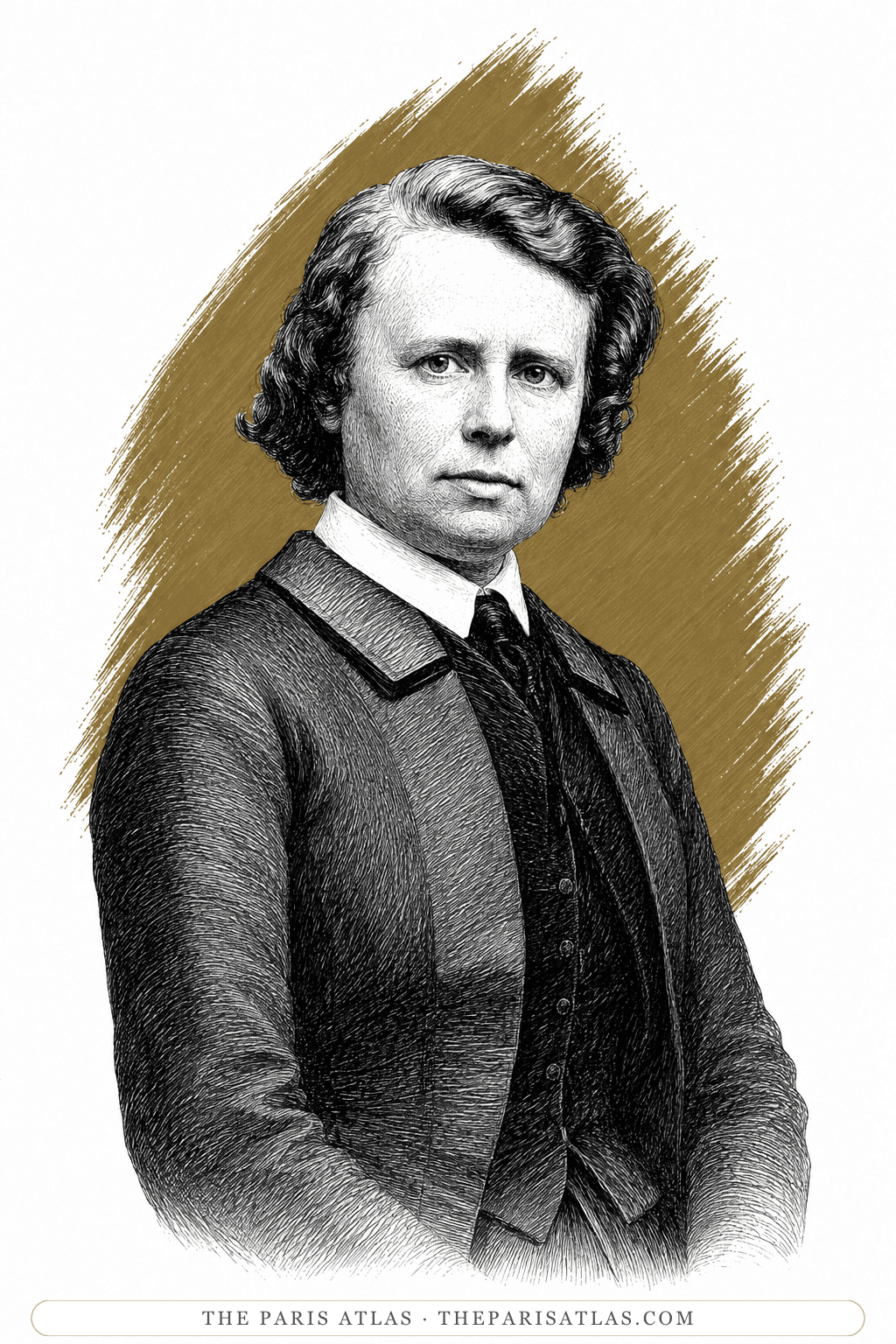
Illustrated portrait of Rosa Bonheur

Rosa Bonheur

Thiebaud recalled seeing The Horse Fair in reproduction at about seven years old and discussed its lasting interest for him as a painter and teacher, particularly its light, spatial construction and animal movement.

Wayne Thiebaud on Rosa Bonheur’s The Horse Fair (2015)

Questions about Wayne Thiebaud

Who was Wayne Thiebaud?

Wayne Thiebaud (1920–2021) was an American painter, best known for pictures of cakes, pies and counter displays. He was born in Mesa, Arizona, grew up mostly in Long Beach, California, and lived in Sacramento from the 1950s until his death. He taught for decades, first at Sacramento Junior College and then at the University of California, Davis.

Why did Wayne Thiebaud paint cakes and pies?

He painted them from memory rather than from life, drawing on the bakeries and diners he had known and on the advertising imagery around him. The food gave him bright, simple, repeated forms to test colour, light and shadow on. He kept returning to the subject for the rest of his career, alongside portraits and landscapes.

Was Wayne Thiebaud a Pop artist?

Critics filed him with Pop art, and he was in two of the 1962 exhibitions that established the movement. He never accepted the label, and preferred to call himself a traditional painter of illusionistic forms. The critic Michael Kimmelman points to the coloured halos and the light in the paintings as qualities that read as memory rather than as the here and now of Pop.

Where did Wayne Thiebaud teach?

He began teaching art and art history at Sacramento Junior College while he was a graduate student at Sacramento State College, and stayed eight years. In 1960 he joined the faculty of the University of California, Davis, and taught there for the rest of his working life. He retired at seventy and kept giving classes as professor emeritus.

What did Wayne Thiebaud paint besides food?

He painted portraits in the same manner as the still lifes, with sober-faced figures against light, empty backgrounds. From the early 1970s he painted the steep streets of San Francisco, and from the late 1990s the flat farmland of the Sacramento River Delta seen from above. From the early 2000s he painted mountains, and his last body of work was a series of circus clowns.

Where can I see Wayne Thiebaud's paintings?

The Crocker Art Museum in Sacramento holds Pies, Pies, Pies (1961) and Boston Cremes (1962). The Whitney Museum of American Art in New York holds Pie Counter (1963) and Ripley Ridge (1977). Valley Streets (2003) is at the San Francisco Museum of Modern Art.

Connections and Sources

Wayne Thiebaud’s connections to people, places, and works, with the sources behind each one.

Influenced by

Rosa Bonheur

Thiebaud recalled seeing The Horse Fair in reproduction at about seven years old and discussed its lasting interest for him as a painter and teacher, particularly its light, spatial construction and animal movement.

Wayne Thiebaud on Rosa Bonheur’s The Horse Fair (2015)

References

References

The sources below include biographies, scholarly essays, interviews, and primary materials that informed this page. They reflect both the historical record and ongoing critical conversations about Wayne Thiebaud and their work.

  1. 1Wayne Thiebaud — biography

    Website
    Wayne Thiebaud Foundation
    Used for

    The artist's own foundation's biography, used for the commercial-art years, the teaching, the subjects and the death date.

    View source
  2. 2Wayne Thiebaud at the Crocker Art Museum

    Website
    Crocker Art Museum, Sacramento
    Used for

    The Crocker Art Museum's artist page, which gives the birth date, the Long Beach childhood, Mather Field, and the college and teaching dates.

    View source
  3. 3Wayne Thiebaud: A Celebration (1920–2021)

    Website
    Crocker Art Museum, Sacramento, 2022
    Used for

    The Crocker Art Museum's release for its 2022 survey, used for the 1951 first solo exhibition, the army cartooning and the clown paintings.

    View source
  4. 4Wayne Thiebaud — biography and audio stories

    Website
    San Francisco Museum of Modern Art
    Used for

    The San Francisco Museum of Modern Art's artist page, used for the knife-laid paint, the outlined edges and Michael Kimmelman's commentary.

    View source
  5. 5Wayne Thiebaud on Rosa Bonheur’s The Horse Fair

    Website
    The Metropolitan Museum of Art, 2015
    Used for

    The Metropolitan Museum of Art's Artist Project film of 2015, in which he talks about Rosa Bonheur's The Horse Fair.

    View source
  1. 6Wayne Thiebaud, Pies, Pies, Pies 1961, accession 1974.12

    Official record
    Crocker Art Museum, Sacramento
    Used for

    The Crocker Art Museum's object record for Pies, Pies, Pies, dated 1961.

    View source
  2. 7Wayne Thiebaud, Boston Cremes 1962, accession 1964.22

    Official record
    Crocker Art Museum, Sacramento
    Used for

    The Crocker Art Museum's object record for Boston Cremes, dated 1962 and accessioned in 1964.

    View source
  3. 8Wayne Thiebaud, Pie Counter 1963, accession 64.11

    Official record
    Whitney Museum of American Art, New York
    Used for

    The Whitney Museum of American Art's object record for Pie Counter, dated 1963 and accessioned in 1964.

    View source
  4. 9Wayne Thiebaud, Ripley Ridge 1977, accession 2018.98

    Official record
    Whitney Museum of American Art, New York
    Used for

    The Whitney Museum of American Art's object record for Ripley Ridge, dated 1977 and accessioned in 2018.

    View source
  5. 10Wayne Thiebaud, Valley Streets 2003, accession FC.732

    Official record
    San Francisco Museum of Modern Art
    Used for

    The San Francisco Museum of Modern Art's object record for Valley Streets, dated 2003.

    View source
i
Why these sources are here

These references anchor the page in the documented record and in the scholarly conversations around Wayne Thiebaud. Every claim on this page traces back to one or more of the works listed here.

Explore more resources