The fourth and final volume of Beauvoir's memoirs — written at sixty-four with the whole life visible behind her, organised by theme rather than chronology, and containing the reckoning with 'I was cheated' that Force of Circumstance had ended on.
Simone de Beauvoir's Tout compte fait (1972) is the fourth and last volume of her memoirs. Instead of continuing the year-by-year account of Force of Circumstance (1963), she organises the book thematically — around dreams, reading, film, music, painting, travel, women, politics, and old age — and uses the sixty-four-year vantage to look back at her whole life rather than to extend it. The book's most quoted material is the several chapters she devotes to walking back the famous last line of Force of Circumstance ('I was cheated'), and to explaining what she had and had not meant. It also contains her clearest account of her own commitment to Movement for the Liberation of Women (MLF) feminism from 1970 onward and of the campaigns of her last two decades (against the Vietnam War, for abortion rights, for the abolition of institutional violence against the old).
The story, in more detail
Beauvoir wrote Tout compte fait between 1969 and 1972 and Gallimard published it in Paris in November 1972. Patrick O'Brian's English translation, All Said and Done, appeared from G.P. Putnam's Sons in New York in 1974 and from André Deutsch in London the same year. The book is longer than Memoirs of a Dutiful Daughter or The Prime of Life (about five hundred pages in most editions) but shorter than Force of Circumstance, and it is the least chronological of the four.
The thematic organisation reflects Beauvoir's own argument about what a fourth memoir volume could still do. She had covered the whole timeline of her life in the three previous books; a fourth strict-chronological volume would only have added the ten years since Force of Circumstance closed, and those ten years — 1962 to 1972 — did not have the shape her earlier decades had. What she did instead was reorganise: chapters on her dreams (the material for which she had been keeping a dream diary since her twenties), on books she had read across her life, on friendship, on the specific women she had loved and worked with, on travel to the Soviet Union and Egypt and Japan, on the 1968 May events and their aftermath, on her turn toward MLF feminism, and on old age in her own body. The book is Beauvoir's most Montaigne-shaped writing — a set of essays under the sign of a life — and it is closer to a philosophical book than any of the earlier memoir volumes.
It is the book most cited by Beauvoir's own defenders when readers who have only read the strict chronological memoirs charge her with self-justification. Tout compte fait is not a defence. It is a fifty-year-old writer, at sixty-four, revisiting the arguments of her earlier books with the whole life visible behind her and admitting where she is now less sure than she was, where she has changed her mind, and where she thinks the world has changed under her without her noticing. It is, by common critical agreement, her most self-critical book.
The full plot
What happens, beginning to end — the ending included. Open when you're ready.
Part I is Beauvoir's answer to Force of Circumstance's 'I was cheated' controversy. She reviews what she had written in 1963, explains what she now thinks the sentence had described, and specifies what she does and does not still endorse of the reckoning of the third memoir volume. She had meant the sentence, she writes, but she had over-generalised from a specific moment. The 'cheating' had been the fifty-five-year-old's recognition that mortality attached to the people she loved, not — as many readers had taken it — a rejection of the political and intellectual work of her postwar decade. She stood by the political work.
Part II is the thematic reorganisation. Beauvoir spends about three hundred pages moving through the categories she had chosen: dreams (drawing on the dream diary she had kept for forty years), a walk through the books she has read across her whole life, a similar chapter on the films she has seen, on music, on painting, on her travel to the Soviet Union in 1962 and 1966 and to Egypt and Japan in the mid-1960s and to Cuba in 1960 and to the United States again in 1964. Extended chapters on friendship name the women she has spent forty years working with — Colette Audry, Olga and Wanda Kosakiewicz, Michelle Vian, Sylvie Le Bon (whom she had met in 1960 and whom she formally adopted as her daughter in 1980), Nelson Algren's estranged wife Amanda, Angela Davis, Gisèle Halimi. Political chapters cover the 1968 May events, the Soviet invasion of Czechoslovakia in August 1968, the ongoing campaign against the Vietnam War, and the murder of the Beauvoir-supported Chilean socialist project in Salvador Allende's 1973 coup (which happened after the book was already at press, and which Beauvoir addressed in a separate essay).
Part III is Beauvoir's clearest account of the turn she had made in 1970 toward active MLF (Mouvement de libération des femmes) feminism. She had, she writes, been reluctant to attach herself to a movement she felt she had done the philosophical groundwork for twenty-two years earlier; the reluctance had been overcome by the specific political urgency of the early 1970s (the abortion-rights campaign that would produce the 1971 Manifesto of the 343 and the 1972 Bobigny trial). The book closes on Beauvoir's recognition that the women's movement of the early 1970s was in some ways the direct application of The Second Sex two decades after its publication, and on her own place in that movement as an ally and public figure rather than a leader.
How it ends — spoilers aheadThe final movement, ending included. Open when you're ready.
The last thirty pages of Tout compte fait are Beauvoir's most sustained account of her own old age. She was sixty-four. Her mother had died at seventy-eight; her own health was still solid, but the friends she had kept for four decades were beginning to die (Merleau-Ponty in 1961, Camus in 1960 in a car accident, Aragon in 1972, Malraux would follow in 1976). Beauvoir writes about how the shrinkage of the future changes what one thinks it worth doing with the present. She writes about the specific pleasure of continuing to work at sixty-four rather than at thirty-four — the same pleasure, less complicated by ambition or by the expectation that any single book will be the one that finally settles the argument. She writes about the compensation, which she says she had not expected, of watching a movement she had helped make possible take up the arguments she had been making twenty years earlier and press them forward with an energy she no longer had.
The last sentence is her most quoted late-career line: 'The past has not made me what I am; I make it what it is.' It is the sentence critics have used to describe the entire memoir project — Beauvoir's insistence, across four books and fifteen years of writing, that a life is not simply the events that happened but the shape a writer gives them by choosing which are still worth remembering. She would live another fourteen years after Tout compte fait was published. In those years she wrote Adieux (1981) about Sartre's death, campaigned for MLF causes, sat for many interviews, and continued her editorship of Les Temps modernes. She died on 14 April 1986 and was buried beside Sartre at Montparnasse. Tout compte fait is the book by which she deliberately closed the sequence of writing that had begun with Memoirs of a Dutiful Daughter in 1958.
Themes and analysis
These readings discuss events throughout the book, including its ending.
A life reorganised by theme
Organizing memory by theme changes what an autobiography asks its reader to follow. Miranda Fricker reads All Said and Done's departure from chronology as a sign of Beauvoir's altered relation to the future: the narrator looks back without the earlier memoirs' expectation of an unfolding destination. On that reading, rearranging a life is not merely sorting recollections into convenient categories. It changes the source of the book's momentum. The interest lies less in what happens next than in how a writer interprets the experiences already accumulated, bringing them into a late self-portrait.
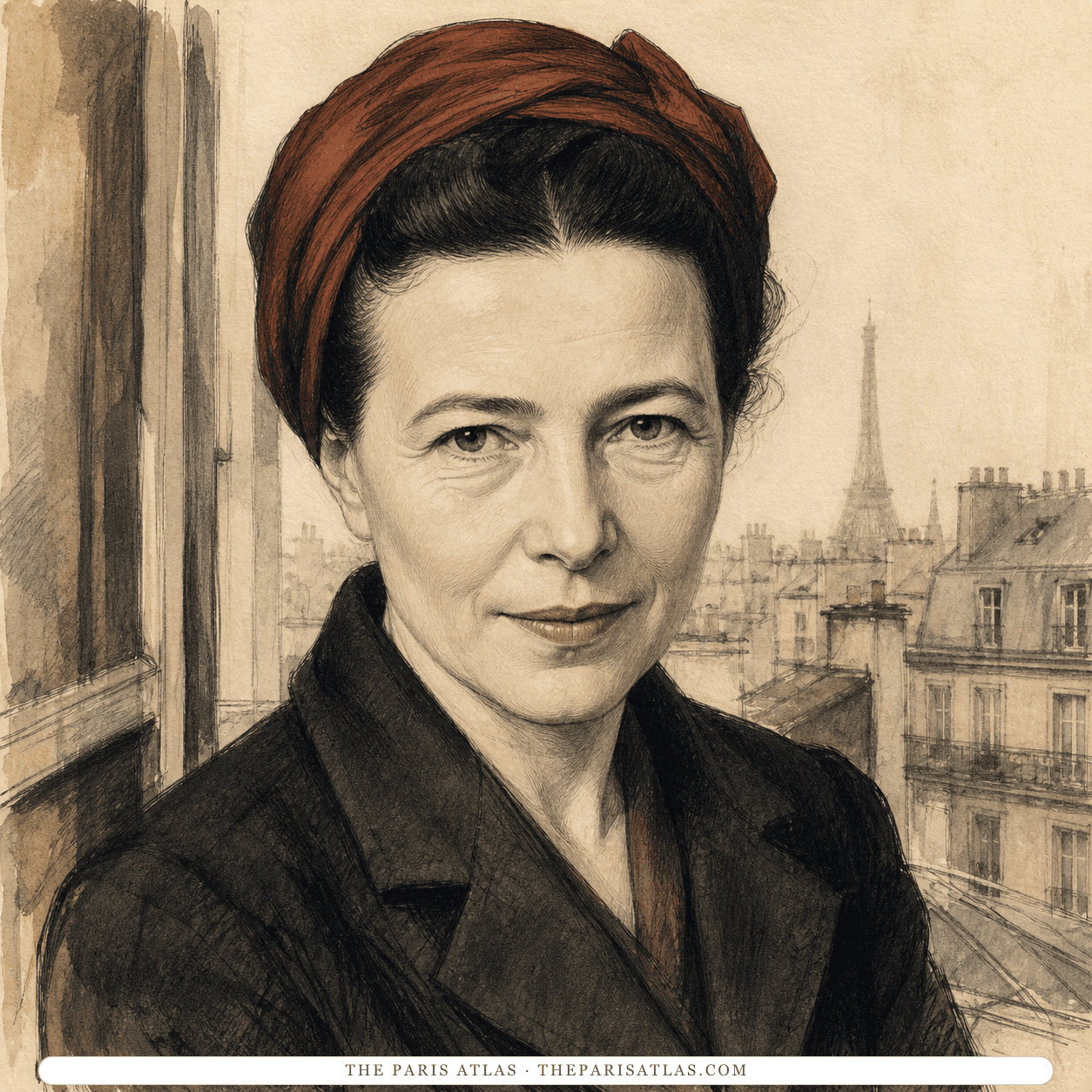
At sixty-four, Beauvoir returns to decades of notebooks, journeys and reading, arranging memory by subject rather than chronology. An imagined reconstruction. (Illustration — The Paris Atlas)
The movement takes the argument forward
In the account of women's liberation excerpted by Redstockings, Beauvoir gives political change several forms: demonstrations, new organizations, articles and books. Her list of writers—including Kate Millett, Shulamith Firestone, Robin Morgan and Germaine Greer—places intellectual work inside an active movement. The passage also follows feminism across national borders, from the United States to Italy and France. Read beside the organizing-table illustration, it suggests that an argument acquires force through other people's actions, not simply through its author's reputation. The memoir's political world contains many participants rather than a single guiding voice.
Beauvoir joins younger activists and Gisèle Halimi around the practical work of the women’s movement, watching an argument become collective action. An imagined reconstruction. (Illustration — The Paris Atlas)
Why we recommend it
1
Why it matters
It is the most useful late self-assessment to read after the first three memoir volumes.
2
Where it fits
Pair it with The Coming of Age to compare social analysis of aging with Beauvoir's account of aging herself.
3
What lingers
It is the fourth and final volume of Beauvoir's memoirs — the one she wrote at sixty-four with the whole life visible behind her, and the closest her autobiography ever gets to a reckoning with her own choices rather than a defence of them.
The people at the centre of the fourth memoir volume. All are real; Beauvoir uses their real names. Simone de Beauvoir is the only one of them with a page of her own; the others appear in this list alone. This is the memoir volume in which Sylvie Le Bon, whom Beauvoir would legally adopt in 1980, becomes a substantial presence.
The book's first-person narrator, at sixty-four, revisiting the whole life across a thematic rather than a chronological framework. Corrects the 'I was cheated' controversy of Force of Circumstance, records her 1970 turn toward MLF feminism, and reviews her own old age.
Jean-Paul Sartre
Still Beauvoir's central partner. The book covers his late-1960s political turn toward the Maoist left, his editing of Libération, and — at press time — the beginnings of the decline that Adieux (1981) would take up.
Sylvie Le Bon
The philosophy student who had approached Beauvoir with a letter in 1960, when Le Bon was seventeen. By the writing of Tout compte fait she was Beauvoir's closest companion after Sartre; in 1980 Beauvoir would legally adopt her as her daughter. She has been Beauvoir's literary executor since 1986.
Also in the book
Gisèle Halimi
The lawyer Beauvoir had worked with on the Djamila Boupacha case in 1960–62. In Tout compte fait she is the most prominent political ally: co-founder of Choisir (1971), lead lawyer in the 1972 Bobigny abortion trial, and one of the co-drafters of the 1971 Manifesto of the 343.
Colette Audry
Beauvoir's oldest friend from the Rouen teaching years in the 1930s. Still Beauvoir's political interlocutor forty years later, and one of the founding editors of the feminist journal Sorcières.
Michelle Vian
Formerly married to the novelist Boris Vian, Sartre's long-term lover from 1949 onward. Still part of the small circle around Sartre and Beauvoir in the late 1960s.
Angela Davis
The American philosopher and Black Panther Party organiser whom Beauvoir met on her 1969 American trip. Featured in Tout compte fait's political chapters. Sartre and Beauvoir led the international defence campaign for Davis during her 1970–72 trial.
Bring it to book club
Tout compte fait replaces chronology with theme. Which of the thematic chapters (dreams, reading, film, painting, travel, women, politics, old age) is the sharpest, and which feels most datable?
The book opens with Beauvoir walking back the 'I was cheated' line of Force of Circumstance. Do the pages of this book do the work? Read them alongside the last chapter of Force of Circumstance.
The women who appear in the friendship chapters — Colette Audry, Sylvie Le Bon, Gisèle Halimi, Michelle Vian, Angela Davis — form the private and political network of Beauvoir's last two decades. What does the roster show about how her feminism had changed since The Second Sex?
The last line — 'The past has not made me what I am; I make it what it is' — is often cited to describe the whole memoir project. Read it alongside the last lines of the other three memoir volumes: what is she trying to leave the reader with?
A complete discussion guide is on our editorial calendar. Join the letter to hear when it ships.
Timeline
1958–1963
Beauvoir publishes the first three memoir volumes: Memoirs of a Dutiful Daughter, The Prime of Life, Force of Circumstance.
1960
Beauvoir meets the philosophy student Sylvie Le Bon; the friendship deepens through the 1960s.
1968
May 1968 events in Paris; the Soviet invasion of Czechoslovakia in August.
1969–1972
Beauvoir writes Tout compte fait.
1970
Beauvoir joins the Mouvement de libération des femmes (MLF) and begins active feminist campaigning.
1971
The Manifesto of the 343 is published in Le Nouvel Observateur on 5 April, calling for abortion rights; Beauvoir signs. Gisèle Halimi founds Choisir.
1972
The Bobigny trial, in which Halimi defends a woman charged with helping her daughter obtain an abortion, becomes a public turning point in the French abortion-rights campaign. Gallimard publishes Tout compte fait in Paris in November.
1974
Patrick O'Brian's English translation, All Said and Done, appears from Putnam and Deutsch.
1975
The Veil law legalises abortion in France, the direct legislative consequence of the campaign the last part of Tout compte fait had described.
1980
Beauvoir legally adopts Sylvie Le Bon as her daughter. Sartre dies on 15 April.
1981
Beauvoir publishes Adieux, the last book of significant length she would publish, on Sartre's last decade.
14 April 1986
Beauvoir dies in Paris and is buried beside Sartre at the Cimetière du Montparnasse.
Book editions
Paperback
Paperback
French
Gallimard
·
1972
Original French publication as Tout compte fait. English editions use the translated title shown on this page.
Paperback
Paperback
Penguin
·
1979
Translated by
Patrick O'Brian
Penguin English edition; 500 pages. OBNB records ISBN-10 014004180X.
The third and longest volume of Beauvoir's memoirs: the eighteen years from the Liberation of Paris in August 1944 through 1962, the years in which she wrote The Second Sex and The Mandarins, met Nelson Algren, campaigned against French torture in Algeria, and became one of the most-watched public intellectuals in Europe.
Beauvoir's six-hundred-page 1970 study of old age — the companion volume to The Second Sex, arguing that Western societies treat their elderly as a scandal to be hidden and that this is a decision, not a fact.
What is All Said and Done by Simone de Beauvoir about?
The fourth and last volume of Beauvoir's memoirs, published in 1972 when she was sixty-four. Instead of continuing the strict year-by-year account of the earlier volumes, she organises this book thematically — around dreams, reading, film, painting, travel, friendship, women, politics, and old age. It is her most Montaigne-shaped writing, and, by common critical agreement, her most self-critical book.
When was All Said and Done published?
Gallimard published Tout compte fait in Paris in November 1972. Patrick O'Brian's English translation, All Said and Done, appeared from G.P. Putnam's Sons in New York and from André Deutsch in London in 1974.
Why does Beauvoir walk back the 'I was cheated' line in All Said and Done?
Force of Circumstance had ended on 'J'ai été flouée' ('I was cheated'), and readers had taken the sentence as a general rejection of the postwar decade. All Said and Done's opening chapters are Beauvoir's answer: she had meant the sentence but had over-generalised from a specific moment. The 'cheating' was her fifty-five-year-old's recognition that mortality attached to the people she loved, not — as many readers had thought — a repudiation of her political and intellectual work. She stood by the work.
How is All Said and Done structured?
Thematically rather than chronologically. Chapters cover Beauvoir's dreams (drawing on a dream diary she had kept since her twenties), her lifelong reading, films, music, painting, travel (Soviet Union, Egypt, Japan, further US trips), friendship (Colette Audry, Sylvie Le Bon, Gisèle Halimi, Angela Davis), politics (1968, Prague, Vietnam, the MLF), and old age in her own body.
How does All Said and Done relate to The Coming of Age?
The Coming of Age (1970) is Beauvoir's philosophical book about old age — the analytical case study of a condition. All Said and Done, two years later, is her account of ageing in her own body. Reading the two together gives the general argument (The Coming of Age) and the specific case (All Said and Done's late chapters) side by side.
Who is Sylvie Le Bon?
A philosophy student who had approached Beauvoir with a letter in 1960, when Le Bon was seventeen. By the writing of All Said and Done in 1971 she was Beauvoir's closest companion after Sartre. In 1980 Beauvoir legally adopted her as her daughter — the same year Sartre legally adopted Arlette Elkaïm-Sartre. She has been Beauvoir's literary executor since her death in 1986.
If you like Simone de Beauvoir
Explore authors with a similar voice, perspective, and influence.
Albert Camus
Both French writers used novels, essays, journalism, and public argument to ask how freedom and responsibility operate without a fixed moral system.
The sources below include the primary text, editions, scholarship, archival materials, and other records that informed this page. They document All Said and Done, its publication, and its place in literary history.
1Life-Story: Document and Solidarity in the Memoirs of Simone de Beauvoir
Essays
Cambridge University Press / author-hosted manuscript, 2003
Used for
Attributed interpretation of thematic form in Fricker's scholarly chapter; the author-hosted manuscript quotes the Prologue and identifies its English edition separately.
Used for independent biographical, archival, or historical context surrounding Simone de Beauvoir's career and the period in which All Said and Done appeared.
The primary text is the baseline reference for every book page. Additional references document publication history, interpretation, and historical context where that evidence is available.








 View source