The third and longest volume of Beauvoir's memoirs: the eighteen years from the Liberation of Paris in August 1944 through 1962, the years in which she wrote The Second Sex and The Mandarins, met Nelson Algren, campaigned against French torture in Algeria, and became one of the most-watched public intellectuals in Europe.
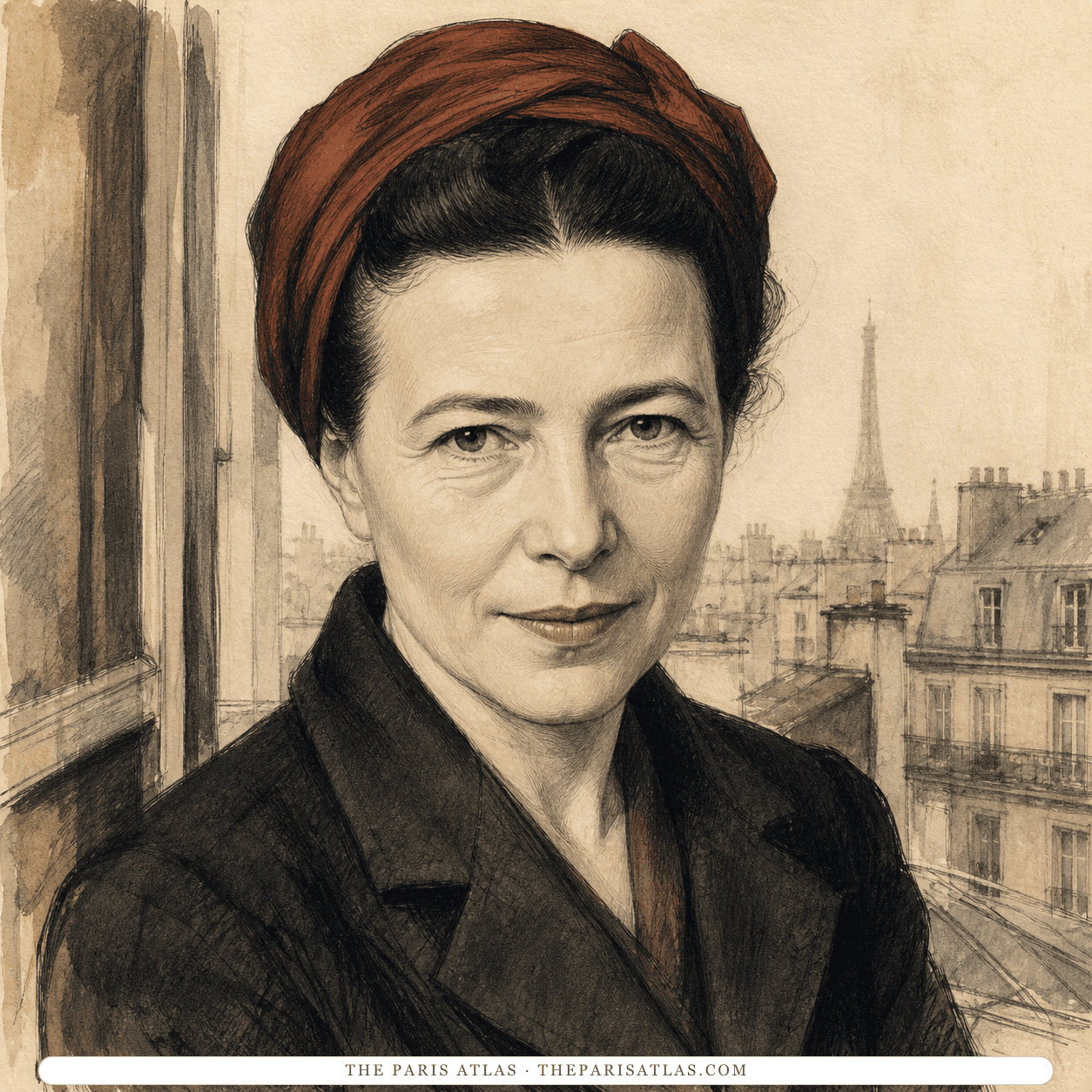
Simone de Beauvoir's La Force des choses (1963) is the third volume of her memoirs and the longest — about eight hundred pages in most editions. It picks up on the last day of The Prime of Life, in the streets of Paris on 25 August 1944, and closes in the summer of 1962 with the end of the Algerian War. Between those two points it covers the founding and eighteen-year fight of Les Temps modernes, the writing and 1949 publication of The Second Sex, the Prix Goncourt for The Mandarins in 1954, the four-year affair with the Chicago novelist Nelson Algren, the four American tours and the summer in Cuba with Fidel Castro, the 1960 open letter against French torture that got her charged in absentia, and the Algerian War protests she and Sartre led with the lawyer Gisèle Halimi from 1958 through 1962. It is the memoir volume in which Beauvoir became the public figure the century now remembers.
The story, in more detail
Beauvoir wrote La Force des choses between 1961 and 1963. Gallimard published the two-volume French edition in October 1963. Richard Howard's English translation, Force of Circumstance, appeared from G.P. Putnam's Sons in New York in 1965; some later English editions (Penguin, Harper) publish it as two paperback volumes matching the French split. The book covers eighteen years — twice as much time as any of the other three memoir volumes — and is correspondingly the longest and most crowded.
The book is the direct sequel to The Prime of Life (1960), and picks up from the Liberation of Paris in August 1944. Its first four hundred pages cover the postwar decade in Beauvoir's own centre — the founding of Les Temps modernes with Sartre in October 1945, the American lecture tour of 1947 (which begins the affair with Nelson Algren), the writing and publication of The Second Sex, the international attacks the book drew from Mauriac, the Vatican, and half the Paris literary press, the Prix Goncourt for The Mandarins in 1954, the purchase of the rue Victor Schoelcher studio, the summers with Algren in Chicago and Mexico. The second half is the Algerian War: the 1958 return of de Gaulle, the 1960 open letter about the torture of Djamila Boupacha which got Beauvoir charged in absentia, and the four-year public campaign she and Sartre and Gisèle Halimi led against French torture and colonial violence.
It is the memoir volume in which Beauvoir came closest to writing what her critics wanted her to write — a book about her own political and intellectual formation as a public figure — and also, in its last hundred pages, the volume in which she recorded the most explicit disappointment with the twenty years she was reviewing. The famous last line — 'J'ai été flouée' ('I was cheated') — set off a small controversy that Beauvoir devoted several later interviews to explaining. She meant it. She spent the next volume (All Said and Done, 1972) qualifying it.
The full plot
What happens, beginning to end — the ending included. Open when you're ready.
The book opens where The Prime of Life ended — 25 August 1944, in the streets of the newly-liberated Left Bank, Beauvoir and Sartre walking home through the crowds. Part I covers the first postwar decade in fast time. In October 1945 they found the monthly journal Les Temps modernes with Maurice Merleau-Ponty, Raymond Aron, and a small editorial committee (Aron and Merleau-Ponty leave over political disagreements by 1948 and 1952). Beauvoir writes The Ethics of Ambiguity (1946–47) and All Men Are Mortal (1943–46); Sartre stages his plays and publishes Existentialism Is a Humanism (1946). They travel — the years of the Occupation had ended six years of stalled travelling — first to Italy, Switzerland, the United States (a lecture tour Sartre had turned down and Beauvoir accepted), Latin America, Scandinavia. On 21 February 1947 in Chicago, Beauvoir meets Nelson Algren, then thirty-eight, a novelist working out of a rented room over a bar. Within a week they are lovers. The affair runs, in some form, from 1947 through 1951 and produces the four American summers she describes with him in Chicago, in Mexico, and in Guatemala.
Part II is dominated by two books. Beauvoir writes The Second Sex between the autumn of 1946 and the spring of 1949. She works at the National Library and at the Café de Flore. The book comes out in two volumes in 1949 and is immediately attacked by François Mauriac in Le Figaro, by the Vatican's Osservatore Romano, by the Communist Party press, and by roughly half the Paris literary establishment. Her mail contains letters accusing her of nymphomania, lesbianism, Marxism, bourgeois complacency, and — from the readers she was actually reaching — declarations that the book had changed the writer's life. Meanwhile she is writing The Mandarins, the roman à clef of the postwar Paris left, drafting through 1949–53. In December 1954 the Académie Goncourt awards it the Prix Goncourt. The prize money buys her the studio at 11 bis rue Victor Schoelcher, on the edge of Montparnasse Cemetery, which she keeps for the rest of her life.
Part III is the Algerian War, which begins in November 1954 and runs until March 1962. From about 1957 the war becomes the centre of Beauvoir's political life. The French army is using torture systematically against Algerian nationalists; Beauvoir, Sartre, and the philosopher Francis Jeanson organise networks of public and clandestine support. In June 1960 the lawyer Gisèle Halimi brings Beauvoir the case of Djamila Boupacha, a twenty-two-year-old Algerian woman arrested in February and tortured and raped by French paratroopers. Beauvoir publishes an open letter in Le Monde on 3 June 1960; the government seizes the newspaper; Beauvoir is charged in absentia for insulting the army. She and Halimi publish a book about the case (Djamila Boupacha, 1962). The war ends with the Évian Accords in March 1962. The last hundred pages of La Force des choses are Beauvoir's account of what the eighteen years have shown her — much of it disappointing.
How it ends — spoilers aheadThe final movement, ending included. Open when you're ready.
The book's last paragraphs are Beauvoir's reckoning. She has been reviewing eighteen years — the largest single stretch of her life she has ever tried to describe in one book. She has been famous for most of it. The Second Sex has been in print for fourteen years. The Mandarins won the Prix Goncourt. Algeria is independent. She lists what she has done and what has been done in her name. The last sentence — 'J'ai été flouée' — has been variously translated as 'I was cheated,' 'I was gypped,' 'I have been swindled.' The sentence caused an immediate small controversy on publication in 1963. Readers who had expected a triumphal close from the author of The Second Sex found instead a fifty-five-year-old woman reporting that the promises of her youth — political, intellectual, sentimental — had not been kept.
Beauvoir spent the next volume, All Said and Done (Tout compte fait, 1972), qualifying the sentence. She did not withdraw it. What she meant, she wrote there, was that the promises the world had made her — that political action could reliably improve human lives, that intellectual work would be judged on its merits, that a long love could be counted on to last — had turned out to be truer sometimes than she had realised in 1963 and less true at other times than she had assumed at twenty. The specific complaint she was making, she wrote, was that at fifty-five one already knows more than one wants to about what will happen to the people one loves. She spent the next twenty-three years being right about that.
Themes and analysis
These readings discuss events throughout the book, including its ending.
A postwar intellectual life
Beauvoir pauses in the Interlude to explain why she follows the years rather than arranging a finished self-portrait. In the passage quoted by Miranda Fricker, aging matters because the world changes too, altering her relationship to it. Chronology therefore does more than order public events: it lets earlier hopes and later disappointments remain distinct. Read beside the editorial scene, this method asks us to see an intellectual position as something formed in circumstances, not a timeless doctrine. The memoir's narrator can describe change without pretending that her earlier self already knew its outcome.
The founding of Les Temps modernes belongs to the postwar work and arguments the memoir reconstructs. An editorial evocation, not a documented meeting. (Illustration — The Paris Atlas)
From the page to public responsibility
Lisa Guenther's reading of the memoir draws attention to Beauvoir's acknowledgment that her education and readership connect her to an economy built on exploitation. Opposition to colonial violence does not place the writer outside that economy. The passage makes public responsibility harder than declaring oneself innocent: even literary work has material conditions that implicate its author. Beside the campaigning scene, it also complicates any easy portrait of a heroic advocate. As Guenther emphasizes, shame may prompt solidarity, but neither good intentions nor political action guarantees freedom from self-interest.
The later memoir turns toward the Algerian War and Beauvoir’s campaigning against torture. A thematic illustration of public advocacy, rather than a reconstruction of a specific event. (Illustration — The Paris Atlas)
Why we recommend it
1
Why it matters
It places Beauvoir's major books inside the political arguments and personal circumstances in which she wrote them.
2
Where it fits
Read it after The Prime of Life; then follow with All Said and Done for Beauvoir's later reassessment of the same eighteen years.
3
What lingers
It is the memoir of Beauvoir's postwar decade — the years of The Second Sex, The Mandarins, the affair with Nelson Algren, the Algerian War protests, and the Sartrean fame that defined the rest of her life.
The people at the centre of the third memoir volume. All are real. Beauvoir uses their real names. Simone de Beauvoir is the only one of them with a page of her own; the others appear in this list alone.
The book's first-person narrator, at fifty-five, covering the eighteen years from the Liberation of Paris to the end of the Algerian War. Writes The Ethics of Ambiguity, The Second Sex, The Mandarins, and Djamila Boupacha during the period the book covers.
Jean-Paul Sartre
The philosophical and political partnership at the centre of the book. Founds Les Temps modernes in October 1945; publishes Being and Nothingness (1943) and What Is Literature? (1948); stages his plays; leads (with Beauvoir) the intellectual campaign against the Algerian War.
Nelson Algren
The American novelist Beauvoir met in Chicago on 21 February 1947. Their affair ran, in some form, from 1947 through 1951. He is the model for Lewis Brogan in The Mandarins. The four American summers she describes with him form the centre of Part II of the memoir.
Gisèle Halimi
The Tunisian-born French lawyer who brought Beauvoir the case of Djamila Boupacha in June 1960. Co-author with Beauvoir of Djamila Boupacha (1962). Later a founder of the Choisir women's rights organisation and the lead lawyer in the 1972 Bobigny abortion trial.
Djamila Boupacha
The twenty-two-year-old Algerian nationalist arrested in February 1960 and tortured and raped by French paratroopers. Beauvoir's June 1960 open letter and 1962 co-authored book made the case a major cause célèbre. Boupacha was released after the Évian Accords and lived until 2024.
Also in the book
Maurice Merleau-Ponty
Beauvoir's Sorbonne classmate, Zaza's fiancé (Memoirs of a Dutiful Daughter closes on the failure of that engagement), and one of the founding editors of Les Temps modernes. Breaks with Sartre over Marxism in 1952; the memoir records the break in painful detail.
Michelle Vian
Formerly married to the novelist Boris Vian, Sartre's long-standing lover from 1949 onward. Named repeatedly in Force of Circumstance as one of the small circle of women in Sartre's life who alternated with Beauvoir.
Claude Lanzmann
The journalist and later filmmaker (Shoah, 1985). Beauvoir's lover from 1952 through 1959 — the only man other than Sartre with whom she lived. His departure closes the personal thread of the middle section of the memoir.
Real people in this book
The real people this book portrays, dedicates itself to, or draws from — every connection carries its source.
Beauvoir's third memoir volume gives one of the closest first-person portraits of Camus in his Left Bank Resistance and postwar years — from Camus's first meeting with the Sartre-Beauvoir circle in 1943 through the public 1952 break over The Rebel to his death in the 1960 car crash. The book's account of the 1952 break is the most detailed contemporary source on the argument that ended the friendship.
— Ronald Aronson, Albert Camus
Bring it to book club
The book's last line — 'I was cheated' — set off an immediate controversy. Read the last chapter alongside the last chapters of the other three memoir volumes. Does the sentence describe the book you have just read?
The Nelson Algren affair takes up several hundred pages. Read Beauvoir's account of the Chicago and Mexico summers alongside The Mandarins (1954), which fictionalises them. What does the memoir add, and what does the memoir hold back?
The Djamila Boupacha case is the political centre of the last third. What does Beauvoir's involvement in Boupacha's defence show about how she understood the argument of The Second Sex a decade after publication?
Force of Circumstance covers eighteen years — twice as much as any other memoir volume. What does the compression cost, and what does it enable?
A complete discussion guide is on our editorial calendar. Join the letter to hear when it ships.
Timeline
25 August 1944
Liberation of Paris. La Force des choses opens where The Prime of Life closed.
October 1945
Beauvoir and Sartre found Les Temps modernes with Merleau-Ponty, Aron, and Michel Leiris.
1946
All Men Are Mortal published by Gallimard.
1947
The Ethics of Ambiguity published. Beauvoir makes her first American lecture tour and meets Nelson Algren in Chicago on 21 February.
1949
The Second Sex published in two volumes; the Vatican, Mauriac, and the Paris literary press attack it.
1952–1959
Beauvoir's relationship with Claude Lanzmann.
1954
The Mandarins wins the Prix Goncourt on 6 December.
1955
Beauvoir uses the Prix Goncourt earnings to buy the studio at 11 bis rue Victor Schoelcher.
November 1954 – March 1962
Algerian War. Beauvoir and Sartre lead the intellectual campaign against French torture.
3 June 1960
Beauvoir publishes the open letter about Djamila Boupacha in Le Monde. The government seizes the newspaper; she is charged in absentia for insulting the army.
1962
Beauvoir and Gisèle Halimi publish Djamila Boupacha. The Évian Accords end the Algerian War.
October 1963
Gallimard publishes La Force des choses in Paris.
1965
Richard Howard's English translation appears from G.P. Putnam's Sons in New York.
1972
All Said and Done, the fourth memoir volume, revisits and qualifies the 'I was cheated' sentence.
Book editions
Paperback
Paperback
French
Gallimard
·
1963
Original French publication as La Force des choses. English editions use the translated title shown on this page.
The third volume of Beauvoir's memoirs, covering the eighteen years from the Liberation of Paris in August 1944 through the end of the Algerian War in the summer of 1962. It is the longest of the memoir volumes and covers the years in which Beauvoir wrote The Second Sex and The Mandarins, met Nelson Algren, and led (with Sartre and Gisèle Halimi) the intellectual campaign against French torture in Algeria.
When was Force of Circumstance published?
Gallimard published La Force des choses in Paris in October 1963, three years after The Prime of Life. Richard Howard's English translation appeared from G.P. Putnam's Sons in New York in 1965. Some later English editions split the book into two paperback volumes matching the French edition.
What is the affair with Nelson Algren covered in Force of Circumstance?
Beauvoir met the Chicago novelist Nelson Algren on 21 February 1947 during her first American lecture tour. Their affair ran, in some form, from 1947 through 1951, with Beauvoir spending long summers with him in Chicago and on trips to Mexico and Guatemala. Algren is the model for Lewis Brogan in The Mandarins. The correspondence behind the affair was published as Letters to Nelson Algren in 1997.
What was Beauvoir's role in the Algerian War?
She and Sartre led, from 1957 onwards, the intellectual campaign against the French army's systematic use of torture in Algeria. In June 1960 the lawyer Gisèle Halimi brought her the case of Djamila Boupacha, a twenty-two-year-old Algerian woman tortured and raped by French paratroopers. Beauvoir published an open letter in Le Monde on 3 June 1960; the government seized the newspaper; she was charged in absentia for insulting the army. She and Halimi co-authored a book about the case in 1962.
What does 'I was cheated' — the book's last line — mean?
The famous last sentence — 'J'ai été flouée' — is Beauvoir's report, at fifty-five, that the promises of her youth (political, intellectual, sentimental) had not all been kept. It caused a small controversy on publication in 1963. In the next memoir volume (All Said and Done, 1972) Beauvoir explained that she meant the sentence exactly as it read but did not think it summed up her life; her specific complaint, she wrote, was that at fifty-five one already knows more than one wants to about what will happen to the people one loves.
How is Force of Circumstance structured?
Three parts. Part I covers the postwar decade (1944–1952): the founding of Les Temps modernes, early travel, The Ethics of Ambiguity, All Men Are Mortal. Part II covers 1947–1954: the American tour and Nelson Algren, the writing and reception of The Second Sex, the writing of The Mandarins, the 1954 Prix Goncourt. Part III covers 1954–1962: the Algerian War, the Djamila Boupacha case, and the reckoning that closes the book.
If you like Simone de Beauvoir
Explore authors with a similar voice, perspective, and influence.
Albert Camus
Both French writers used novels, essays, journalism, and public argument to ask how freedom and responsibility operate without a fixed moral system.
The sources below include the primary text, editions, scholarship, archival materials, and other records that informed this page. They document Force of Circumstance, its publication, and its place in literary history.
1Life-Story: Document and Solidarity in the Memoirs of Simone de Beauvoir
Essays
Cambridge University Press / author-hosted manuscript, 2003
Used for
The Interlude's account of chronological form as quoted and discussed by Fricker; the analysis identifies this mediation and does not claim a newly collated full memoir.
Guenther's explicitly attributed reading of the memoir's account of colonial implication, including the limits of treating shame or advocacy as moral purification.
The primary text is the baseline reference for every book page. Additional references document publication history, interpretation, and historical context where that evidence is available.













 View source