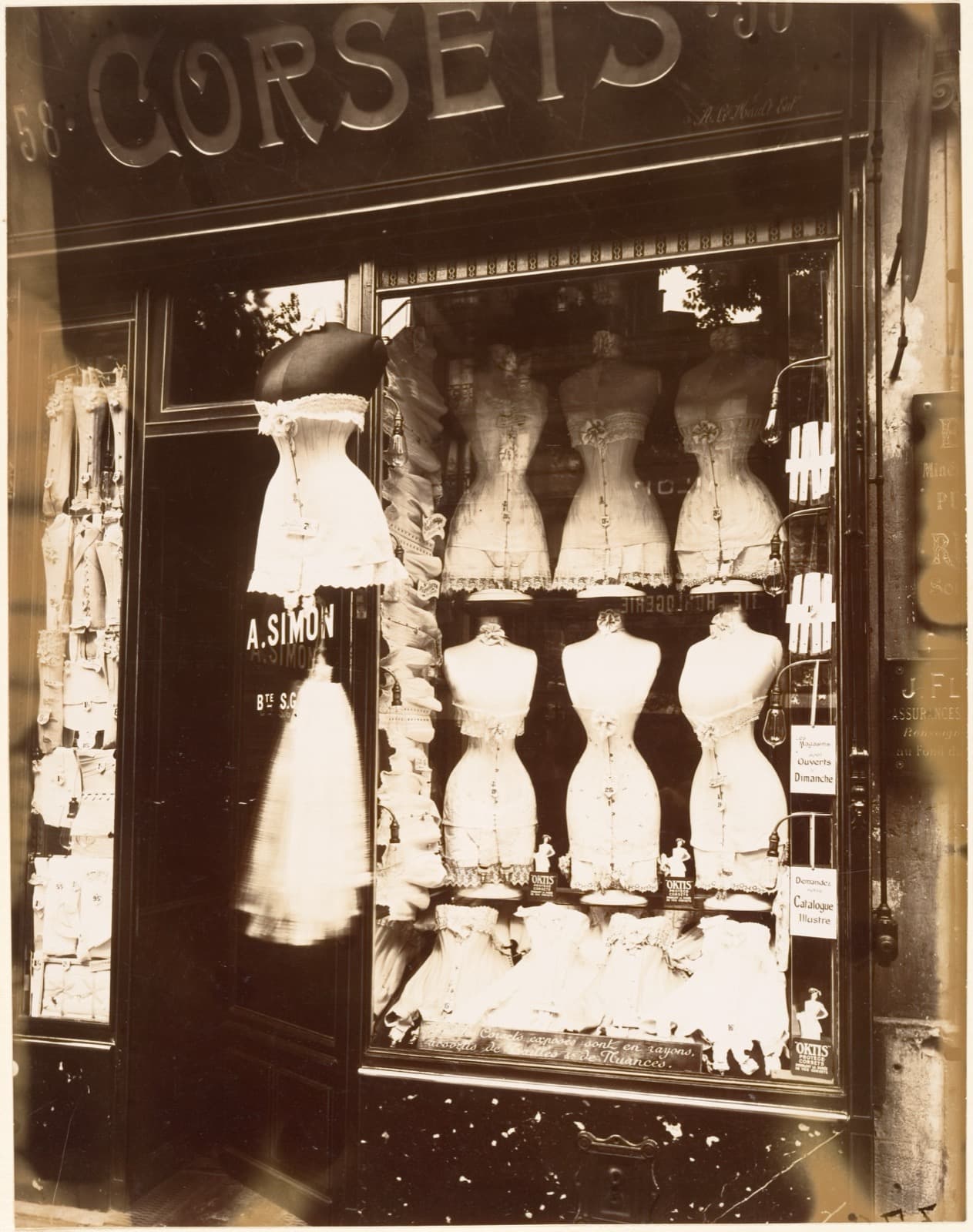
Boulevard de Strasbourg, Corsets
by Eugène Atget
Corseted torsos hang and stand in a shop window on the boulevard de Strasbourg, laced and boned and headless. Atget made the photograph in 1912 as trade documentation of a Paris shopfront, a few years before the corset went out of fashion altogether.
- 1912
- Albumen silver print from a glass negative
About Eugène Atget
What the photograph shows
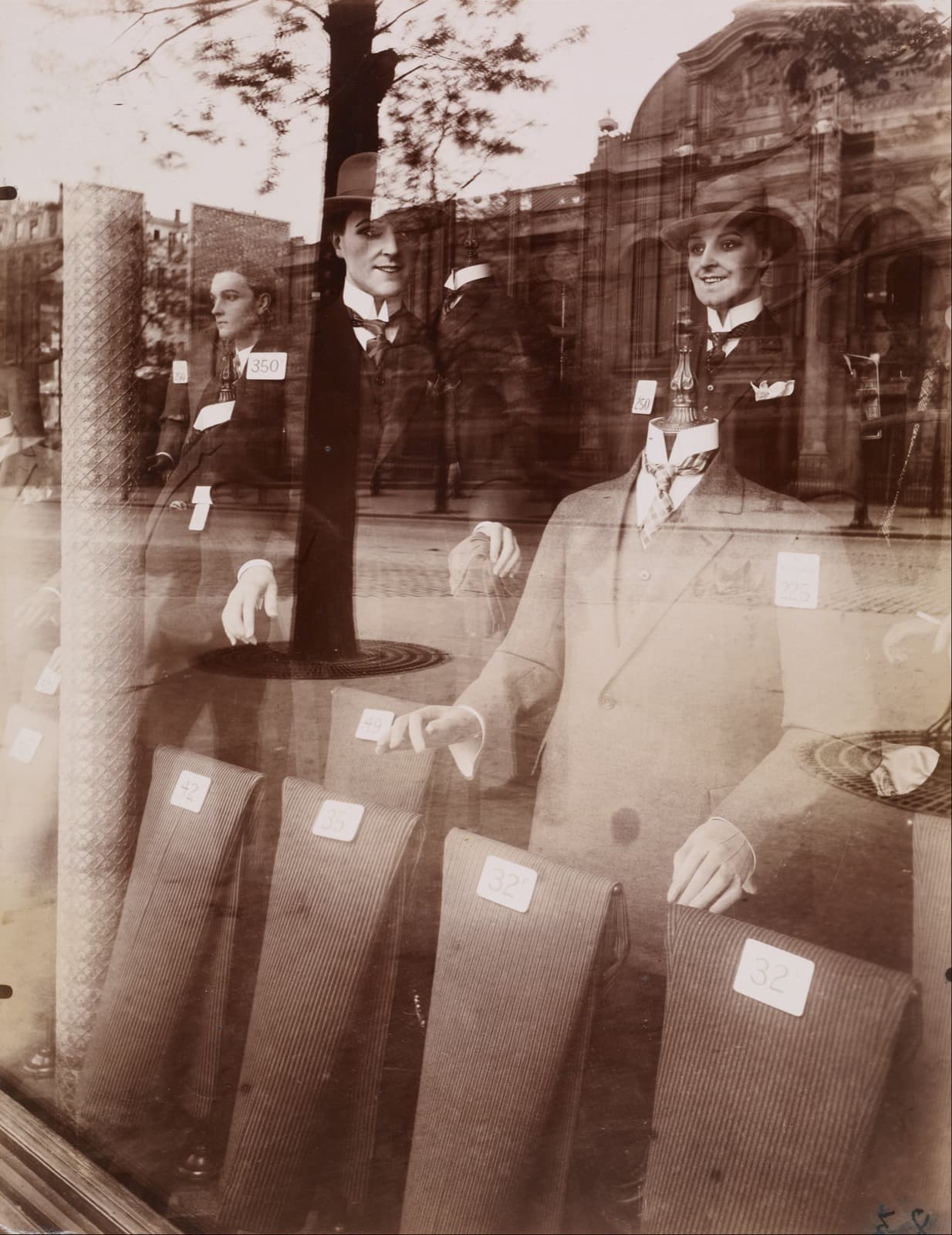
A shop window on the boulevard de Strasbourg, filled with corsets on headless dress forms. Some stand on the floor of the display, some hang from above. Small cards give the prices.
There is no person in the picture. The forms are shaped like torsos and arranged in rows, so the window reads as a crowd of bodies that are not bodies.
A trade record of 1912
Atget photographed the window as part of his documentation of Paris shops and trades, the same working practice that produced hundreds of shopfronts, courtyards and street traders. He sold the prints as reference to artists, decorators and archives.
The date matters to what is in the window. Paul Poiret had begun designing for an uncorseted figure around 1906, and by the early 1920s the corset had largely gone. This is a photograph of a trade shortly before it collapsed.
Close reading
Reading the work, detail by detail
The shopfront arranges garments into a crowded display of substitute bodies. These views follow its lettering, repeated torsos, reflected light, and small sales notices.
1.The sign overhead
The letters announce the merchandise before the individual garments can be examined. Their oversized curves echo the narrowing and swelling shapes displayed below.
2.The hanging torso
The black upper form makes the pale corset unusually distinct. Suspended beyond the main display, it seems to advance toward the street while the other torsos remain behind glass.
3.Bodies in a row
The repeated waists turn separate garments into a measured sequence. Small differences in trim and contour become noticeable because the shop has arranged the bodies so similarly.
4.Bright lower forms
The lower torsos almost merge with their white garments in the strong light. Their missing heads and arms make the display feel both insistently bodily and strangely impersonal.
5.Light in motion
The light shape loses its firm outline as it extends downward. Beside the sharply ordered window, this blur interrupts the display's stillness and makes the photographic exposure apparent.
6.The small notices
The notices bring the eye back from uncanny bodies to ordinary commerce. Their compact rectangles offer another scale of reading within the much larger sign and window.
Where to see it
A viewing location has not yet been listed for this work.
Frequently asked questions
What is Atget's Boulevard de Strasbourg, Corsets?
A 1912 photograph by Eugène Atget of a corset shop window on the boulevard de Strasbourg in Paris. The window is filled with headless dress forms wearing laced corsets, arranged in rows with price cards.
Why did Atget photograph a shop window?
Shopfronts were part of his systematic record of Paris trades. He sold prints as working reference to artists, decorators, designers and municipal archives, and window displays documented both the goods and the way they were sold.
Why is the date significant?
Because the corset was about to disappear. Paul Poiret had been designing for an uncorseted figure since around 1906, and by the early 1920s corsetry had largely gone out of women's fashion. The photograph records a trade a few years before it ended.
Where is the boulevard de Strasbourg?
In the 10th arrondissement of Paris, running north from the Porte Saint-Denis toward the Gare de l'Est.
Who holds this photograph?
Prints are held by several institutions; the reproduction used here was donated to Wikimedia Commons by the Metropolitan Museum of Art. The Museum of Modern Art holds the Abbott-Levy collection, the body of Atget material Berenice Abbott bought from his studio in 1928.
More by Eugène Atget
References
The sources below include collection records, catalogues, scholarly research, and primary materials that informed this page. They document Boulevard de Strasbourg, Corsets, its making, and its place in cultural history.


1Eugène Atget
WebsiteWikipediaUsed forWeb source consulted for documented facts and historical context presented on the Boulevard de Strasbourg, Corsets page.

2The Work of Atget
Exhibition catalogueThe Museum of Modern Art, 1981Used forThe Museum of Modern Art study of the archive and its working practice.
3Eugène Atget
WebsiteThe Museum of Modern ArtUsed forThe Museum of Modern Art's artist record.
4Eugène Atget
WebsiteEncyclopaedia BritannicaUsed forEncyclopaedia Britannica's biography, used for the outline of the career.
These references provide the documented foundation for this work's history and interpretation. Claim-level citations remain attached to the specific claims they support.
 Explore more resources