The Eclipse
by Eugène Atget
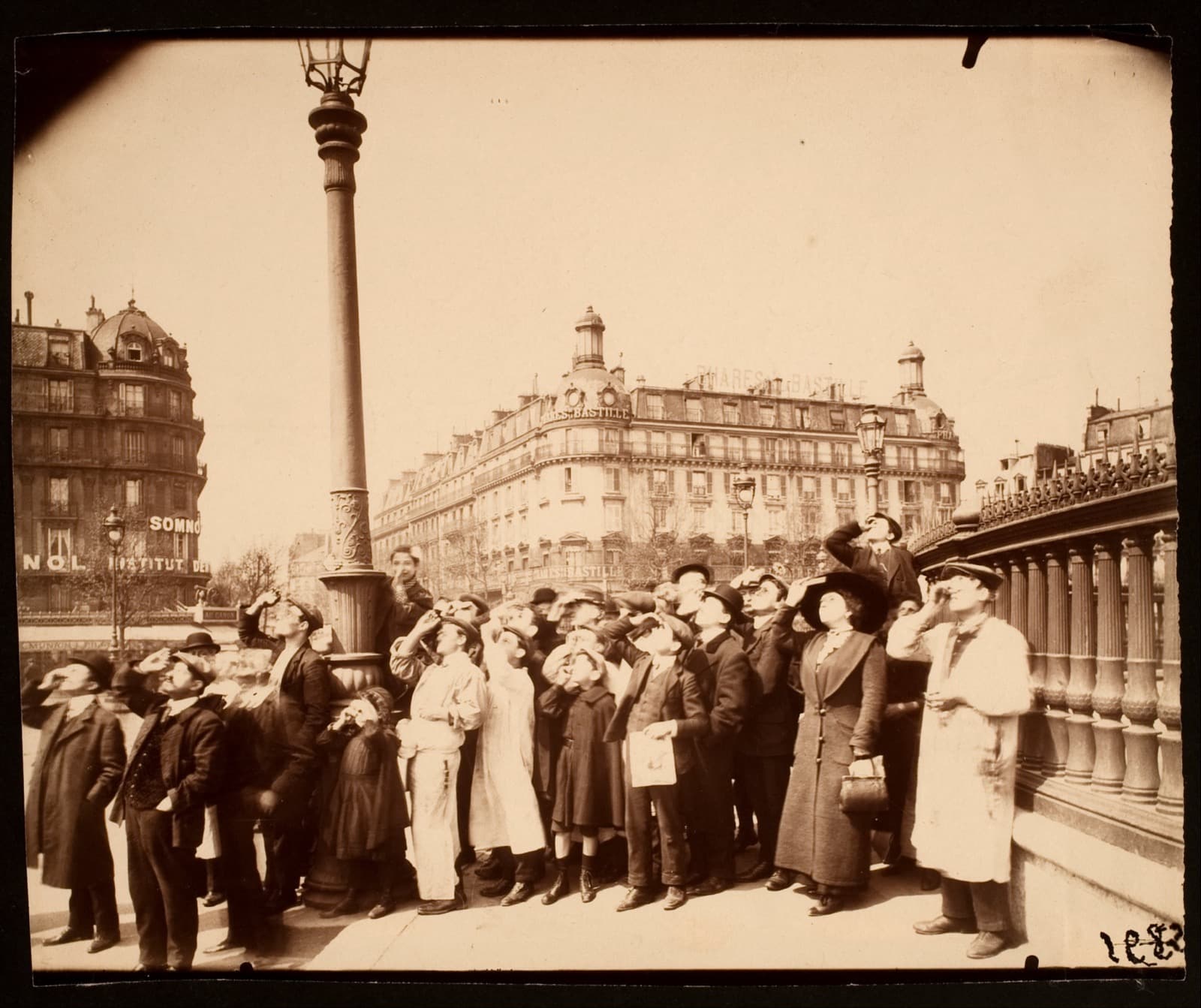
A crowd stands in the open, heads tipped back at the same angle, squinting at the sun through smoked glass and their own fingers. Atget made it during the solar eclipse of 17 April 1912. Fourteen years later Man Ray put it on the cover pages of a Surrealist magazine, and it became the picture that pulled Atget into a movement he wanted no part of.
- April 1912
- Gelatin silver print from a glass negative
About Eugène Atget
What the photograph shows
A crowd fills the frame, packed shoulder to shoulder in hats and long coats, every head tilted back at the same angle. Several people hold small squares of smoked glass to their eyes. Others simply squint through their fingers.
Nobody looks at the camera. The subject of the picture is a sky that the photograph does not show, and the crowd's uniform posture is the only evidence of it.
17 April 1912
Atget made the photograph during the solar eclipse of 17 April 1912, at the Colonne de Juillet on the place de la Bastille. It belongs to the run of Paris street work he was producing in his fifties, sold as reference material to painters and to municipal archives.
He would have set up a large wooden bellows camera on a tripod and exposed a glass plate for a comparatively long time, which is why some figures at the edges blur slightly.
How the Surrealists took it
In 1926 Man Ray, who lived on the same Montparnasse street, published the photograph in the magazine La Révolution surréaliste, in the issue of 15 June. The picture was fourteen years old by then.
What the Surrealists saw was a crowd behaving strangely for no visible reason, which is close to their idea of the uncanny surfacing inside ordinary documentary. Atget did not accept the label. When Man Ray asked to use the image, Atget's condition was that his name be left off it, because these were simply documents he made.
Close reading
Reading the work, detail by detail
Atget photographs the eclipse through the people watching it. Follow their repeated gestures, then the street furniture and buildings that give this moment its setting.
1.Upturned faces
The heads turn at different angles, but nearly every gaze leaves the frame in the same direction. The event becomes visible through its effect on the crowd.
2.Hands at the eyes
Raised hands interrupt the line of faces. The repeated gesture links people of different heights and dress, giving this loosely assembled crowd a shared rhythm.
3.A pale coat
The bright coat stands out against the dark clothes nearby. Its broad vertical shape helps close the crowd at the right edge without making the group look formally arranged.
4.The lamppost
The lamppost carries the eye from the crowded pavement into the almost empty sky. Its firm vertical divides the picture, while the people cluster unevenly around its base.
5.The building beyond
Repeating windows make a steady horizontal band behind the restless heads. The architecture supplies a durable city setting for an event that lasts only a short time.
6.An empty sky
The sky takes up much of the image, yet the eclipse itself cannot be picked out here. That absence keeps attention on the act of looking and makes the watchers the real subject.
Where to see it
A viewing location has not yet been listed for this work.
Frequently asked questions
What is Atget's The Eclipse?
A photograph Eugène Atget made in April 1912 of a crowd on the place de la Bastille in Paris watching a solar eclipse. Everyone in the frame is looking upward through smoked glass or their fingers, and the eclipse itself is outside the picture.
When was it taken?
During the solar eclipse of 17 April 1912, at the Colonne de Juillet on the place de la Bastille.
Why did the Surrealists use it?
Man Ray published it in La Révolution surréaliste on 15 June 1926, drawn to a crowd behaving oddly for a cause the photograph withholds. That gap between visible behaviour and invisible reason is close to what the Surrealists meant by the uncanny.
Did Atget consider himself a Surrealist?
No. He asked Man Ray to publish the photograph without his name attached, saying they were simply documents he made. He sold his pictures as working material to painters and archives and did not present them as art.
How was the photograph made?
On a glass plate in a large-format wooden bellows camera on a tripod, using the slow emulsion Atget worked with throughout his career. The long exposure is why figures at the edges of the crowd blur slightly.
More by Eugène Atget
References
The sources below include collection records, catalogues, scholarly research, and primary materials that informed this page. They document The Eclipse, its making, and its place in cultural history.

1Eugène Atget
WebsiteWikipediaUsed forWeb source consulted for documented facts and historical context presented on the The Eclipse page.

2The Work of Atget
Exhibition catalogueThe Museum of Modern Art, 1981Used forThe Museum of Modern Art study of the whole Atget archive, which treats the catalogue rather than the single print as the work.
3Eugène Atget
WebsiteThe Museum of Modern ArtUsed forThe Museum of Modern Art's artist record, which holds the Abbott-Levy collection.
4Eugène Atget
WebsiteEncyclopaedia BritannicaUsed forEncyclopaedia Britannica's biography, used for the outline of the career.
These references provide the documented foundation for this work's history and interpretation. Claim-level citations remain attached to the specific claims they support.
 Explore more resources