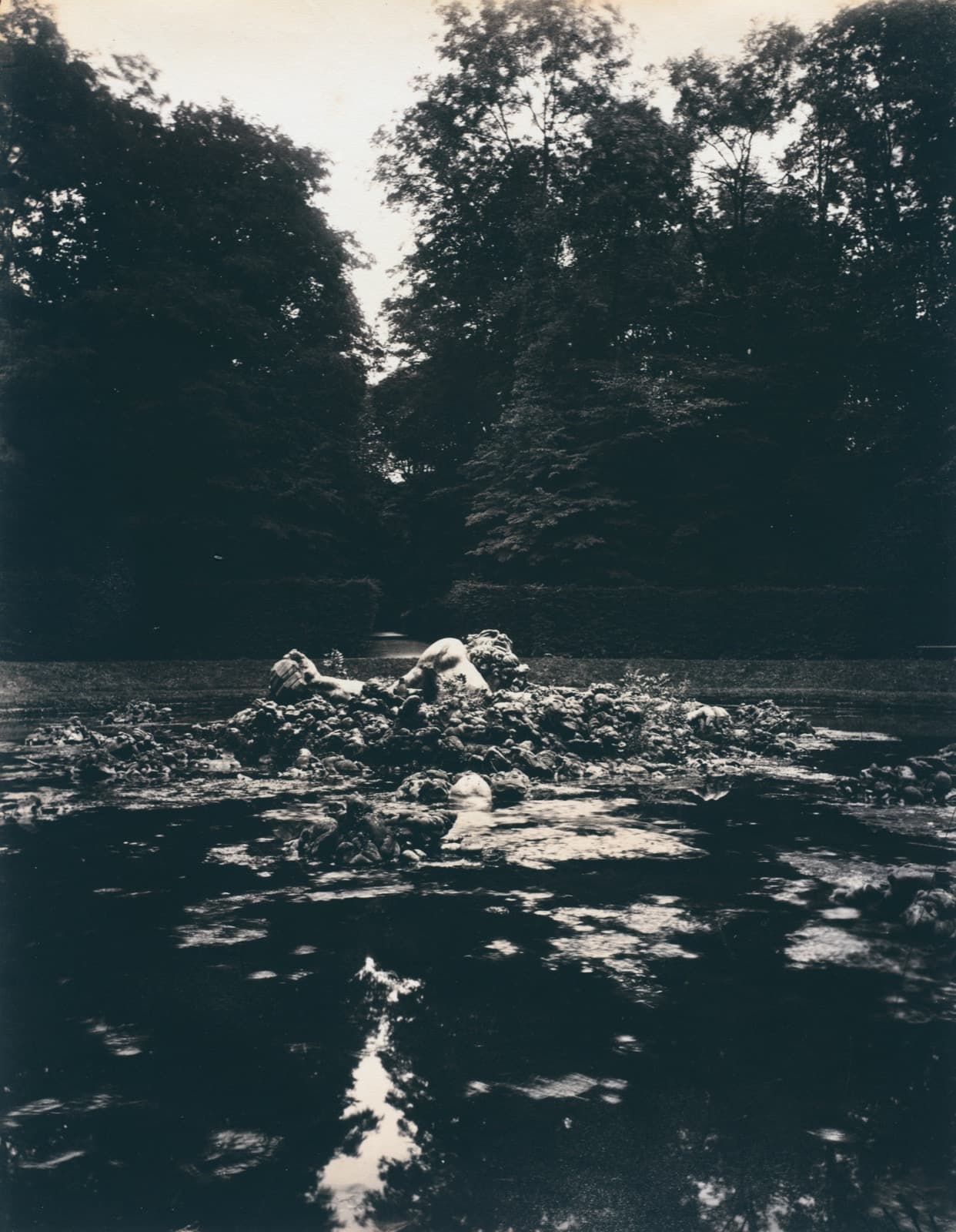
Versailles, Fountain of Enceladus
by Eugène Atget
The gilded head and straining arm of the giant Enceladus rise from a heap of rock in the Versailles gardens, half buried by the mountain the gods threw down on him. Atget photographed the Versailles park from 1901 until the year he died, and the fountains and statuary were among the subjects he returned to most.
- 1922–1923
- Matte albumen print from a glass negative
About Eugène Atget
What the photograph shows
The Fountain of Enceladus sits in a bosquet in the gardens of Versailles. The sculpture shows one of the giants of Greek myth crushed under the rocks of Mount Olympus, only his head, shoulder and one straining arm still clear of the pile.
Atget photographed it from close in, with the basin and the clipped hedges behind. Because he used a slow plate and a long exposure, the water is not caught as droplets but as a soft mass.
Twenty-six years at Versailles
Atget first photographed the Versailles gardens in the summer of 1901 and kept returning until 1927, the year he died. The park was a difficult subject at a scale that combined architecture, sculpture and planting, and he used it to work out how to balance a composition and hold perspective.
The Versailles pictures are one of the thirteen series he ran concurrently, alongside Art in Old Paris, Picturesque Paris, Interiors, Saint-Cloud, Sceaux and the rest. He would put a series aside for years and then come back to it.
Close reading
Reading the work, detail by detail
The fountain's figure lies low beneath a mass of trees. These details trace how light, water, and foliage change the visibility of the sculpture.
1.The emerging giant
Light catches the shoulder and head while surrounding forms remain dark. The figure seems to struggle into visibility as well as out of the rocks.
2.The outstretched hand
The hand is separated from the body by a tangle of rough forms. Its recognizable fingers give the eye a clear human detail inside the fountain's stony confusion.
3.Rocks and water
Water breaks the solid edge into patches of reflected light. Stone and liquid become harder to distinguish where both are recorded as flickering white shapes.
4.The foreground reflection
The water repeats the sky in scattered fragments. These bright marks bring the foreground into the composition without giving it the solidity of the sculpture.
5.A passage through trees
The opening supplies a small suggestion of depth behind the crowded fountain. Its quiet recession contrasts with the figure's strained movement across the picture.
6.The canopy overhead
The canopy occupies far more space than the giant. This imbalance lets foliage dominate the monument, making the garden feel dense and enclosing.
Where to see it
A viewing location has not yet been listed for this work.
Frequently asked questions
What does this Atget photograph show?
The Fountain of Enceladus in the gardens of Versailles, photographed in 1922 or 1923. The sculpture shows the giant Enceladus of Greek myth buried under the rocks of Mount Olympus, with only his head, shoulder and one arm still visible.
How long did Atget photograph Versailles?
Twenty-six years. He began in the summer of 1901 and was still photographing the park in 1927, the year of his death. Versailles was one of the thirteen series he worked on concurrently.
Why did he keep returning to the park?
It was a hard compositional problem. The gardens combine architecture, sculpture, water and planting at a scale that is difficult to frame, and returning to it let him work out how to balance a picture and keep perspective under control.
Who is Enceladus?
A giant in Greek myth who fought the gods and was crushed beneath a mountain. The Versailles fountain shows him at the moment of being buried, which is why only his head and one arm rise out of the rocks.
Where is this print held?
The Cleveland Museum of Art holds the print reproduced here, accession 1985.117. Atget prints are widely distributed; the largest single holding is the Abbott-Levy collection at the Museum of Modern Art in New York.
More by Eugène Atget
References
The sources below include collection records, catalogues, scholarly research, and primary materials that informed this page. They document Versailles, Fountain of Enceladus, its making, and its place in cultural history.


1Eugène Atget
WebsiteWikipediaUsed forWeb source consulted for documented facts and historical context presented on the Versailles, Fountain of Enceladus page.
2Versailles, Fountain of Enceladus
WebsiteCleveland Museum of ArtUsed forThe Cleveland Museum of Art's record for the print, accession 1985.117.

3The Work of Atget
Exhibition catalogueThe Museum of Modern Art, 1981Used forThe Museum of Modern Art study, which sets the Versailles pictures among the thirteen concurrent series.
4Eugène Atget
WebsiteEncyclopaedia BritannicaUsed forEncyclopaedia Britannica's biography, used for the outline of the career.
These references provide the documented foundation for this work's history and interpretation. Claim-level citations remain attached to the specific claims they support.
 Explore more resources