Corner of the Rue de Seine
by Eugène Atget
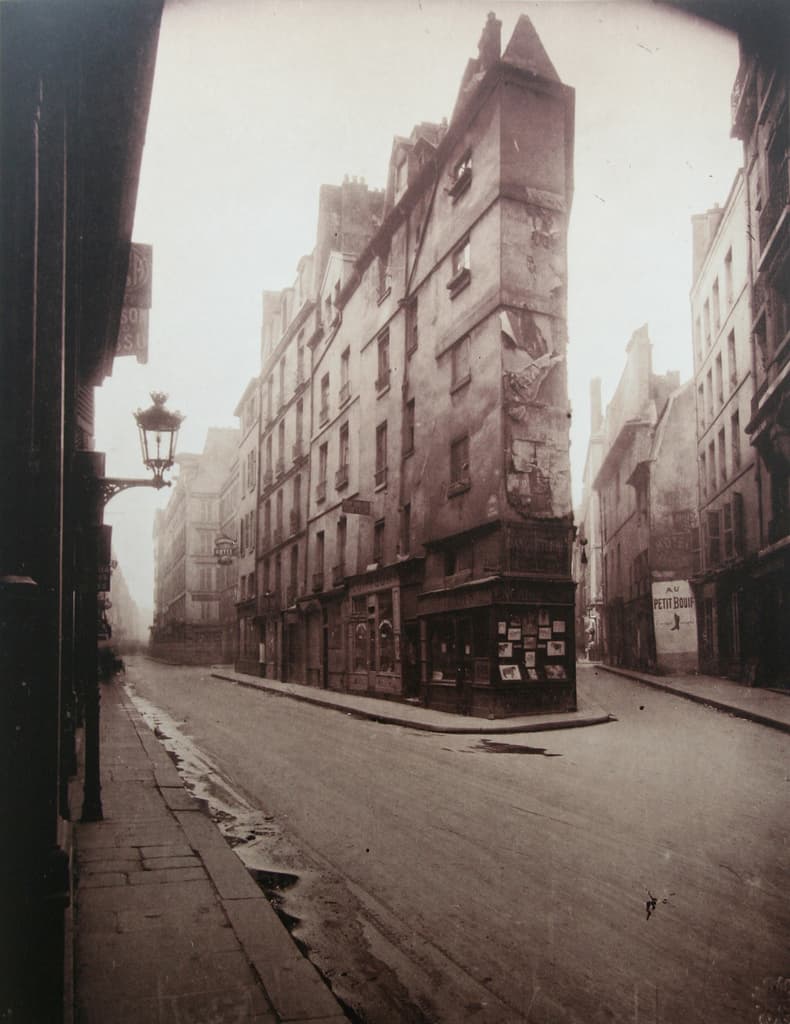
A narrow street corner on the Left Bank, photographed empty in the early morning: shuttered shopfronts, a lamp bracket, worn paving, and a receding line of house fronts. It is the kind of picture Atget made by the thousand, and the reason a great deal of pre-Haussmann Paris is known at all.
- 1924
- Matte albumen print from a glass negative
About Eugène Atget
What the photograph shows
A corner of the rue de Seine, in the 6th arrondissement, with the shopfronts shuttered and nobody in the street. The buildings are older and narrower than the boulevards Haussmann drove through Paris in the previous century.
Atget worked early, before the traffic started, which is why so many of his streets are empty. It was practical rather than atmospheric: his plates were slow and anything moving would blur.
Photographing what was about to go
From the early 1900s Atget concentrated on the Paris that predated the Revolution, reading its history and photographing streets in context rather than as flat architectural elevations. Much of what he recorded was demolished within his lifetime or shortly after.
He sold the prints as documents: to painters and set designers who wanted reference, and in bulk to the Musée Carnavalet and the Bibliothèque historique de la ville de Paris, which commissioned him around 1906 to photograph old buildings systematically.
Close reading
Reading the work, detail by detail
A wedge-shaped building divides two streets. Look at how Atget turns its narrow corner, worn surfaces, and empty approaches into the structure of the photograph.
1.The narrow prow
Seen from this angle, the building becomes a tall blade between two streets. Its narrow front gives unusual force to an otherwise ordinary block of houses.
2.Torn surfaces
The ragged patches break up the wall's straight edges. They make wear and repeated use visible on a facade whose overall shape initially attracts the eye.
3.The corner shop
The clustered rectangles offer a miniature display at the building's base. Their intimate scale contrasts with the high, almost blank wall above them.
4.The left-hand street
The curb and repeated windows converge toward the distance. This long retreat makes the central building feel deeper than its exceptionally thin corner first suggests.
5.The other route
The lighter opening on the right offers another route through the scene. The photograph holds both streets in view, so the corner becomes a choice of directions.
6.The foreground gutter
The dark gutter begins close to the viewer and draws the eye inward. Its rough, wet patches give the otherwise quiet street a tactile foreground.
Where to see it
A viewing location has not yet been listed for this work.
Frequently asked questions
What is Coin rue de Seine?
A 1924 photograph by Eugène Atget of a corner of the rue de Seine in the 6th arrondissement of Paris, showing shuttered shopfronts and an empty street. The French title means simply corner of the rue de Seine.
Why are Atget's streets always empty?
Because he worked early in the morning, before traffic, and because his glass plates were slow. A long exposure turns anything moving into a blur, so an empty street was both the practical choice and the one that recorded the buildings clearly.
What was Atget documenting?
The parts of Paris that predated the French Revolution, which were being cleared as the city modernised. He photographed streets in context rather than as architectural elevations, and much of what he recorded was demolished within his lifetime or soon after.
Who bought these photographs?
Painters, architects, decorators and set designers bought them as working reference, and institutions bought them in bulk. The Musée Carnavalet and the Bibliothèque historique de la ville de Paris began purchasing in 1898, and the latter commissioned him around 1906 to photograph old buildings systematically.
Where is the rue de Seine?
In the 6th arrondissement on the Left Bank, running between the boulevard Saint-Germain and the quai Malaquais, in the Saint-Germain-des-Prés quarter.
More by Eugène Atget
References
The sources below include collection records, catalogues, scholarly research, and primary materials that informed this page. They document Corner of the Rue de Seine, its making, and its place in cultural history.


1Eugène Atget
WebsiteWikipediaUsed forWeb source consulted for documented facts and historical context presented on the Corner of the Rue de Seine page.
2Atget, Paris
WebsiteBibliothèque nationale de FranceUsed forThe Bibliothèque nationale de France's Atget exhibition, the source of this reproduction.

3Atget, photographe de Paris
NonfictionHenri Jonquières, 1930Used forThe first book of his photographs, published in 1930 with Berenice Abbott as photo editor.
4Eugène Atget
WebsiteEncyclopaedia BritannicaUsed forEncyclopaedia Britannica's biography, used for the outline of the career.
These references provide the documented foundation for this work's history and interpretation. Claim-level citations remain attached to the specific claims they support.
 Explore more resources