Bride's Toilet
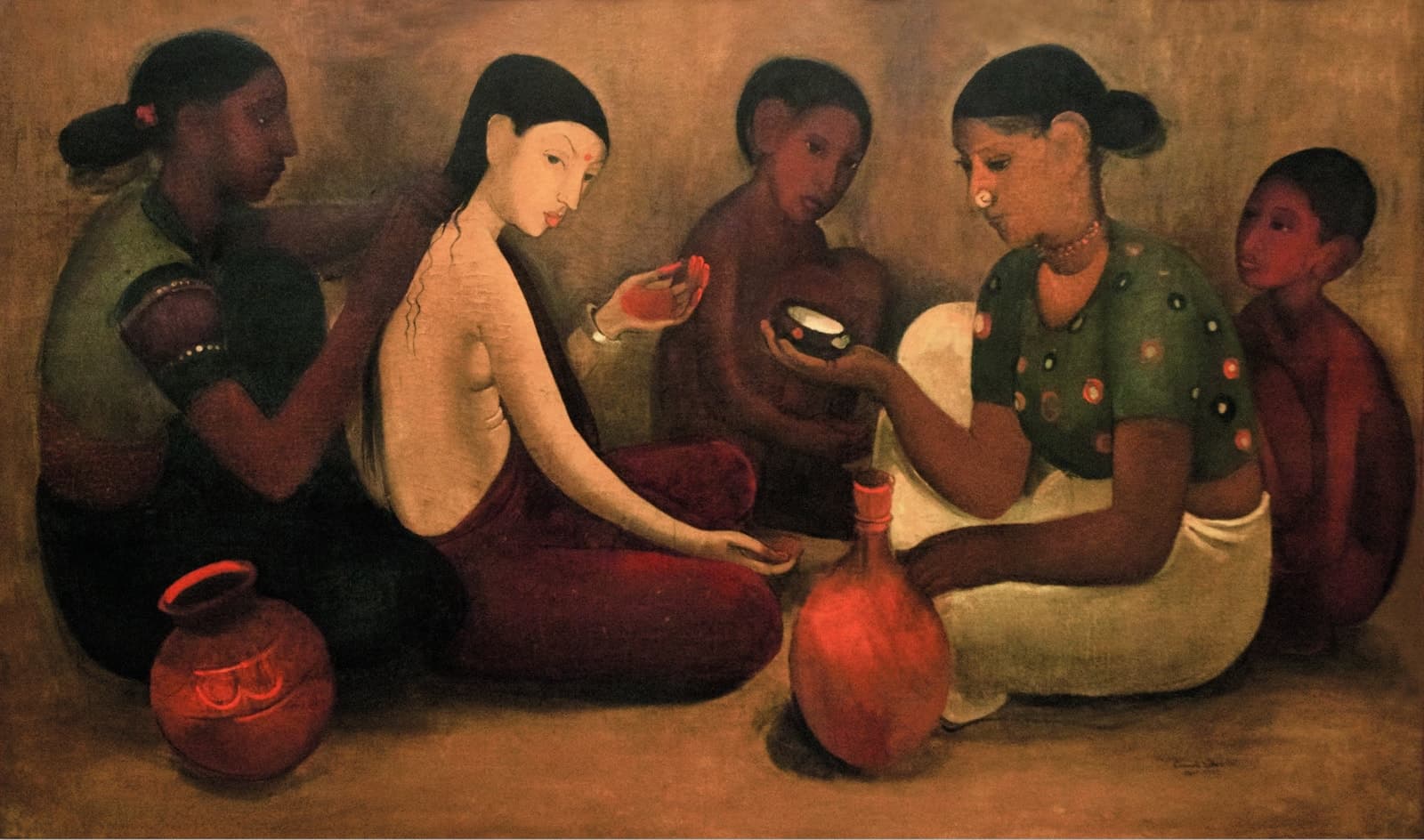
Five figures sit on the ground in a bare brown room. A pale-skinned young woman, bare to the waist, sits in profile at the centre-left while a dark-skinned woman behind her dresses her long black hair. Facing her, a woman in a green spotted blouse holds out a dark bowl of white paste; two children look on, and two red clay pots stand in the foreground. Amrita Sher-Gil painted it in Simla in April 1937, after her journey through South India, and it is one of the three canvases the National Gallery of Modern Art calls her South Indian trilogy. It is accession number 69 in that museum in New Delhi.
- 1937
- Oil on canvas
- National Gallery of Modern Art, New DelhiNew Delhi, India
About Amrita Sher-Gil
What the painting shows
The bride sits at the centre-left with her back half turned to the viewer, on a dark red skirt, her skin painted a pale cream against the browns of everyone else. Her black hair hangs down her back in a long sheet, with two thin strands loose at the shoulder. A red dot marks her forehead and her lips are red. She looks sideways out of the picture. Her left hand rests palm down on her knee, her raised right hand holds a small red bowl, and the fingertips of both hands are red.
Behind her a dark-skinned woman in a green blouse with beaded maroon sleeves, a red flower in her bun, works on the bride's hair with both hands. Facing the bride across the middle of the canvas sits a woman in white cloth and a green blouse printed with dark circles and coloured dots. She wears a large white nose ring and a string of red beads, and holds out a dark bowl with white paste in it, flecked with red and green.
Two children complete the group. A small dark figure with cropped hair sits behind the bride, facing the viewer, and a naked child at the far right sits with white cloth over the lap and looks in at the others. In the foreground stand two red clay pots, a round one with a painted band at the left and a long-necked flask at the right. The wall behind is a mottled brown, with no window or door.
The museum's record gives the size as 146 by 88.8 centimetres, about four feet nine by two feet eleven, and notes the signature "amrita Shergil april 1937" brushed in black at the lower right. It is too faint to read in the reproduction.
The journey south and Ajanta
In November 1936 Sher-Gil visited the painted caves of Ajanta and Ellora with Barada Ukil, and in Bombay Karl Khandalavala introduced her to Pahari, Basohli, Rajput and Mughal miniatures. In December she went south to Trivandrum, in January 1937 to Cape Comorin, and then to Cochin to see the Mattancherry frescoes. Back in Simla between April and November 1937 she painted Bride's Toilet, Brahmacharis, The Story Teller and South Indian Villagers Going to Market.
“The journey from Madurai to here was beautiful. The soil was ochre red, on it's rich emerald green vegetation, coconut trees, banana trees, palm trees, small red thatched huts or red clay hovels not a single European and no trace of European "civilization".”
The National Gallery of Modern Art says that Bride's Toilet, along with the paintings done in this period, "was inspired by the classical tradition of the Ajanta murals", and that she "painted the image with a large group of figures and used a richly diverse palette to delineate them". The ochre ground and the red clay pots repeat the colours of that letter.
The South Indian trilogy
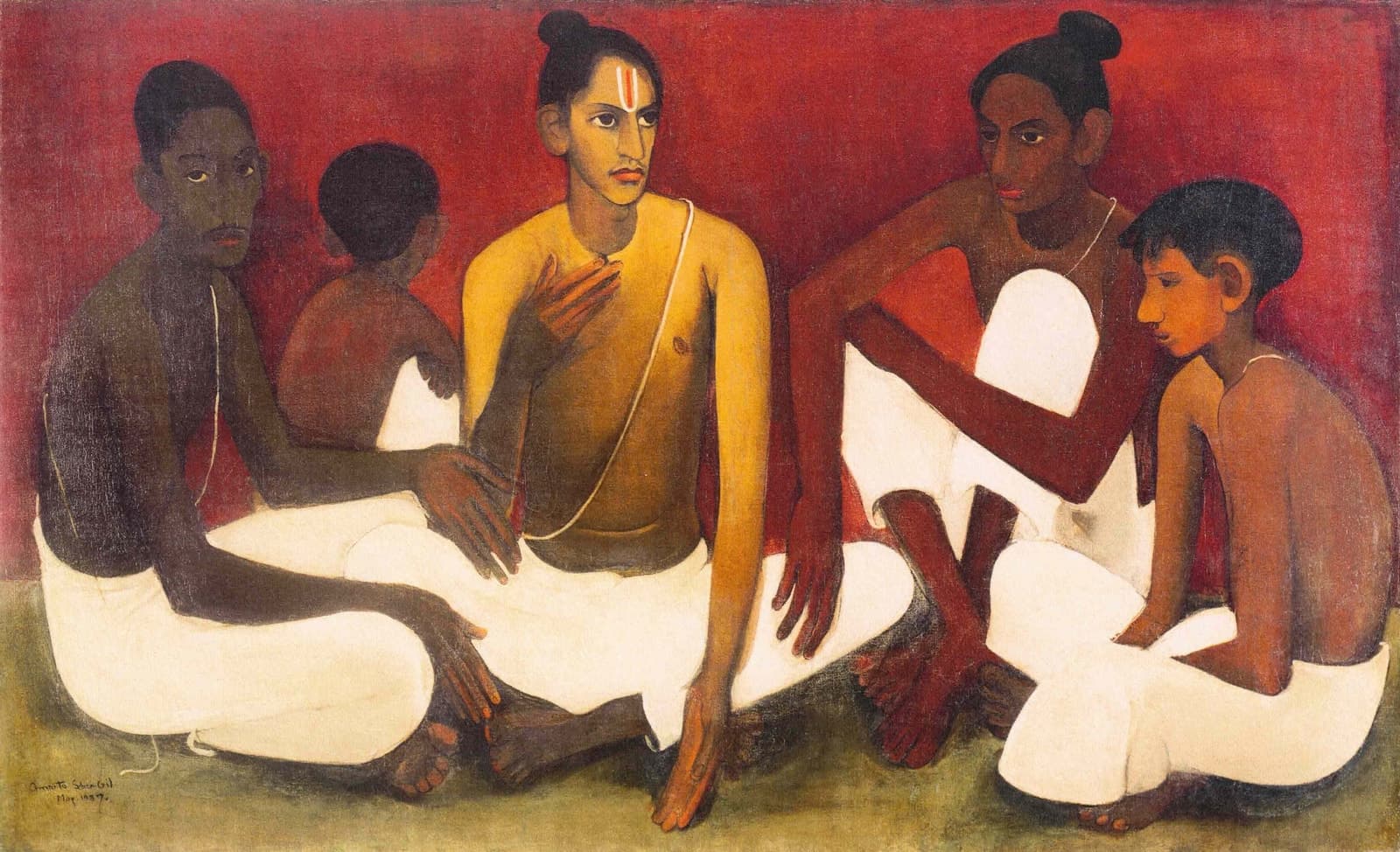
Bride's Toilet, Brahmacharis and South Indian Villagers Going to Market are known as her South Indian trilogy, a name the National Gallery of Modern Art uses for all three. Bride's Toilet is dated April 1937 in its inscription and Brahmacharis May 1937, so this canvas came first; the museum's record for Brahmacharis calls that one the second of the three.
The subject is a toilet in the old sense, the dressing and adorning of a bride before her wedding. No wedding is shown, and the mood is of work rather than celebration. The museum's record does not name the models.
Where it is
The painting is accession number ngma-00069 at the National Gallery of Modern Art in New Delhi, one of 107 paintings by her in that collection. The Government of India has declared her works national art treasures.
Close reading
Reading the work, detail by detail
The group is set on one plane, like a frieze, with the bride's pale back at its centre. Close view shows the hands at work in her hair, the red fingertips, the two bowls, the printed blouse and nose ring of the woman opposite, the two children, and the two red pots.
1.Hands in the bride's hair
The woman at the left is seen from behind and the side, her hair in a bun with a red flower in it. Her blouse is green with maroon sleeves edged in white dots, and both her hands are raised into the bride's hair. She is the only figure at work.
2.The bride in profile
The bride's skin is cream, paler than everyone else's, and her black hair hangs in a sheet down her back with two thin strands loose at the shoulder. A red dot marks her forehead and her lips are red. Her eyes turn sideways toward the viewer while her body stays in profile.
3.A red bowl and red fingertips
The bride's right hand is raised with a small red bowl in it, and her fingertips are red. A thin bangle circles the wrist. The red on the fingers is painted, not reflected from the bowl, and matches the red on the fingertips of her other hand, which rests on her knee.
4.A dark bowl of white paste
The woman opposite holds out a dark bowl in her left hand. It is full of white paste, with a fleck of red and a fleck of green on it. It is offered across the canvas toward the bride's raised hand.
5.A child between the women
Between the bride and the woman with the bowl sits a child, dark-skinned, with cropped hair, facing the viewer. The child's chest is bare, and the face is painted in the same dark red-brown as the arm of the woman beside it.
6.A printed blouse and a nose ring
The woman facing the bride wears her hair in a bun, a large white ring in her nose and a string of red beads at her throat. Her blouse is green, printed with dark circles and dots of red, white and yellow. It is the busiest surface in the picture, set against the plain white cloth of her lap.
7.The child at the edge
The fifth figure is a child at the far right edge, naked, with short hair, seated with white cloth over the lap. The child looks left into the group and is painted in the same red-brown as the child behind the bride.
8.A red clay pot with a painted band
At the lower left stands a round red clay pot with a flared neck and a band of scroll marks painted round its shoulder. It catches more light than anything else on the floor. Its red is the red of the earth she described in her letter from Trivandrum.
9.A long-necked flask
The second vessel is a long-necked flask with a ringed lip, standing between the bride's outstretched hand and the white cloth of the woman opposite. Both pots are painted without highlights, in flat red-orange, like the wall.
Timeline
November 1936
Visits Ajanta and Ellora with Barada Ukil; in Bombay Karl Khandalavala introduces her to Pahari, Basohli, Rajput and Mughal miniatures.
December 1936 – January 1937
Travels to Trivandrum, Cape Comorin and Cochin, where she sees the Mattancherry frescoes.
April 1937
Paints Bride's Toilet in Simla, signed and dated amrita Shergil april 1937 at the lower right.
May 1937
Paints Brahmacharis, the second canvas of the South Indian trilogy.
December 1937
Exhibits in Lahore at Faletti's Hotel.
Where to see it
National Gallery of Modern Art, New Delhi
New Delhi, India
A public viewing address has not yet been confirmed for this holding.
The museum holds 107 of her paintings. As of September 2026 its online record does not say whether Bride's Toilet is on display, so check with the museum before travelling.
Frequently asked questions
What does Bride's Toilet mean?
A toilet in the old sense: the dressing and adorning of a bride before her wedding. The painting shows a woman dressing the bride's hair while another holds out a bowl of white paste, with two children watching.
Where is Bride's Toilet?
At the National Gallery of Modern Art in New Delhi, accession number ngma-00069. As of September 2026 the museum's online record does not say whether it is on display, so check before travelling.
What is the South Indian trilogy?
Three canvases painted in Simla in 1937 after her journey through South India: Bride's Toilet, Brahmacharis and South Indian Villagers Going to Market. The National Gallery of Modern Art uses the name for all three and links them to the murals of Ajanta.
Who is the bride in Bride's Toilet?
The museum's record does not name her or any of the other four figures. She is the pale-skinned young woman in profile at the centre-left, bare to the waist, with a red dot on her forehead and red fingertips.
What is in the bowl?
A white paste flecked with red and green, held out to the bride by the woman in the green spotted blouse. The bride herself holds a small red bowl in her raised right hand.
How big is Bride's Toilet?
88.8 centimetres high by 146 wide, about two feet eleven by four feet nine, oil on canvas. The museum records the signature amrita Shergil april 1937 in black at the lower right.
Why does the National Gallery of Modern Art link it to Ajanta?
Because Sher-Gil had visited the Ajanta caves in November 1936, months before painting it. The museum says the paintings of this period were inspired by the classical tradition of the Ajanta murals, with a large group of figures and a richly diverse palette.
More by Amrita Sher-Gil
If you like Amrita Sher-Gil
Explore painters from the same movements and circles.
Tarsila do Amaral
Brazilian painter who spent the 1920s moving between São Paulo and Paris, studied Cubism under André Lhote, Albert Gleizes and Fernand Léger, and used what she learned to paint Brazilian towns, railways, plants and bodies. Her 1928 painting Abaporu prompted the manifesto that gave the Anthropophagic movement its name.
View artist
Marcel Duchamp
The century's quietest revolutionary — readymades, the abandonment of painting, chess on a Paris rooftop in Entr'acte, and one anemic film of spinning puns signed Rrose Sélavy.
View artist
Vincent van Gogh
Dutch painter who lived in Montmartre with his brother Theo from March 1886 to February 1888 — the two years in which his dark Dutch palette turned into colour. He painted more than 200 pictures in Paris and died at Auvers-sur-Oise, north of the city, in 1890.
View artist
References
The sources below include collection records, catalogues, scholarly research, and primary materials that informed this page. They document Bride's Toilet, its making, and its place in cultural history.


1Bride's Toilet — Amrita Sher-Gil (accession ngma-00069)
Official recordNational Gallery of Modern Art, New Delhi, on Museums of India, the Ministry of Culture's National Portal and Digital RepositoryUsed forThe museum's object record: title, accession number, Shimla and April 1937, the black signature and date, the dimensions, the South Indian trilogy and the Ajanta murals.

2An Unfinished Journey: Amrita Sher-Gil
WebsiteNational Gallery of Modern Art, New DelhiUsed forThe chronology of the southern journey, Ajanta and Ellora, the miniatures shown by Karl Khandalavala, the Simla paintings of 1937, the Lahore exhibition, and the Trivandrum letter.
3Bride's Toilet — Amrita Sher-Gil, 1937
WebsiteGoogle Arts & Culture / National Gallery of Modern Art, New DelhiUsed forThe museum's Google Arts & Culture entry, giving the dimensions as 146 by 88.8 centimetres.
4Brahmacharis — Amrita Sher-Gil (accession ngma-00070)
Official recordNational Gallery of Modern Art, New Delhi, on Museums of India, the Ministry of Culture's National Portal and Digital RepositoryUsed forThe record for Brahmacharis, which names Bride's Toilet and South Indian Villagers Going to Market as the other two canvases of the trilogy and calls Brahmacharis the second.
5Amrita Sher-Gil — Feature and Chronology
PeriodicalEmbassy of India in HungaryUsed forThe trilogy and the declaration of her works as national art treasures.
6Bride's Toilet (Q30224423)
WebsiteWikidataUsed forHeight 88.8 cm, width 146 cm, inventory ngma-00069.
These references provide the documented foundation for this work's history and interpretation. Claim-level citations remain attached to the specific claims they support.
 Explore more resources