Young Girls
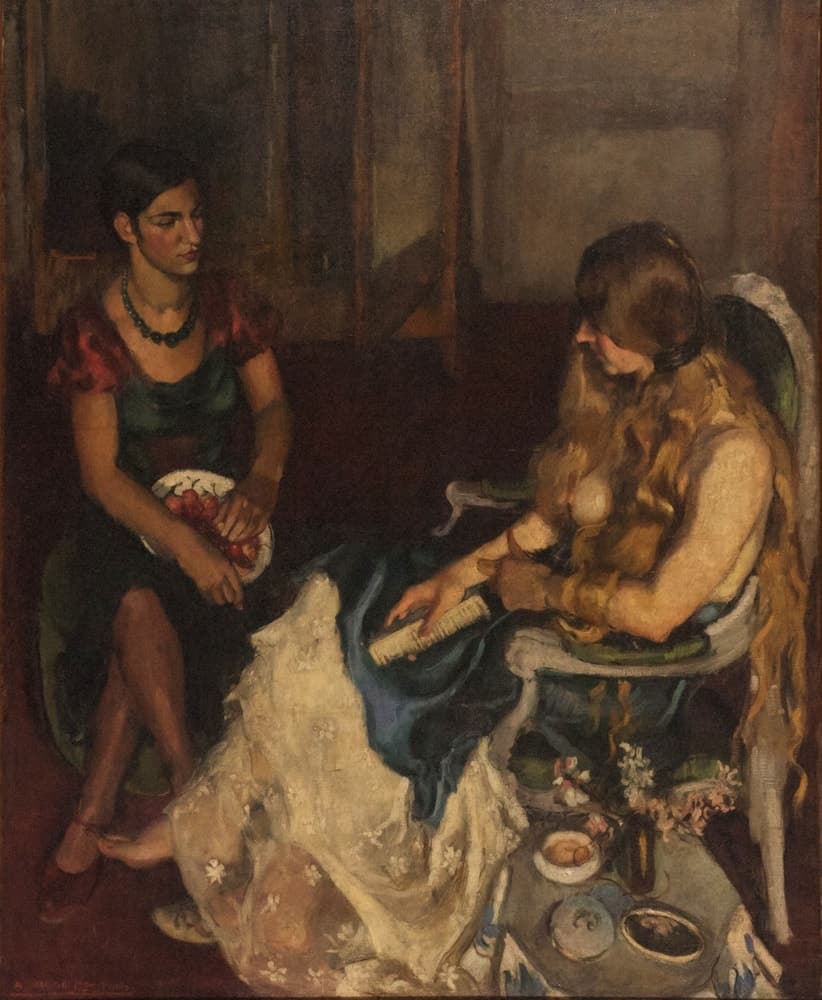
Two young women sit in a dim Paris room. On the left, in a green dress with crimson sleeves, the artist's younger sister Indira Sher-Gil holds a plate of cherries and looks across at her companion. On the right her friend Denyse Proutaux slumps bare-shouldered in a white chair, her long fair hair over her face and a comb in her hands. Sher-Gil painted it in June 1932, at nineteen, and showed it at the Grand Palais in 1933 as Jeunes filles, in the Salon of the Société nationale des Beaux-Arts. That May the society elected her an associate. It is accession number 29 at the National Gallery of Modern Art in New Delhi.
- 1932
- Oil on canvas
- National Gallery of Modern Art, New DelhiNew Delhi, India
About Amrita Sher-Gil
What the painting shows
The room is dark red-brown, with a tall window at the upper right and a cupboard door standing ajar behind the woman on the left. She sits upright on a green chair with her legs crossed, in dark stockings and red shoes. Her dress has short crimson sleeves and a green bodice, and she wears a necklace of green beads. Her dark hair is combed back. She looks down and across at the other woman, and in her lap she holds a white plate of red cherries.
The woman on the right sits lower, in a chair with a white-painted frame and a green seat. Her long fair hair falls forward over her face and down past her bare shoulder, so that only her nose and chin show. Her torso is bare, and one breast is visible through the hair. Her hands hold a white comb over a heap of blue cloth in her lap. A white embroidered shawl, scattered with small flowers, spills from her lap across the floor toward the other woman. A bare pale foot shows beneath it beside the red shoe.
At the lower right stands a low grey table. On it are a saucer holding a small round object, a dark vase of pink and white blossom, a round lidded box, and an oval gold-rimmed object that reads as a hand-mirror lying face up. A blue-and-white cloth hangs over the table's edge. The canvas is signed A. Sher-Gil 1932 in red at the lower left, as the museum's record notes. It measures 164 by 134 centimetres, about five feet five by four feet five.
Who sat for it
The National Gallery of Modern Art identifies the dressed figure as Sher-Gil's younger sister Indira, "the formally clad figure of the visitor in the painting". The fair-haired woman is Denyse Proutaux, a French art writer and critic who had befriended Indira at a drawing class. Christie's, which sold a rediscovered portrait of her in 2021, describes Young Girls as depicting Denyse partially undressed alongside the artist's dressed sister.
The three young women went about the Paris art world together and holidayed at Royan on the Atlantic coast. Four portraits of Denyse Proutaux by Sher-Gil are known. Young Girls is the most famous, and a profile of her in a black beret from the same year is also at the National Gallery of Modern Art. A third, larger composition of 1933 showed Denyse, Indira, the artist and a model together. Sher-Gil cut Denyse's seated figure out of that canvas and gave it to her, and it was lost during the Second World War.
The Salon of 1933
The picture went to the Grand Palais in 1933, to the annual Salon of the Société nationale des Beaux-Arts, the society to which Lucien Simon belonged. The catalogue lists her as "Sher-Gil (Amrita), Hindoue, née à Budapest", living at 11 rue Bassano, with one entry, number 1925, Jeunes filles. Lucien Simon, her teacher at the École des Beaux-Arts, appears a few lines below with five works, one of them Jeunes filles de Plougastel-Daoulas.
The weekly Beaux-Arts, reviewing the Salon of 1933, singled out "les Deux amies de Sher-Gil", the two friends, as painted in the manner of Anders Zorn, the Swedish painter of fair-haired nudes. At the end of May the society announced its new members. Le Journal on 25 May and Comœdia on 26 May printed "Sher Gil" among the painters elected associés, between Rivier and Waldraff.
The National Gallery of Modern Art records that the painting won her associate membership of "the Grand Salon" in 1933, and its chronology also speaks of a gold medal. The election is in the Paris lists. The medal is not: what the Nationale published that May were prizes, new sociétaires and new associés. She was twenty. She showed at the Nationale again in 1934, when Le Matin's critic noted "a poor nude, of sincere and intense expression" by "Amrita Sher Gil, artiste hindoue" in Salle AP.
What Paris taught, and what it did not
The National Gallery of Modern Art calls her early career "a usual beginning with oils, portraits and models from life in a largely academic style", and Young Girls the reflection of that period. The interior, the still life on the table and the two contrasted models are the kind of exercise Lucien Simon's atelier set. What is not academic is the mood. Nobody poses for the viewer and nobody smiles; the two women sit close enough to touch and stay apart.
“I'm an individualist, evolving a new technique, which, though not necessarily Indian in the traditional sense of the word, will yet be fundamentally Indian in spirit.”
She left the École des Beaux-Arts in July 1933, two months after the election, and set up a studio with her friend Marie-Louise Chassany. In December 1934 she sailed for India with her parents. The painting is now one of 107 by her at the National Gallery of Modern Art in New Delhi, which lists it under accession number ngma-00029. The Government of India has declared her works national art treasures.
Close reading
Reading the work, detail by detail
The picture is dark, and the light falls on three things: a plate of cherries, a white embroidered shawl and a head of fair hair. Close view shows the two dresses, the comb in Denyse Proutaux's hands, the still life on the table at the lower right, and the red signature Amrita Sher-Gil put in the corner at nineteen.
1.Indira looks down and across
The dressed sitter is the artist's younger sister Indira Sher-Gil, according to the National Gallery of Modern Art. Her hair is combed flat back, her lips are red, and a necklace of round green beads sits on her collarbone. The short sleeves of her dress are crimson and the bodice green. She looks down and to her right, toward the other woman, without smiling.
2.A plate of cherries in her lap
The plate is white and the cherries red with their stalks on, held with both hands over the dark green skirt. It is the brightest patch of colour on the left half of the canvas. The white shawl of the other woman begins just below it.
3.A white comb over blue cloth
Denyse Proutaux's hands hold a white comb, teeth downward, over a heap of blue cloth in her lap. The comb suggests she has been combing the hair that now hides her face. Under the blue lies the edge of the white embroidered shawl.
4.Hair over the face
The head is bowed and the long fair hair falls forward so that only the nose and the chin show. A dark band holds it at the back. The shoulder below is bare, and one breast shows through the strands. Behind the head are the white-painted frame of the chair and its green upholstery.
5.The white embroidered shawl
The shawl is white with small embroidered flowers and falls from her lap to the floor between the two chairs. It is painted loosely, in thick pale strokes, and it carries the light across the lower half of the canvas. Blue cloth lies over it on her knees.
6.A dressing table at the lower right
The low grey table carries a saucer with a small round object on it, a dark vase of pink and white blossom, a round lidded box, and an oval object with a gold rim that reads as a hand-mirror lying face up. A blue-and-white patterned cloth hangs over the front edge. It is the still-life exercise inside the figure painting.
7.A red shoe and a bare foot
Indira's crossed legs are in dark stockings, one foot in a red shoe with a strap. Beside it, at the edge of the shawl, a bare foot shows, pale enough to belong to the fair-haired woman, whose legs stretch under the white cloth toward the left.
8.Signed in red at the lower left
The corner carries A. Sher-Gil 1932 in small red letters on the dark floor. The National Gallery of Modern Art records the signature and date as brushed in red at the bottom left.
9.A window and a cupboard door
The upper background is a tall window with grey-brown panes at the right and, at the left, a dark cupboard with one door standing ajar. Nothing outside the window can be read. The room is painted in thin dark scumbles that leave the two figures to carry the light.
Timeline
1929
In April she is admitted to the Académie de la Grande Chaumière under Pierre Vaillant; in October she joins Lucien Simon's studio at the École nationale des Beaux-Arts.
1932
Paints Young Girls in Paris in June, with her sister Indira and Denyse Proutaux as models. Signed and dated A. Sher-Gil 1932.
1933
Shown at the Grand Palais in the Salon of the Société nationale des Beaux-Arts as number 1925, Jeunes filles; the weekly Beaux-Arts calls it Les Deux amies.
May 1933
Le Journal and Comœdia print her among the painters newly elected associés of the Nationale.
July 1933
Leaves the École des Beaux-Arts and sets up a studio with Marie-Louise Chassany.
1934
A nude by her hangs in the Nationale's Salon in May. In December she returns to India with her parents.
Where to see it
National Gallery of Modern Art, New Delhi
New Delhi, India
A public viewing address has not yet been confirmed for this holding.
The museum holds 107 of her paintings. As of September 2026 its online record does not say whether Young Girls is on display, so check with the museum before travelling.
Frequently asked questions
Where is Young Girls by Amrita Sher-Gil?
At the National Gallery of Modern Art in New Delhi, accession number ngma-00029, one of 107 paintings by her in that collection. As of September 2026 the museum's online record does not say whether it is on the wall, so check before travelling.
Who are the two women in Young Girls?
The dressed woman on the left is the artist's younger sister Indira, which the National Gallery of Modern Art states. The fair-haired woman on the right is Denyse Proutaux, a French art writer and friend of both sisters, according to Christie's.
What did Young Girls win in Paris?
Election as an associate of the Société nationale des Beaux-Arts. The painting hung in the society's 1933 Salon at the Grand Palais as Jeunes filles, and Paris newspapers printed her among the new associés on 25 and 26 May 1933. The National Gallery of Modern Art also mentions a gold medal, which the published lists do not record.
How big is Young Girls?
164 by 134 centimetres, about five feet five by four feet five, oil on canvas. It is signed and dated A. Sher-Gil 1932 in red at the lower left.
Why is the painting called Young Girls?
Because the 1933 Salon catalogue listed it as Jeunes filles, and the English title is a translation. The critic of the weekly Beaux-Arts called it Les Deux amies, the two friends, and compared its handling to Anders Zorn.
What is Indira holding?
A white plate of red cherries, held in her lap with both hands. The other woman holds a white comb over blue cloth, and a low table beside her carries a saucer, a vase of blossom, a round box and an oval mirror.
Who taught Amrita Sher-Gil in Paris?
Pierre Vaillant at the Académie de la Grande Chaumière from April 1929, then Lucien Simon at the École nationale des Beaux-Arts from October 1929 to July 1933. Simon showed in the same 1933 Salon as Young Girls, a few catalogue lines below her.
More by Amrita Sher-Gil
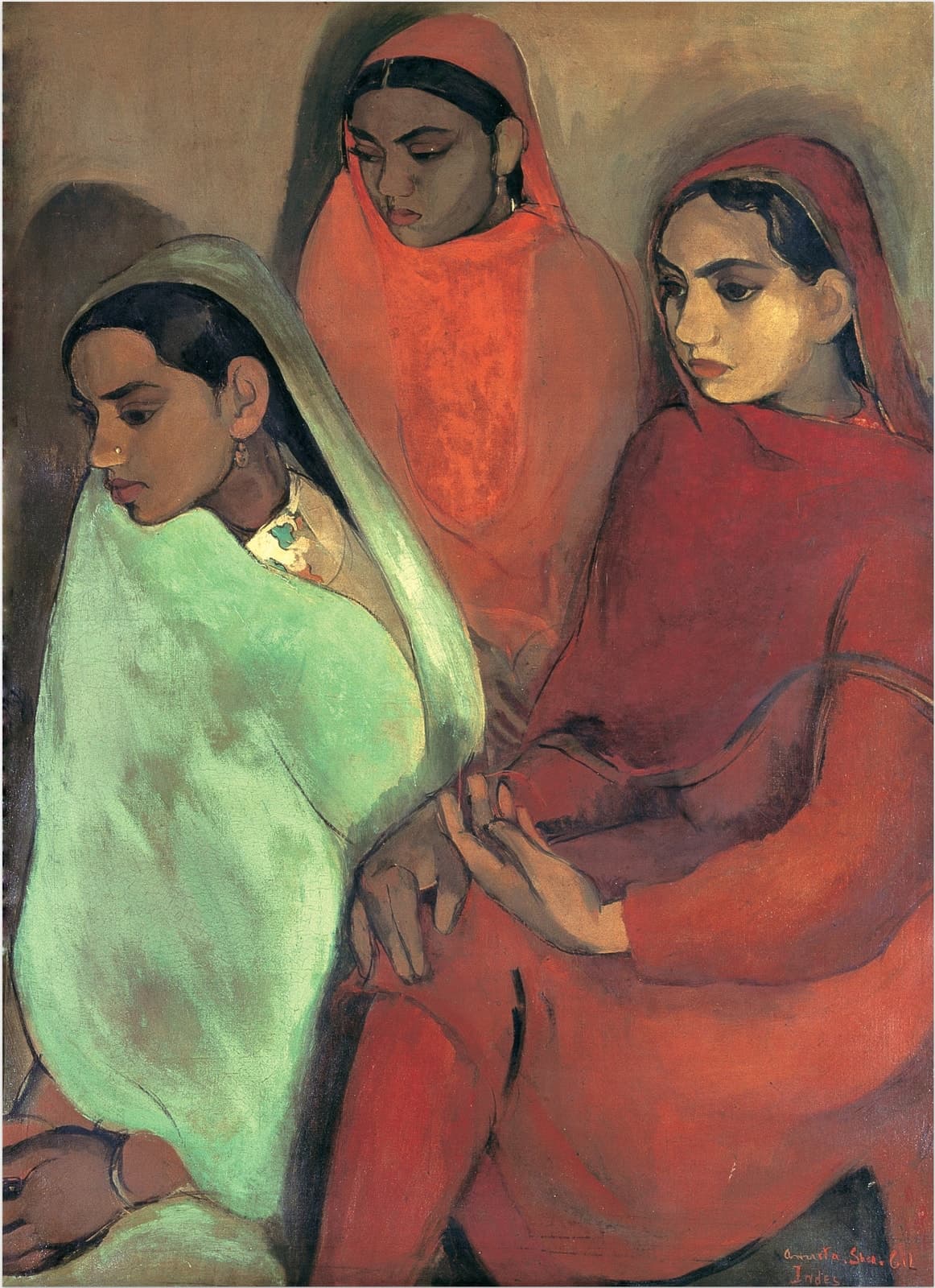
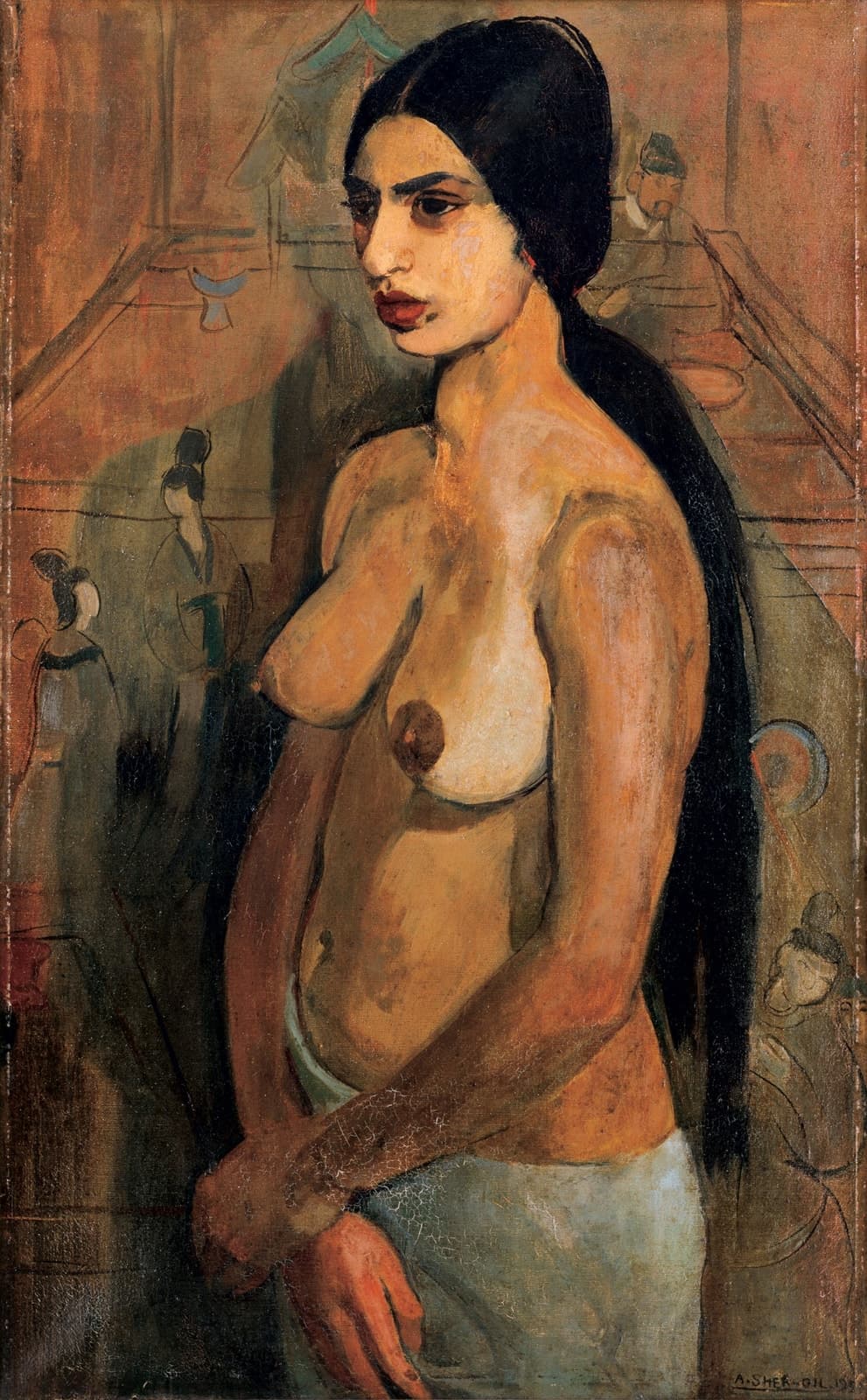
If you like Amrita Sher-Gil
Explore painters from the same movements and circles.
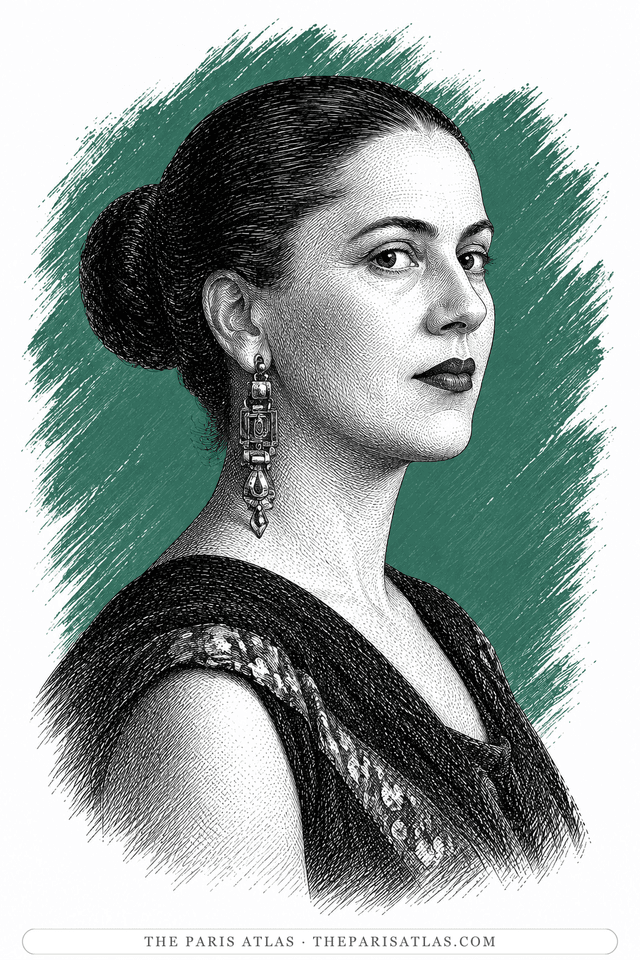
Tarsila do Amaral
Brazilian painter who spent the 1920s moving between São Paulo and Paris, studied Cubism under André Lhote, Albert Gleizes and Fernand Léger, and used what she learned to paint Brazilian towns, railways, plants and bodies. Her 1928 painting Abaporu prompted the manifesto that gave the Anthropophagic movement its name.
View artist
Marcel Duchamp
The century's quietest revolutionary — readymades, the abandonment of painting, chess on a Paris rooftop in Entr'acte, and one anemic film of spinning puns signed Rrose Sélavy.
View artist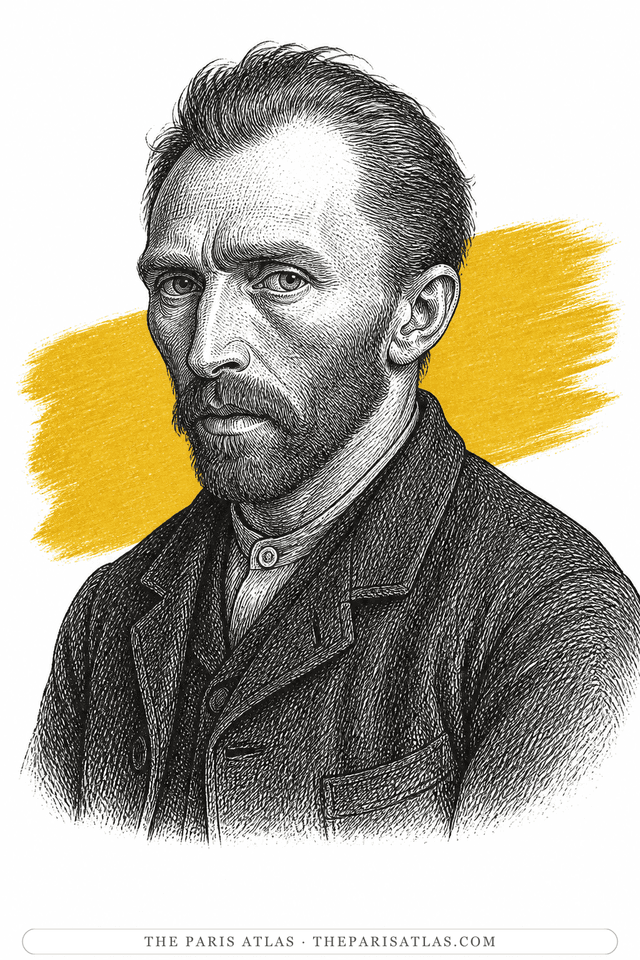
Vincent van Gogh
Dutch painter who lived in Montmartre with his brother Theo from March 1886 to February 1888 — the two years in which his dark Dutch palette turned into colour. He painted more than 200 pictures in Paris and died at Auvers-sur-Oise, north of the city, in 1890.
View artist
References
The sources below include collection records, catalogues, scholarly research, and primary materials that informed this page. They document Young Girls, its making, and its place in cultural history.


1Young Girls — Amrita Sher-Gil (accession ngma-00029)
Official recordNational Gallery of Modern Art, New Delhi, on Museums of India, the Ministry of Culture's National Portal and Digital RepositoryUsed forThe museum's object record: title, accession number, medium, Paris and June 1932 as place and date, the red signature and date, the dimensions, and the identification of Indira.

2An Unfinished Journey: Amrita Sher-Gil
WebsiteNational Gallery of Modern Art, New DelhiUsed forThe museum's chronology and virtual tour: the Grande Chaumière, Lucien Simon's studio, the 1933 election, the July 1933 departure from the École, the return to India, and the quotation on technique.
3Young Girls — Amrita Sher-Gil, 1932
WebsiteGoogle Arts & Culture / National Gallery of Modern Art, New DelhiUsed forThe museum's Google Arts & Culture entry, giving Paris as the place of creation and the dimensions as 134 by 164 centimetres.
4Catalogue des ouvrages de peinture, sculpture, dessin, gravure, architecture, arts décoratifs — Salon de 1933
Exhibition catalogueHérissey, Évreux; digitised by the Bibliothèque nationale de France on Gallica, 1933Used forThe Salon catalogue entry: Sher-Gil (Amrita), Hindoue, née à Budapest, 11 rue Bassano, Jeunes filles; Lucien Simon's five entries follow.
5Le prix du Salon de la Société nationale des Beaux-Arts
PeriodicalLe Journal, 25 May 1933, p. 6, via Gallica (Bibliothèque nationale de France), 1933Used forThe Nationale's prizes and new sociétaires and associés for the Salon of 1933, with Sher Gil among the painters elected associés.
6Les nouveaux lauréats, sociétaires et associés de la Nationale
PeriodicalComœdia, 26 May 1933, p. 3, via Gallica (Bibliothèque nationale de France), 1933Used forThe same list under the heading Les nouveaux lauréats, sociétaires et associés de la Nationale.
7Le Salon de 1933
PeriodicalBeaux-Arts: chronique des arts et de la curiosité (Gazette des Beaux-Arts weekly), 1933, via Gallica (Bibliothèque nationale de France), 1933Used forThe review of the Salon of 1933 that names les Deux amies de Sher-Gil, painted in the manner of Anders Zorn.
8Le Salon: La Société nationale
PeriodicalLe Matin, 2 May 1934, p. 5, via Gallica (Bibliothèque nationale de France), 1934Used forThe room-by-room review of the Nationale's 1934 Salon that notes a nude by Amrita Sher Gil, artiste hindoue, in Salle AP.
9Portrait of Denyse and Sher-Gil's Paris Circle
WebsiteChristie'sUsed forDenyse Proutaux, the drawing class, Royan, the four portraits, the lost 1933 composition, and the 107-strong NGMA holding as 'the majority of her 172 documented works'.
10Amrita Sher-Gil — Feature and Chronology
PeriodicalEmbassy of India in HungaryUsed forThe declaration of her works as national art treasures.
11Young Girls (Q100353269)
WebsiteWikidataUsed forHeight 164 cm, width 134 cm, inventory ngma-00029, each referenced to the Museums of India record.
These references provide the documented foundation for this work's history and interpretation. Claim-level citations remain attached to the specific claims they support.
 Explore more resources