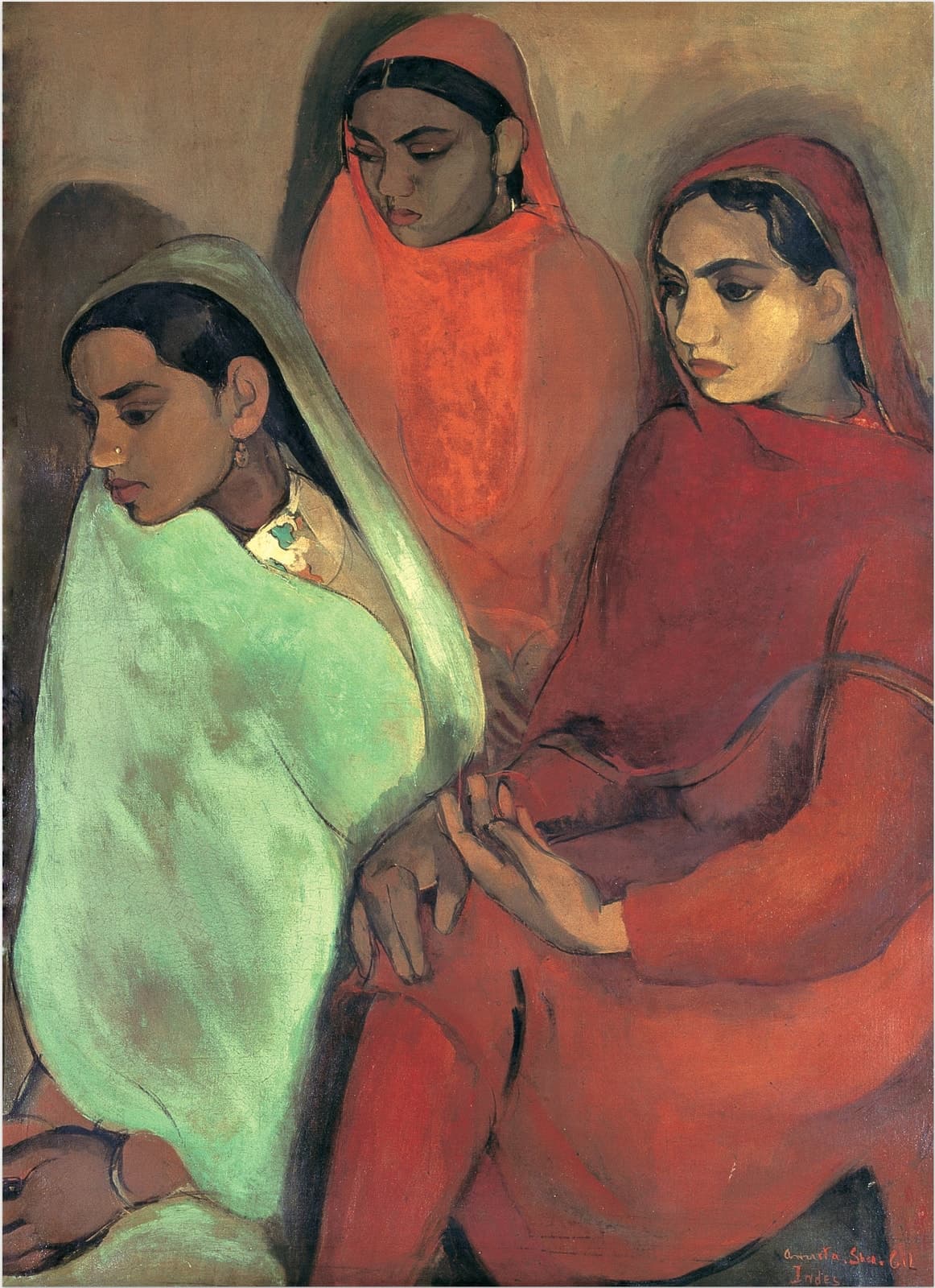
Group of Three Girls
Three young women wrapped head to lap in pale green, orange-red and crimson sit close together against a bare brown wall, and none of them looks at the others. Amrita Sher-Gil painted it in Amritsar in January 1935, a month after coming home from Paris, and the National Gallery of Modern Art calls it the first painting she made after Europe. It won the Bombay Art Society's gold medal in 1937. The museum catalogues it as Group of Three Girls; most writing calls it Three Girls.
- 1935
- Oil on canvas pasted on board
- National Gallery of Modern Art, New DelhiNew Delhi, India
About Amrita Sher-Gil
What the painting shows
The woman on the left sits in profile, facing left, wrapped from head to lap in a pale green cloth. She has a small gold stud in her nose, a drop earring, and a collar of white patterned cloth with green and orange marks at her throat. Her eyes are lowered. Her hands rest in her lap at the bottom left of the canvas, with a dark bangle at the wrist.
Behind her and higher up, a second woman in orange-red looks down, her head covered, a gold earring at her ear and a black band across her hair. On the right the third woman, in deep crimson and paler-skinned than the others, turns her large dark eyes to the left, past the first woman, at nothing in the picture. Her open hand lies at the centre of the canvas over the second woman's darker hand.
There is no floor, furniture or window, only a wall of ochre-brown with soft shadows behind the heads. The canvas is signed in red at the lower right, Amrita Sher-Gil, with the word Indes beneath. It measures 99.5 by 73.5 centimetres, about three feet three by two feet five, and the museum's virtual tour describes it as oil on canvas pasted on board.
Amritsar, January 1935
Sher-Gil returned to India with her parents in December 1934 and stayed in Amritsar with the family of her uncle Sunder Singh Majithia. The National Gallery of Modern Art's chronology dates the painting to January 1935, and its object record gives Amritsar as the place. The museum calls it the first picture she made after her return from Europe following her art studies in Paris.
The museum sees in it "a change in her visual language compared to that of her paintings done in Europe", with the influence of Paul Gauguin in the flattened treatment of the figures. "The use of a brilliant red," it adds, "becomes more patent in her work from this time onwards." Two of the three women here wear it.
Her early career, in the museum's words, had been "a usual beginning with oils, portraits and models from life in a largely academic style". Its summary of what followed is that she interpreted the life of Indians, notably the common ignored Indians, and painted images of infinite submission and patience. The three lowered faces of this canvas were painted in her first month back.
Three names for one picture
The National Gallery of Modern Art catalogues the picture as Group of Three Girls, the title used in the 2007 catalogue Amrita Sher-Gil: An Indian Artist Family of the Twentieth Century. The art historian Partha Mitter has referred to it as The Three Women, as the museum's record notes. Most writing on her calls it Three Girls. The museum's record does not name the sitters.
Bombay, Lahore and after
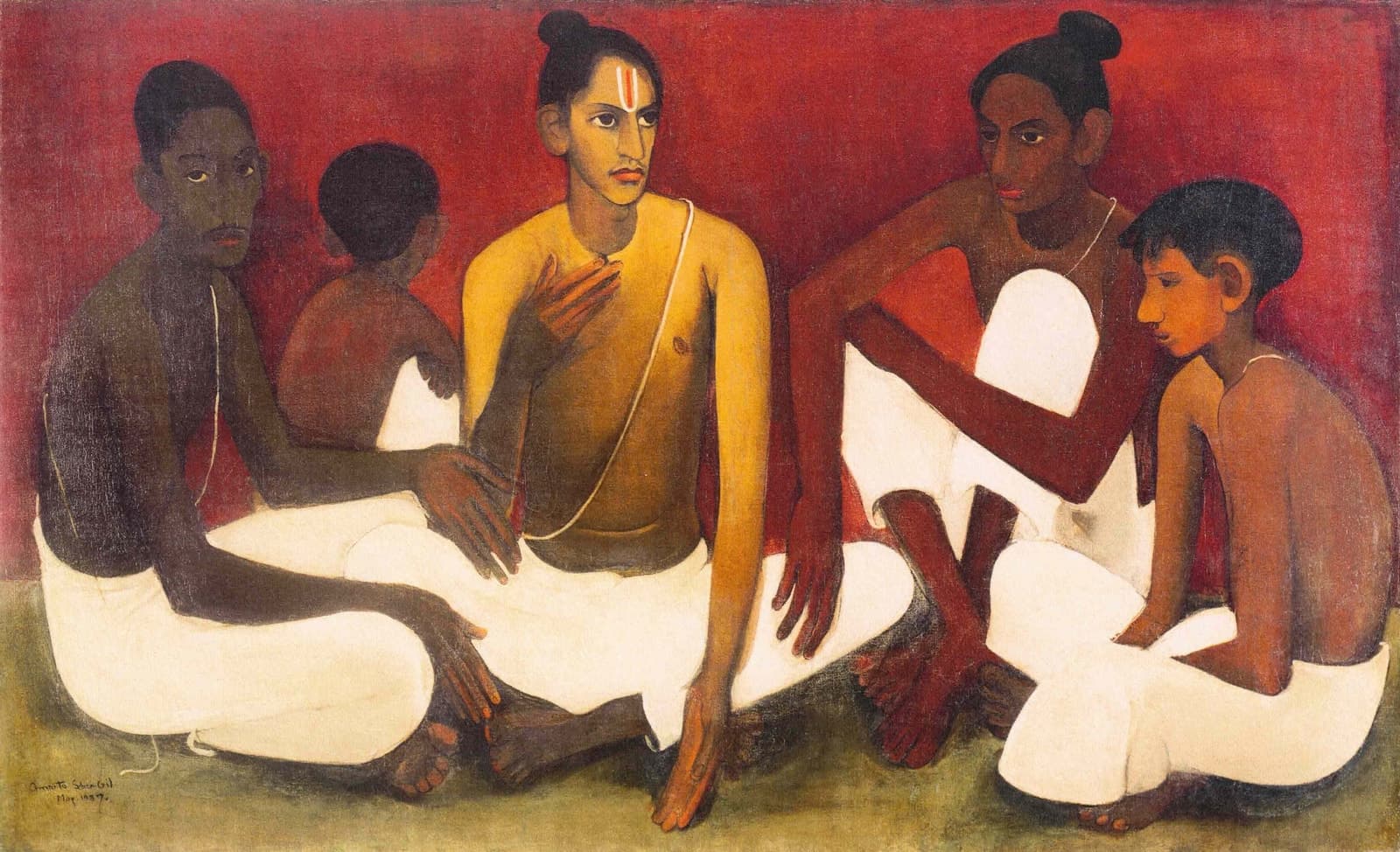
In January 1937 the painting won the gold medal at the Bombay Art Society's forty-sixth annual exhibition. In November that year she showed at Faletti's Hotel in Lahore, and a photograph of the hang there shows this canvas on the wall beside Brahmacharis, painted that May. The National Gallery of Modern Art holds it as accession number ngma-00982, one of 107 paintings by her in the collection.
When the museum marked her birth centenary in 2014 with almost its whole Sher-Gil collection, around ninety-five works, it listed Group of Three Girls among the rarely displayed paintings in the show, with Two Mendicants, Bride and Brahmacharis.
Close reading
Reading the work, detail by detail
Three heads, three colours and a bare wall. Close view shows the small jewellery on each woman, the patterned collar under the green wrap, the two hands that touch at the centre, and the signature in red with the word Indes beneath it.
1.A profile with a nose stud
The woman in green is painted in strict profile, facing left. Her eyes are lowered, a small gold stud sits on her nostril, and a drop earring hangs by her jaw. The green cloth covers her hair and falls behind the ear. Her lips are a dull red.
2.The woman in orange-red
The second woman sits highest and furthest back. Her head is covered by the orange-red cloth, a black band crosses her hair at the parting, and a gold earring hangs at her ear. Her eyes are cast down. The orange-red is the brilliant red the National Gallery of Modern Art says becomes more patent in her work from this picture on.
3.Large eyes looking away
The third woman is paler than the other two and the only one whose eyes are open wide. She looks to the left, past the first woman, at nothing in the picture. The crimson cloth covers her hair and shoulders, and a darker crimson shadows her cheek.
4.Two hands meet at the centre
At the centre of the canvas a pale hand lies open over a darker one, on the crimson cloth of the right woman's lap. The pale hand belongs to the woman in crimson; the darker hand, coming from behind, to the woman in orange-red. It is the only place where the three touch.
5.A patterned collar under the green
Where the green wrap opens at the throat a strip of white cloth shows, patterned with green and orange marks like leaves and flowers. It is the one patterned fabric on the canvas, and it sits between the dark skin of the neck and the flat green.
6.A block of pale green
The wrap is painted as one block of pale green, broken only by a few darker folds. It fills the lower left of the canvas. The flattened treatment is what the National Gallery of Modern Art links to Paul Gauguin.
7.Hands in the lap
At the bottom left the first woman's hands rest together in her lap, a dark bangle at the wrist. They are painted brown against the green and the ochre ground, without the outline that firms up the faces.
8.Signed Amrita Sher-Gil, Indes
The corner is signed Amrita Sher-Gil in red-orange script, with Indes written beneath it, the French word for India. The museum's record gives no inscription; the signature is read here from the reproduction.
Timeline
December 1934
Returns to India from Paris with her parents and stays in Amritsar with her uncle Sunder Singh Majithia's family.
January 1935
Paints Group of Three Girls in Amritsar, the first painting after her return from Europe. Signed Amrita Sher-Gil, Indes, in red at the lower right.
January 1937
Wins the gold medal at the Bombay Art Society's forty-sixth annual exhibition.
November 1937
Shown at her Lahore exhibition at Faletti's Hotel, hung beside Brahmacharis.
2014
Shown in the National Gallery of Modern Art's birth-centenary exhibition, which listed it among its rarely displayed paintings.
Where to see it
National Gallery of Modern Art, New Delhi
New Delhi, India
A public viewing address has not yet been confirmed for this holding.
The museum holds 107 of her paintings and called this one rarely displayed in 2014. As of September 2026 its online record does not say whether it is on the wall, so check with the museum before travelling.
Frequently asked questions
Where is Three Girls by Amrita Sher-Gil?
At the National Gallery of Modern Art in New Delhi, catalogued as Group of Three Girls, accession number ngma-00982. As of September 2026 the museum's online record does not say whether it is on display, so check before travelling.
Is the painting called Three Girls or Group of Three Girls?
Both. The National Gallery of Modern Art uses Group of Three Girls, the title of the 2007 catalogue Amrita Sher-Gil: An Indian Artist Family of the Twentieth Century, and notes that Partha Mitter has called it The Three Women. Three Girls is the name most writing uses.
Who are the three women?
The museum's record does not name them. The painting was made in Amritsar in January 1935, where Sher-Gil was staying with her uncle Sunder Singh Majithia's family after her return from Paris.
What prize did Three Girls win?
The gold medal at the Bombay Art Society's forty-sixth annual exhibition in January 1937, according to the National Gallery of Modern Art.
Why does Three Girls matter?
Because the National Gallery of Modern Art dates the change in her visual language from it. It was the first painting after Paris, with flattened figures the museum links to Paul Gauguin and a brilliant red that becomes a fixture of her Indian work. The lowered eyes and bare setting return in her pictures for the rest of her life.
How big is Three Girls?
99.5 by 73.5 centimetres, about three feet three by two feet five. The museum's virtual tour describes it as oil on canvas pasted on board.
More by Amrita Sher-Gil
If you like Amrita Sher-Gil
Explore painters from the same movements and circles.
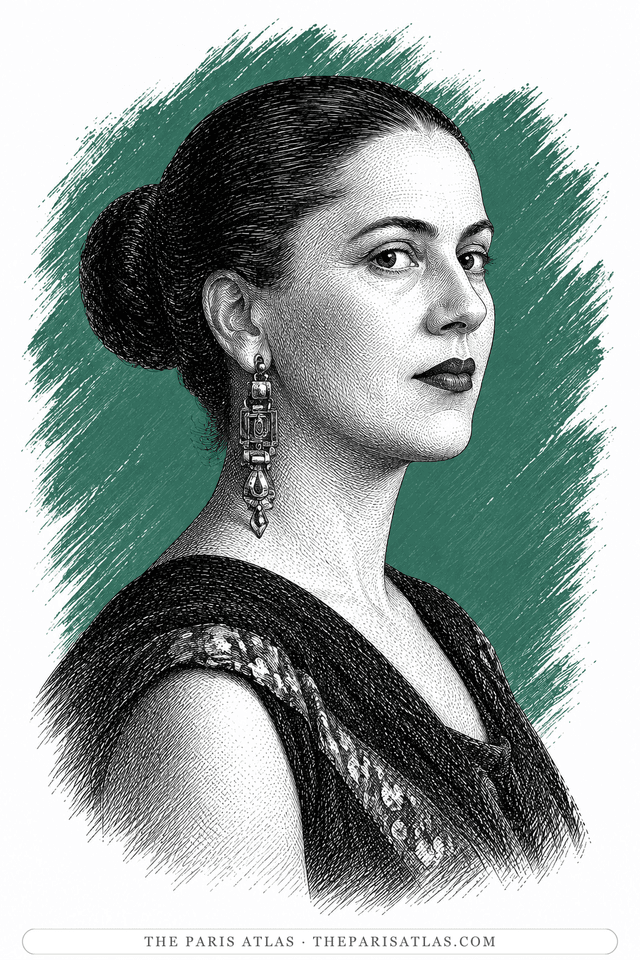
Tarsila do Amaral
Brazilian painter who spent the 1920s moving between São Paulo and Paris, studied Cubism under André Lhote, Albert Gleizes and Fernand Léger, and used what she learned to paint Brazilian towns, railways, plants and bodies. Her 1928 painting Abaporu prompted the manifesto that gave the Anthropophagic movement its name.
View artist
Marcel Duchamp
The century's quietest revolutionary — readymades, the abandonment of painting, chess on a Paris rooftop in Entr'acte, and one anemic film of spinning puns signed Rrose Sélavy.
View artist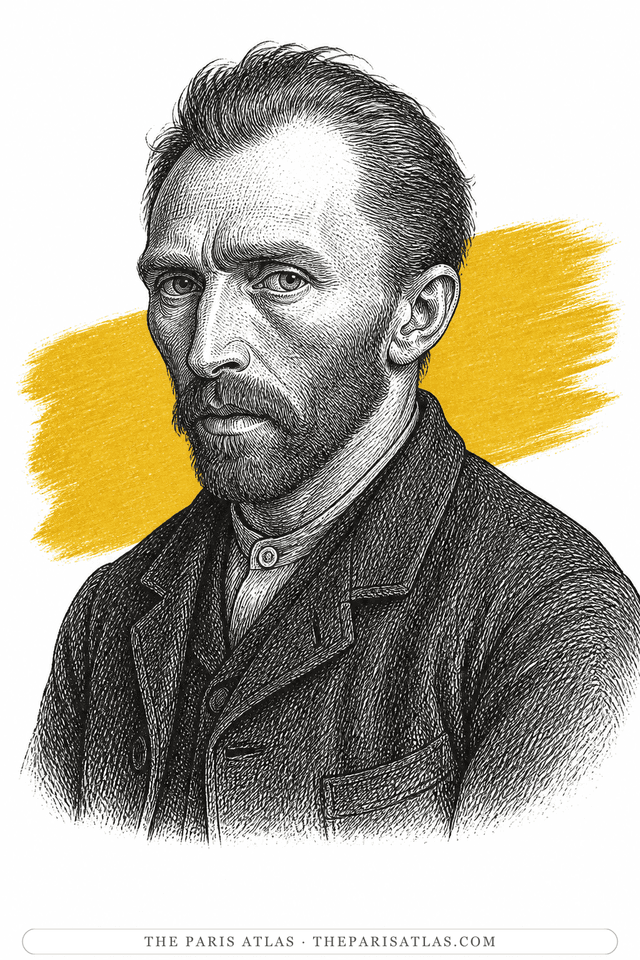
Vincent van Gogh
Dutch painter who lived in Montmartre with his brother Theo from March 1886 to February 1888 — the two years in which his dark Dutch palette turned into colour. He painted more than 200 pictures in Paris and died at Auvers-sur-Oise, north of the city, in 1890.
View artist
References
The sources below include collection records, catalogues, scholarly research, and primary materials that informed this page. They document Group of Three Girls, its making, and its place in cultural history.


1Group of Three Girls — Amrita Sher-Gil (accession ngma-00982)
Official recordNational Gallery of Modern Art, New Delhi, on Museums of India, the Ministry of Culture's National Portal and Digital RepositoryUsed forThe museum's object record: title, accession number, Amritsar and January 1935, the dimensions, the first painting after Europe, the Bombay Art Society gold medal, Partha Mitter's title and the 2007 catalogue title.

2An Unfinished Journey: Amrita Sher-Gil
WebsiteNational Gallery of Modern Art, New DelhiUsed forThe virtual tour and chronology: oil on canvas pasted on board, the December 1934 return to Amritsar, January 1935, the gold medal at the forty-sixth Bombay Art Society exhibition, the Lahore show, and the museum's reading of the change in her language.
3Group of Three Girls — Amrita Sher-Gil, 1935
WebsiteGoogle Arts & Culture / National Gallery of Modern Art, New DelhiUsed forThe museum's Google Arts & Culture entry, giving Amritsar as the place of creation and the dimensions as 73.5 by 99.5 centimetres.
4Amrita Sher-Gil: The Passionate Quest
WebsiteNational Gallery of Modern Art, MumbaiUsed forThe 2014 centenary exhibition of around ninety-five works, which listed Group of Three Girls among its rarely displayed paintings.
5Amrita Sher-Gil at her Lahore exhibition, November 1937 (photograph)
ArchiveWikimedia Commons, from Vivan Sundaram (ed.), Amrita Sher-Gil: A Self-Portrait in Letters and Writings, vol. 2 (Tulika Books, 2010)Used forThe photograph of the November 1937 Lahore hang, with this canvas beside Brahmacharis.
6Three Girls (Q7797494)
WebsiteWikidataUsed forHeight 99.5 cm, width 73.5 cm; the duplicate item Q100353631 carries the inventory number ngma-00982.
 View source
These references provide the documented foundation for this work's history and interpretation. Claim-level citations remain attached to the specific claims they support.
 Explore more resources