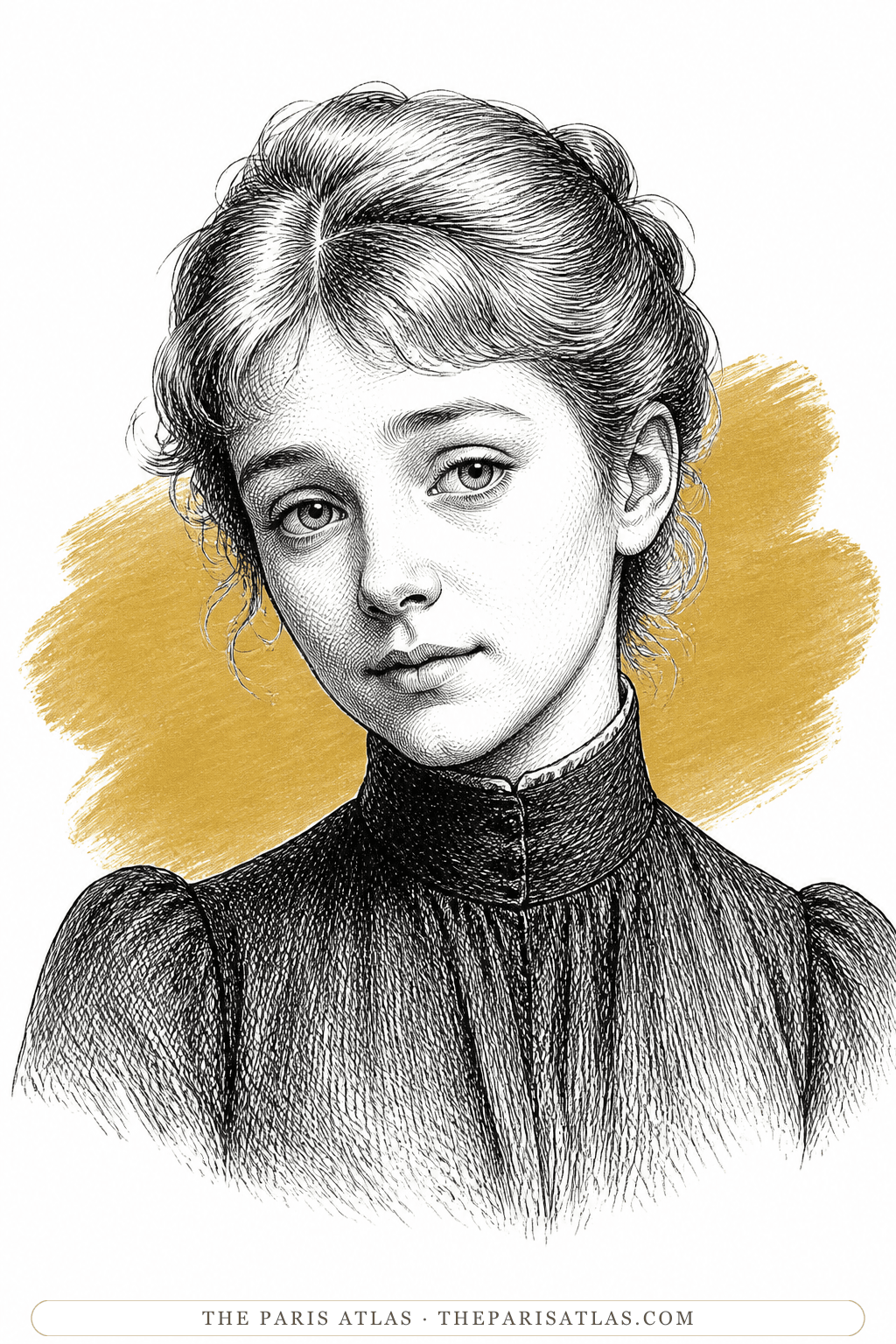
Aimée Lanthenay
The young assistant teacher Claudine is drawn to — and the object of the headmistress's attentions as well.
To be warm, admired and looked after. Claudine says in the first chapter that Aimée's whole body is asking for a comfort she has never had, and every choice she makes in the book goes in that direction.
The book

At a glance
- Nineteen, four years older than Claudine and a head shorter
- Junior assistant teacher at the Montigny girls' school, on seventy-five francs a month with board deducted; later moved up to teach the older girls history, drawing and needlework
- A stonemason father, a mother who hit her, three brothers and a sister. Her sister Luce, fifteen, is sent to the school as a boarder during the book
- Armand Duplessis, an assistant master at the boys' school, whom Claudine nicknames Richelieu
- Good enough to be sold as lessons, not good enough to survive an examiner. The science and English examiner laughs at her pupils' pronunciation, and Claudine, furious, reads her passage almost inaudibly to hide it
- An old laryngitis, which conveniently keeps her out of the choir practice all year
Who they are in the book
Spoiler-freeAimée Lanthenay is the junior assistant teacher at the village school in Claudine at School, the 1900 novel by the French writer Colette. She is nineteen, four years older than Claudine, the girl who narrates the book, and small enough that the top of her head reaches Claudine's ear. She was still a pupil herself three months before the novel opens.
She is poor and has been poor all her life. Her father is a stonemason, her mother used to hit her, and she has a sister and three brothers. She trained at the teachers' college in the county town, where the water froze in the jugs, everyone got up at five, and she was permanently half asleep; at home in the holidays her family put her back on the housework and told her she would do better making soup than playing the young lady. She now earns seventy-five francs a month and pays her board out of it.
Claudine falls for her immediately and describes her carefully: a pink face, golden-yellow eyes with curled lashes, cheekbones slightly too high, a short nose, a mouth a little too full that makes an odd small crease at the left corner when she laughs, and a skin so fine that cold does not turn it blue. She is looked at by everyone. Masons stop mixing mortar when she passes, boys show off in the street, and the men who take their vermouth at the café in the evening discuss her.
Claudine gets her father to pay for private English lessons so that she can have her to herself twice a week. Almost no English is done. Within about a month the headmistress, Mademoiselle Sergent, has cried at Aimée, told her she is jealous, and asked her to stop coming. Aimée stops coming. From then on she belongs to the headmistress, and the change is quick, complete and entirely unembarrassed. She also accepts a proposal of marriage from a young assistant master, goes off alone with the district doctor when the headmistress arranges it, and by spring has a bedroom with pink-flowered curtains and a bed enamelled white that she has plainly not paid for.
Claudine's verdict on her is blunt and never softened: she likes her comfort the way a cold cat does, and she goes where the comfort is. She is not cruel so much as without memory, without remorse and without much thought about anyone else, including the fifteen-year-old sister she has brought into the school and treats badly.
How Aimée Lanthenay Is Portrayed
- Nineteen, and paid seventy-five francs a monthShe chatters like the boarding pupil she was until recently, with a need for tenderness and for tucking herself up against people that Claudine finds touching. She keeps her small cold hands pressed under a collar of fake fur, and the fifteen francs a month for Claudine's English lessons is a windfall she did not expect.
- What she looks likeGolden-yellow eyes with lashes that curl up, a fresh pink face, high cheekbones and a short nose. Claudine, who is in love with her at the time, notes without stopping loving her that the eyes are neither kind, nor frank, nor trustworthy.
- The English lessonsTwice a week in Claudine's father's library, under a lamp that lights only the table. On the first evening they get through ten minutes of grammar. After that Claudine takes her jacket off her, tells her she is thin enough to break, puts her head on her chest, and asks her about the headmistress until the hour runs out.
- How she explains changing sidesShe tells Claudine the whole scene the headmistress made her, in tears, and then says that the headmistress really does seem very fond of her and that she had not realised. Claudine, sitting on a footstool with her arms round Aimée's waist, hears the sentence and lets go. She says nothing, but she understands from that moment that it is over.
- Engaged in the school gardenArmand Duplessis, a shy young assistant master who has been standing under her window in the cold for weeks, tells her he loves her and asks to speak to the headmistress about it that evening. She accepts. When Claudine asks whether she loves him, she answers: « Mais, dame, puisque je l'accepte pour mari ! » — well, obviously, since she is taking him as a husband.
- The errand upstairsThe headmistress announces to the class that a crack has appeared in her bedroom wall and sends Aimée to show it to Dr Dutertre, the district school delegate. Aimée starts to object, thinks better of it, and goes. She is away long past the geography lesson and comes back flushed and short of breath.
- How she treats her sisterShe brings Luce, fifteen and painfully shy, into the school as a boarder, calls her a little idiot in front of everyone, and slaps her for not doing her arithmetic. When Luce threatens to ask their mother who paid for the new furniture in Aimée's room, Aimée says she will have her sent home for laziness. Luce shuts up.
- Spoiled by springHer room is the prettiest and warmest of the assistant teachers' rooms, with pink-flowered curtains, linoleum, a goatskin and a bed enamelled white. The headmistress does her hair for her in the morning, which Claudine proves by pointing out that the bottom of Aimée's own water jug is dusty. She has become the petted animal of the household and is starting to be a tyrant about it.
- The slip in front of the classDuring a sewing lesson the headmistress calls across the room to her by her title, and Aimée absent-mindedly shouts back the intimate form of you, the one used between family and lovers, in front of thirty girls. The room goes silent, then laughs. Her explanation, that anyone can make a mistake, convinces nobody.
Her fiancé finds out. He watches Dutertre come out of the new school building alone, spends the night in the woods, and comes back the next morning green with moss and with twigs in his hair to shout at Aimée and the headmistress in front of the whole school, calling them whores and telling Aimée she is worse than a streetwalker. He is dragged off by a colleague. He is transferred out of the district; Dutertre arranges the post and puts about a story of dangerous fever, because a talking Duplessis would have cost him his seat in parliament. Aimée is not moved anywhere. Claudine, coming back from measles a month later, is told that within a week Aimée was laughing with the headmistress exactly as before.
At the ball that closes the novel she comes down in a white evening blouse with roses in her hair, ignores the headmistress's jealous scene in the corner, and waltzes with a large blond stranger who holds her close and brushes her with his lips without her flinching. Then the headmistress's mother starts screaming down the staircase that she has caught Dutertre in her daughter's bed, and throws his boots down after him. Aimée goes white, stares at the boot lying in the doorway with everyone else looking at it, bursts into tears and runs out of the room. Claudine's only comment, made to herself, is that a bad hour now will make her happy ones taste sweeter.
If you like Claudine at School


If you like Colette
Explore authors with a similar voice, perspective, and influence.

Henry Miller
The Brooklyn dropout who arrived in Paris broke at thirty-eight and wrote the exuberant, banned books that ended American censorship.
View author
Louis-Ferdinand Céline
The doctor of the Paris slums who wrote the century's blackest, funniest novel — and changed the sound of French prose.
View author
Martha Gellhorn
War correspondent who covered the Spanish Civil War, D-Day, and conflicts across five more decades; Hemingway's third wife, 1940–1945.
View author