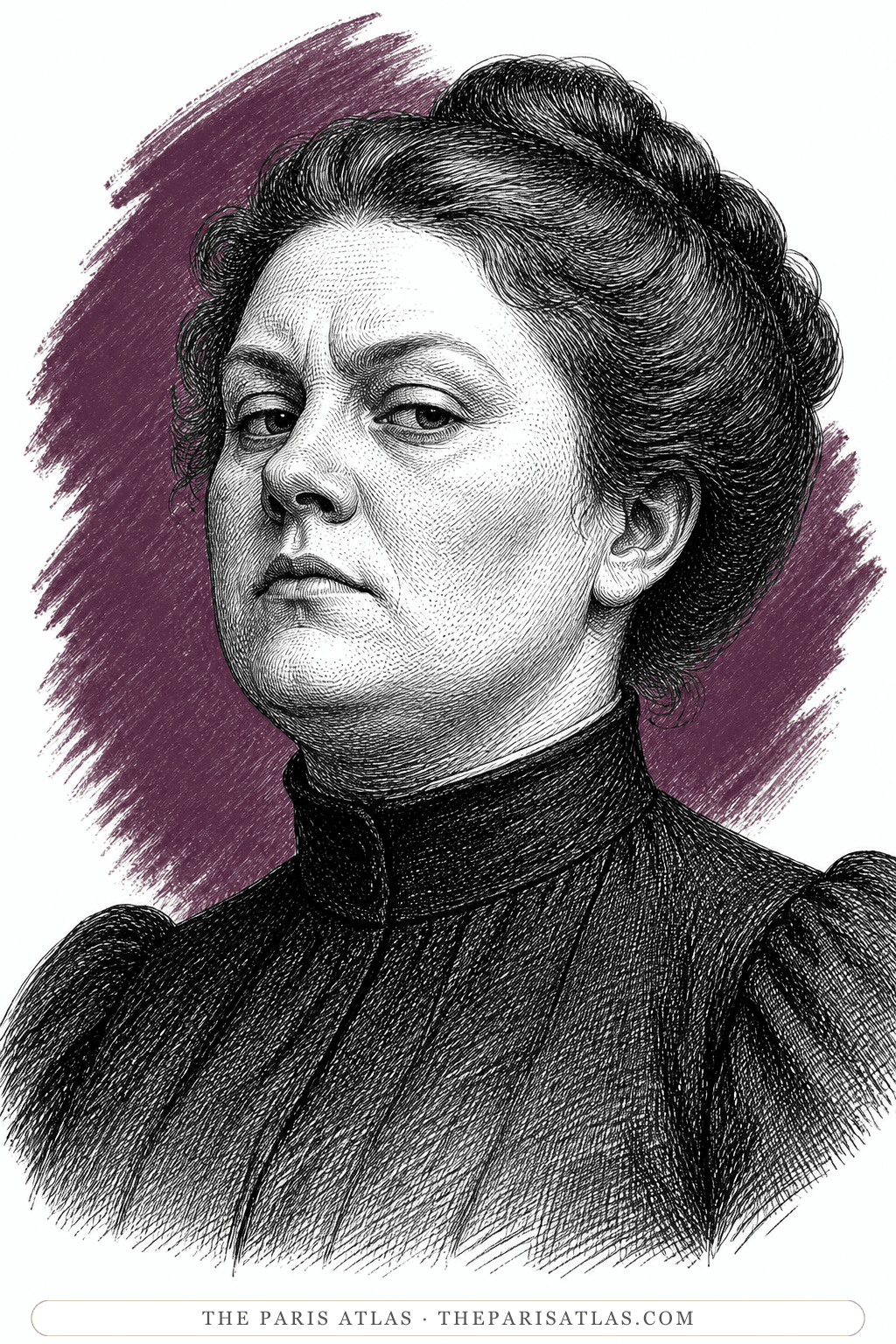
Mademoiselle Sergent
The village school's new headmistress — Claudine's antagonist, and the center of the school's charged adult intrigues.
Aimée Lanthenay's affection, exclusively. She says it out loud in the first month, asking Aimée only not to hate her, and promising to give her more love than Claudine is capable of feeling.
The book

At a glance
- Headmistress of the girls' school at Montigny, from the demolition of the old building through the opening of the new one
- She lives at the school with her mother, a shrewd peasant woman in a bonnet who waits on her, admires her, and clears the table
- Dr Dutertre, the district school delegate and a candidate for parliament, who gave her the post. Claudine is certain she is in love with him and suspects he owes her money
- Aimée Lanthenay, and later Mademoiselle Griset, a pale, frightened assistant whom the other two leave to eat alone
- Sing. She sings out of tune and has to hand the examination choir to Claudine and a young assistant master from the boys' school
- Claudine lets slip her given name once, in passing: Olympe
Who they are in the book
Spoiler-freeMademoiselle Sergent is the new headmistress of the girls' school in Montigny, the invented Burgundy village where Claudine at School is set. She arrives in the first pages, at the same time as the workmen who come to knock the old school down, and she gets the job because Dr Dutertre, the local doctor and political fixer, wanted the previous teacher's post for someone of his own. Claudine, the fifteen-year-old girl who narrates the novel, decides to dislike her before they have spoken.
Claudine describes her plainly and without kindness: red-haired, well built, wide-hipped, with a puffy, permanently flushed face, a slightly flattened nose and small black eyes set deep and suspicious. Her eyes give away whatever she is thinking, which is the only thing about her that is easy to read.
She is also, Claudine admits within a page or two, a first-rate teacher. Her voice is clear, her sentences are exact, and the whole classroom goes silent the moment she raises it. Her will would be admirable, Claudine says, if anger did not blind it. Once, rather than throw an inkwell at Claudine's head, she walked out of the room.
The thing that occupies her for the whole book is Aimée Lanthenay, the nineteen-year-old assistant teacher who shares the school with her. Within a few weeks of the novel's opening she has wept at Aimée, told her she is jealous of the affection Aimée shows Claudine, and asked her to stop giving Claudine private English lessons. She wins. From then on the two of them kiss in empty classrooms, sit with an arm round each other's waist in front of the class, and disappear upstairs for hours at a time, leaving fifty children unsupervised. By spring the pupils have all learned not to open a door the two teachers have shut.
At the same time she is the protégée and, the village says, the mistress of Dutertre, who is running for parliament and owes her nothing except a job. She is fiercely jealous when he handles the older girls, and not jealous at all when he takes Aimée off alone, which puzzles Claudine until she works out that the arrangement suits everyone but Aimée's fiancé. What she guards above all is the reputation of her school: she cancels an expulsion rather than risk Claudine talking, and in examination week she laughs at the girls' cheating and only warns them not to be careless.
How Mademoiselle Sergent Is Portrayed
- How she gets the jobThe previous teacher, a kind and ignorant woman of forty who cried for a whole day when the transfer notice came, is moved out because Dr Dutertre wanted her post for a protégée of his own. In this district, Claudine says, whatever Dutertre wants, the minister wants.
- What she looks likeRed hair, a good figure and wide hips, an openly ugly face, flushed and swollen, a snub nose between small deep-set black eyes. When someone resists her, her eyes catch fire and the red hair goes damp with sweat.
- A very good teacherClaudine, who cannot stand her, grants it at once: clear, often cutting, exact, with a lucidity that only anger spoils. When the class gets out of hand she takes it back in one sentence, and the lesson is recited at a gallop with nobody daring to fidget.
- She lives better than her salaryWhen the girls carry the teachers' things to the new building, Claudine finds the headmistress's washing set is cut-crystal bottles large and small, nail buffers, atomisers, brushes, tweezers, powder puffs and an enormous basin. The two assistant teachers have a bowl, a small water jug, a round mirror, a toothbrush and a bar of soap.
- The night she takes Aimée away from ClaudineAimée reports the scene afterwards: two days of unusual kindness, then tears, then the headmistress sitting down beside her, taking her hands, and saying that Aimée's indifference is breaking her heart. About the English lessons she says: « Claudine n'y pensera plus au bout d'une semaine, et je vous donnerai plus d'affection qu'elle n'est capable d'en éprouver ! » — Claudine will have forgotten about it in a week, and she will give Aimée more affection than Claudine is capable of feeling.
- They stop hiding itClaudine climbs the stairs in her socks and sees, through a half-open door, Aimée sitting on the headmistress's knees like a baby. One of the young assistant masters walks into a dark classroom and finds the two women kissing; the headmistress turns round without hurrying and asks who is there. From the scaffolding the masons watch it through the window every day and say the pair might as well be husband and wife.
- The crack in the wallIn front of the whole class she announces that there is a worrying crack running down the new wall of her bedroom, and sends Aimée off to show it to Dr Dutertre. They are gone for the best part of an hour. When Aimée comes back, flushed and out of breath, the headmistress questions her urgently, gets a shake of the head and a knowing smile, and sighs with relief.
- Cheating is allowed in examination weekClaudine tells her how the girls passed answers to each other in the written papers, and she laughs and is pleased, telling them only not to be too reckless. Everything is permitted for the honour of the school.
- Why she does not expel ClaudineAfter the slap she tells Claudine to leave and then calls her straight back, saying she does not want to lose a pupil who is difficult but not mediocre. Claudine, sitting back down, works out the real reason: she would have talked, and a scandal would have damaged both the headmistress's reputation and the expensive new school going up in the yard.
- What she says to Claudine near the endIn their one honest conversation she tells Claudine the bad start was Claudine's fault, that she made advances of her own and had them thrown back, and that she had thought Claudine intelligent and pretty enough to interest her, having neither a sister nor a child. Claudine understands that she could have had Aimée's place if she had wanted it, and is not sorry.
Aimée's fiancé, an assistant master at the boys' school, spends a night in the woods after watching her come out of the new building with Dutertre, and comes back the next morning and has to be held back bodily from getting into the classroom, shouting insults at both women that the whole school hears through the windows. The headmistress shuts the door and sends the pupils home; a notice goes out that she is ill and the school is closed for a week. Dutertre has the young man transferred and puts it about the town that he suffered a dangerous fever and was treated in time by the school doctor, who was himself.
The novel's last scene is the public ball on the night the new school is opened. Around one in the morning the dancing stops because of screaming from the private staircase: the headmistress's mother has caught Dutertre in her daughter's bed and beaten him with a broom handle. She shouts the whole thing down the stairwell so that the ballroom can hear it, including the accusation that her daughter's salary rise was paid for in kind, and finishes by throwing his boots downstairs. One of them, patent leather and highly polished, bounces to the bottom and lands in the light of the open door, where nobody dares touch it.
Mademoiselle Sergent had already left the room and does not come back. Someone eventually closes the little door to hide the boot, the band starts again, and the ball goes on more cheerfully than before.
If you like Claudine at School


If you like Colette
Explore authors with a similar voice, perspective, and influence.

Henry Miller
The Brooklyn dropout who arrived in Paris broke at thirty-eight and wrote the exuberant, banned books that ended American censorship.
View author
Louis-Ferdinand Céline
The doctor of the Paris slums who wrote the century's blackest, funniest novel — and changed the sound of French prose.
View author
Martha Gellhorn
War correspondent who covered the Spanish Civil War, D-Day, and conflicts across five more decades; Hemingway's third wife, 1940–1945.
View author