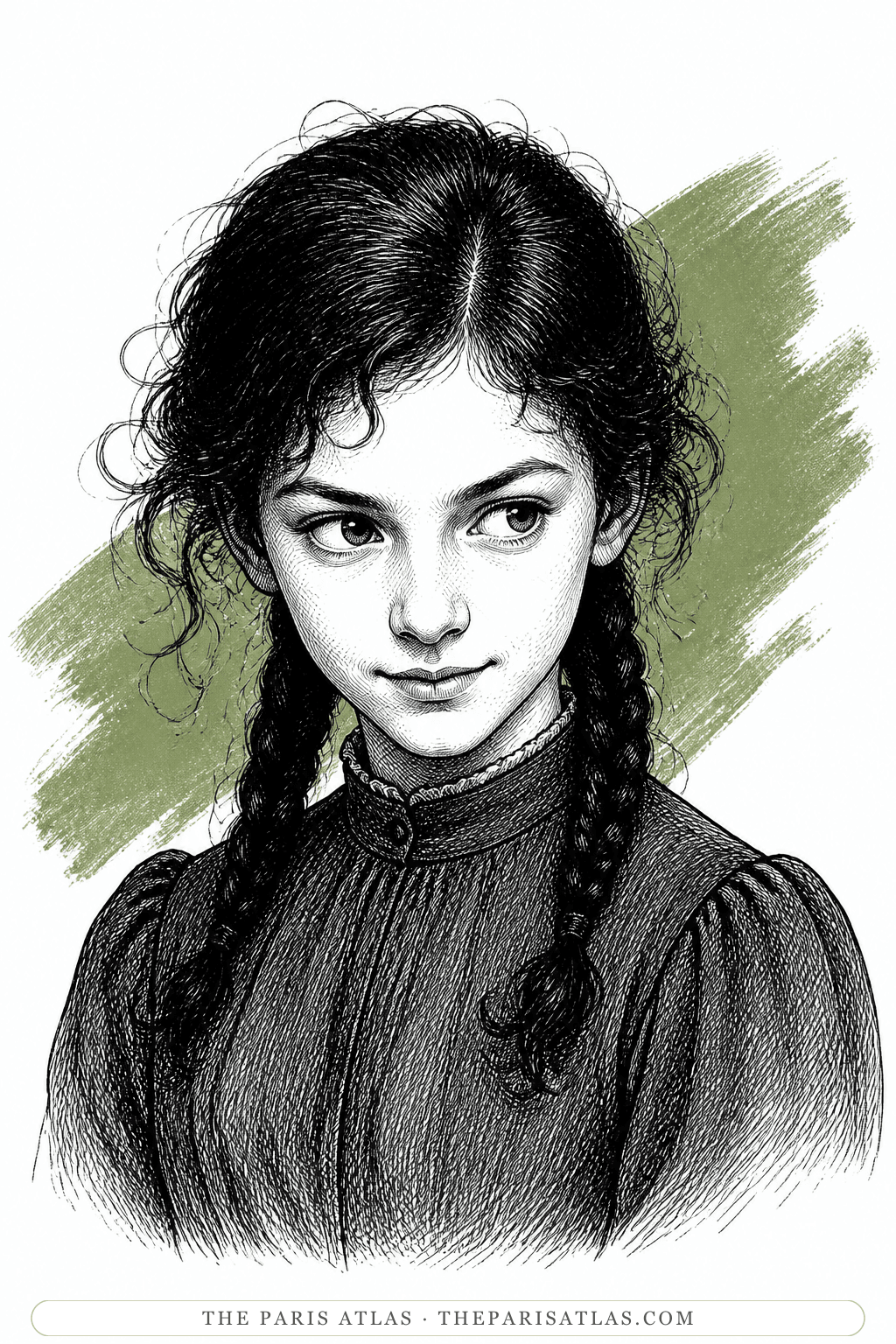
Claudine
Fifteen, motherless, and merciless in her observation — the sardonic narrator whose voice carries the whole book.
To not be shut in. She turns down boarding school and teacher-training college for the same stated reason, that you cannot leave; as a small child she screamed and clawed at the windows until she was taken home again.
The book

At a glance
- Fifteen when the diary starts, sixteen by the end; born in Montigny in 1884
- Montigny-en-Fresnois, an invented Burgundy village of 1,950 people that Claudine loves and refuses to leave
- Her father, a naturalist writing an unfinishable study of the local slugs; her mother is dead; no brothers or sisters. Her white cat is called Fanchette
- Top of the class in French composition, hopeless and unwilling at arithmetic, the only girl there who can read music
- The brevet élémentaire, the leaving certificate most of her classmates need in order to train as teachers. She takes it in July and does not want the career it leads to
- Mademoiselle Sergent, the headmistress; Aimée Lanthenay, the assistant teacher she is drawn to; and Dr Dutertre, the district school delegate, who visits far more often than his duties require
Who they are in the book
Spoiler-freeClaudine is the narrator and the invented central character of Claudine at School, a novel published in 1900 by the French writer Colette. She is fifteen when it opens and sixteen when it ends, and she tells the entire book herself, as a diary of one school year. She lives in Montigny, an invented Burgundy village of about two thousand people in eastern France. On the first page she says she was born there in 1884 and will probably not die there.
Her mother is dead. Her father is a naturalist who keeps slugs under glass bells and in wire cages, weighing how much each one eats in a day, for a study of the region's snails and slugs that he will never finish. He is affectionate and pays her almost no attention. That leaves her free to come and go, which is what she wants, and it also leaves her alone with his library of 2,307 volumes and every literary review that arrives in the post. She reads all of it, including novels a fifteen-year-old was not supposed to read, and says so cheerfully to any adult who asks.
She is not a good girl and makes no effort to seem like one. She slaps a classmate hard enough to mark her face, digs her nails into another, invents stories to frighten the gullible ones, and amuses herself during handwriting practice by dictating obscure modern poetry to farmers' daughters who copy it down without understanding a word.
She is also openly attracted to Aimée Lanthenay, the nineteen-year-old assistant teacher, and talks her father into paying for private English lessons so that she can sit close to her twice a week. When the headmistress takes Aimée for herself, Claudine is jealous, says so at length, and then gets over it. She spends the rest of the year watching the two women with an eye that misses nothing and reports what she sees without drawing a moral from it.
Nearly every girl around her is working towards teacher training and a life on seventy-five francs a month. Claudine has refused that from the start. She sits the leaving examination only because her father vaguely expects it and because a rival would enjoy her failing.
This is the first of four Claudine novels and the book that made Colette's reputation, although her name was not on it. The 1900 first edition was published under the name of her husband, the literary entrepreneur who used the pen name Willy, and it was years before her authorship was acknowledged. Claudine herself became a national craze in France: plays, merchandise, a haircut. The later books follow her to Paris.
How Claudine Is Portrayed
- Fifteen, and newly in long skirtsShe dates the start of her diary precisely. Two months after she turned fifteen she let her skirts down to her ankles, because her calves were attracting attention and already made her look too much like a young woman. In the same season the old school was demolished and the teacher replaced.
- Her hair, and the trouble it causesCurls almost to her waist, a colour that shifts with the weather between dark chestnut and dark gold, against coffee-brown eyes. She has never worn plaits or a bun, because buns give her migraines and plaits do not frame her face. The school inspector objects to it at every visit; she tells him her father will not allow braiding, which is not true.
- The woodsShe has spent ten years roaming the woods around the village and knows all of them. She prefers to go alone, because the other girls are afraid of brambles, caterpillars and heath spiders, and complain and get tired. Under the firs she lights fires because it is forbidden, and cooks an apple or a potato stolen from a field.
- Her father and his slugsHe shuts himself in the coldest room in the house from seven in the morning until nine at night. When she has measles he nurses her devotedly and brings her candied chestnuts to bring the fever down. When she comes home from three days of examinations he asks what she has been doing lately, and then asks what examination.
- She reads whatever she likesAsked by the visiting doctor what she is reading, she tells him she finished Pierre Louÿs's Aphrodite yesterday and starts his La Femme et le Pantin tonight. She also gets through Léon Daudet, Paul Adam, Rudyard Kipling's animal stories, and every review her father subscribes to, from the Revue des Deux Mondes to the Mercure de France. She cuts the pages for him and reads them because nobody else in the house will.
- The English lessonsShe asks her father to pay Aimée Lanthenay, the young assistant teacher, fifteen francs a month for English grammar twice a week, and is pleased with the trick. Almost no English is done. She takes off Aimée's jacket, tells her she has pretty eyes by lamplight, puts her head on her chest and asks her questions about the headmistress.
- She hits peopleWhen Anaïs, the sharpest and nastiest of her friends, suggests she is only defending Luce Lanthenay because she got nowhere with Luce's older sister, Claudine slaps her across the face hard enough to leave the cheek mottled. The headmistress tells her to leave the school and then, minutes later, calls her back.
- The night she was locked inAt the county town for the written papers, she refuses to spend the evening making paper roses in the hotel courtyard, so the headmistress locks her room and pockets the key. Claudine drags the chest of drawers away from a connecting door, walks across town alone at night to friends of her father, plays music with them until ten, and then presents herself in the courtyard on her way back.
- Arguing with the examinerAsked at the oral about the Wars of the Roses, she gets through the names of the two sides and stops, then says they fought like ragpickers for a long time and it did not stay in her memory. She goes on to defend the historian Jules Michelet against the examiner, who thumps the table. He tells her afterwards that she has wrong ideas and bad reading habits, but that he would rather deal with an impertinent girl than a stupid one.
- Reciting to a government ministerAt the ceremony opening the new school she is put in the middle of a living tricolour flag, three girls in white with white, red and blue ribbons, and delivers a speech of welcome written for her by one of the young assistant masters. Her ears ring so loudly at the first line that she cannot hear herself, and then she settles down and finishes it as calmly as a recitation in class. The Minister of Agriculture, prompted in a whisper by the local doctor, kisses her clumsily and scratches her with his beard.
She passes. Twenty out of twenty in music and nineteen out of twenty in French composition carry her over a deliberately mean mark from the science and English examiner, who was three points below the average and would have failed her on his own. Of her five friends only Marie Belhomme is turned down, and she cries in the street all the way back to the hotel.
The school year closes with the opening of the new school buildings by the Minister of Agriculture and a public ball that night. Claudine dances, is kissed on the corner of the mouth by the district doctor earlier in the book and propositioned by him again at the ball, and refuses him both times. She goes home at one in the morning, after the scandal that ends the novel, and says she is entirely happy to have finished her school years on a night like that.
Her last lines are a goodbye to the classroom, to the headmistress and her friend, and to two of the girls. She is going out into the world, she says, and will be surprised if it amuses her as much as school did. The sequels follow her to Paris.
If you like Claudine at School


If you like Colette
Explore authors with a similar voice, perspective, and influence.

Henry Miller
The Brooklyn dropout who arrived in Paris broke at thirty-eight and wrote the exuberant, banned books that ended American censorship.
View author
Louis-Ferdinand Céline
The doctor of the Paris slums who wrote the century's blackest, funniest novel — and changed the sound of French prose.
View author
Martha Gellhorn
War correspondent who covered the Spanish Civil War, D-Day, and conflicts across five more decades; Hemingway's third wife, 1940–1945.
View author