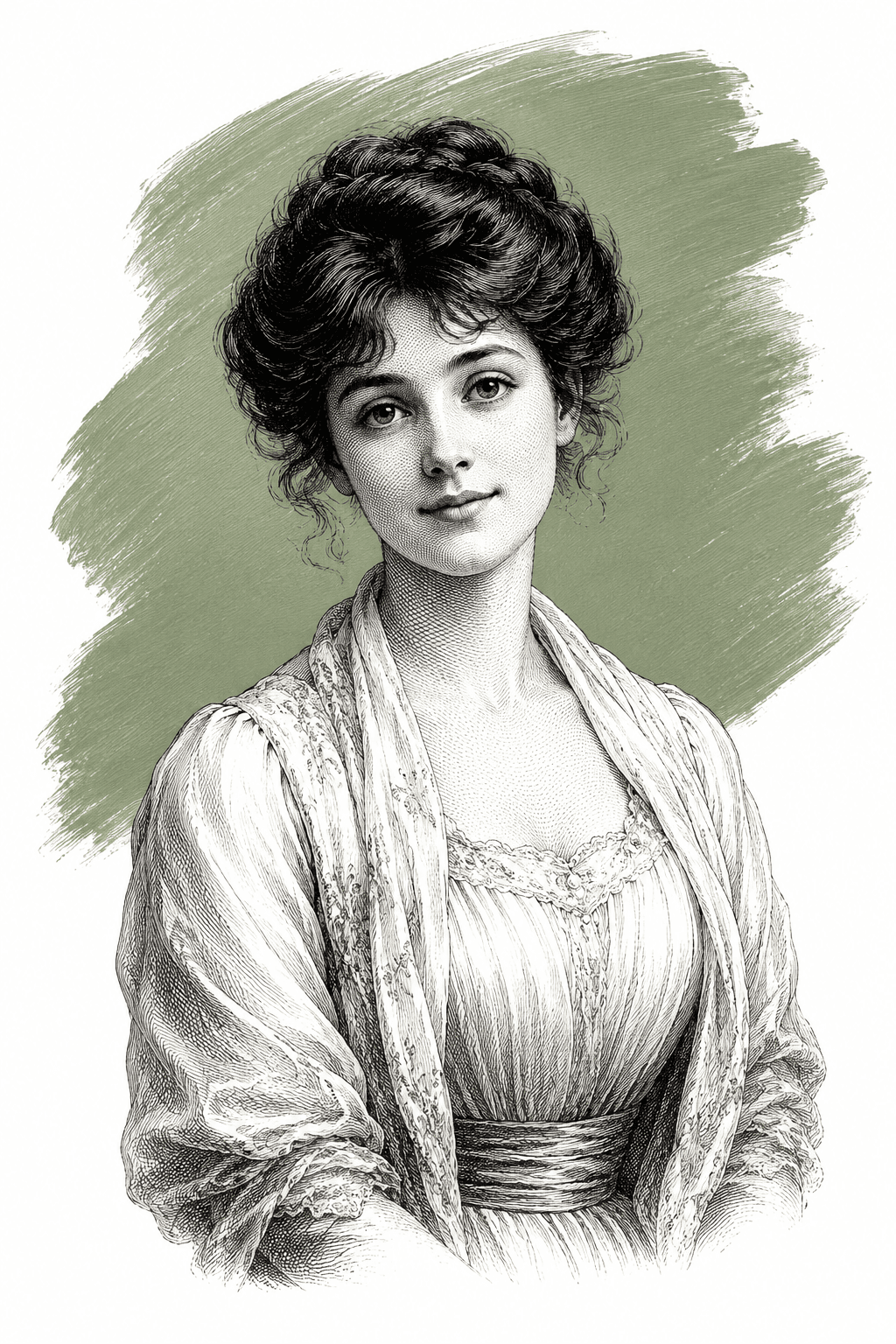
Marianne
Herbert's wealthy current wife — the fortune his plan depends on, and the marriage that leaves no room for Julie.
To do what her husband asks of her. She sits up all night when he collapses, and when he tells her to go and see the wife he had before her, she goes.
The book

At a glance
- Thirty-five
- Marianne-Hélène Anfredi, widow of Ludovic-Ramon Hortiz
- First Ludovic-Ramon Hortiz, who died; then Herbert d'Espivant, three years before the novel opens
- One son, Toni — Antoine-René Hortiz — seventeen years old, of whom she is the legal guardian
- Overseas mining and commodities, run from offices by a clerk named Saillard
- Not a dowry. She put all her property at his disposal, which left him owning nothing
- In person, only in the seventh of the novel's eight chapters
Who they are in the book
Spoiler-freeMarianne is the present wife of Herbert d'Espivant, who used to be married to Julie de Carneilhan, the woman Colette's 1941 novel is named after. She is thirty-five, very rich and very beautiful, and she is the person the whole plan in the book is aimed at. Herbert wants Julie to produce an old receipt showing that he owes her a million francs, because Marianne hates his debts and will settle one she can see written down.
Her money came from a first marriage. Her full name in her own lawyers' paperwork is Marianne-Hélène Anfredi, widow of Ludovic-Ramon Hortiz, and she has one son from that marriage, a seventeen-year-old called Toni, whose guardian she legally is. The fortune is in minerals and commodities abroad, and it is not the kind of wealth anybody can simply spend. Herbert describes it as an administration: files, cold offices, calculating machines and, at the end of a corridor, an untitled old clerk called Saillard who decides what may and may not be bought.
The two people who talk about her for most of the novel are her husband, who lies to her constantly, and Julie, who has never met her and has decided in advance that she is a rich curiosity rather than a person. Both of them are wrong about her in the same way, and the book quietly lets that show. When she finally appears in person, more than two-thirds of the way through, she is calm, direct and rather dignified, and she is the only one of the three who does not know what is actually going on.
How Marianne Is Portrayed
- The hair, which everybody mentionsDark red-brown hair, and Julie confirms privately that none of it comes out of a bottle. She wears it as a diadem of braids crossed and re-crossed over her ears and tight across her forehead and temples. Herbert says that in the early days it was so long and so thick when it spread across his bed that it frightened him.
- How Colette describes her faceSkin with no transparency in it, the grain and opacity of marble, which reads as pallor until daylight makes it rose. Very large dark eyes, wide open like eyes in ancient Greek painting, lashed on both lids, the whites tinged with blue. A full outlined mouth with a small hollow at the corner. Julie's verdict is that she is a magnificent creature with no idea whatever of what suits her.
- She pays, she does not giveThe line is Herbert's, and he means it as a complaint. On the day he collapses, callers arrive all afternoon and she promises them a bridge, a school, a wash-house and an orphanage. Then the estimates will be submitted, and she will have them examined, and that will take time.
- The money does not obey her eitherBecause she is her son's guardian she is answerable for the capital, and Saillard's office holds her to it. He has pointed out that her diamonds were reset when she remarried and that a new set of emeralds was bought recently, and refused the estate and the small Fragonard her husband wanted. She goes to Saillard, comes back with a long face and says it did not work, Saillard will not.
- Her sonToni is seventeen and remarkably good-looking, and she gives him money in drops because she believes that is how it should be done; her husband used to slip him five louis on the side. He is in love with Julie de Carneilhan. Halfway through the book he stays out all night, leaving a note saying he will never set foot in the house again, and Marianne goes looking for him herself. He is found unconscious at the Hôtel Continental, having taken veronal, with a photograph of Julie beside him, a letter saying he was killing himself, and a note from Julie turning down a meeting. He survives, and his mother sends him to the Swiss mountains to recover.
- The night her husband collapsesShe stays up the whole night at his bedside. In the morning he tells Julie that Marianne is resting, and has the two of them served a lunch of fruit in his room. There is ham on the tray, which Julie says is unnecessary and which Herbert supposes his wife ordered. Julie, walking through the house, is fairly sure Marianne is behind the doors watching her go past, and she is right.
- She comes to Julie's flatShe turns up in person at four in the afternoon, in a black afternoon dress and a hat with a floating veil, and introduces herself at the door. She has left her pearls at home. She says at once that she is only there because her husband asked her to come, that he is genuinely ill today, and that she waited until his injection before leaving him.
- The way she talksA pretty voice, soft with something slightly sharp at the top of it. She is careful and formal and will not let a word past her: when Julie says her husband accepts that the claim is legitimate, Marianne corrects her — he said only that he would not contest it. Julie notes a naive, plain, unaristocratic quality in her and thinks she is being condescending about it. It does not stop Marianne getting through the interview better than she does.
The visit to Julie's flat is Herbert's doing, and he has prepared it by lying to his wife. He has told her that Julie's claim came with threats about his name and his reputation attached, and has dated the whole thing a fortnight back rather than to the letter Julie actually sent two days before. Marianne repeats the fortnight, Julie hears the discrepancy, and says nothing.
So Marianne arrives believing she is dealing with a blackmailer, and behaves better than that: she says she would understand a woman driven to arguments of last resort, and she keeps offering Julie a way out. Julie, who could clear herself in a sentence and destroy Herbert in the process, tells her instead that her husband has told her the truth. Marianne's answer is to say that a woman cannot always be equal to circumstances, and that they should not think about it any more.
Then Julie bursts into tears, and Marianne says the tears have moved her, and that seeing Julie she would doubt her own ears about what her husband was forced to explain to her. She is that close to the truth and does not get it, because the only person who could tell her has chosen not to.
On the way out she leaves an envelope on the table without a word about it — a hundred thousand francs in new notes. Julie's last thought about her is that whatever else she is, she is not a woman who loses her head. Marianne ends the book still married to Herbert, still not knowing what he did, and out a hundred thousand francs at the least.
If you like Julie de Carneilhan


If you like Colette
Explore authors with a similar voice, perspective, and influence.

Henry Miller
The Brooklyn dropout who arrived in Paris broke at thirty-eight and wrote the exuberant, banned books that ended American censorship.
View author
Louis-Ferdinand Céline
The doctor of the Paris slums who wrote the century's blackest, funniest novel — and changed the sound of French prose.
View author
Martha Gellhorn
War correspondent who covered the Spanish Civil War, D-Day, and conflicts across five more decades; Hemingway's third wife, 1940–1945.
View author