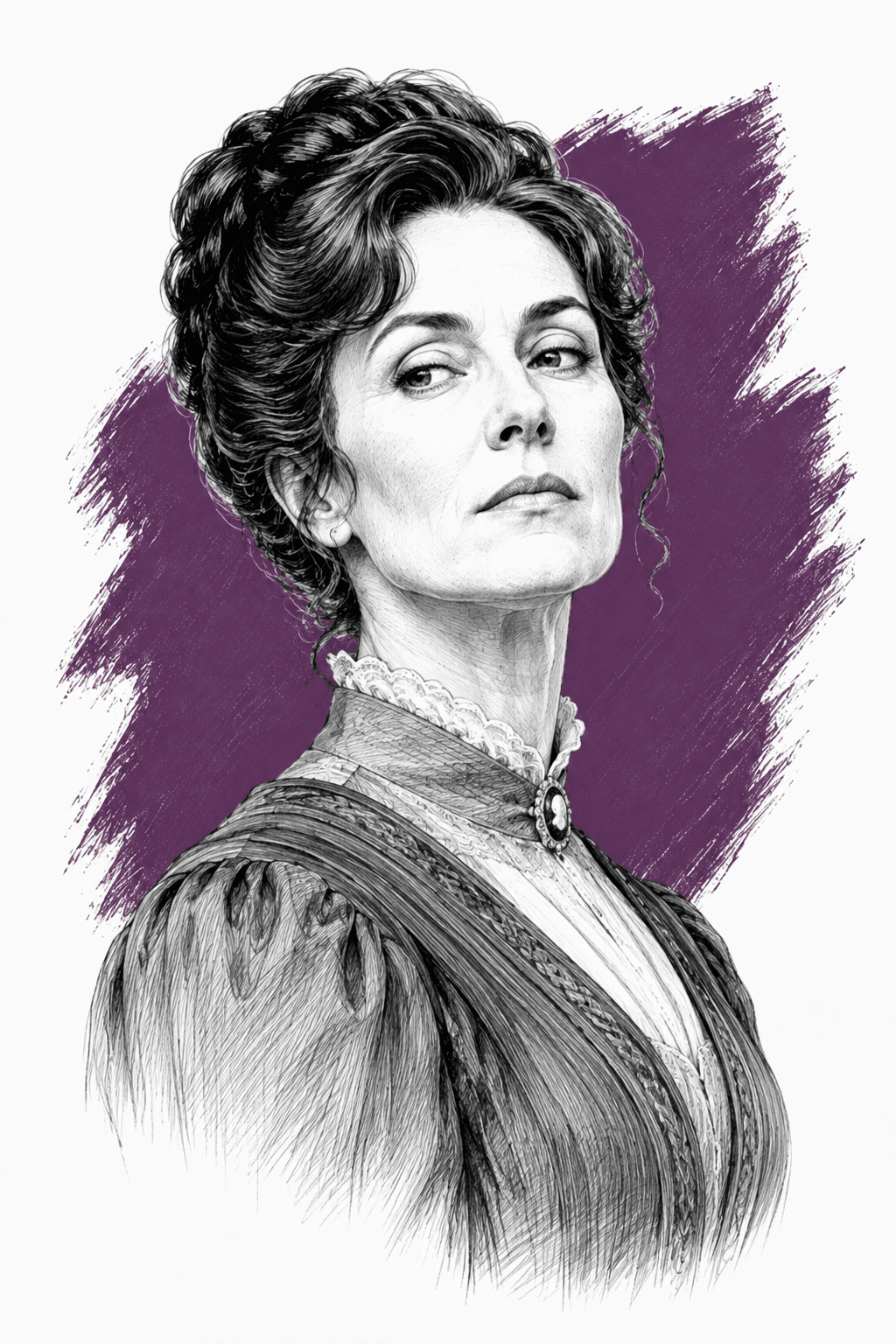
Alice
Widowed after the events of Duo, she returns to her sisters and the family flat — grief absorbed into the household she came from.
Not to be alone at night. She turns up at her sisters' door at midnight on the first evening and says so without embarrassment, and by the end she is planning to move back into the flat and do it up.
The book

At a glance
- The sister who comes home; the whole novel runs over about two days in May, almost all of it in one Paris flat
- Three weeks earlier. Her husband Michel was found under a weir, barely marked by the water, with cherry petals in his wet hair
- The life insurance plus the sale of the country property — around 285,000 francs, which her sisters hear as an impossible sum
- Costume designer; she keeps her sketches for a show called La Reine Aliénor at the married flat
- One of the four daughters of a piano and sight-singing teacher named Eudes, now dead — his cherry-wood pipe is still on the desk. Her sisters are Colombe, Hermine and Bizoute, who is abroad
- The toutounier: the family's word for the huge sagging sofa in the studio, which the sisters have shared since they were girls
Who they are in the book
Spoiler-freeAlice is the widow at the centre of Le Toutounier, a short novel the French writer Colette published in 1939. It opens with her climbing the stairs of the Paris flat she grew up in, feeling the bent ring of the old key in her hand. Her husband Michel drowned three weeks earlier in the river below their country house, and she has spent those three weeks alone down there dealing with the insurance company, the notary and the men who want to buy the land. She is still wearing mourning black with a short crêpe veil when she arrives. She has it off and a borrowed mustard-coloured dress on within a few minutes.
The toutounier of the title is the enormous, indestructible English sofa in the middle of the studio flat, sagging in the centre like a forest track after rain. Toutounier is a word the family made up. The four Eudes sisters have slept on it together since childhood — piled in, arms and legs across each other, a plaid rug for a blanket — and the word has come to mean the sofa, the flat, and the whole way of behaving that goes with them. Alice has come back to it because she cannot bear to spend a night in her own married flat.
Colette wrote the book as a sequel to Duo (1934), which is the story of Alice's marriage and ends with Michel's death; but the two books work in opposite directions, and this one needs no advance knowledge of the first. Duo shut two people in a house together. Le Toutounier opens a room to three sisters over about two days in May, and its subject is what a woman does with grief when her family will not let her make a performance of it.
What is unusual about Alice's mourning is that it is mostly anger. She thinks her husband should not have died, and says so plainly. She also tells her sister that drowning by accident at six in the morning is a suspicious thing to do; asked straight out whether she believes it was deliberate, she says no, and then, more quietly, that it is possible. Either way her verdict is the same: a suicide is a shabby thing whatever caused it. Underneath that, in the parts of the book where nobody is watching, she is frightened of the dark and of her own front door.
How Alice Is Portrayed
- The first thing she does is take off the blackShe arrives from the funeral in mourning, snags the crêpe streamer on her hat against a sheet of music, and goes straight to the cupboard for a two-piece in mustard jersey that belongs to one of her sisters. When one of them asks whether she means to go out like that, she says she has left all the crêpe in the cupboard, that she will put it back on tomorrow, and that it is nobody's business but hers.
- She is angry with her husband for dyingHer grief keeps turning into a grudge. People do not die that stupidly, she tells her sister; you do not fall in a river like an idiot, or else you swim. She says she is not very pleased with him over this business, and that in her view he should not have died, and repeats it because she wants to be sure she has been understood.
- Three weeks of selling the estateBefore the book begins she has held off the insurance company, which opened an inquiry into the death, and dealt with two men who wanted the property. She would not sell to her husband's own farm manager, on the grounds that it would look cheap, so she invited the other buyer to lunch instead — armagnac, beef daube, a hare taken in a snare — and got her price. She now says she understands why country widows put on weight.
- The night she cannot stay in her own flatShe goes back to the married apartment intending to sleep there, opens her husband's study, and sees his yellow leather gloves lying on the desk with the fingers still bent into the shape of a hand. She starts to sweat, counts her heartbeats, decides she has had enough, turns the lights off behind her and walks out. Half an hour later she is knocking on her sisters' door saying she was frightened on her own.
- She takes over the moneyThe insurance and the sale will leave her better off than anyone in the family has ever been. She hands her sister a five-hundred-franc note the first evening for the asking, tells her she is an idiot for not saying sooner, takes charge of paying the concierge, and later offers to fund the move that will take one sister out of Paris. She says plainly that she does not like the money she has.
- She is the one who feeds everybodyLeft alone in the flat she buys fennel, smoked beef, rolls, cakes and fruit, lays the little worn pink cloth over the desk they use as a table, washes a pair of her sister's stockings in the sink because they were soaking there, and calls the others to eat with a rhyme the four of them have used since they were children.
- Grief that goes away and comes backIt never settles at a steady level. She catches herself thinking she must have his summer overcoat relined, and the correction sends the blood to her face. Then whole stretches pass in which she feels like a woman who never had a husband at all, and she tries to be ashamed of that and finds she is not.
- The second sight she has lostBoth her sisters can shut their eyes and describe exactly what their man is doing at that moment, in what room, with what expression. Alice watches them do it and works out that she can no longer do it herself, and wonders how little a dead husband weighs beside their appetite for what happens next.
Both sisters get what they want in the space of a single evening, and both of them will be leaving Paris because of it. Alice works out before they do that this makes her the odd one left over, and that the flat she has just come home to is about to be empty.
Lying awake on the sofa on the last night, she decides she will keep it: come back, clean it, repair it, hold it open in case either of them returns. She also puts to herself the question of whether she might one day be waiting for a man instead, and answers it with a flat no. The book closes before dawn, when the youngest sister creeps onto the sofa beside her; half asleep, Alice touches her head and calls her by the name of the fourth sister, the one on the other side of the world, and the lie is accepted on both sides.
If you like Le Toutounier


If you like Colette
Explore authors with a similar voice, perspective, and influence.

Henry Miller
The Brooklyn dropout who arrived in Paris broke at thirty-eight and wrote the exuberant, banned books that ended American censorship.
View author
Louis-Ferdinand Céline
The doctor of the Paris slums who wrote the century's blackest, funniest novel — and changed the sound of French prose.
View author
Martha Gellhorn
War correspondent who covered the Spanish Civil War, D-Day, and conflicts across five more decades; Hemingway's third wife, 1940–1945.
View author