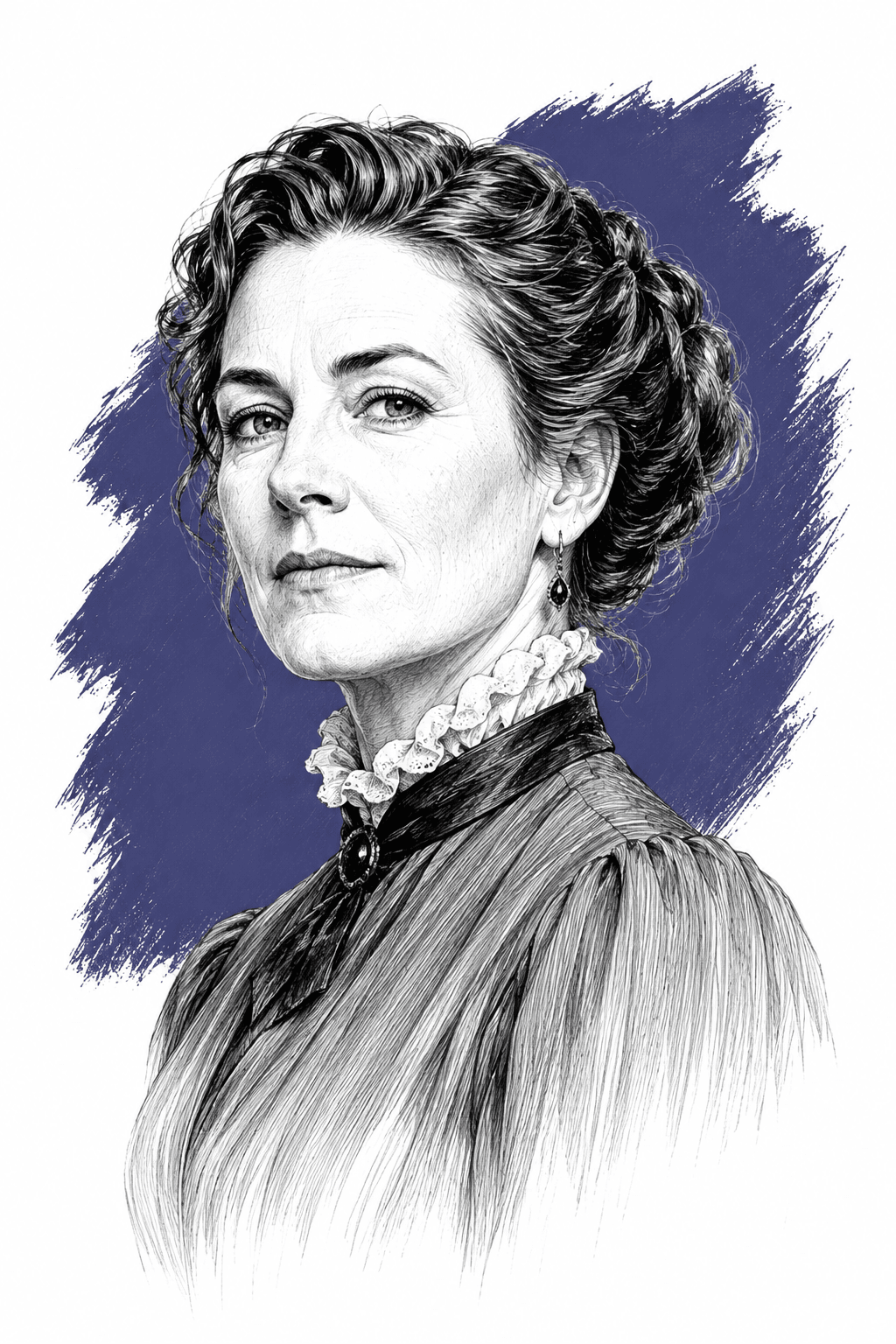
Alice's sisters
The self-supporting, plain-spoken sisters who take Alice back in around the toutounier — the durable female solidarity at the book's center.
The book

At a glance
- Two of the three sisters live in the flat where the novel takes place; the fourth is abroad and never appears
- They are the Eudes sisters, daughters of a piano and sight-singing teacher; their mother is never mentioned and their father is dead
- Thirty-four. Piano teacher, arranger, chain-smoker; sleeps on the sofa in her father's pyjamas. Attached for years to a conductor the sisters call the Balabi, whose real name is Carrine
- Twenty-nine, blonde by choice, formerly a fashion model and a film extra. Office work, and one married man she has been planning around for two years
- Married and absent, making documentary films in the Marquesas Islands in what the book calls sunlit poverty
- All of them tall, with heavy hair, wide well-set teeth and the flat nose Colette calls the family's; strangers take them for near-twins until they put on three different hats
Who they are in the book
Spoiler-freeThere are four Eudes sisters in Le Toutounier, a novel the French writer Colette published in 1939, and the book is named after their sofa. The toutounier is a made-up family word for the huge English divan that fills the studio flat they grew up in: indestructible, sagging in the middle like a rutted forest track, jammed up against the piano, made up at night with sheets tucked in anyhow and a plaid rug on top. They have slept on it in a heap since childhood. Over the years the word has stretched to mean the flat as well, and then a way of behaving — joking without laughing, ducking no subject, and not crying in front of anyone.
Their father, Eudes, taught piano and sight-singing and is dead; his cherry-wood pipe is still on the desk. They had no mother. Everything the four of them know about earning money they learned young, in a bad way: playing as a mediocre string quartet in cafés, modelling, sitting in theatre box offices, extra work at the film studios. They shared one outfit between two, one hat between three and a pair of gloves between four, and they still open each other's wardrobes without asking.
By the time this book starts there are only two of them in Paris. Colombe teaches piano all over the city and writes orchestrations at night for a married conductor she has loved for years without ever going to bed with him. Hermine, the youngest, has bleached her hair blonde and works in the office of a married businessman the sisters have nicknamed Monsieur Weekend. The fourth, Bizoute, married in a hurry while the others were away and is somewhere in the Pacific making semi-invented documentary films with her husband on almost no money. Alice, the widow whose return the book is about, is the third.
How Alice's sisters Is Portrayed
- The rules, which are numberedThey live by what they call the toutounier code and quote its clauses at each other by number. Paragraph three: no rows while people are eating. Paragraph four: never argue in public. Paragraph seven: what is yours is mine and what is mine is yours — a text one of them concedes may need revising, since it would mean swapping husbands.
- A private languageThey keep a working vocabulary invented in childhood and use it in front of each other every day. A hat is a tricbalous, a cupboard a padirac, cigarettes are sisibecques, the key is the busette and the plaid blanket is the dipla. Guézézi is the word for comfort, said over a sister who is crying and again over one who is asleep, to keep bad dreams off.
- Colombe, who works to the boneShe is thirty-four, smokes forty a day with a permanent cough, plays with one eye shut against the smoke, and gives lessons across Paris — two by the Val-de-Grâce, a choral class out in Auteuil — before sitting down to write scoring and transcriptions for the conductor she loves. He is married, his wife is seriously ill, and Colombe cannot always keep the hope out of her voice when she mentions it. One of his songs has been taken up by Maurice Chevalier, and she wrote all of it except the refrain.
- Hermine and Monsieur WeekendThe youngest is twenty-nine and has stopped taking the family teasing. She has spent two years training herself, in her own words, for one man: her employer, forty-five and married, whose real name comes out in the middle of the book. She has never slept with him. She has, however, sought out his wife and got to know her, which the middle sister considers the genuinely immoral part.
- The shot that does not go offHermine takes a revolver to the wife and pulls the trigger, and it clicks. The wife twists her wrist, takes the gun off her, puts it in a drawer, declines to call the police, and tells her she has cheap serial fiction in her blood and can go home. Hermine reports all of this to her sisters that afternoon and is chiefly annoyed at having been clumsy.
- Bizoute, who is not thereThe absent sister exists in the flat as a sheet of cardboard propped against the stovepipe, covered with snapshots: Bizoute on an atoll, Bizoute in a pareo with flowers in her hair, Bizoute holding up a fish. She married a man the others regard as a mistake, and their verdict on her is short — she is lost — and delivered without any suggestion that anything can be done about it.
- How they got through it beforeThe bad years come up over dinner. One Christmas the four of them were hired as a café orchestra from five in the evening until seven the next morning and did not dare eat in case they fell asleep on the floor. Hermine was fifteen, drank, was sick, and got a round of applause because the customers thought she was drunk. Colombe tried to go for a man with a chair.
- What they do instead of sympathyNobody says anything gentle to Alice about her husband for most of the book. When she starts to slide into it they click their tongues at her — tt, tt, tt — which is the whole of the reprimand and the whole of the comfort. When one of them cries at the restaurant table, the others look away and go on eating, and wait.
Both of them get their wish on the same evening, and the flat empties. The conductor is offered a season at Pau and festivals at Biarritz, and Colombe goes with him as his assistant — a job she can only take because Alice lends her the money, and which she describes, with some difficulty, as the first selfish thing she has ever done.
Hermine's man telephones that night to say his wife has asked for a divorce and that they will marry and go abroad, possibly to Madeira. She comes back into the room shaking, in tears, and is furious with him for keeping the news until the end of the call. Her sisters note that she is already proud of the damage.
The last scene of the book is Hermine climbing onto the sofa in the dark, between her sisters, for what the narration suggests may be the last time.
If you like Le Toutounier


If you like Colette
Explore authors with a similar voice, perspective, and influence.

Henry Miller
The Brooklyn dropout who arrived in Paris broke at thirty-eight and wrote the exuberant, banned books that ended American censorship.
View author
Louis-Ferdinand Céline
The doctor of the Paris slums who wrote the century's blackest, funniest novel — and changed the sound of French prose.
View author
Martha Gellhorn
War correspondent who covered the Spanish Civil War, D-Day, and conflicts across five more decades; Hemingway's third wife, 1940–1945.
View author