

Tender Is the Night
F. Scott Fitzgerald's novel of the same marriage and the same Riviera, published eighteen months later.
Read our takeSave Me the Waltz
Zelda Fitzgerald
Zelda Fitzgerald's only novel. A Southern judge's daughter marries a painter, follows him to the Riviera and Paris, and trains as a ballet dancer years too late.
Save Me the Waltz is the only novel Zelda Fitzgerald published. She finished the draft in March 1932 at the Phipps Clinic in Baltimore, where she was a psychiatric patient, and Scribner's published it on 7 October 1932.[1] The heroine, Alabama Beggs, is the daughter of a Southern judge. She marries a painter, David Knight, and follows him to New York, the Riviera and Paris. In Paris she takes up ballet, at an age when most dancers are already established.[2] The book retells the first ten years of the Fitzgeralds' marriage from Zelda Fitzgerald's side. F. Scott Fitzgerald was writing about the same years in Tender Is the Night at the time.[3]
Zelda Fitzgerald was already working on a novel in January 1932, on a trip to Florida. On 12 February she entered the Phipps Psychiatric Clinic of Johns Hopkins Hospital in Baltimore. Her doctors let her write for two hours a day, and on 9 March Dr. Mildred Squires told her husband the book was finished.[2]
She sent the typescript straight to Maxwell Perkins, her husband's editor at Scribner's, before F. Scott Fitzgerald had seen it.[2][4] He was angry when he read it. He had been working for four years on a novel about their life in Europe, and he believed parts of hers took his material. After a month of revision in Baltimore, with her husband close by, Perkins accepted the book for the autumn of 1932.[2]
The title came from a record catalogue. Nobody knows what Zelda Fitzgerald first called the book, because her drafts are lost. She dedicated the novel to Dr. Mildred Squires.[2]
Scribner's printed 3,010 copies at two dollars. About 1,400 sold, and reviewers were unkind. The book had barely been copy-edited, and the first edition is full of errors.[2] Her earnings from it in 1932 came to about 120 dollars.[2][5]
The novel was hardly read for more than thirty years. Southern Illinois University Press brought it back in 1967, and the text needed more than 500 corrections.[6][7] Nancy Milford's biography Zelda (1970) revived interest in her life, and scholars now teach and write about the novel more and more.[4]
The novel has four parts. The first opens in a Southern town, in the house of Judge Austin Beggs, a stern and distant father. His youngest daughter, Alabama, is the wildest of three sisters. During the First World War she meets David Knight, a painter serving as an army officer, and marries him.[2][3]
David Knight becomes successful fast, and the couple become celebrities in New York. A visit from Alabama's parents to their house in Connecticut goes badly. Alabama sees that she can no longer live by her father's rules.[2]
In the second part the Knights have a daughter, Bonnie, and go to the French Riviera. Alabama falls in love with a French naval aviator, Jacques Chevre-Feuille. She does not sleep with him, and he talks her out of leaving her husband.[2] The episode draws on Zelda Fitzgerald's own attachment in 1924 to Edouard Jozan, a French aviator.[8]
The Knights move to Paris, where the parties never seem to end. David Knight has an affair with an actress. Alabama decides to become a ballet dancer and begins lessons with a Russian teacher known as Madame.[2][7]
The third part follows her training. She works for hours every day, and the studio matters more to her than her husband or her daughter.[2][3]
In the fourth part Alabama accepts a place with a ballet company in Naples and dances her first professional role there. A blister on her foot becomes infected, she gets blood poisoning, and the operation ends her dancing for good.
The Knights go home to the South because Judge Beggs is dying. After his death they give a party, where David is admired as usual. Alabama empties the ashtrays too early and tells him she is ready to go on. The Knights then prepare to leave the South together.
By March 1932 F. Scott Fitzgerald had about 50,000 words of the novel that became Tender Is the Night. He told Dr. Mildred Squires that Zelda Fitzgerald had heard those chapters, and that one whole section of her book imitated them.
His other complaint was about names. In her first draft the husband was called Amory Blaine, the hero of F. Scott Fitzgerald's first novel, This Side of Paradise. He asked Maxwell Perkins by telegram to wait for a revised version, and the name was changed.
Zelda Fitzgerald agreed to cut the passages he objected to, but she argued that the things that had happened to them both were hers to use too. She said the revision would be made on artistic grounds. Matthew J. Bruccoli, the Fitzgerald biographer, found that only a few corrections on the surviving proofs are in F. Scott Fitzgerald's hand.
Tender Is the Night came out in April 1934, eighteen months after Save Me the Waltz. Readers have compared the two novels ever since. Alabama is jealous of the attention her husband gets and is trying to fill an empty life. Nicole Diver, the wife in Tender Is the Night, is jealous without reason and given to sudden outbursts.
The ballet chapters come from Zelda Fitzgerald's own training in Paris. The Fitzgeralds rented a flat at 58 rue de Vaugirard from April to August 1928. In mid-summer 1928 she began lessons with Lubov Egorova, a former ballerina and one of the leading teachers in Paris.
Gerald and Sara Murphy had recommended Lubov Egorova, who taught their daughter Honoria. Her studio was above the Olympia music hall. Morning and afternoon lessons cost 300 dollars a month, and Zelda Fitzgerald wrote magazine stories partly to pay for them herself.
In September 1929 the San Carlo Opera ballet company in Naples offered her a solo part in Aida. She turned it down, and nobody knows why. In the novel Alabama accepts the same kind of offer and goes to Naples alone.
In April 1930 Zelda Fitzgerald broke down and entered the Malmaison clinic outside Paris. The doctors there recorded that she kept saying she had to go and see Madame, her dance teacher. In the novel the head of the studio is simply called Madame.
F. Scott Fitzgerald used their life in several books. Here the same courtship, the Riviera summer and the Paris years are told by the wife.
The two novels were written at the same time from the same material, and F. Scott Fitzgerald asked for cuts to hers. Reading both shows what each of them saw.
The ballet chapters come from Zelda Fitzgerald's training with Lubov Egorova in Paris in 1928 and 1929. The novel follows the daily work of a dancer in detail.
She finished the draft in a few weeks as a patient at the Phipps Clinic in Baltimore. Save Me the Waltz was her only novel.
1928
The Fitzgeralds rent a flat at 58 rue de Vaugirard in Paris, and Zelda Fitzgerald begins ballet lessons with Lubov Egorova.
1929
In September the San Carlo Opera ballet company in Naples offers her a solo part in Aida. She declines.
1930
She breaks down in April and is treated at Malmaison, outside Paris, then at Prangins in Switzerland.
1932
She enters the Phipps Clinic in Baltimore on 12 February and finishes the draft by 9 March. She sends it to Maxwell Perkins.
1932
After revisions, Scribner's publishes the novel on 7 October in a printing of 3,010 copies. About 1,400 sell.
1934
F. Scott Fitzgerald's Tender Is the Night, drawn from the same years, is published on 12 April.
1953
Grey Walls Press publishes a London edition.
1960
Frances Scott Fitzgerald Lanahan, the couple's daughter, renews the copyright on 29 September.
1967
Southern Illinois University Press reissues the novel with a corrected text.
1991
The novel is reprinted in The Collected Writings of Zelda Fitzgerald.


F. Scott Fitzgerald's novel of the same marriage and the same Riviera, published eighteen months later.
Read our take
His earlier novel about the marriage, which Zelda Fitzgerald said used pages from her diary.
Read our take

Ernest Hemingway's memoir of the same Paris years, with his hostile portrait of Zelda Fitzgerald.
Read our takeThe Collected Writings of Zelda Fitzgerald
Zelda Fitzgerald
Reprints the novel with her play, stories, essays and letters.
Read our takeDear Scott, Dearest Zelda
F. Scott Fitzgerald
The Fitzgeralds' letters, including the ones Zelda Fitzgerald wrote from the clinics.
Read our takeAlabama Beggs, a Southern judge's daughter, marries a painter named David Knight. The couple become famous in New York and move to the Riviera and Paris. In Paris she trains as a ballet dancer, and in Naples an infected foot ends her career.
Yes, closely. Alabama and David Knight stand in for Zelda Fitzgerald and F. Scott Fitzgerald, and Bonnie for their daughter Scottie. The main change is the ballet job in Naples, which Zelda Fitzgerald turned down in 1929 and Alabama accepts.
She began it early in 1932 and finished the draft at the Phipps Clinic of Johns Hopkins Hospital in Baltimore. She was admitted on 12 February, and her doctor reported the book finished on 9 March.
He made her revise it. He objected that parts of it used material from his novel in progress, later Tender Is the Night. She rewrote it in about a month. Only a few corrections on the surviving proofs are in his handwriting.
Badly. Scribner's printed 3,010 copies in October 1932 and sold about 1,400. Her earnings from it in 1932 came to about 120 dollars.
Not yet in the United States. The copyright was registered on 7 October 1932 and renewed on 29 September 1960 by the Fitzgeralds' daughter, so it runs until the end of 2027.
Zelda Fitzgerald found the phrase in a record catalogue. Her original title is not known, because the drafts have not survived.
Explore authors with a similar voice, perspective, and influence.
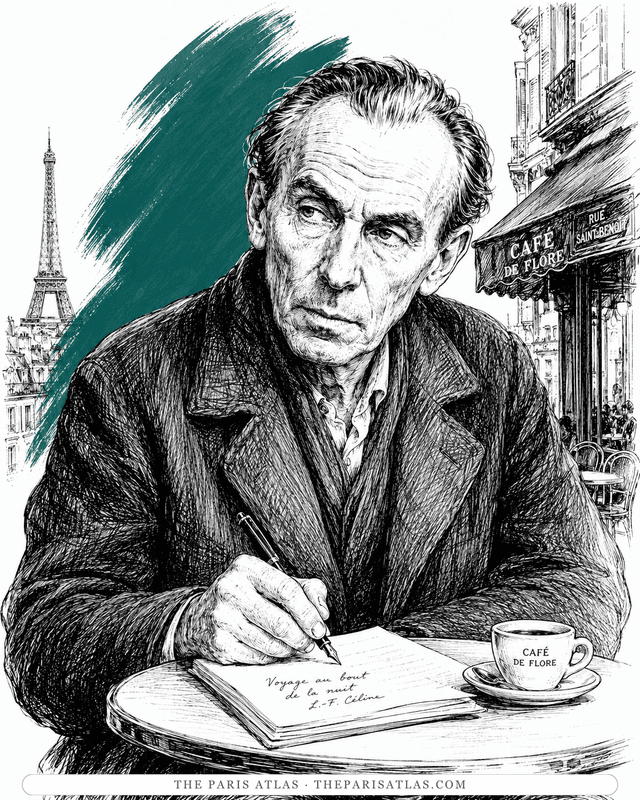
The doctor of the Paris slums who wrote the century's blackest, funniest novel — and changed the sound of French prose.
View author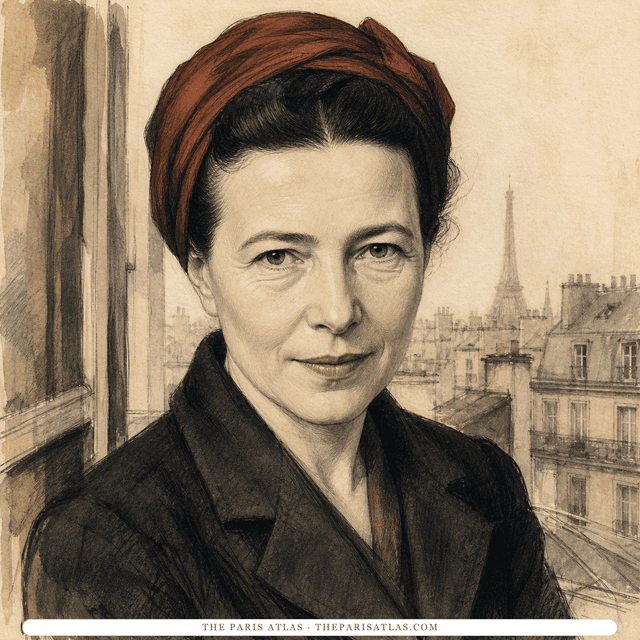
French writer and philosopher whose novels, memoirs, and social analysis examined freedom, gender, responsibility, aging, and the material conditions that shape a life.
View author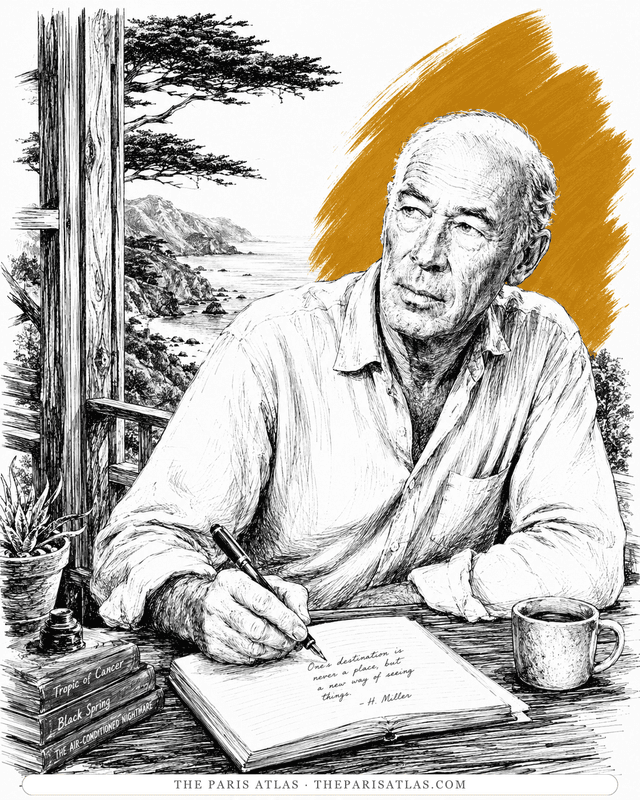
The Brooklyn dropout who arrived in Paris broke at thirty-eight and wrote the exuberant, banned books that ended American censorship.
View authorThe sources below include the primary text, editions, scholarship, archival materials, and other records that informed this page. They document Save Me the Waltz, its publication, and its place in literary history.


University of South Carolina chronology for the dates in Paris, Baltimore and publication.

Matthew J. Bruccoli's biography of F. Scott Fitzgerald: the writing at Phipps, the quarrel and revision, the print run, sales and royalties, and a summary of all four parts.
Encyclopedia of Alabama, for the royalties.
Catalogue record for the Southern Illinois University Press edition.
The editors' note identifying Edouard Jozan, page 68.
The same biography on 1928 to 1930: Lubov Egorova's studio, the San Carlo offer, and the Malmaison clinic report.
The copyright registration and 1960 renewal.
Catalogue record for the first edition.
Edition records for the 1953, 1971 and 2001 printings.
Publisher's page for the 2013 Scribner ebook.
Publisher's page for the Vintage Deco paperback.
The primary text represented by this page, used for descriptions of the work’s contents and for any quoted passages shown here.
The primary text is the baseline reference for every book page. Additional references document publication history, interpretation, and historical context where that evidence is available.
 Explore more resources