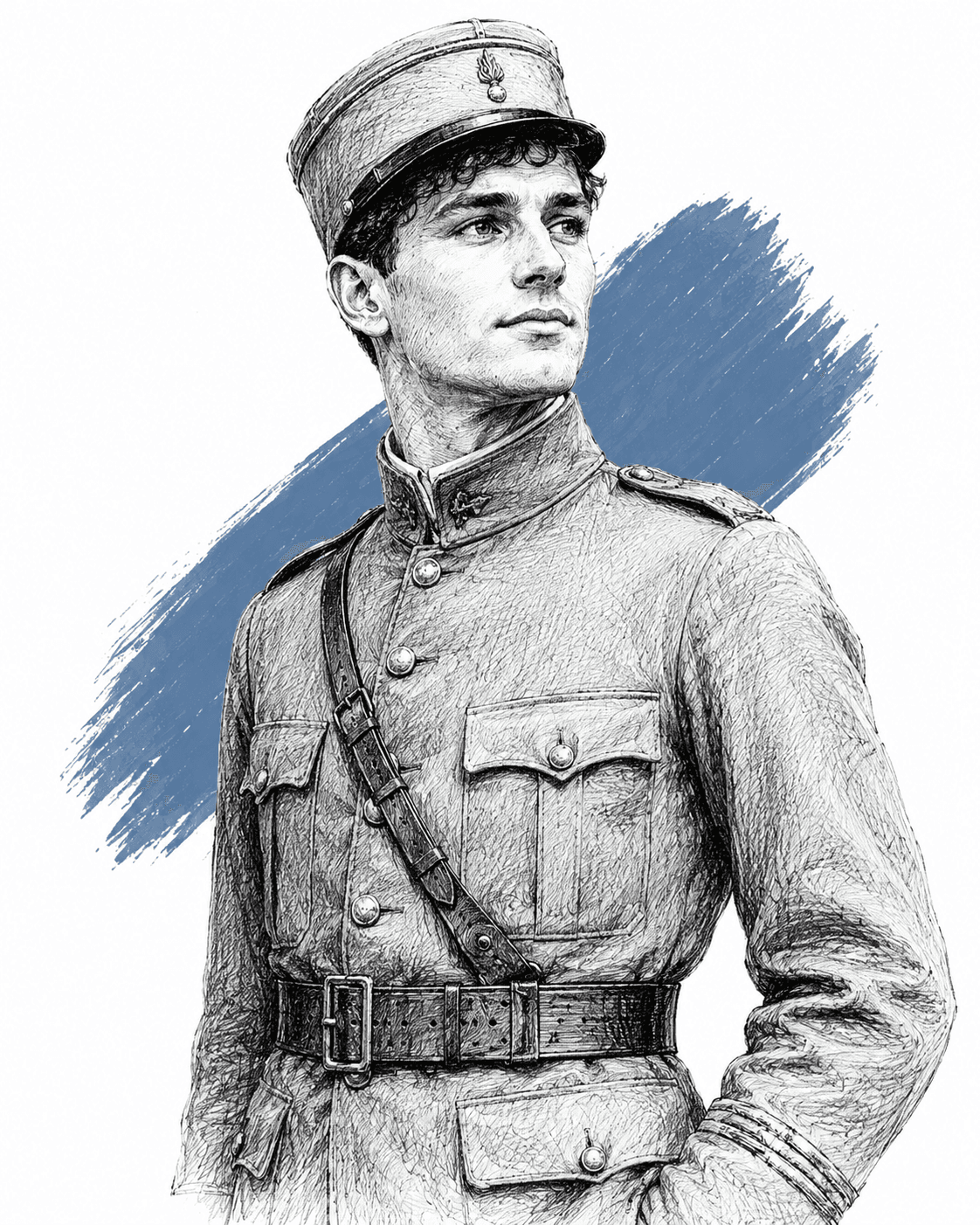
The Lieutenant Bleu
The army officer Mitsou meets backstage and falls for by letter. He names himself the Blue Lieutenant in his first letter, and he is the one who decides, on the last night of his leave, that the affair was a mistake.
To see Mitsou. One letter says it three times in a row — «J'ai envie de vous voir», I want to see you — and adds that he can think of nothing else to tell her.
The book

At a glance
- The officer at the other end of Mitsou's correspondence, from the opening dressing-room scene onward
- No surname is ever given. He signs every letter Lieutenant Bleu; the first name Robert appears only once Mitsou says it aloud
- Twenty-four, the same as Mitsou
- Sous-lieutenant — a second lieutenant — in the horizon-blue uniform the French army wore from 1915
- The front. By his own photograph, the German lines are four hundred metres away
- The khaki lieutenant, hidden in the same cupboard, whose leave ends before his
Who they are in the book
Spoiler-freeThe Blue Lieutenant is the man Mitsou writes to in Colette's novel Mitsou (1919). He is a second lieutenant in the French army, and the book identifies him by the colour of his cloth: from 1915 French troops wore a pale grey-blue called horizon blue, and the officer who comes into Mitsou's dressing room with him that night is in khaki. Colette names them the Blue and the Khaki, and her verdict is that the khaki one is very good-looking and the blue one is better. He picks the label up himself and signs his first letter to Mitsou Lieutenant Bleu, then signs every letter after it the same way. He is twenty-four, the same age as she is.
Mitsou has his real name from the start — Petite-Chose copied the names and addresses of both officers off a card the same night — and he knows she has it, and goes on signing himself the anonymous Blue Lieutenant anyway. She likes the nickname better and tells him why: my lieutenant would be ordinary, my Blue Lieutenant is nice. The one time she says his real name aloud, months later and with her eyes shut in his arms, it is a first name only, Robert, and Colette's stage directions begin calling him Robert from that line on. No surname is ever printed.
What he is, on paper, is a young man with very little behind him. He tells Mitsou that the war took his generation at the school gate and made men of them, and that they will always be short of having been young men — short of the years in which you learn the pitch of your own voice, the habit of freedom and of family, and how to approach a woman who is not thinking about your desire or your money. He is afraid of what he will bring her when the leave comes: an aged schoolboy, or a man too young, ripened on one side and green on the other.
He is also a great deal quicker with words than she is, and he uses it. His first letter is a joke at the expense of her dressing room, and his second a joke at the expense of her reply. She answers that some of it reads as though he were taking her for somebody else, and that if he wrote those passages hoping she would not follow them, it is not a very high-class pastime for a young man.
How The Lieutenant Bleu Is Portrayed
- Why he is called the Blue LieutenantThe French army's uniform from 1915 was a pale grey-blue known as horizon blue. He is wearing it the night he is pushed into Mitsou's dressing room; the friend with him is in khaki; and Colette identifies them by nothing else. His first letter opens by telling Mitsou that he is the blue lieutenant, on his own now, because his friend's leave ran out before his did.
- The night in the cupboardPetite-Chose, a performer in the same revue, smuggles the two of them into Mitsou's dressing room to hide them from Boudou, the seventy-two-year-old stage doorman, who has just caught a soldier in another woman's wardrobe. They stand flat against the back of the cupboard, and Colette says they would not swap places for a war medal. He comes out once, to fasten four hooks on the back of Mitsou's belt.
- What Petite-Chose noticedShe gives Mitsou and Mitsou's protector the inventory: an eye of flame, the mouth, and small nostrils that flutter when he breathes hard. Colette has already put his head beside Mitsou's in the dressing-table mirror — two dark young heads with big eyes, alike enough to be brother and sister.
- The first presentTwo days later he sends cut glass from a shop called Dauvel: two flasks and what he takes to be a powder box. The covering letter is not gallant. He points out that the powder in her dressing room is escaping from its original packet and the litre of verbena toilet water still carries a department-store label, and supposes she spent the month's wages on the car waiting for her outside. Mitsou's dresser then informs her that the powder box is a jam pot.
- He refuses a war godmotherFrench soldiers were paired with civilian women who wrote to them and sent them parcels — marraines de guerre, war godmothers. He tells Mitsou he has none and wants none. His friends, his fellow officers and his own men have gone in for such an orgy of letter-writing and such a squandering of godmothers that he keeps clear of it, full up, he says, before he has started.
- The two useless things he asks forMitsou offers to send him things of no use, on the grounds that a family sends what is useful and nothing else. He names two: a photograph of her, and a piece of strawberry-coloured velvet the size of his two hands, to cover a book he loves, in the exact shade of the stockings she wears as the Rose Jacqueminot. A later letter tells her he has been keeping the velvet against him while he sleeps.
- The photograph he sends backIt is yellowed and unmounted and he says he looks ugly in it, his nose wrinkled against the sun. He then identifies the small ripple visible in the distance, through the gap between two walls of earth: the German lines, four hundred metres off.
- A night on guardMitsou asks him outright whether a night on guard duty is dangerous. Not very, he answers, but it is a trial in which the length of the night makes two things heavy: responsibility and solitude. Responsibility is the lighter of the two, because you can measure it and you are equal to it. Solitude fills a man with dreams, with shivers, and with calls he has to hold down.
He gets forty-eight hours in Paris accompanying a captain, and goes to Mitsou's flat for tea. He does not recognise her. He had seen her once in strawberry stockings and tulle, and had drawn her a hundred times since against the sky over the trenches, and the woman holding out her hand is a pale girl in a black dress. He finds her pretty and touching, kisses her hand, and does not dare kiss her cheek.
Dinner at the restaurant Lavoie, near the Madeleine, is where it comes apart, quietly. He orders lobster, which he has not eaten in four months, and chicken with morels, and describes a Bordeaux that smells faintly of coffee and violet; she asks for mayonnaise with the lobster, salad with the chicken, cherries in ice because they have lost their flavour and that is funny, and a champagne with no taste. He works at the evening, fails, notices that he does not want her, and tries to talk himself into it by watching the Americans at the next table admire her. Outside the music hall afterwards she tells him about a serious number in the coming revue called The Ivy of the Battlefield, and he laughs out loud at people who imagine ivy growing on a battlefield.
They spend the night together at her flat, and he falls asleep immediately afterwards. He wakes at five, looks at her and works out that he has stopped being in love with her. He is fair about it. She is better than the women he names by the month he had them, Lili of March and Cricri of last September; no affair has ever satisfied him less; and she is not a fool. What he holds against her is that she obliges him to think about her, and that she is plainly waiting for him to turn her into the woman he will love. He decides that work belongs to someone older and more patient than a soldier of twenty-four, says goodbye to her under his breath while she sleeps, and then wakes her cheerfully with good morning.
That afternoon the captain leaves and his leave goes with it. He sends a letter round by a private, cancelling the drive in the Bois and the second night, telling her to write to him, and joking that if she takes up with some other lieutenant dressed in blue he will at least get one last honest letter out of it. He signs it Lieutenant Bleu. The novel then gives the last word to Mitsou's reply and prints no answer to it.
If you like Mitsou


If you like Colette
Explore authors with a similar voice, perspective, and influence.

Henry Miller
The Brooklyn dropout who arrived in Paris broke at thirty-eight and wrote the exuberant, banned books that ended American censorship.
View author
Louis-Ferdinand Céline
The doctor of the Paris slums who wrote the century's blackest, funniest novel — and changed the sound of French prose.
View author
Martha Gellhorn
War correspondent who covered the Spanish Civil War, D-Day, and conflicts across five more decades; Hemingway's third wife, 1940–1945.
View author