Minet-Chéri
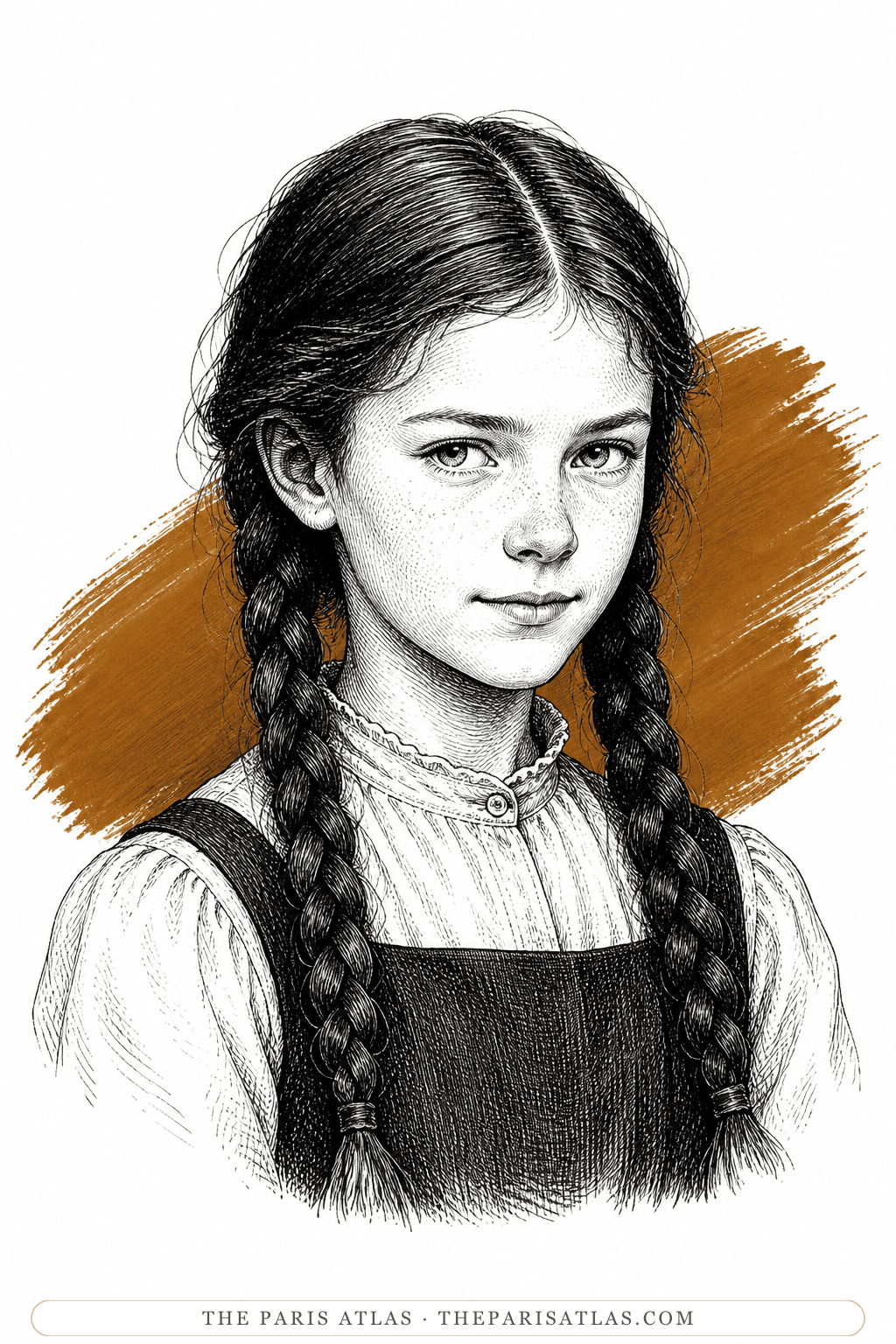
The child Colette, called by her mother's pet name — the watching, remembering center from which the sketches are recovered.
To be outdoors and unaccounted for: over the gate with her shoes off, up the walnut tree, off after her brothers into the woods, and home before the lamps are lit.
The book

At a glance
- The child at the centre of the memories, and the adult voice remembering them
- Minet-Chéri by her mother, la Petite by the village and the book, Bel-Gazou by her father
- Seven when her brother builds his cardboard cemetery, not quite eight on the garden wall, nine the night she is carried downstairs, twelve with the plaits, thirteen and a half at the maid's wedding, fourteen when she steals the Zola, fifteen in the sketch called Amour
- The youngest of four: Juliette and Achille from her mother's first marriage, then Léo, then her
- Long arms, a flat back, too small a chin, and greenish eyes that her smile pulled slanting. Her mother said she looked like her own father's other daughter, a newborn he brought home one day without saying where she had come from
- Paris at six, at eleven, and for a fortnight at sixteen. Otherwise she crossed the boundary of her district twice a year, for the winter and spring shopping, by carriage
- Colette, born Sidonie-Gabrielle Colette, who wrote the book · 1873–1954 · Saint-Sauveur-en-Puisaye, Burgundy
Who they are in the book
Spoiler-freeMinet-Chéri is Colette herself, as a child. The book is memory rather than invention, so the girl in it is the writer at seven, at nine, at thirteen, at fifteen, in the Burgundy village where she grew up. Minet-Chéri is what her mother called her. It is built on minet, the French for kitten, and means something close to darling kitten. The village and the book also call her la Petite, the little one. Her father called her Bel-Gazou, which Colette guesses is a southern dialect phrase for lovely chatter; years later she gave the same name to her own daughter.
She is the youngest of four. Juliette, her half-sister, read novels in bed all day behind a curtain of black hair so heavy that combing it exhausted their mother. Achille, her half-brother and the eldest, was in Paris finishing a medical thesis. Léo took watches apart, played back at the piano whatever he had heard once, and spent a year filling the garden with cardboard gravestones for people he had invented.
The child in these sketches is out of doors nearly all the time and unnervingly quiet. She goes over the garden gate rather than through it, takes her shoes off, comes home over a neighbour's low wall, and bleeds calmly from a split knee under a dressing of cobwebs and ground pepper. She reads whatever is in the house, which is a great deal of it. Her mother worries about her constantly and cannot find her.
She grows up inside the book. By the last sketches her mother is seventy-one and Minet-Chéri is a woman in Paris with cropped hair, blue on her eyelids and a career on the stage, being told from the sickbed that the heavy perfume she drowns herself in is there to mislead people into thinking she is original and free of prejudice, and that her mother, at least, is not taken in.
How Minet-Chéri Is Portrayed
- The word she refused to have explainedShe was not quite eight when she heard an adult say presbytère, the French word for the house a priest lives in. She did not ask what it meant. She kept it, slept with it, and carried it up onto the wall between the garden and the poultry yard, which was as wide as a pavement and served her as a private terrace. From up there she threw it at the horizon as a curse, telling invisible outcasts that they were all presbyteries. Later the word lost its venom and she decided it must be the scientific name of a small yellow and black striped snail. Then she made the mistake of showing her mother the pretty little presbytery she had found, was told what the word really means, tried to hold on to her own version, and gave in. She named the wall Presbytère instead and made herself its curé, which is French for parish priest: no vestments, no sermons, no disrespect, a curé the way other people are bald or arthritic.
- The night she was carried downstairsShe was nine, and her married sister's room on the first floor had just become hers. Her mother had started dreaming that she was being stolen. There was a story in the papers about a girl who had been abducted and shut up somewhere; a tramp turned away at nightfall had jammed his stick between the front doors until her father came; travellers on the road had offered, smiling, to buy the child's hair; and an old man who spoke to nobody had offered her sweets out of his snuffbox. One windy night two arms came under her back and her neck, gathered the sheet and blanket around her, and carried her down. She did not call out. The air on the stairs was colder and each step rocked her, and she half dreamed her way into an elopement out of an old engraving hanging in the corridor. She woke in her old attic cubbyhole, now full of ladders and broken furniture, where her mother had carried her in the night the way a cat moves a kitten, and where her mother was now asleep, worn out. Colette gives the child the last line of the piece: 'Mamaan! viens vite! Je suis enlevée!', which means Mummy, come quickly, I have been abducted.
- What she said she would be when she grew upSix village girls spent a whole Thursday in the garden acting out the adults they knew, and finished with a game about what they would be. Most named their mothers' shops: the clockmaker's girl would be a clockmaker, the grocer's a grocer. Jeanne said she would be a cocotte, meaning a woman kept by a series of rich lovers, and Minet-Chéri thought privately that this was babyish. Out of ideas, she said with contempt that she would be a sailor, because she sometimes wanted to be a boy in blue trousers and a beret; the sea and the ships came afterwards, as a background for the outfit. Then a lamp was lit in the drawing room, the garden turned blue and unfriendly, and she watched a hand with a bright thimble on it pass in front of the flame. She got up and went in, content to be a child of her village like the others, with a world that ends at a field boundary, a shop gate, and a circle of lamplight.
- What she liked about the butcher's shopOn some days Léonore's shop pleased her as much as a sweetshop. The knives, the hatchet, the inflated ox lungs swaying in the draught, pink as begonia flesh. Léonore cut her a transparent ribbon of salt pork and handed it over with cold fingers. In the yard behind it a girl born on the same day as her was still amusing herself pricking pigs' bladders and pressing them underfoot to make a fountain. The sound of skin coming away from fresh meat, and the kidneys sitting round in their white fat, produced a complicated disgust that she went looking for and hid. The fine fat left in the cloven trotter when the fire burst a dead pig's feet she ate as a wholesome treat.
- The books in the houseBefore she could read she used to curl up between two volumes of the Larousse dictionary like a dog in its kennel. Nobody bought her children's books. She read Labiche and Daudet early, then Mérimée, who dazzled her eight-year-old self with things she could not follow, and Les Misérables. She refused Dumas's musketeers outright, and she would not read Perrault's fairy tales at all: she got two pages in and went back to looking at the engravings. Her mother worked through the eighteen volumes of Saint-Simon at her bedside and was puzzled that an eight-year-old did not share the pleasure. Her verdict on the rest was that her daughter was intelligent enough to keep to herself whatever she understood too well, and that there are probably no bad books.
- The Zola she stoleHer father kept the whole of Zola locked in a desk. Her mother handed over three of the novels. At fourteen, offended that one corner of a house where the doors banged and the cats came in at night had been bolted against her, she took one of the others into the garden. It was a mild story about heredity until a frail young wife gave birth, in sudden anatomical detail, with the colour and the smell and the noise all supplied. None of it matched what a country girl already knew from watching animals and listening to farmers' wives talk about a heifer or a daughter in labour. She tried to summon her mother's voice against it, the one that said she had taken three days and two nights to be born and had never been regretted for a minute, and could not hear it. The garden went blue, the walls went the colour of smoke, the sky went yellow, and she fainted in the grass. She came round at her mother's feet with eau de Cologne being rubbed on her nose, and was told that what she had just had was a good little tap on the head from the finger of God.
- Drunk on the campaign trailHer father took her along on his election lectures, and afterwards to the bar, where he stood the parish council a drink. He drank fizzy water. She was given mulled wine and knew her manners: she called for the jug to be brought level with the brim, wished the company good health, clinked, drank, banged the empty glass down and wiped the sweet burgundy off her lip with the back of her hand. Then ten or fifteen kilometres home under the winter stars, asleep in the bottom of the carriage, rolled in the red tartan shawl that smelled of iris and her mother. She was, she says, perfectly drunk. Her mother put the state of her down to tiredness for a while, then one evening smelled her breath.
- Her plaits, and what she used them forAt twelve she had the speech and manners of a rather gruff, intelligent boy, and two long plaits that whistled around her. She used them as rope through the handle of the lunch basket, as brushes to dip in ink or paint, as straps to correct the dog and as ribbon to play with the cat. Her mother had to get her up half an hour earlier than the other schoolchildren to deal with them, and on black winter mornings she fell asleep sitting in front of the wood fire while her head was brushed. Long hairs turned up on the low branches in the garden and on the frame that held the trapeze and the swing. A chick in the yard was taken for lame from birth until they found a single hair grown over with flesh, tied tight round its leg.
- The wedding she went to for the foodShe was thirteen and a half and talked her way into being a bridesmaid at the wedding of Adrienne Septmance, the family's maid. Her mother refused to be drawn into an argument and told her to save her breath and simply say that she adored servants' weddings. The barn was hung with unbleached sheets with a red June rose pinned to them. Five meat dishes, three puddings, a tall nougat centrepiece with a plaster rose trembling on top, and glass bowls of sugar lumps down the table to be sucked dipped in wine between courses, which loosens the tongue and brings the appetite back. One local celebrity drank white wine out of a milking pail; another was brought a whole leg of lamb and surrendered nothing but the bone. Full of rabbit sauce and sweet wine, she was as pleased with herself as an overfed adult. Then a friend walked her round the back of the farmhouse to look in at a lit window: the couple's room, a huge black pear-wood wardrobe, a high narrow bed stuffed with feathers, two bunches of roses and camomile going over in blue glass vases and smelling like a funeral. She had not thought about the bed. She ran across the lettuces and the asparagus beds, and when her friend caught up and asked what was wrong, she said, crying, that she wanted to go and see her mother.
- Her first jealousyAt thirteen she watched her eldest brother bring his best friend from Paris for two months of the holidays. Colette calls him Maurice and tells the reader to assume that was his name. She stole from him: illustrated papers, Turkish cigarettes, cough pastilles, a pencil with teeth marks in it, and above all the empty matchboxes with photographs of actresses on the lids, whose names she learned by heart. At bedtime she tried the effect of one of her mother's veils over a bare shoulder. For a week she was sulky, jealous, pale and blushing by turns, and then it wore off and she settled for being charming instead, in a big straw hat with her hands in the cake dough. Near the end of the summer she asked him what his fiancée would do while he was being a lawyer, and then whether, once he was married, he would still be able to come back and walk beside her brother holding her two plaits by the ends like reins. He looked around the garden, looked her over, shrugged and said no, obviously not. She writes that this was the first time she mixed a small victorious grown woman's grief into a child's regret.
If you like My Mother's House


If you like Colette
Explore authors with a similar voice, perspective, and influence.

Henry Miller
The Brooklyn dropout who arrived in Paris broke at thirty-eight and wrote the exuberant, banned books that ended American censorship.
View author
Louis-Ferdinand Céline
The doctor of the Paris slums who wrote the century's blackest, funniest novel — and changed the sound of French prose.
View author
Martha Gellhorn
War correspondent who covered the Spanish Civil War, D-Day, and conflicts across five more decades; Hemingway's third wife, 1940–1945.
View author