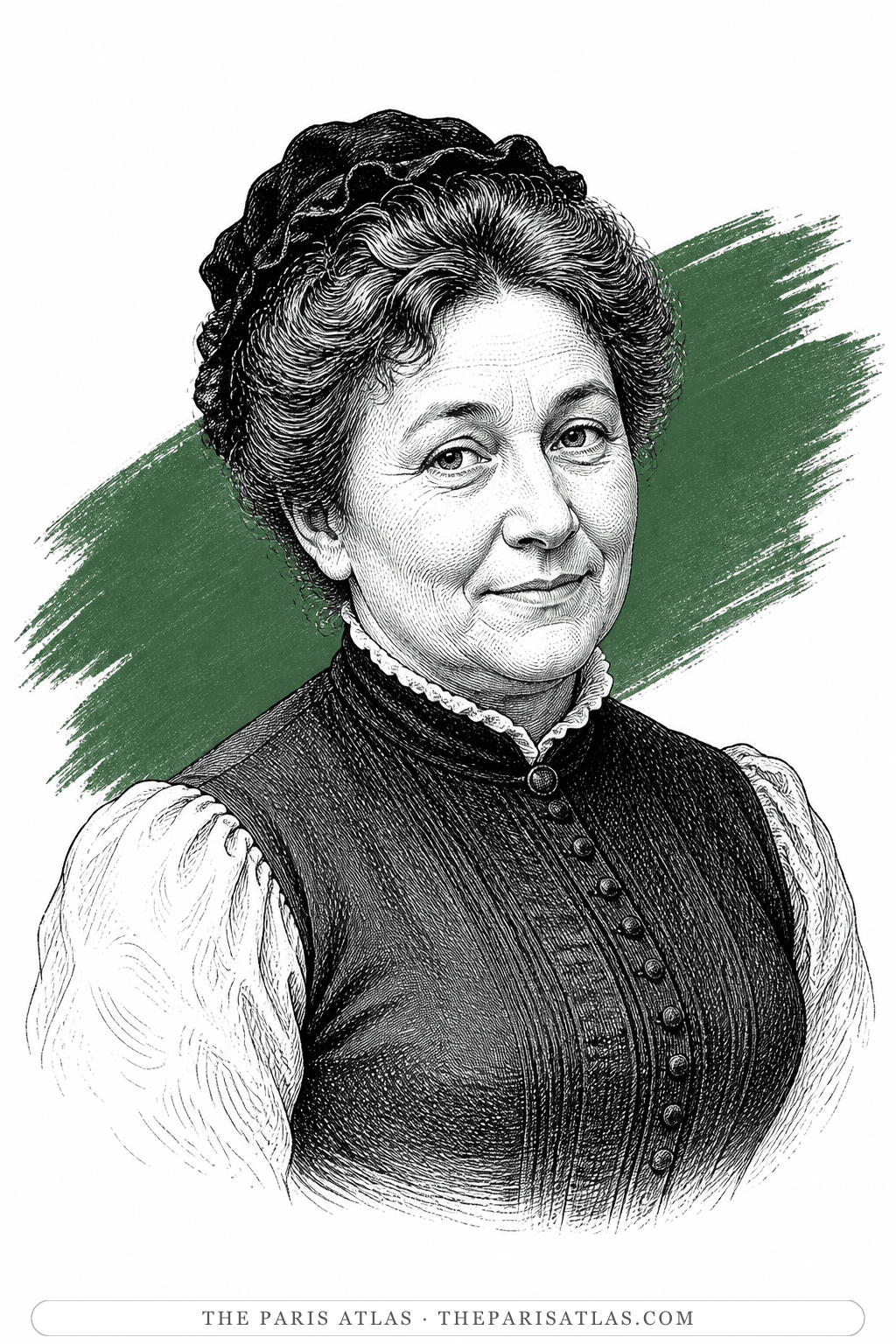
Sido
Colette's mother, Sidonie — the presiding figure of the book, attentive to garden, weather, and children alike, and the origin of Colette's greatest subject.
To keep the living things around her within reach and alive: the children she calls for across the garden, the caterpillar eating her shrub, the pregnant maid the neighbours want turned out.
The book

At a glance
- The mother. She is somewhere in most of the thirty sketches, and six of them carry her in the title
- Sido, short for Sidonie; maman by her children; Sido by her friend Mme Saint-Alban. She calls her husband by the family surname, Colette
- Fifty-four when her youngest child is fifteen; seventy-one in the last two pieces about her
- Twice. First at eighteen, to the Burgundy landowner the village called the Savage; then to Colette's father
- Four. Juliette and Achille from the first marriage, then Léo and Colette, the youngest
- The big dark-fronted house on the rue de l'Hospice, with a walled upper garden and a hot kitchen garden below it, in the Puisaye country of Burgundy
- Adèle Eugénie Sidonie Landoy, Colette's mother · Raised in Belgium; she came to Burgundy at eighteen on her first marriage
Who they are in the book
Spoiler-freeSido is Colette's mother, and she was a real woman. My Mother's House is a book of memories rather than a novel, so the people in it lived: Sidonie Colette kept a house in a Burgundy village, raised four children, gardened, and read at three in the morning when she could not sleep. Her family and friends shortened Sidonie to Sido, and Sido is the name her daughter used for her ever after.
She arrived in the village at eighteen, by an arrangement she had no part in. She had grown up in Belgium among her two brothers, who were French journalists, and their friends, who were painters and musicians and poets. She had no money, no dowry and no trade, and she lived at her brothers' expense. A landowner from the French forest country saw her one summer, made enquiries, and set the lawyers and the parents moving. The book says a girl in her position has nothing to do but keep quiet, accept her luck and thank God.
Colette's father was her second husband. By the time the sketches begin she has been in the same house long enough to have made it hers: the upper garden and the kitchen garden below it, the animals, the cats that produce kittens faster than anyone can count them, and four children she can never find.
Most of the thirty pieces have her somewhere in them and six carry her in the title. She calls her children in from a garden she cannot see them in, because she is short-sighted. She refuses to kill a caterpillar that is stripping her shrub. She goes to Mass without believing a word of it, and takes her dog. She is fifty-four when the daughter telling the story is fifteen, and seventy-one in the last pieces about her.
How Sido Is Portrayed
- Calling the children inThe first sketch is named for the question she asks in it: 'Où sont les enfants?', which means where are the children. She comes out under an old iron arch that the wisteria has pulled sideways, tips her head back at the sky, and calls. The call crosses the garden, hits the wall of the hay barn and comes back thin and worn out. The children are a few yards away and say nothing: one stretched along a thick branch of the walnut tree like a cat, another up in the loft with a book. She was too short-sighted to find them and had given up trying.
- What she had on when she calledHer clothes reported what she had been doing. White cotton sleeves meant she had been kneading dough for a flat cake, or a pudding sauced with rum and jam. A big blue apron meant she had washed the dog. Sometimes she waved a sheet of crackling yellow butcher's paper, because she was calling in her wandering cats at the same time as her children, and the cats came for raw meat.
- How she came to be married to the SavageThe neighbourhood called her first husband the Savage because he rode alone, hunted without a dog or a companion, and said very little. She left a warm Belgian house that smelled of gas and bread and coffee for a place with a white-and-gold drawing room downstairs, a first floor barely plastered, plenty of silver and wine, and nobody to talk to. She grew thin, and cried, and denied it. He worked out that something was missing, rode forty kilometres to the county town, and came back the next night with two things: a small mortar of rare marble for pounding almonds, and a cashmere shawl from India. She told her daughter it was the first unselfish thing he had done, and the last. She kept both objects for the rest of her life.
- She would not kill the caterpillarHer daughter came home from Paris at sixteen to find a caterpillar as thick as a thumb and more than ten centimetres long on a shrub in the garden, cabbage-green with hairy turquoise studs, the branch around it eaten down to bare stalks. Asked what she meant to do about it, Sido said that the shrub it was eating was strangling the honeysuckle anyway, and then that she could hardly kill the creature. Colette files that sentence with the others her mother said all her life: this child must be looked after, can that woman not be saved, do those people have anything to eat in the house.
- The spider that drank her chocolateShe slept badly, and at about three every morning she lit the lamp and opened her book. A bowl of chocolate stood warming on the night-light all night. A large garden spider lived on a web on her bedroom ceiling, and at three it woke too, took its surveyor's measurements, came down on a thread directly over the bowl, gripped the rim with eight legs, leaned in head first and drank until it had had enough. Then it climbed back up heavy, with the pauses a full stomach requires. Her husband made the obvious joke, because in French to have a spider in your ceiling means to be cracked. She left it where it was.
- She took her dog to MassShe did not believe in God and rarely missed the eleven o'clock service. She brought a foot-warmer in winter, a parasol in summer, a fat black prayer book, and her dog. The priest pointed out that Mass was not said for dogs and that the animal had growled during the elevation. Of course he growled, she said: she had trained him herself to bark at the sound of a bell. The argument ran for a long time, in truces and flare-ups, and she won it. The book with a cross stamped on both covers, which she read with such devotion through the service, held the plays of Corneille in small type.
- Sent to scold the priest, back with a cuttingShe let her daughter attend catechism class at eleven or twelve and complained about it steadily. She disliked the questions and disliked confession more, on the grounds that it teaches a child to pick over itself out loud with more vanity than humility. She announced she would go and say so, put on her black cashmere and her little bonnet with the dark lilac clusters, and went. She came back radiant. What she had come back with was the cutting of the pelargonium the priest had been guarding, the one with two dark purple petals and three pink, plus a promise of his Spanish honeysuckle. Her husband asked whether she had given the man a piece of her mind about the child. It had not come up.
- What she said about the girl who was pregnantA neighbour brought the news that a daughter of a poor local family with a title had been meeting a young man at night in a pavilion beside her parents' house, was pregnant, and would now be married to him at speed. Sido said that in the mother's place she would tell her daughter to carry the pregnancy away, not away from her mother but away from that man, and never see him again. If the girl still wanted him, she should meet him at night and hide it. Sinning and regretting it is not the irreparable shame. The ruin begins the day she agrees to be the wife of a dishonest man, and the mistake is hoping that the man who took her out of her parents' house can give her a house of her own.
- The night her eldest daughter gave birth next doorHer elder daughter had married, taken her husband's family's side in a legal fight with her parents, and stopped speaking to them. She lived in the house whose garden backed onto theirs, across a shared wall. When the birth began a neighbour came in bare-headed, whispered two words to Sido and left again. That night Colette watched from a dark window. Her mother crossed the road in a white dressing gown, went into the garden, looked up and measured the wall with her eyes as though working out how to get over it, then walked up and down and crushed a bay twig in her hand. At the first cry from the other side she threw her crossed hands against her chest. At the second and third she took hold of her own sides, turned on herself, stamped the ground and began to groan low, doubling the labour of a daughter who was not speaking to her.
Her husband dies in the sketch called Le Rire, which means laughter. She walks to the graveside without faltering, murmuring words of love meant for him alone, and comes home and loses her temper with her mourning: the crape catches on every drawer key, the cashmere dress is stifling, and she asks whether she can put her blue dress back on now. She gets up to go into the empty room, stops, and admits with a small plain gesture that she has forgotten for the first time that day that he is dead. Then a kitten of four or five months comes in, performs, falls over itself and turns into a spinning top, and she laughs the sharp young laugh that makes her pince-nez tremble, and claps her hands. She never apologised for laughing, that day or afterwards.
The last two pieces about her are set in her old age. At seventy-one she talks for pages from her bed while she waits for her son the doctor: about the funeral going past the window, about the two things that shame her, which are no longer being able to wash her own little blue milk pan and looking at her own hand on the sheet. She makes her daughter promise not to mention the three attacks she had in the night, offers a bracelet with three turquoises for the silence, and asks for the powder puff. In the last sketch her son comes home before dawn from a patient and finds her in the yard in her nightclothes and heavy garden clogs, one foot up on the trestle, sawing logs.
If you like My Mother's House


If you like Colette
Explore authors with a similar voice, perspective, and influence.

Henry Miller
The Brooklyn dropout who arrived in Paris broke at thirty-eight and wrote the exuberant, banned books that ended American censorship.
View author
Louis-Ferdinand Céline
The doctor of the Paris slums who wrote the century's blackest, funniest novel — and changed the sound of French prose.
View author
Martha Gellhorn
War correspondent who covered the Spanish Civil War, D-Day, and conflicts across five more decades; Hemingway's third wife, 1940–1945.
View author