Displayed at · 1977
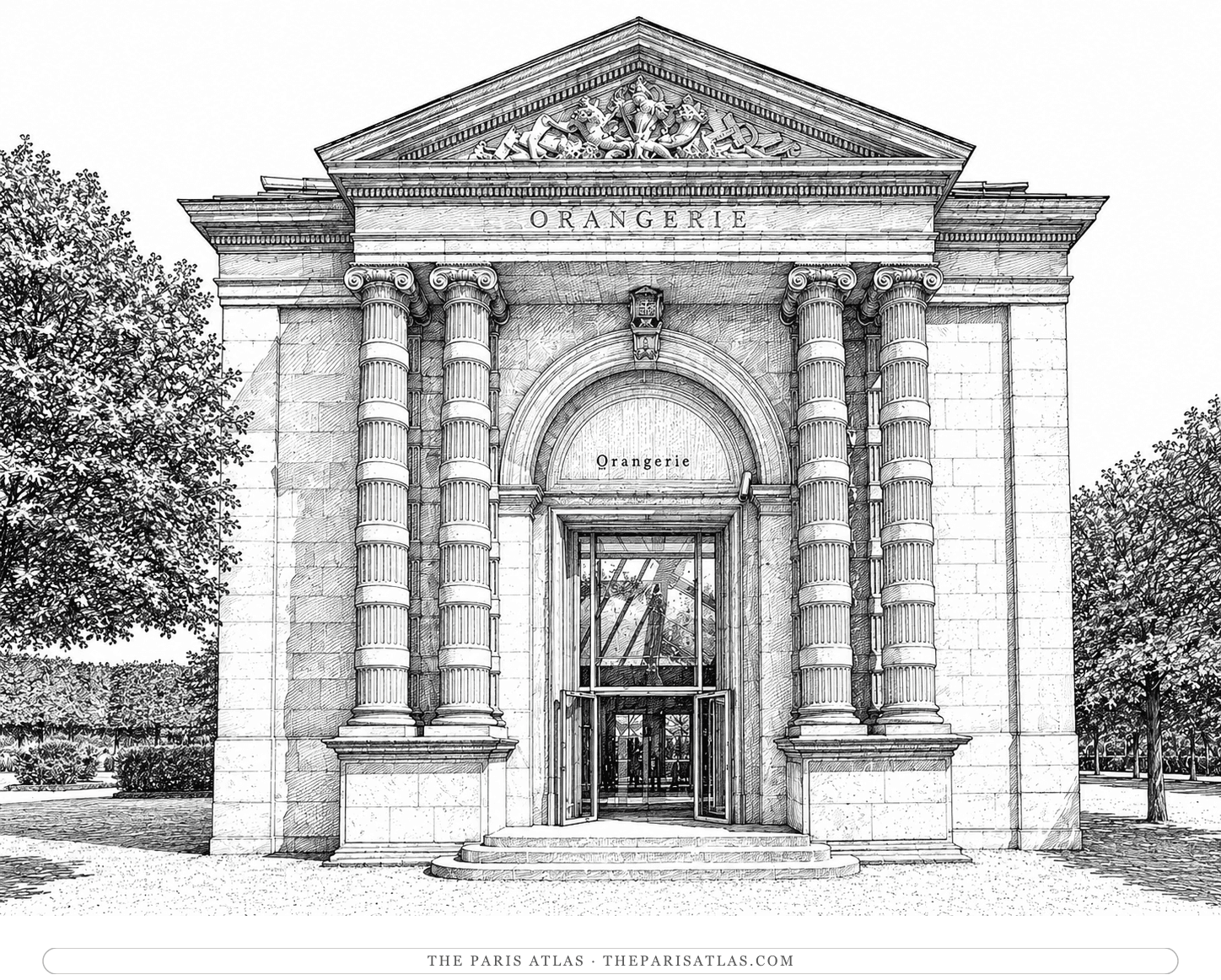
Orangerie des Tuileries
In the Walter-Guillaume rooms since its 1977 physical entry; the museum's record places it in room 10, level −2. Holdings rotate.
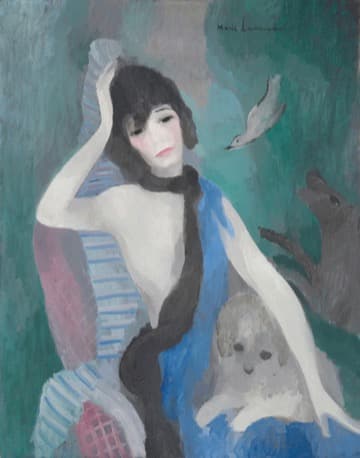
Laurencin's 1923 portrait of Coco Chanel, commissioned by the couturière and refused by her; the painter kept the canvas, and it hangs today in the Orangerie's Walter-Guillaume rooms.
Chanel sits facing the viewer in a languid pose, head resting against her right arm, a white poodle on her knees. A second dog leaps at the lower right, and a turtle dove descends toward her from above — the museum's own notice wonders whether it should be read like the dove of the Holy Spirit, 'perhaps a symbol of freedom?' The palette is the painter's usual harmony of green, blue, and pink, tightened by what the museum calls the long black line of the scarf draped around the model's neck.
It is a Laurencin before it is a likeness. The sitter is folded into the pale, dark-eyed type the painter had made her signature, and that, by the museum's account, was the problem.
In the autumn of 1923 Marie Laurencin was designing the sets and costumes for Les Biches for Serge Diaghilev's Ballets Russes while Coco Chanel — born, like the painter, in 1883 — was making the costumes for Le Train Bleu. The commission came out of that shared Ballets Russes moment.
Chanel did not appreciate the portrait and refused to buy it. Laurencin, the Orangerie records, was furious, declined to paint a second version, and kept the original. The provenance the museum prints carries two question marks — 'Paul Rosenberg (?); Paul Guillaume (?)' — before the certainty of Domenica Walter, from whom the state purchased it in 1963 with the help of the Société des Amis du Louvre.
The result is a small irony of the collection: the portrait of Chanel that Chanel never owned now represents her in a national museum.
The painting hangs in the collection's lower rooms (the museum's record places it in room 10, level −2), one of the works that made Laurencin's reputation as the portraitist of fashionable 1920s Paris. Its EU copyright runs to the start of 2027, which is why the reproduction here is small and shown for commentary.
Close reading
Laurencin absorbs Coco Chanel into her own pale, dreamlike vocabulary instead of delivering a hard-edged fashion likeness. Details of the pose, animals, and looping black scarf show why the result belongs unmistakably to the painter.
1.Chanel's pose becomes languor rather than command
The tilted head, dark almond eyes, and supported cheek slow the sitter into reverie. Laurencin replaces the alert public image of the designer with her own recurring type of inward figure.
2.The animals keep the portrait from settling into ceremony
One dog rests within the sitter's pose while another enters more abruptly at the edge. They turn the portrait into a small domestic world rather than a display of professional status.
3.The black scarf controls the pale color
A dark line loops down from the neck through the soft palette, giving the composition a firm graphic path. Clothing becomes less an item of fashion than the structure that holds Laurencin's colors together.
4.The supported head replaces the posture of a commanding couturière
Chanel leans into her own hand instead of sitting rigidly upright. Laurencin turns a powerful public figure into a dreamy participant in the painter's pale, invented world.
5.The white dog merges with the sitter's pale clothing
The animal is visible through contour and small tonal changes rather than strong contrast. It joins the decorative harmony while giving Chanel something physical to hold.
6.The dove makes the portrait gently improbable
The bird enters like an emblem rather than an observed studio visitor. Its downward movement balances Chanel's raised arm and confirms that Laurencin is constructing a poetic likeness, not documenting an ordinary sitting.
1923
Commissioned by Chanel in the autumn; painted, refused, and kept by Laurencin.
1963
Purchased by the French state from Domenica Walter with the Société des Amis du Louvre.
1977
Physically enters the Musée de l'Orangerie.
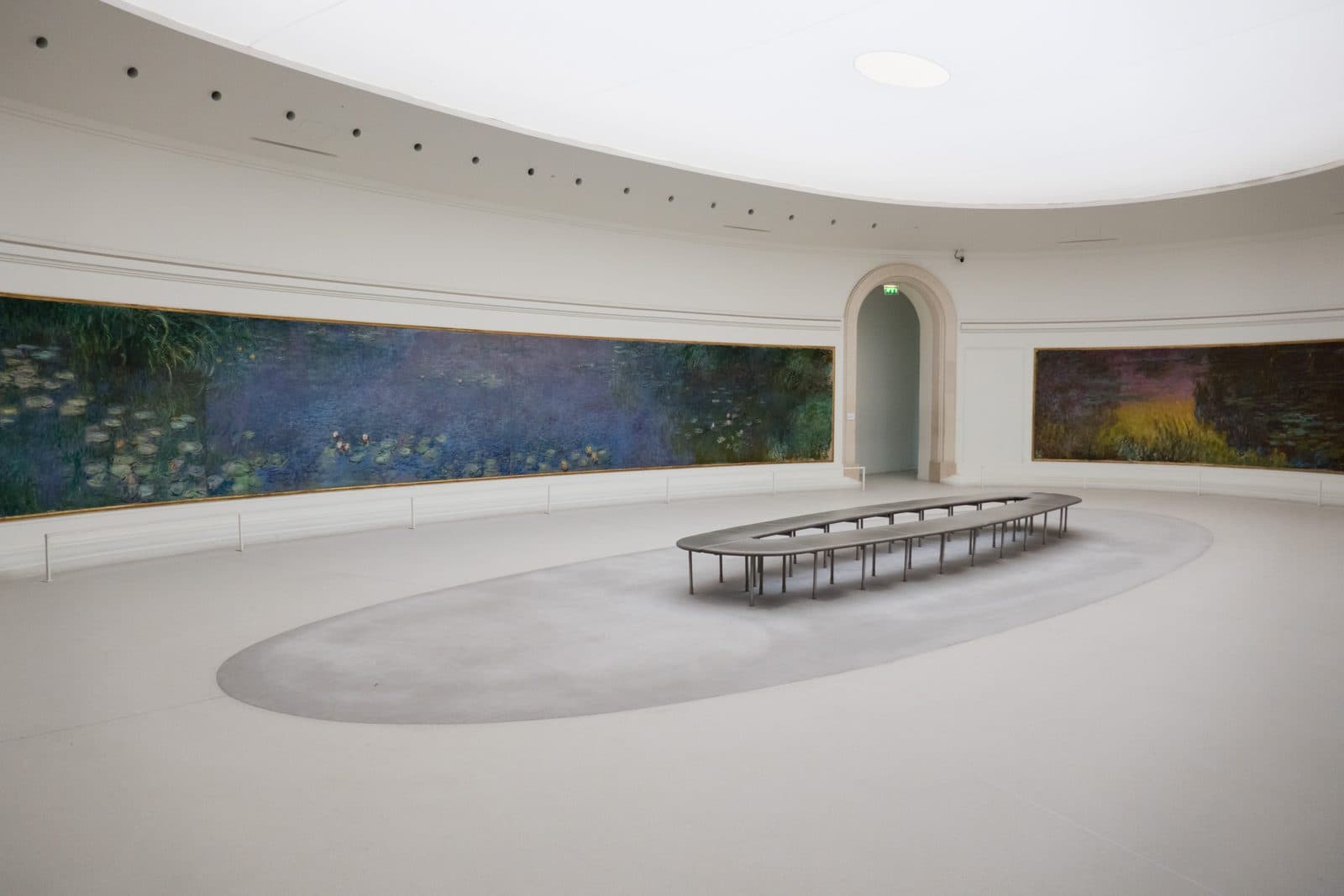
Musée de l'Orangerie, Paris
Jardin des Tuileries, Place de la Concorde (Seine side), 75001 Paris, France
Displays and loans can change. Check whether this work is on view before making a special trip.
Plan your visitThe Musée de l'Orangerie, which owns the painting, records that Chanel did not appreciate it and refused to buy it. Laurencin refused to paint a second version and kept the canvas.
Chanel seated in a languid pose, head resting on her right arm, with a white poodle on her knees, a second dog leaping at the right, and a turtle dove descending toward her — all in Laurencin's green, blue, and pink harmony, cut by the black line of a scarf.
In the Walter-Guillaume collection at the Musée de l'Orangerie in Paris. The state bought it in 1963 from Domenica Walter with the help of the Société des Amis du Louvre.
In 1923, while Laurencin was designing Les Biches for Diaghilev's Ballets Russes and Chanel was making the costumes for Le Train Bleu.
The oil painting measures 92 by 73 centimetres, or about 36.2 by 28.7 inches. It is large enough for Laurencin to surround Chanel's seated figure with two dogs and a descending dove rather than treating the work as a tightly cropped head-and-shoulders portrait.
Displayed at · 1977
In the Walter-Guillaume rooms since its 1977 physical entry; the museum's record places it in room 10, level −2. Holdings rotate.
Depicts · 1923
Chanel commissioned the portrait from Marie Laurencin in 1923, disliked the result and refused to buy it; Laurencin declined to paint a second version and kept the canvas. The Musée de l'Orangerie, which has held it since the state bought it from Domenica Walter, records the whole episode on the painting's own notice.
Explore painters from the same movements and circles.
The Le Havre house-painter's son who invented Cubism in Montmartre with the Spanish painter Pablo Picasso between 1908 and 1914 — the quieter half of the most consequential partnership in modern art — and who invented papier collé, the pasted-paper picture, in September 1912. He was given a French state funeral in 1963.
View artist
Painter between Impressionism and everything after — shown in the independents' exhibitions, emulated by the Cubists, and present at the Orangerie through 15 works in the Walter-Guillaume collection.
View artist
The century's quietest revolutionary — readymades, the abandonment of painting, chess on a Paris rooftop in Entr'acte, and one anemic film of spinning puns signed Rrose Sélavy.
View artistThe sources below include collection records, catalogues, scholarly research, and primary materials that informed this page. They document Portrait de Mademoiselle Chanel, its making, and its place in cultural history.

Web source consulted for documented facts and historical context presented on the Portrait de Mademoiselle Chanel page.
Used to place Portrait de Mademoiselle Chanel within Marie Laurencin's documented oeuvre and verify its period, medium, or institutional context.
Used to cross-check artist chronology and the work's relationship to Marie Laurencin's wider practice.
Used for an additional museum or scholarly perspective on Portrait de Mademoiselle Chanel's history and interpretation.
These references provide the documented foundation for this work's history and interpretation. Claim-level citations remain attached to the specific claims they support.
 Explore more resources