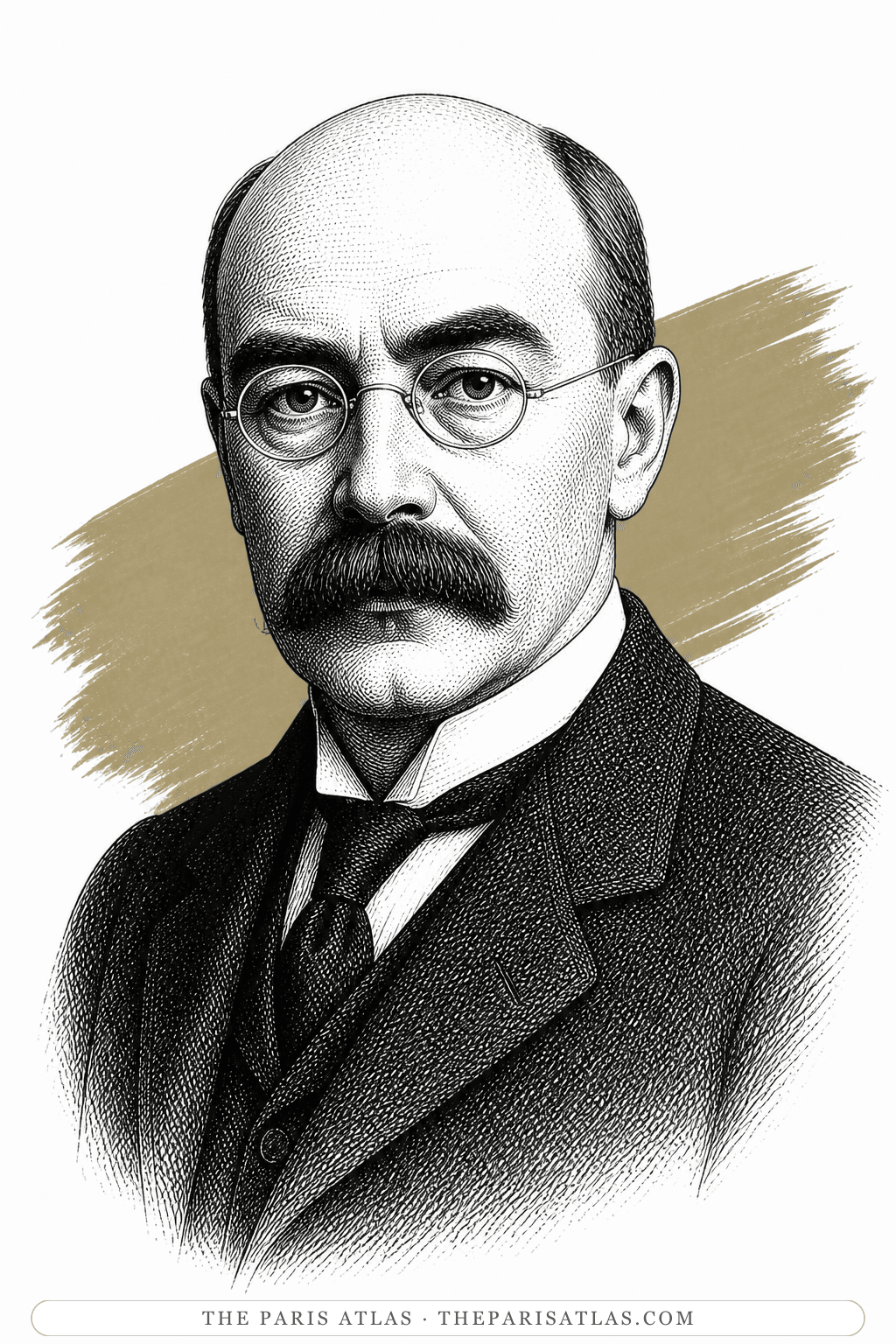
If—
Kipling's most famous poem, printed after "Brother Square-Toes". Thirty-two lines of advice from a father to a son, ending "you'll be a Man, my son!"
Rewards and Fairies
Rudyard Kipling
Puck brings back the dead of English history to talk to two children in Sussex, and between two of their stories sits "If—".
Rewards and Fairies, published in 1910, is Rudyard Kipling's sequel to Puck of Pook's Hill. Dan and Una, a brother and sister living on a farm in Sussex, meet Puck again, the last of the fairies in England. Puck brings them people from the past who tell their own stories: Queen Elizabeth I, a Stone Age shepherd, a French prisoner of war, a Sussex smuggler's son who met George Washington and Talleyrand. The book has eleven stories, each set between poems. The most famous poem in the book, and probably the best known Kipling ever wrote, is "If—". The poem follows "Brother Square-Toes", the story about George Washington.
The book came out four years after Puck of Pook's Hill (1906), and continues it.[1] Kipling's introduction says the children are older and wiser now, and wear boots instead of going barefoot. As before, Puck takes away their memory of each meeting afterwards.[2] Two of the stories ran first in The Delineator, an American women's magazine: "Brother Square-Toes" in July 1910 and "A Priest in Spite of Himself" in August.[3][4] Macmillan published the book in London and Doubleday, Page in New York the same year.[5]
Donald Mackenzie, who edited the two Puck books for Oxford World's Classics, says the second book ranges further than the first. Rewards and Fairies centres on famous figures: Elizabeth I, Washington, Talleyrand, Napoleon, Francis Drake, and King Harold, who in the last story has survived the Battle of Hastings as a wandering beggar with his mind gone. Mackenzie finds one question at its core, and the characters keep asking it: "What else could I have done?"[1]
Kipling had lived at Bateman's, a house at Burwash in Sussex, since 1902, and the stories keep to the country around it. Marklake, the village of one story, is just up the road from Burwash.[6][7] In 1926 the Kiplings went to see a pageant of scenes from the book at Rushlake Green, near Burwash.[6]
In "Cold Iron", a human baby raised by the fairies has to choose between their world and ours, and the choice is an iron slave-ring. In "Gloriana", Queen Elizabeth I tells how she sent two young men on a secret venture against Spain. In "The Wrong Thing", a master builder explains why Henry VII knighted him, and it was not for his art. In "Marklake Witches", Una meets Philadelphia, the squire's sixteen-year-old daughter, and a French prisoner on parole who is trying out a new instrument for listening to the chest. "The Knife and the Naked Chalk" goes back to a Stone Age shepherd who gives an eye to get iron knives for his people.[2][7]
"Brother Square-Toes" and "A Priest in Spite of Himself" belong together. Pharaoh Lee, a Sussex boy from a smuggling family, is run down in the Channel fog by a French warship in 1793 and carried to Philadelphia. There he meets two Seneca chiefs, Red Jacket and Cornplanter, and goes with them to hear George Washington refuse to join France in a war on England. He also befriends a lame, penniless French exile who turns out to be Talleyrand.[3][4]
The last four stories jump about in time. St Wilfrid brings Christianity to the South Saxons in the seventh century. Nicholas Culpeper, the astrologer and physician, tells how he fought the plague in a Sussex village during the Civil War. Francis Drake appears in "Simple Simon". "The Tree of Justice" ends the book with Harold, the old English king, alive and lost forty years after Hastings.[2][1]
"If—" is printed straight after "Brother Square-Toes", the story of George Washington holding out against his own public for America's good. The poem is one long sentence of advice from a father to a son, and nothing resolves until its last lines. Alastair Wilson, writing for the Kipling Society, points out that the placement fits a thread through the whole book: responsible leaders doing what is needed without fear or favour.
Kipling himself named the model. In his memoir he said the verses were drawn from the character of his friend Leander Starr Jameson, who stayed with the Kiplings in Sussex. Jameson, a close colleague of Cecil Rhodes, led the Jameson Raid of 1895 against the Boer republic of the Transvaal. The raid failed, and Jameson was tried and jailed. He later served as Prime Minister of the Cape Colony, from 1904 to 1908.
Kipling was startled by what happened next. He wrote that the poem escaped from the book and ran about the world. Schools set it as a punishment exercise, it was printed on cards for offices and bedrooms, and he counted translations into twenty-seven languages. Some of the schoolboys who had copied it out as lines later asked him why he had written it.
The first story sets the question. The Boy in "Cold Iron" has been raised by the fairies, and Thor has forged an iron slave-ring for him. He puts it round his own neck. The Lady Esclairmonde cries out that the catch is still open and he can still take it off. He puts up his hand, the snap locks home, and he says: "What else could I have done?"
The same words come back in at least five later stories: "The Wrong Thing", "Marklake Witches", "The Knife and the Naked Chalk", "A Priest in Spite of Himself" and "A Doctor of Medicine". Each time someone has made a hard choice, often a sacrifice, and does not regret it. Mackenzie reads the book as a study of leadership and service, and of what they cost.
"A Priest in Spite of Himself" ends in Paris. Pharaoh Lee, now a ship's captain with his own cargo of tobacco, is taken by a French warship. He follows the tobacco up the Seine on a barge and reaches the city in November 1799, during the revolutionary calendar month of Brumaire. The barge is laid up below Notre-Dame, and Pharaoh sleeps on board while he runs from office to office asking for justice and gets speeches about liberty.
Then a carriage crosses the bridge with General Bonaparte in it, and beside him Talleyrand, the exile Pharaoh once looked after in Philadelphia. Pharaoh runs after it playing a French tune on his fiddle. The scene falls just after the coup of November 1799, in which Bonaparte and his allies overthrew the Directory. Out of gratitude, and against Bonaparte's wishes, Talleyrand gives Pharaoh back his ship and twice the value of his cargo.
Paris also gave "If—" its French life. André Maurois put a French version into his novel Les Silences du colonel Bramble, published by Bernard Grasset in Paris in 1918. In the novel the French narrator, serving alongside British officers, sets himself one evening to put the poem into French. His version ends "Tu seras un homme, mon fils". The stories themselves appeared in Paris as Retour de Puck, translated by S. and J. Vallette.
The two Philadelphia stories are told by Pharaoh Lee in his own voice, and his voice includes a racial slur. He uses it seven times for the Black servants and workers of the city, as if it were an ordinary word. The Kipling Society prints a warning on every Kipling text that contains the word, and explains its history in the commentary.
If you can dream—and not make dreams your master; / If you can think—and not make thoughts your aim
If you can talk with crowds and keep your virtue, / Or walk with Kings—nor lose the common touch
What else could I have done?
Probably Kipling's best-known poem was first collected here, printed after a story about George Washington doing the unpopular thing. The story and the poem explain each other.
A Stone Age shepherd, Elizabeth I, a French prisoner who invents the stethoscope, and a smuggler's son who meets Washington all tell their own stories.
Pharaoh Lee sleeps on a barge below Notre-Dame in November 1799 and watches Bonaparte and Talleyrand cross the river in a carriage.
The complete text is in the public domain, and Project Gutenberg has it as ebook 556.
The brother. "The Wrong Thing" is told to him alone.
The sister. Some stories are told to her alone, among them the story of Philadelphia and the French prisoner.
Also called Robin Goodfellow, the last of the People of the Hills left in England. Brings the children their visitors and takes their memories away afterwards.
A Sussex boy from a smuggling family who ends up in Philadelphia, meets George Washington, befriends Talleyrand, and follows his tobacco to Paris.
The squire of Marklake's sixteen-year-old daughter. Everyone in the story knows she is dying of consumption except her.
A French prisoner of war on parole in Sussex who tests a wooden listening tube on the villagers' chests. The historical Laennec invented the stethoscope.
Kipling's most famous poem, printed after "Brother Square-Toes". Thirty-two lines of advice from a father to a son, ending "you'll be a Man, my son!"
The opening story, and a poem of the same name: a fairy-raised boy chooses the iron ring.
Pharaoh Lee, a Sussex boy, meets the Seneca chiefs and George Washington in Philadelphia in 1793. First printed in The Delineator, July 1910.
Pharaoh Lee befriends Talleyrand in exile, then meets him again in Paris beside Bonaparte. First printed in The Delineator, August 1910.
A dying girl, a village cunning-man, and a French prisoner of war who is inventing the stethoscope. Followed by the poem "The Way through the Woods".
A poem about the one friend in a thousand who stays, printed after the story "Simple Simon".
A poem that measures the distance from a child at play to Napoleon's last island, printed before "A Priest in Spite of Himself".
1906
Puck of Pook's Hill introduces Dan, Una and Puck.
1910
"Brother Square-Toes" appears in The Delineator in July and "A Priest in Spite of Himself" in August. Macmillan publishes Rewards and Fairies in London, and Doubleday, Page in New York.
1918
André Maurois prints his French version of "If—", ending "Tu seras un homme, mon fils", in Les Silences du colonel Bramble, published in Paris by Bernard Grasset.
1935
Retour de Puck, the French translation by S. and J. Vallette, is on its third edition in Paris with Paul Hartmann.
1993
Oxford publishes Puck of Pook's Hill and Rewards and Fairies in one volume, edited by Donald Mackenzie.

The Jungle Book
Rudyard Kipling
Kipling's first great book for children, which also puts a song after every story.
Read our takeJust So Stories
Rudyard Kipling
The stories he wrote for his own children eight years earlier, and his other book with poems between the tales.
Read our takeKim
Rudyard Kipling
The novel of India he finished just before settling in Sussex, where this book is set.
Read our takeThe Man Who Would Be King
Rudyard Kipling
An early story about two men who make themselves kings, the opposite of the careful leaders praised here.
Read our takeRewards and Fairies, published in 1910. The poem is printed after the story "Brother Square-Toes", in which George Washington refuses to be pushed into a war with England.
Kipling said the poem was drawn from the character of his friend Leander Starr Jameson. Jameson led the failed Jameson Raid against the Boer republic of the Transvaal in 1895, and later became Prime Minister of the Cape Colony.
Two children in Sussex, Dan and Una, meet Puck, who brings them people from English history. Each visitor tells a story, from the Stone Age to the Napoleonic Wars, and every story is set between poems.
Yes. Rewards and Fairies follows Puck of Pook's Hill (1906), with the same children and the same Puck. Kipling's introduction to Rewards and Fairies sums up the first book in a paragraph.
Yes. At the end of "A Priest in Spite of Himself", Pharaoh Lee follows his seized cargo up the Seine to Paris in November 1799. He sleeps on a barge below Notre-Dame and meets Talleyrand beside General Bonaparte.
André Maurois published a French version in 1918, in his novel Les Silences du colonel Bramble. Maurois's version ends "Tu seras un homme, mon fils", which means "You will be a man, my son".
Explore authors with a similar voice, perspective, and influence.
The doctor of the Paris slums who wrote the century's blackest, funniest novel — and changed the sound of French prose.
View author
The Brooklyn dropout who arrived in Paris broke at thirty-eight and wrote the exuberant, banned books that ended American censorship.
View author
American novelist and composer whose expatriate fiction explores dislocation, unstable intimacy, fatalism, and North Africa.
View authorThe sources below include the primary text, editions, scholarship, archival materials, and other records that informed this page. They document Rewards and Fairies, its publication, and its place in literary history.

Catalogue records for the 1910 London and New York editions and the modern Oxford ISBN.
The poem's place in the book, Kipling's own account of it, and Leander Starr Jameson.
How the Kipling Society handles the racial language in Kipling's texts.

The Bibliothèque nationale de France record of Maurois's novel, Paris, 1918.
A scan of a 1919 printing, where the French "If—" is on pages 137 and 138.
The Bibliothèque nationale de France record of the French translation of the stories.
The primary text represented by this page, used for descriptions of the work’s contents and for any quoted passages shown here.
The primary text is the baseline reference for every book page. Additional references document publication history, interpretation, and historical context where that evidence is available.
 Explore more resources