Mowgli's Brothers
The wolves adopt the baby, the pack buys him for a bull, and ten years later he leaves with fire in his hands. First printed in St Nicholas Magazine in January 1894.
The Jungle Book
Rudyard Kipling
Seven stories and their songs: a boy raised by wolves, a mongoose against two cobras, a white seal, and a night when the elephants dance.
Rudyard Kipling began the stories of The Jungle Book in Vermont in 1892 and published the collection in 1894. Three of its seven stories follow Mowgli, a small boy who wanders into a wolves' cave in the Seeonee hills of central India and is raised as one of the pack. Baloo the bear teaches him the Law of the Jungle, Bagheera the black panther buys his place in the pack with a bull, and Shere Khan the lame tiger wants him dead. The other four stories leave Mowgli behind. Rikki-tikki-tavi is a mongoose who fights two cobras in an English family's garden, Kotick is a white seal looking for a beach where no man comes, and Little Toomai sees the elephants dance. Each story ends with a song.
Kipling wrote the opening story, "Mowgli's Brothers", in November 1892. He had married Caroline Balestier that year, and the couple were living in a small rented cottage outside Brattleboro, Vermont, while their own house was built. In his memoir Something of Myself he described his workroom as seven feet by eight, with the snow level with the window-sill from December to April.[1]
Kipling had never been to the Seeonee hills. He built Mowgli's jungle out of books: his father's Beast and Man in India, Robert Armitage Sterndale's natural histories of the district, and a pamphlet by W. H. Sleeman about children said to have been raised by wolves.[1] Kipling himself named two more sparks, a boys' magazine story about lions who were Freemasons and a passage about ghost-wolves in H. Rider Haggard's novel Nada the Lily.[2]
"Mowgli's Brothers" appeared in St Nicholas Magazine, an American children's monthly, in January 1894, and the book came out the same year.[1] Macmillan published it in London and the Century Company in New York. The book's illustrations are by Kipling's father, John Lockwood Kipling, with W. H. Drake and P. Frenzeny.[3][4] The Second Jungle Book followed in 1895.
"Mowgli's Brothers" opens on a warm evening in the Seeonee hills. Shere Khan the tiger has jumped at a woodcutter's campfire and burned his feet, and the woodcutter's baby toddles into a wolves' cave. Mother Wolf takes him in and names him Mowgli, the Frog. At the pack's council, Baloo the bear speaks for him and Bagheera the black panther pays for him with a freshly killed bull. Ten years later the young wolves turn against their old leader, Akela, and against Mowgli. Mowgli drives them off with a pot of fire from the village and leaves the jungle in tears.[5]
"Kaa's Hunting" goes back to Mowgli's childhood. Baloo is teaching him the Master Words, the phrases that make every animal a friend, when the Bandar-log, the monkey people, carry him off to a ruined city called the Cold Lairs. Baloo and Bagheera ask Kaa, an enormous old rock python, for help. "Tiger! Tiger!" follows Mowgli into a village, where a woman named Messua takes him in because he looks like the son a tiger took from her. He herds the village buffalo and uses them to trap Shere Khan in a ravine.[5]
The last four stories have nothing to do with Mowgli. Kotick, a pure white fur seal born on an island in the Bering Sea, sees the hunters club the young seals and swims for years looking for a safe beach. Rikki-tikki-tavi, a young mongoose, is washed out of his burrow by a flood and adopted by an English family in an army station in India. Little Toomai, a ten-year-old whose family has handled elephants for generations, rides out at night on the old elephant Kala Nag. "Her Majesty's Servants" overhears the army's camp animals talking the night before a grand parade.[5]
Shere Khan is trampled to death by the stampeding buffalo. Mowgli skins him, and the village stones Mowgli out as a sorcerer. Messua runs out to tell him she knows he has paid for her son's life. Mowgli pegs the tiger's hide on the Council Rock, as he promised, and goes back to hunting in the jungle with his four wolf brothers.
Kotick follows Sea Cow, a slow sea mammal, through an underwater tunnel to untouched beaches, and leads the seals there. Teddy's father shoots Nag while Rikki-tikki holds the cobra by the head; Rikki-tikki later kills Nagaina after following her into her own hole. Little Toomai watches the wild elephants dance in a forest clearing, a sight no man had seen, and the hunters rename him Toomai of the Elephants. After the parade an old chief from Central Asia asks how the animals were made to obey. An Indian officer tells him that every creature obeys the one above it, up to the Viceroy, the servant of the Empress.
Almost everything a reader remembers about Mowgli's jungle was imagined in the snow. Kipling had left India for the last time at the end of 1891, and the Seeonee hills and the Waingunga River were places he knew only from books. Daniel Karlin, who introduced the Penguin Classics edition, points out that the Arctic stories, "The White Seal" among them, were built the same way.
Karlin also shows how freely Kipling bent his main source. Robert Armitage Sterndale had no good word for either the tiger or the panther. Kipling made Shere Khan a lame coward and Bagheera noble. Sterndale wrote that wolves took village children as a matter of course; in the book, only wolves corrupted by Shere Khan do it.
The wolf-children in Sleeman's reports were the opposite of Mowgli. In his accounts they ran on all fours and growled instead of speaking, and one boy was never known to laugh or smile. Mowgli walks upright, bathes every day, learns the animals' languages and cries when he has to leave. Karlin reads him as close to an exact inversion of the reports Kipling had been reading.
The Law of the Jungle in the book is almost the reverse of what the phrase now means. The Law is a code of order: the pack inspects every new cub, a hunter may not move to new ground without warning, and nobody kills man except in special cases. The reason the Law gives for that last rule is practical. Killing a man brings white men on elephants with guns, and then everybody in the jungle suffers.
The last story makes the imperial frame plain. Mules, camels, elephants and horses gossip in an army camp at Rawalpindi before a parade for the Viceroy of India and the visiting Amir of Afghanistan. Afterwards an Afghan chief asks how the beasts were made to obey. The Indian officer's answer runs up a chain of command from driver to Viceroy to Empress. The officer then adds that the Amir, whom the chief's people do not obey, must come to take orders from the Viceroy.
Readers in Kipling's lifetime saw both sides at once. The Swedish Academy's speech at the 1907 Nobel Prize called him an imperialist who had done more than any other writer to bind England to her colonies. In the next breath it praised the jungle books as fables loved by children in many countries. Marghanita Laski, quoted in the Kipling Society's notes, put the lessons bluntly: respect the family, the teachers and the overlords, and despise the talkers who never get anything done.
"The White Seal" looks like a rescue story, and it ends with Kotick fat and happy on a sheltered beach. Karlin points out what sits underneath. The guide who leads Kotick there is Sea Cow, and the northern sea cow had already been hunted to extinction when Kipling wrote. The song that follows the story, "Lukannon", mourns seals shot in the water and clubbed on land.
French readers met Mowgli through a Paris publisher. The Paris publishing house of the Mercure de France issued Le Livre de la jungle in 1899. The translation was by Louis Fabulet and Robert d'Humières, and the two men did The Second Jungle Book the same year. Fabulet made the first French translations of Kipling. In 1921, when the Sorbonne gave Kipling an honorary doctorate, Fabulet wrote to the Mercure de France to point out that he had introduced Kipling to France.
We be of one blood, ye and I.
No, Little Brother. That is only tears such as men use.
The dawn was beginning to break when Mowgli went down the hillside alone, to meet those mysterious things that are called men.
Baloo, Bagheera, Kaa and Shere Khan all start here. The book is stranger and harder than any adaptation, and Mowgli leaves the jungle in tears at the end of the very first story.
The mongoose story is often printed alone. Here it sits beside Mowgli, Kotick and Little Toomai, and Daniel Karlin points out that Rikki is another foundling taken in by a strange family.
The dialogue runs on "thee" and "thou", the songs rhyme, and every story has a clear shape. The opening Mowgli story appeared in an American children's magazine.
The text is in the public domain, and Project Gutenberg has it in full as ebook 236.
A woodcutter's baby who wanders into a wolves' cave and is raised in the pack. Speaks the animals' languages, stares any wolf down, and is cast out first by the wolves and then by the village.
The black panther who buys Mowgli's place in the pack with a bull. Was born in the cages of the king's palace at Oodeypore and broke the lock to escape, so he knows about men.
The sleepy brown bear who teaches the wolf cubs the Law of the Jungle, and teaches Mowgli the Master Words.
The lame tiger who hunted the baby Mowgli and never forgave the wolves for keeping him. His mother called him Lungri, the Lame One.
The great grey Lone Wolf who leads the Seeonee pack, until the young wolves trick him into missing a kill.
Takes the baby in, names him Mowgli the Frog, and faces down Shere Khan in the mouth of her cave. Raksha means the Demon.
An enormous old rock python, feared by the monkey people. Baloo and Bagheera have to flatter him into helping them rescue Mowgli.
A young mongoose washed out of his burrow by a flood and adopted by an English family. His war cry is "Rikk-tikk-tikki-tikki-tchk!"
A fur seal born pure white on an island in the Bering Sea, who spends years looking for a beach the hunters cannot reach.
The wolves adopt the baby, the pack buys him for a bull, and ten years later he leaves with fire in his hands. First printed in St Nicholas Magazine in January 1894.
The monkey people kidnap Mowgli to a ruined city, and Baloo and Bagheera have to ask a python for help.
Mowgli lives in a village, herds its buffalo, and uses them to kill Shere Khan.
A white fur seal in the Bering Sea searches for a beach the seal hunters cannot reach.
A young mongoose adopted by an English family fights the two cobras living in their garden.
A ten-year-old elephant boy rides out at night and sees the wild elephants dance.
The camp animals of an army review talk through a rainy night. Printed in some editions as "Servants of the Queen".
1892
In November, in a cottage outside Brattleboro, Vermont, Kipling finishes "Mowgli's Brothers", the first story of the book.
1894
"Mowgli's Brothers" appears in St Nicholas Magazine in January. The Jungle Book is published later that year by Macmillan in London and the Century Company in New York.
1895
The Second Jungle Book follows, with five more Mowgli stories.
1897
For a new collected edition, Kipling moves all the Mowgli stories into the first volume and the other stories into the second.
1899
Le Livre de la jungle, translated by Louis Fabulet and Robert d'Humières, is published in Paris by the Société du Mercure de France.
1907
The Swedish Academy's Nobel Prize speech singles out the jungle books as fables loved by children in many countries.


Just So Stories
Rudyard Kipling
Kipling's other animal book for children, written for his own children eight years later.
Read our takeKim
Rudyard Kipling
The novel of India he was working toward. Critics have long compared Kim to Mowgli, a boy torn between two worlds.
Read our takeRewards and Fairies
Rudyard Kipling
The last of his books for children, set in Sussex rather than India.
Read our takeThe Man Who Would Be King
Rudyard Kipling
An early story of British India, written for adults, about two men who set out to rule a people.
Read our take
George Orwell's 1942 essay on Kipling, which states the case against him in its first paragraph and then defends what survives.
Read our takeSeven stories about animals in India and the Arctic, each followed by a song. The first three follow Mowgli, a boy raised by wolves, until he kills the tiger Shere Khan. The others are about a mongoose, a white seal, an elephant boy and the animals of an army camp.
Yes. "Rikki-Tikki-Tavi" is the fifth of the seven stories, followed by the song "Darzee's Chant". The mongoose lives with an English family at an army station in India and fights the cobras Nag and Nagaina.
In Vermont. He wrote the first Mowgli story in November 1892 in a rented cottage outside Brattleboro, his wife's hometown. He had never been to the Seeonee hills where the stories are set.
The book is darker, and most of it is not about Mowgli at all. Mowgli leaves the wolves at the end of the first story, lives in a village, and kills Shere Khan with a buffalo stampede. Kaa the python is on his side and rescues him from the monkeys.
A code of order, not survival of the fittest. The Law says who may hunt where, how new cubs join the pack, and why no animal should kill a man. Baloo teaches it to the wolf cubs.
In 1899. Louis Fabulet and Robert d'Humières translated it as Le Livre de la jungle for the Société du Mercure de France in Paris. They also translated The Second Jungle Book the same year.
The book takes British rule in India for granted, and its last story ends with an officer explaining that every creature obeys the Empress. The Swedish Academy itself called Kipling an imperialist in 1907. The Kipling Society, which exists to promote his work, warns readers that some of it holds views on race now generally considered unacceptable.
Explore authors with a similar voice, perspective, and influence.
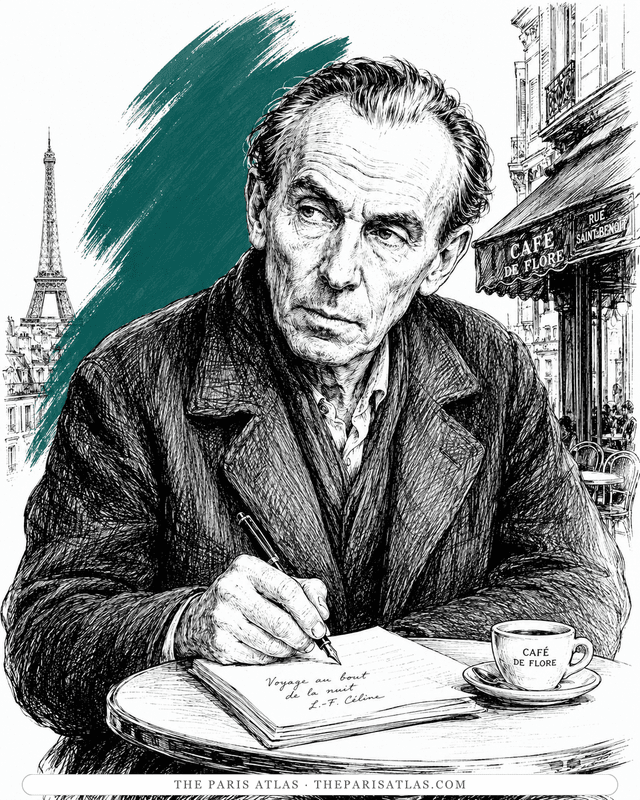
The doctor of the Paris slums who wrote the century's blackest, funniest novel — and changed the sound of French prose.
View author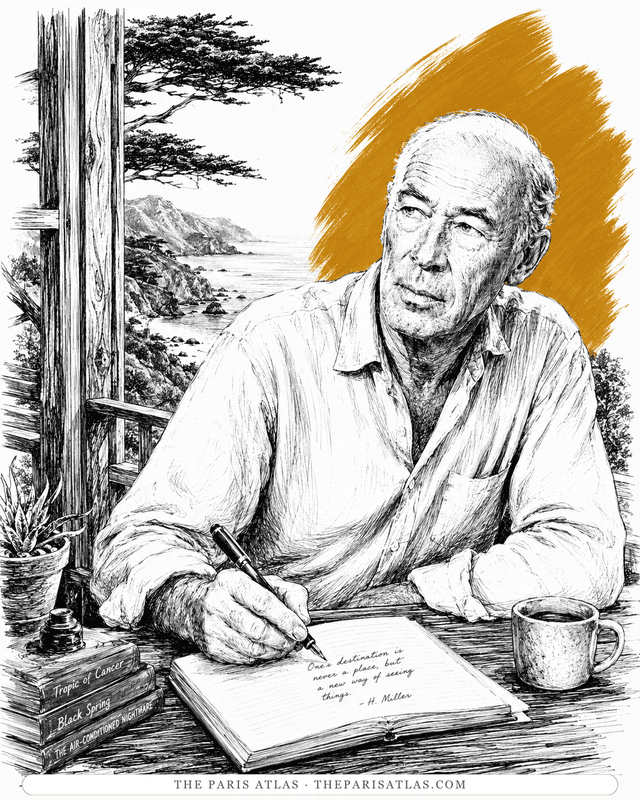
The Brooklyn dropout who arrived in Paris broke at thirty-eight and wrote the exuberant, banned books that ended American censorship.
View author
American novelist and composer whose expatriate fiction explores dislocation, unstable intimacy, fatalism, and North Africa.
View authorThe sources below include the primary text, editions, scholarship, archival materials, and other records that informed this page. They document The Jungle Book, its publication, and its place in literary history.

Daniel Karlin's introduction to the Penguin Classics edition: the Vermont winter, Kipling's sources, and the White Seal's extinct guide.
Library catalogue records of the 1894 London and New York editions.

A 1916 printing whose title page names the illustrators, John Lockwood Kipling, W. H. Drake and P. Frenzeny.
The Swedish Academy's 1907 speech, on Kipling as imperialist and on the jungle books.
The Bibliothèque nationale de France record of the first French translation, Paris, 1899.
Louis Fabulet as Kipling's first French translator, and his 1921 letter to the Mercure de France.
Catalogue records for the modern Oxford and Penguin editions and their ISBNs.
The primary text represented by this page, used for descriptions of the work’s contents and for any quoted passages shown here.
The primary text is the baseline reference for every book page. Additional references document publication history, interpretation, and historical context where that evidence is available.
 Explore more resources