The Paris AtlasCharting the artists, works, and places worth returning to.
  • Author
  • Poet
  • Journalist
· British · 1865–1936

Rudyard Kipling

The English writer of the Jungle Books, Kim and Just So Stories, and in 1907 the first author writing in English to win the Nobel Prize in Literature. His love of France began at twelve, when his father turned him loose alone in the Paris Exhibition of 1878 with two francs a day; it ended with the war-graves work that kept him crossing the Channel after his only son was killed at Loos, and with a small French book, Souvenirs of France, published in Paris in 1933.

Details

Lived
1865–1936
Born
30 December 1865
Birthplace
Bombay, British India
Died
18 January 1936 · aged 70
Place of death
London
Nationality
British
Profession
Short-story writer, novelist and poet
Major works
The Jungle Book, The Second Jungle Book, Kim, Just So Stories, Barrack-Room Ballads, Puck of Pook's Hill
Married
Caroline (Carrie) Balestier · 1892–1936
Children
Josephine Kipling, Elsie Kipling, John Kipling
Roles
AuthorPoetJournalist

About Rudyard Kipling

Rudyard Kipling was born in Bombay in 1865, made his name in India as a very young newspaperman writing verse and stories between shifts, and by his thirties was the most widely read writer in the English-speaking world. The Jungle Books, Kim and the Just So Stories are still in print everywhere; so is 'If—', which regularly tops polls of Britain's favourite poem. He was also the poet the British Empire adopted as its own, and that is the reason his reputation has been fought over ever since.

The Paris thread runs the whole length of the life and is the least-known part of it. In the spring of 1878 his father, John Lockwood Kipling, was in charge of the Indian section at the Exposition Universelle — the vast international exhibition France staged on the Champ de Mars and around the newly built Trocadéro palace — and took his twelve-year-old son with him. He gave the boy a free pass, about two francs a day and no supervision at all. Kipling spent the following fifty-five years saying that this was where his life-long love of France began; he was made a doctor of the University of Paris in 1921, wrote the epitaphs on the war memorials of two countries, and in 1933, three years before he died, published the little book of French memories that says so outright.

Bombay, Southsea, and the newspapers of British India

He was born on 30 December 1865 in Bombay, the son of John Lockwood Kipling, an artist and teacher of architectural sculpture who later became a provincial art director and museum curator in India, and Alice Macdonald, one of four sisters who married remarkable men — one of Rudyard's uncles by marriage was the painter Edward Burne-Jones, and one of his cousins, Stanley Baldwin, became prime minister. At five he and his sister were sent back to England and boarded with a foster family in Southsea, on the south coast, where he was miserable for years; he went on to the United Services College at Westward Ho! in Devon, a school for the sons of army officers, and turned it into the schoolboy stories of Stalky & Co.

In 1882, aged sixteen, he went back to India to work on the Civil and Military Gazette in Lahore and then the Pioneer in Allahabad. Journalism was the apprenticeship: he filled the columns with poems and short stories written around his reporting, and when they were collected into cheap paper-covered volumes for the Indian railway bookstalls they made him famous before he had properly left the country. He returned to England in 1889 by the long way round — Burma, Singapore, Hong Kong, Japan, then across the United States — and arrived to instant success with the soldiers' poems of Barrack-Room Ballads.

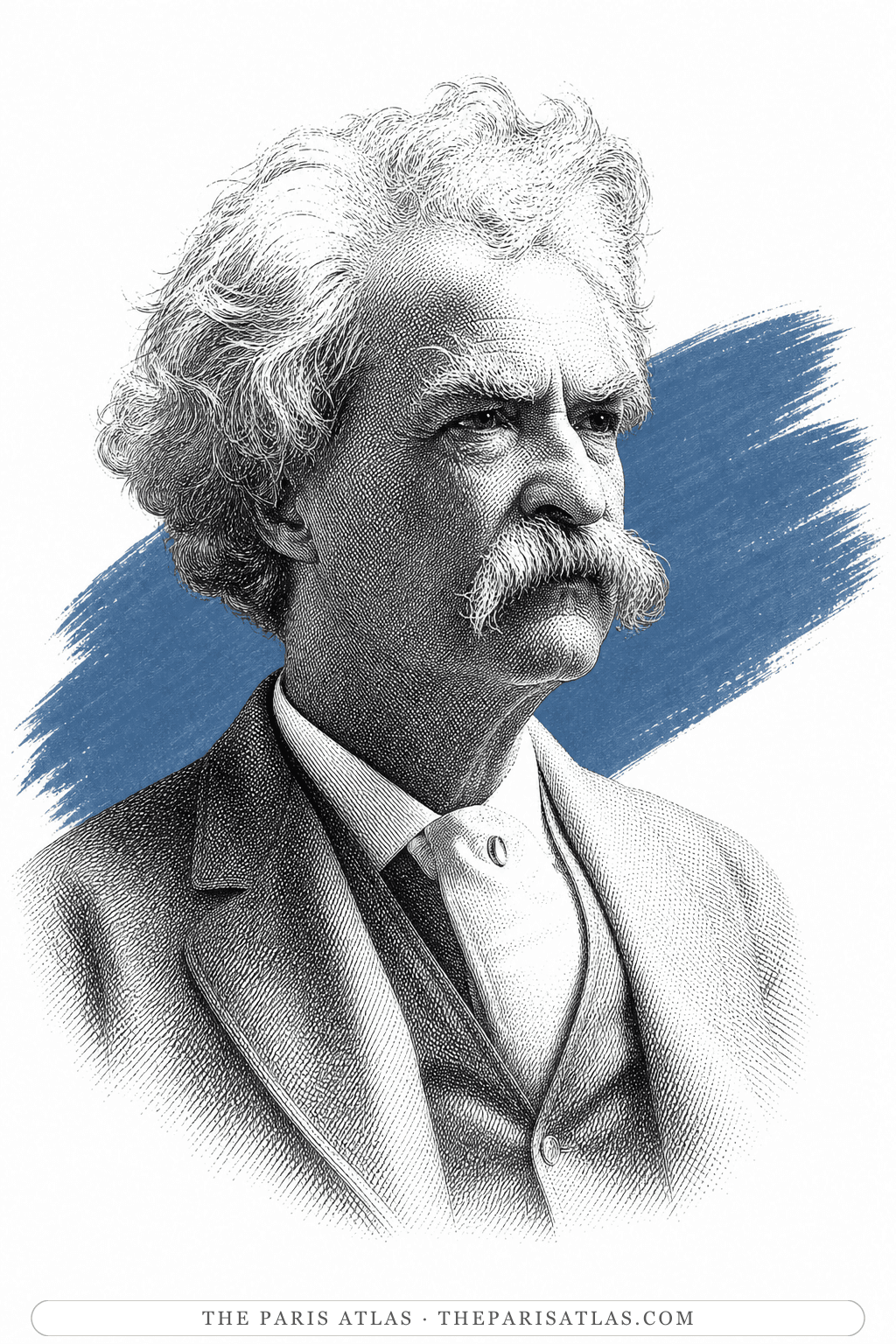
On the American leg of that journey he made a detour of his own: he hunted Mark Twain down at Elmira in upstate New York, was misdirected by half the town, finally reached the ivy-covered house on East Hill and talked to him for two hours over two cigars. The write-up he sent the papers begins by telling his readers in India that they are all a contemptible lot, because they have not met Mark Twain and he has.

A boy loose in the Exposition Universelle, 1878

In the spring of 1878 France held an Exposition Universelle — a world's fair, staged in Paris to show that the country had recovered from its defeat by Prussia eight years earlier. Lockwood Kipling was there to arrange the Indian section, and he brought his son on the condition that the boy gave no trouble. They crossed the Channel and lodged in a boarding house behind the Parc Monceau, and on the first morning his father handed him about two francs, told him there were restaurants called Duval all over Paris where he could eat for one franc, promised him a free pass to the Exhibition, and left him to it.

It was through the eyes of France that I began to see.

Rudyard Kipling, Souvenirs of France (1933)

What followed was, as he put it, the delight of a child let loose among all the wonders of all the world as they came out of their packing cases. After a few days nobody checked his pass. He wandered the half-built pavilions around the Trocadéro palace, picked up workmen's French from the men in blue blouses, ran paper-chases in the Bois de Boulogne with two English schoolboys in the yellow stockings and blue gowns of Christ's Hospital until the gendarmes stopped them, found the bookstalls on the Quai Voltaire and the men clipping poodles on the quays below the bridges, and discovered Notre-Dame de Paris for himself by way of Victor Hugo's novel. The exhibit he climbed most often was the head of Bartholdi's Statue of Liberty, then still in Paris awaiting shipment to New York: five centimes bought you the staircase up into the skull, and you looked out through the empty eyes.

He went home, he wrote later, knowing that there was a land across the water where everything was different and delightful and all the food tasted extremely well — and he never revised the verdict. His memoir Something of Myself puts it flatly: his father allowed him, at twelve years old, the full freedom of that spacious and friendly city, and it set his life-long love for France.

The Jungle Books, Kim, and the Nobel Prize

In 1892 he married Caroline Balestier, an American, and the couple settled for four years at her family's home in Brattleboro, Vermont. The Jungle Book (1894) and The Second Jungle Book (1895) were written there: linked stories about Mowgli, a boy raised by wolves in the Indian forest and taught the Law of the Jungle by a bear and a black panther, with animal fables — Rikki-Tikki-Tavi the mongoose, the white seal — set among them. They are moral tales in the shape of adventure, and they made him the most widely read children's author alive. (Walt Disney's 1967 cartoon, which keeps the names and almost nothing else, is how most people now meet them.)

Kim (1901) is the other book people mean when they say Kipling. Kimball O'Hara is the orphaned son of an Irish soldier, growing up as a street child in Lahore, who attaches himself as disciple to an old Tibetan lama walking India in search of a sacred river — and is simultaneously recruited by British intelligence for the espionage between empires that the book calls the Great Game. It is a spy novel, a road novel and a portrait of the whole subcontinent at once, and the argument over it — whether the loving detail of India cancels or merely decorates the imperial frame — has never been settled.

In 1907 the Swedish Academy gave him the Nobel Prize in Literature, citing his power of observation, originality of imagination and remarkable talent for narration. He was forty-one, and the first writer in English to receive it. It was very nearly the only honour he ever accepted: he turned down a knighthood, the Order of Merit and the Poet Laureateship, and in 1934 he declined the Légion d'honneur — the French state's order of merit — as well. The distinctions he took from France were academic: honorary doctorates from Paris and Strasbourg, both in 1921.

John Kipling, Loos, and the graves

Kipling's son John was seventeen when the First World War began, and had already decided on the army; he was rejected by three recruiting offices for his eyesight, so his father used his friendship with Field Marshal Lord Roberts, colonel of the Irish Guards, to get him a commission. John went to France in August 1915, a few days after turning eighteen, and was killed at the Battle of Loos on 27 September, effectively his first day in the line. His body was not identified. Whether Kipling had pushed him into uniform, and what guilt he carried afterwards, has been argued over ever since; the family record shows the boy choosing the army himself in 1913, before any war existed to be sent to.

In September 1917 Fabian Ware — the man who had spent the war recording where the dead lay, and had just had his work made permanent as the Imperial War Graves Commission — invited Kipling to join it. He accepted the next day and gave it the rest of his life. He argued for regimental badges on the headstones, wrote pamphlets defending the Commission's decisions, and above all supplied the words: after his death the Commission recorded that every inscription on every memorial it had raised anywhere in the world had been written, approved or selected by him. The ones it named as his alone include Thiepval on the Somme, the Menin Gate at Ypres, Tower Hill in London, Delville Wood, Baghdad, Lagos, Dar-es-Salaam — and the memorial to the British Empire's dead inside Notre-Dame in Paris.

The work also gave him a reason to keep crossing the Channel. Through the 1920s the Kiplings wintered in the south of France or Algeria, met their Rolls-Royce and chauffeur at Marseilles, and wandered home northwards through the old front, stopping at any Commission cemetery near the road so that he could note what still needed doing. He was in the party for King George V's pilgrimage to the battlefields in May 1922; his own travel diary of it records the sole at the Hôtel Terminus in Calais, the price of a butter knife, and the rebuilt Ypres, which he thought absolutely ghastly. In August 1930 he was to speak at Dud Corner Cemetery at Loos, close to where John had died, and could not: he was overcome and did not deliver it.

Souvenirs of France, 1933 — and the argument since

On 19 November 1921 the University of Paris made him a doctor honoris causa in the great amphitheatre of the Sorbonne, alongside the anthropologist Sir James Frazer, before the President of the Republic, Alexandre Millerand — the citation naming both men as eminent friends of France. Kipling's own comic account of the day, printed in a Paris educational paper a month later, has a distinguished old writer receiving the degree while remembering the night thirty years earlier when he and three companions had tried to push the Sorbonne's walls over by moonlight and run from the gendarmes. Louis Fabulet, who had made the first French translations of Kipling and was not invited to the ceremony, wrote to the Mercure de France to point out that it was he, and nobody at the Sorbonne, who had introduced Kipling to France.

Twelve years later he set the whole attachment down. Souvenirs of France appeared first in French, in two instalments of the Revue des Deux Mondes on 1 and 15 March 1933, translated by the critic Louis Gillet; the English text ran in the Daily Telegraph the same month, and the little book went through five editions in Paris. It moves from the boy with his two francs at the Trocadéro to the motoring years, the Algerian journeys and the graves — a book about one country written by a man from another, and the warmest thing he ever published.

He haemorrhaged at Brown's Hotel in London on 13 January 1936, from the duodenal ulcer a Paris doctor had finally diagnosed three years earlier, was operated on at the Middlesex Hospital and died of peritonitis on 18 January, two days before King George V. His ashes were interred in Poets' Corner in Westminster Abbey on 23 January. Bateman's, the seventeenth-century ironmaster's house in Sussex he had bought in 1902 and where he wrote Puck of Pook's Hill and 'If—', went to the National Trust under his widow's will in 1939, and is open to visitors. His reputation has been contested for a century: George Orwell, reviewing T. S. Eliot's selection of his verse in 1942, opened by conceding that no civilised person could accept Kipling's view of life, and then spent the rest of the essay explaining why he outlasts the people who sneer at him. The Kipling Society, which exists to promote his work, prints a warning at the foot of every page of its website that some of it contains words and views on race and gender now generally considered unacceptable. Both things are true at once, and any honest account of him has to hold them together.

Life events

  1. 1865

    Born in Bombay on 30 December, son of the artist and art teacher John Lockwood Kipling.

    Rudyard Kipling 1865–1936; Rudyard Kipling – Facts, Nobel Prize in Literature 1907

  2. 1878

    Aged twelve, taken to the Paris Exposition Universelle, where his father runs the Indian section. Given a free pass, two francs a day and no supervision, he spends the spring wandering the Trocadéro building site and the city — and dates his love of France to it for the rest of his life.

    Rudyard Kipling, Souvenirs of France (1933); France — notes by Philip Holberton (Readers' Guide)

  3. 1882

    Returns to India at sixteen to work on the Civil and Military Gazette in Lahore, then the Pioneer.

    Rudyard Kipling 1865–1936

  4. 1889

    Travels home from India by way of Japan and the United States, tracking down Mark Twain at Elmira, New York, on the way; arrives in England and is famous within months.

    Rudyard Kipling, From Sea to Sea, Letter XXXVII: An Interview with Mark Twain (1890); Rudyard Kipling 1865–1936

  5. 1894

    The Jungle Book, written in Vermont, is published; The Second Jungle Book follows in 1895.

    Rudyard Kipling 1865–1936; Rudyard Kipling – Facts, Nobel Prize in Literature 1907

  6. 1901–1902

    Publishes Kim, the novel of an orphan boy, a Tibetan lama and the espionage called the Great Game, and buys Bateman's at Burwash in Sussex, his home for the rest of his life.

    Rudyard Kipling – Facts, Nobel Prize in Literature 1907; Rudyard Kipling 1865–1936

  7. 1907

    Awarded the Nobel Prize in Literature, the first writer in English to receive it.

    Rudyard Kipling – Facts, Nobel Prize in Literature 1907; Kipling's Academic Honours, by John McGivering

  8. 1913

    Publishes the poem 'France' in the Morning Post to mark President Poincaré's state visit to London; it makes him, in his biographer's phrase, more than ever a celebrity in France.

    France — notes by Philip Holberton (Readers' Guide)

  9. 1915

    His son John, an eighteen-year-old subaltern in the Irish Guards, is killed at the Battle of Loos on 27 September, effectively his first day in the line. His body is not identified.

    Kipling and the Imperial War Graves Commission, by Alastair Wilson; Kipling's Sussex: A Chronology, by Michael Smith

  10. 1917

    Fabian Ware invites him to join the newly chartered Imperial War Graves Commission; he accepts the next day and works for it until his death.

    Kipling and the Imperial War Graves Commission, by Alastair Wilson

  11. 1921

    Made a doctor honoris causa of the University of Paris on 19 November, in the great amphitheatre of the Sorbonne, before President Millerand; Strasbourg gives him a degree the same year.

    The First Assault upon the Sorbonne — notes edited by John Radcliffe; Kipling's Academic Honours, by John McGivering

  12. 1930

    Due to speak on 4 August at Dud Corner Cemetery at Loos, near where his son was killed, he is overcome and cannot deliver the speech.

    Kipling's Sussex: A Chronology, by Michael Smith

  13. 1933

    Souvenirs of France appears in the Revue des Deux Mondes on 1 and 15 March, translated by Louis Gillet, and in the Daily Telegraph in English; the Paris booklet runs through five editions.

    Souvenirs of France — notes by Max Rives (Readers' Guide); Rudyard Kipling, Souvenirs of France (1933)

  14. 1936

    Dies in London on 18 January, two days before King George V; ashes buried in Poets' Corner. Bateman's passes to the National Trust under Carrie Kipling's will in 1939.

    Kipling's Sussex: A Chronology, by Michael Smith; Rudyard Kipling 1865–1936

People they knew

Documented connections — every one carries its source.

Mark Twain

  • Author
  • Journalist

Met · 1889

On the American leg of his 1889 journey home from India, the twenty-three-year-old Kipling went looking for Mark Twain, was sent to Buffalo, Hartford and Portland by people who were sure they knew, and finally ran him down at Elmira in upstate New York — up a hill, in an ivy-covered house nobody could direct him to. They talked for more than two hours over two cigars. The piece Kipling filed opens by informing his readers in India that they are a contemptible lot, because he has shaken Mark Twain's hand and they have not.

Rudyard Kipling, From Sea to Sea, Letter XXXVII: An Interview with Mark Twain (1890)

Rudyard Kipling’s Places

The cataloged places connected to Rudyard Kipling — through the books, and through the documented record.

Places you can enter today appear first, followed by addresses to see from outside and sites that have vanished.

In works

Works in these pages connected to Rudyard through the claims of the graph.

Cover of Critical Essays by George Orwell

Depicted in · Book

Critical Essays

George Orwell · 1946

One of the ten essays in Orwell's 1946 collection is about Kipling, written as a review of the selection of his verse that T. S. Eliot made for Faber. Orwell concedes the case in his first paragraph — no civilised person, he says, can accept Kipling's view of life — denies that he was a fascist, and then spends the essay explaining why he outlasts the refined people who sniggered at him, inventing the category of the good bad poet to hold him. The comparison Orwell reaches for is Harriet Beecher Stowe: Kipling is as a poet what she was as a novelist.

George Orwell, Critical Essays (1946), "Rudyard Kipling", pp. 100-113

Questions about Rudyard Kipling

What was Rudyard Kipling's connection to France?

It began at twelve. In the spring of 1878 his father was in charge of the Indian section at the Paris Exposition Universelle, took him along, gave him a free pass and about two francs a day, and left him to explore the city alone. Kipling said for the rest of his life that this was where his love of France started, and he wrote a whole book about the attachment — Souvenirs of France, published in Paris in 1933. In between came the 1913 poem 'France', years of motoring holidays all over the country, an honorary doctorate from the Sorbonne in 1921, and the war-graves work in France and Flanders that occupied his last two decades.

What is Souvenirs of France?

A short memoir Kipling wrote about France near the end of his life. It came out first in French, in two instalments of the Paris review Revue des Deux Mondes on 1 and 15 March 1933, translated by Louis Gillet, and in English in the Daily Telegraph the same month; the Paris booklet went through five editions. It runs from the boy with two francs at the 1878 Exhibition, through the early motoring tours, to the devastated battlefields he crossed for the Imperial War Graves Commission. The most quoted line is about climbing into the head of Bartholdi's Statue of Liberty at the Exhibition and looking out through its eyes: 'It was through the eyes of France that I began to see.'

Was Kipling given the Légion d'honneur?

Not as far as the record shows. The Kipling Society's chronology of his life notes that in 1934 he declined membership of the Légion d'honneur — which fits his lifelong pattern of refusing honours: he also turned down a knighthood, the Order of Merit and the Poet Laureateship. What he did accept from France was academic. In November 1921 the University of Paris made him a doctor honoris causa at the Sorbonne, and Strasbourg gave him a degree the same year.

What happened to Kipling's son John?

John Kipling was commissioned into the Irish Guards after being turned down by three recruiting offices for poor eyesight — his father pulled strings with Lord Roberts to get him in. He crossed to France in August 1915, days after his eighteenth birthday, and was killed at the Battle of Loos on 27 September 1915, on what was effectively his first day in action. His body was not identified. Two years later Kipling joined the Imperial War Graves Commission, and gave the last eighteen years of his life to the graves and memorials of other people's sons.

What are the Jungle Books actually about?

The Jungle Book (1894) and The Second Jungle Book (1895) are collections of linked stories, not a single novel. The central ones follow Mowgli, a small boy lost in the Indian forest and raised by a wolf pack, taught the Law of the Jungle by Baloo the bear and Bagheera the black panther, and hunted by Shere Khan the tiger. Around them sit separate animal tales — Rikki-Tikki-Tavi, the mongoose who fights cobras in a garden; the white seal; the elephants' dance. Kipling wrote them in Vermont, thousands of miles from India, for his own small daughter's generation. Disney's 1967 film keeps the names and very little else.

How is Kipling's imperialism regarded now?

As the central problem of reading him, and one his admirers do not deny. He identified himself completely with British imperial power, wrote in racial language that is now plainly offensive, and produced in 'The White Man's Burden' one of the era's frankest statements of the case for empire. The Kipling Society, which exists to promote his work, prints a standing warning that some of it contains views on race and gender now generally considered unacceptable, and flags the worst wording where it publishes his texts. The counter-argument was put best by George Orwell in 1942: he conceded in his first paragraph that no civilised person could accept Kipling's view of life, denied that Kipling was a fascist, and then asked why he survives when the refined people who sniggered at him have not. Most readers today end up somewhere in that argument rather than outside it.

Sourced claims

Every connection the graph holds for Rudyard, with the evidence behind it.

Met · 1889

Mark Twain

On the American leg of his 1889 journey home from India, the twenty-three-year-old Kipling went looking for Mark Twain, was sent to Buffalo, Hartford and Portland by people who were sure they knew, and finally ran him down at Elmira in upstate New York — up a hill, in an ivy-covered house nobody could direct him to. They talked for more than two hours over two cigars. The piece Kipling filed opens by informing his readers in India that they are a contemptible lot, because he has shaken Mark Twain's hand and they have not.

Rudyard Kipling, From Sea to Sea, Letter XXXVII: An Interview with Mark Twain (1890)

Visited · 1878

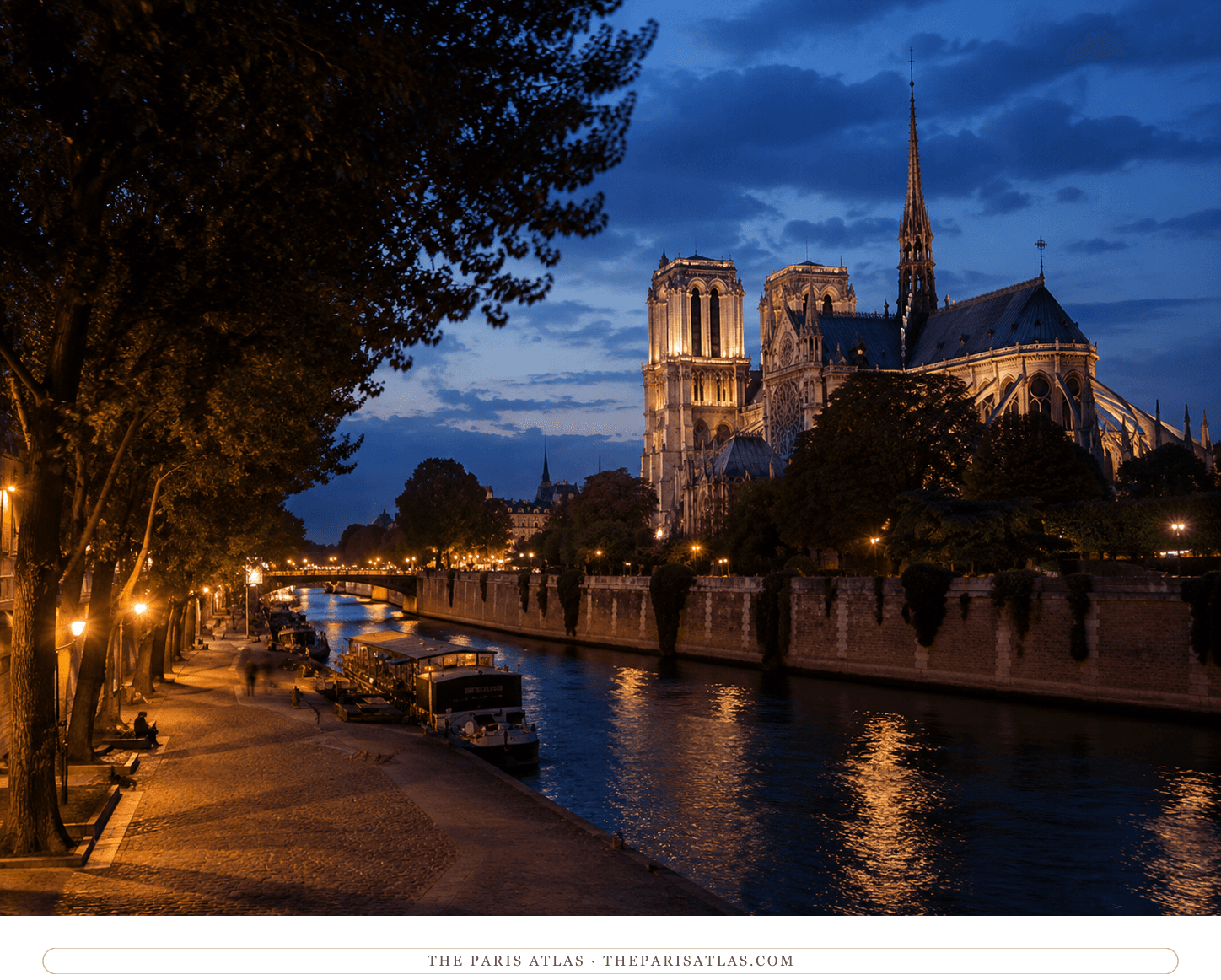
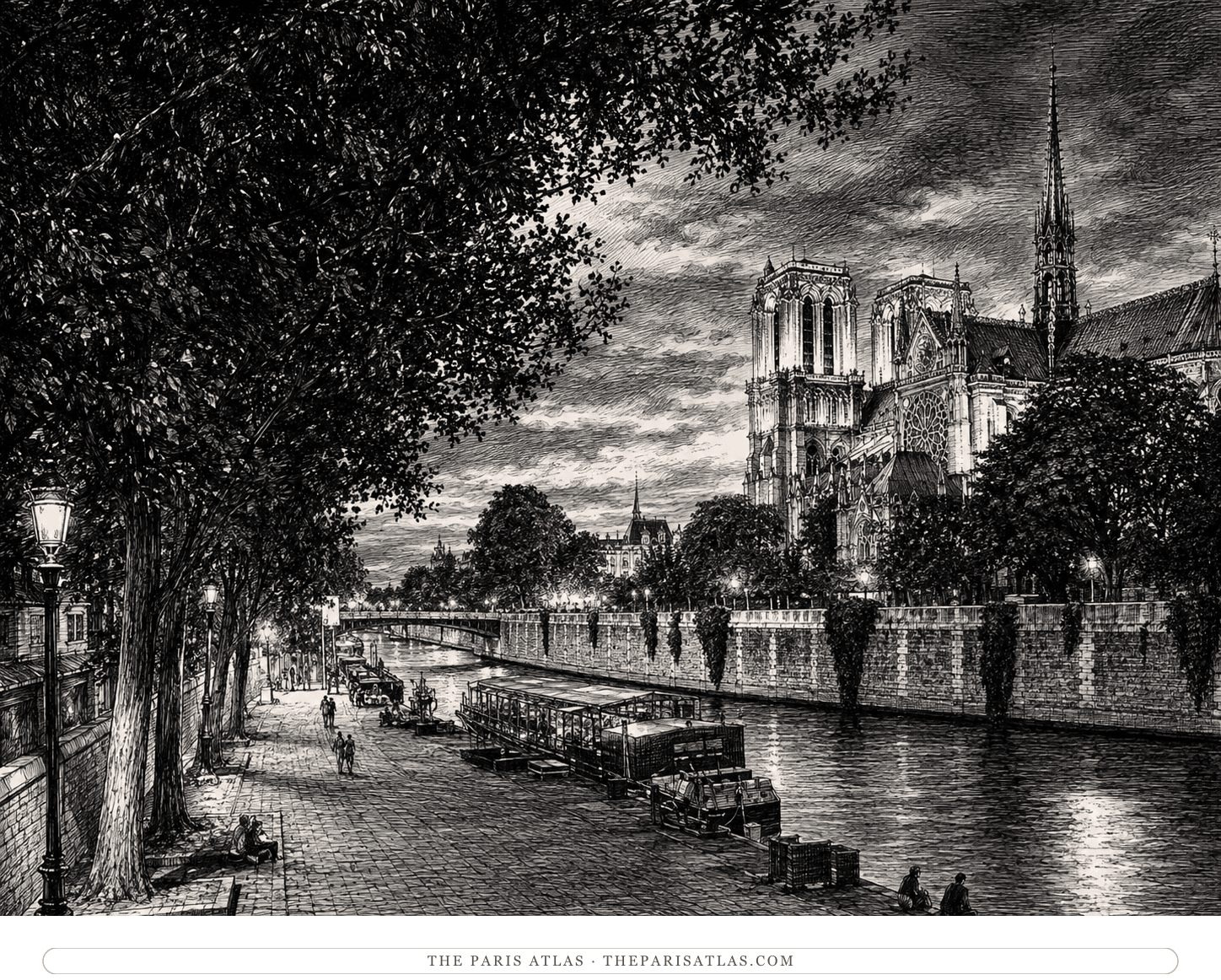
Notre-Dame de Paris

Kipling was twelve, turned loose in Paris while his father arranged the Indian section of the 1878 Exposition Universelle, and found the cathedral for himself by way of Victor Hugo: "I discovered on my own account Quasimodo's Notre Dame." Forty years later the building took his words back. The Imperial War Graves Commission recorded after his death that the inscriptions on its memorials had all been written, approved or selected by him, and named the memorial in Notre Dame among the handful that were his work alone.

Rudyard Kipling, Souvenirs of France (1933), Souvenirs of France, part I; Kipling and the Imperial War Graves Commission, by Alastair Wilson

Depicted in · 1946

Critical Essays

One of the ten essays in Orwell's 1946 collection is about Kipling, written as a review of the selection of his verse that T. S. Eliot made for Faber. Orwell concedes the case in his first paragraph — no civilised person, he says, can accept Kipling's view of life — denies that he was a fascist, and then spends the essay explaining why he outlasts the refined people who sniggered at him, inventing the category of the good bad poet to hold him. The comparison Orwell reaches for is Harriet Beecher Stowe: Kipling is as a poet what she was as a novelist.

George Orwell, Critical Essays (1946), "Rudyard Kipling", pp. 100-113

References

References

The sources below include biographies, scholarly essays, interviews, and primary materials that informed this page. They reflect both the historical record and ongoing critical conversations about Rudyard Kipling and their work.

  1. 1Rudyard Kipling 1865–1936

    The Kipling Society

    The Society's own outline of the life.

    View source
  2. 2Souvenirs of France

    Rudyard Kipling, 1933

    Kipling's own account of France, from 1878 to the graves.

    View source
  3. 3France — notes by Philip Holberton (Readers' Guide)

    The Kipling Society
    View source
  4. 4Kipling and the Imperial War Graves Commission, by Alastair Wilson

    The Kipling Society
    View source
  1. 5Kipling's Sussex: A Chronology, by Michael Smith

    The Kipling Society
    View source
  2. 6Rudyard Kipling – Facts, Nobel Prize in Literature 1907

    Nobel Prize Outreach
    View source
  3. 7Critical Essays

    Secker & Warburg, 1946

    Orwell's 1942 essay, the classic statement of the case for and against.

    View source
  4. 8Derogatory Language Policy

    The Kipling Society

    How his own society handles the racial language in his work, and the source of the warning it prints on every page of its site.

    View source
i
Why these sources are here

These references anchor the page in the documented record and in the scholarly conversations around Rudyard Kipling. Every claim on this page traces back to one or more of the works listed here.

Explore more resources
Browse all authors