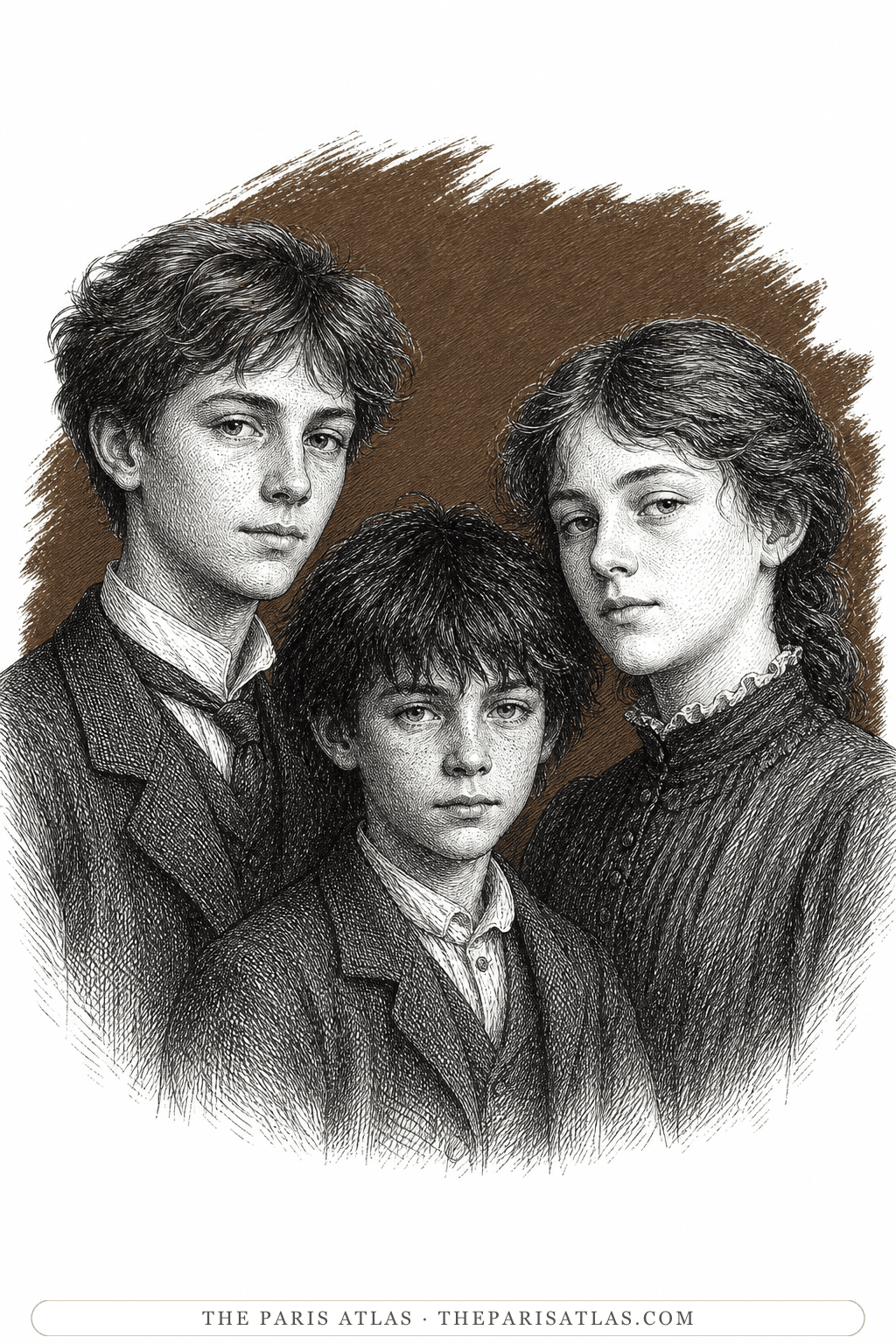
Les Sauvages
The siblings — the 'wild ones' — who ran loose through the same house and countryside, filling out the world of Colette's childhood.
To be left alone, in country nobody else has walked on. Colette writes that from the whole village world the two boys wanted only what was untouched, and that the younger hoped nothing would ever start for him except the next morning.
The book

At a glance
- The subject of the third part, headed Les Sauvages, the wild ones
- Achille, seventeen, and Léo, thirteen, when the section opens, plus their eldest sister Juliette, whom their mother called another kind of savage
- Juliette and Achille were their mother's children by her first marriage; Colette was the youngest of the four
- Brown bread, hard cheese, salad, a fresh egg, leek or pumpkin tart. They took all of it over meat
- Achille studied medicine and practised as a doctor. Léo escaped music, then pharmacy, then everything else, and worked as a copying clerk
- She was twenty-five and Colette was eleven. Asked who she was marrying, their mother answered that it was the first comer
Who they are in the book
Spoiler-freeLes Sauvages means the savages, or the wild ones, and it is what Colette's mother called her two older sons. Looking at the boys, she would ask what on earth was to be done with such savages. The third and last part of the book takes the word for its title and is about them. They were real people: Achille, seventeen at the start of the section, chestnut-haired, with a mouth that smiled only at the family and at a few pretty girls, and Léo, thirteen, dark, his badly cut hair hanging down to the lead-blue eyes he had from their father. Their older sister Juliette gets less room. Her mother called her another kind of savage and said that nobody understood her, herself included.
The two eldest, Juliette and Achille, were their mother's children by her first marriage. All of them were lean, bony and light-footed, and as frugal as their parents: brown bread, hard cheese, salad, a fresh egg, a leek or pumpkin tart, in preference to meat. The boys were so gentle that nobody could get at them or set them against each other. They read to excess, in treetops and haylofts, day and night. They barely played, in the ordinary sense. Nobody ever saw them dressed up as Robinson Crusoe or as conquerors, and when the younger one was folded into a troupe of boys putting on tragedies, the only part he would take was a silent one, the idiot son.
The elder gave the orders and knew that he was going to study medicine. The younger hoped that nothing would ever begin for him at all, beyond the next day and the freedom to daydream and say nothing. Both of them got what they expected. Achille became a doctor and was dead by the time Colette wrote this. Léo escaped music, then pharmacy studies, then everything else, earned his living copying documents at a desk, and at sixty-three would let himself into his sister's Paris flat after dark, open her watch to look at the second hand, peel a foreign stamp off an envelope, take one long breath of gramophone music and leave without having said a word.
How Les Sauvages Is Portrayed
- What their mother called themShe would look at her two boys, find them handsome and ask out loud what was to be done with such savages. She used the same word for her eldest daughter, calling Juliette another kind of savage and adding that nobody understood that one, including her.
- The word they bannedThe boys outlawed the French word mignonne, roughly sweetie, which they pronounced with a twisted grimace followed by a mimed retch. They ran a kitty on it: every mignonne found in a new book put two sous in, and a book with none in it was worth ten sous to whoever had read it. The money was for feasts, butterfly nets and a fish trap. It produced long arguments about whether Dickens should count, since a translator stood in the way, and whether history books ought to be excluded for paying ten sous every single time. Colette was eight and too young to be admitted, but she learned to say the word with the grimace and to grade novelists under the new rules.
- The boy who followed the clarinettistAt six, Léo followed a one-eyed clarinet player four kilometres to the next village. By the time he came back his mother was having the wells of the district dragged. He listened kindly to the reproaches, and when they were over he went to the piano and played every one of the man's tunes exactly, with simple, correct harmonies of his own added.
- Two sous of prunes and two sous of hazelnutsFor five evenings, then ten, the same small boy asked at bedtime for two sous of prunes and two sous of hazelnuts. His mother did not smack him. She got up, reached into the cupboard by the fireplace, set down two sacks the size of newborn babies on either side of him and told him to buy more when they ran out. He went pale, and then he cried: but I don't like them. Asked what he had wanted, he made the mistake of answering: «Je voulais les demander.» He had wanted to ask for them.
- Found on the ceiling of a grocer's shopOn one of the quarterly drives to Auxerre, the county town, he disappeared while the sugar loaf, the five kilos of chocolate, the vanilla and the black pepper were being packed up. His mother, with no wells to hand, was inspecting the oil vats and the brine barrels. He was up at the ceiling, gripping a twisted cast-iron pillar with his thighs and feet the way men climb coconut palms, working and listening to the movement of a big clock bolted to the main beam.
- The wall above the laneThey lay along the top of the garden wall in the afternoon sun, arguing about books without ever insulting each other, going silent and flattening themselves at the sound of footsteps in the lane below. When a girl called Flore Chebrier came up it, red hair and a lilac blouse, the younger jeered at her for being a redhead. The elder said he found her very, very mignonne, which was the forbidden word, and the two of them went off the wall together into the dug earth under the apricot trees, and untangled immediately. Colette says they never once fought or insulted each other.
- What they builtCork setting boards where swallowtail butterflies dried, a fountain under construction, and a still for distilling marsh mint. The still was unreliable in one particular way: it took the smell of mint out of what came through and left the smell of the marsh in.
- The afternoon they let Mathieu passThey chose a schoolmate to torment, a well-dressed, sociable boy called Mathieu M., who came over on his tricycle bringing sheet music and asked whether the elder would play four hands with him. The answer was: with you, no; without you, yes. He kept coming back. One day the brothers left the house after lunch and returned at dusk, steaming and excited. They had hidden in a wood above the road and lain still while he cycled past below them, close enough to touch. Going over it that evening, the younger asked how easy it would have been to kill him. The elder lay rigid with his eyes shut and did not answer. Then they laughed, and the younger promised his eight-year-old sister that they would kill him next time.
- The broken window on the wedding nightTheir sister Juliette married badly, and when the neighbours called it an event their mother corrected them: an accident. Rather than walk in the procession in tailcoats, the boys offered to play the music at the mass, which kept them at the keyboard and beside her for only a moment. They played, Colette says, like angels. When the dancing started the elder gave up, jumped the garden wall, broke a pane to get into the shut and empty house, and was asleep with his arms folded when his mother came home. She thought this proved he was the best-behaved child alive, since he had broken the window in order to be by himself and asleep with the night air on him.
- The gate they had oiledDecades later Léo got a lift back to Saint-Sauveur and came to report on it at his sister's fire in Paris. The woods above the house had been cut flat. Potatoes had been put in where the flowers were, wire had been strung over the lawns for cows, and the canal was a soup of mosquitoes. He was saving the real news. At the Cour du Pâté there was a gate whose latch, turned a certain way, let the gate swing open under its own weight singing four notes; brother and sister sang the notes together as he told it. They had oiled the gate. He left almost at once, having nothing else to say.
If you like Sido


If you like Colette
Explore authors with a similar voice, perspective, and influence.
Henry Miller
The Brooklyn dropout who arrived in Paris broke at thirty-eight and wrote the exuberant, banned books that ended American censorship.
View author
Louis-Ferdinand Céline
The doctor of the Paris slums who wrote the century's blackest, funniest novel — and changed the sound of French prose.
View author
Martha Gellhorn
War correspondent who covered the Spanish Civil War, D-Day, and conflicts across five more decades; Hemingway's third wife, 1940–1945.
View author