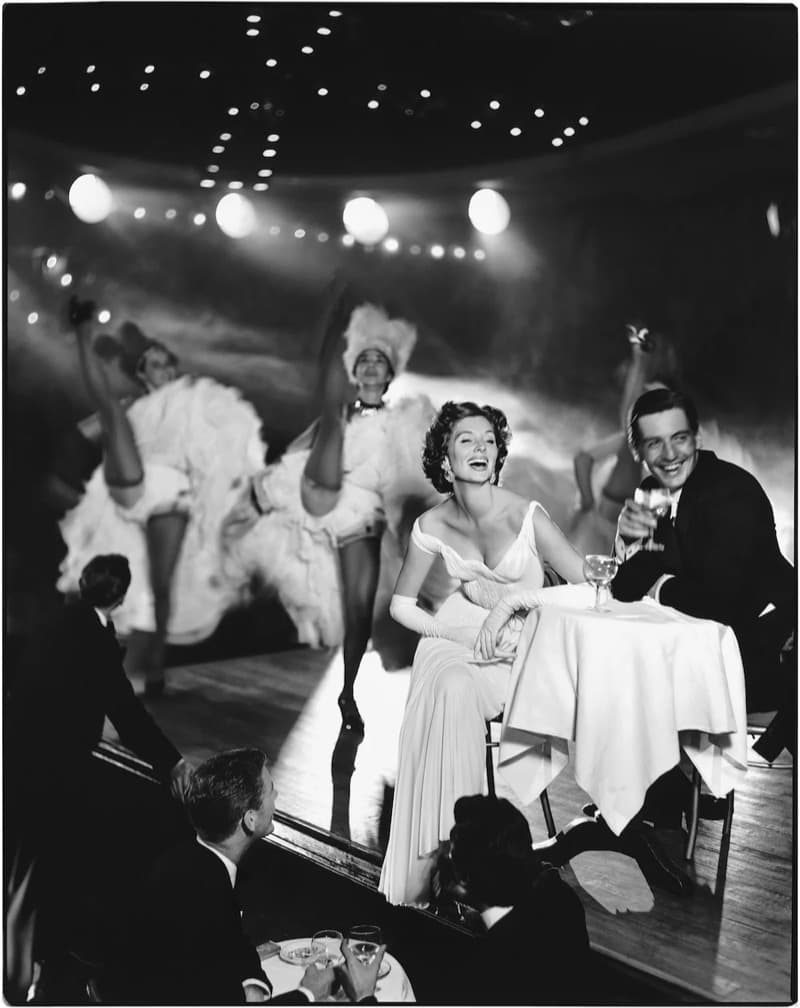
Suzy Parker and Robin Tattersall, evening dress by Grès, Moulin Rouge, Paris, August 1957
A woman in a pale pleated evening dress sits at a small nightclub table, laughing with her head tipped back, while a chorus line kicks in the blurred distance behind her. A man in a dinner jacket raises a glass beside her. Richard Avedon made the photograph in Paris in August 1957, during the couture collections.
- August 1957
- Gelatin silver print
What the photograph shows
Suzy Parker sits at a small round table covered in a white cloth, turned towards the camera and laughing with her mouth fully open. Her head is tipped slightly back and her eyes are almost closed. Her hair is dark, short and curled, and a large pale cluster earring hangs at each ear.
Her gown is pale and cut off the shoulder. The bodice is built from bands of fine pleating that wrap across the body and cross at the centre, leaving a deep narrow V between them. Long pale gloves are pushed down and ruched along her forearms, and her gloved hands rest folded together in her lap. Her left forearm leans on the table, beside a stemmed glass.
Robin Tattersall sits to her right in a dark dinner jacket with a white shirt and a dark tie, his hair combed back from a side parting. He is laughing too, and he lifts a stemmed glass towards the camera. A white pocket square shows at his chest.
Behind them the stage is in use. Two dancers in white ruffled costumes kick high, one wearing a tall feathered headdress and a dark band at the throat, and both are smeared by movement. Further back, more dancers are barely legible. The ceiling above is almost black, scattered with small points of light, with a curved row of four large globe lamps and a swag of smaller bulbs strung between them.
The foreground belongs to other people. A grey-haired man in a dinner jacket is seen from behind and above, his face in profile towards the stage, and a woman with dark upswept hair sits with her back to the camera. Their table carries two stemmed glasses and a small plate.
The dress, and how it is built
The Richard Avedon Foundation credits the gown to Grès. That house was built on exactly the construction visible here: fabric pleated into narrow parallel bands by hand, then drawn across the body and anchored, so the dress is shaped by the pleating rather than by cutting and seaming.
The bands run diagonally over each shoulder, cross low on the chest and continue round the ribs. Where they meet they leave a long narrow V. There is no visible dart, no waist seam and no fastening in the frame. The skirt falls from the same pleated mass and pools over her knees without a break.
The gloves are a separate piece of engineering. They are long enough to reach above the elbow, and they have been pushed down so that the surplus gathers in soft rings along the forearm. That is a wearer's adjustment rather than a maker's, and it is the kind of thing Richard Avedon left in.
A title two institutions disagree on
The Richard Avedon Foundation publishes this photograph as Suzy Parker and Robin Tattersall, evening dress by Grès, Moulin Rouge, Paris, August 1957. Its own file name for the image repeats that wording and adds an edition reference, 102.23.
The Metropolitan Museum of Art holds an August 1957 print of Suzy Parker with Robin Tattersall and catalogues it differently: evening dress by Griffe, Folies-Bergère. The accession number is 1979.512.8, from the Parfums Nina Ricci gift of 1979.
The disagreement is about the couturier and the nightclub at once, and it cannot be settled from published records. The Metropolitan Museum of Art serves no image of its print, so the two cannot be compared frame to frame. The museum is not simply mis-transcribing Grès either: it spells that name correctly on another photograph in the same gift, Sunny Harnett at the casino in Le Touquet.
The title above follows the Richard Avedon Foundation, because the Foundation is the copyright holder and its gallery is the source of the reproduction shown. Whether the Metropolitan Museum of Art's print is this photograph or another frame from the same August is left open.
What is documented about the making, and what is not
No camera, lens, film stock, lighting setup or exposure is recorded for this photograph by the Richard Avedon Foundation or by the Metropolitan Museum of Art. Nothing here infers them.
The picture nevertheless states its own conditions. Suzy Parker is sharp and the dancers behind her are not, so the shutter was long enough to let stage movement smear while she held still. The small lights on the ceiling are rendered as clean points rather than streaks, which means the camera itself did not move.
The tonal range is very wide and the print does not try to compress it. The ceiling lamps and the tablecloths run to pure white with no detail, and the dinner jackets and the ceiling fall to near-black. Almost all the modelling is carried in the narrow band between them, on her face, her gloves and the pleating.
The light on Suzy Parker comes from the front and slightly above, brighter than the room around her. Whether that was added for the photograph or was the club's own light falling on a front table is not recorded.
Photographed in the room, not in front of it
The composition puts the fashion picture inside a working evening. Strangers occupy the foreground with their backs turned, the stage is mid-number, and the model is seated at a table like a customer. A studio photograph of the same dress would have shown the pleating better and the evening not at all.
This was Richard Avedon's method through the Paris seasons. He photographed the collections in cafés, on pavements, in casinos and in nightclubs. The Metropolitan Museum of Art's own Paris holdings from the 1979 gift record the range: the Café des Beaux-Arts, the Pré-Catelan, the Ritz, the Marais, a casino at Le Touquet.
Robin Tattersall is part of that method. He appears repeatedly as the man in Richard Avedon's Paris pictures, including the roller-skating photograph made in the place de la Concorde the previous August.
Close reading
Reading the work, detail by detail
The Richard Avedon Foundation's own web copy is reproduced whole. The exposure was long enough to smear the dancers on the stage while the seated couple stayed sharp, and the small ceiling lights stayed as clean points, so the camera itself did not move. Highlights run to pure white and the dinner jackets fall to near-black.
1.The laugh is wide open and unposed
The mouth is fully open and the eyes are almost closed, which is a laugh caught rather than a smile held. Her head tips back a few degrees off the vertical. In a frame where everything else is arranged, this is the one thing that could not have been.
2.A cluster earring catches the key light
The earring is a cluster of small pale stones that breaks the light into separate points. It sits exactly where the key light is strongest, at the hinge between the lit face and the dark hair. It is the smallest sharply resolved object anywhere in the frame.
3.The bodice is built from pleated bands
The cloth is pleated into narrow parallel ribs by hand, then drawn across the body in bands rather than cut and seamed to shape. Each band changes direction where it crosses another. This is the construction the house of Grès was built on, and it is fully legible here.
4.A band runs over the shoulder and holds the neckline
A single pleated band passes over the shoulder and carries on across the chest, which is what holds the neckline off the shoulder without a strap. No fastening is visible anywhere on the garment in this frame. The weight of the pleating does the work a seam would normally do.
5.The gloves are pushed down into rings
The gloves are long enough to reach above the elbow and have been pushed down so the surplus gathers into soft rings along the forearm. That is the wearer's adjustment, not the maker's. Richard Avedon left it in, where a studio photograph would have had them smoothed.
6.The gloved hands are folded in the lap
Both hands are folded together and laid still in her lap while her face is wide open in a laugh. The contrast between the two is what keeps the pose from reading as a snapshot. The gloved fingers are the only part of the picture where the white runs to a soft grey rather than to paper white.
7.A stemmed glass stands on the white cloth
A short-stemmed footed glass stands on the table beside her forearm, its contents throwing a scatter of small highlights. The tablecloth beneath it is one of the surfaces the print lets run to pure white. The glass survives as a shape only because its stem and foot are drawn in grey.
8.He raises a glass towards the lens
Robin Tattersall lifts his glass towards the camera rather than towards his companion, which makes the viewer the third person at the table. His hair is combed back from a hard side parting and he is laughing as widely as she is. He is lit from the same front source and falls half a stop darker.
9.A white pocket square breaks the black
A white pocket square shows as a small hard-edged triangle against cloth that is otherwise printed to near-black. It is one of only three white notes on the right side of the frame, with his shirt front and his glass. Without it the jacket would read as a flat silhouette.
10.A dancer's feathered headdress, blurred by movement
The dancer at the centre wears a tall feathered headdress and a dark band at the throat, and her whole outline is smeared sideways by the exposure. Her face is tipped up and away. The blur is horizontal, matching the direction of the kick rather than any camera shake.
11.Two legs go up and dissolve
Two dancers kick high in white ruffled costumes and their raised legs are reduced almost to streaks. The ruffles hold more detail than the limbs, because the cloth was moving more slowly than the feet. Further dancers behind them are barely separable from the backdrop.
12.Two kinds of light hang overhead
The ceiling carries small fixed points of light scattered in irregular clusters, and below them a curved row of four large globe lamps with a swag of smaller bulbs strung between. The small points are rendered sharp and the globes are soft, because the globes are nearer the camera and outside the plane of focus.
Timeline
1946
Richard Avedon joins Harper's Bazaar as a staff photographer under the art director Alexey Brodovitch, and stays until 1965.
1956
Photographs Suzy Parker with Robin Tattersall on roller skates in the place de la Concorde on 1 August, during the previous Paris season.
1957
Photographs Suzy Parker and Robin Tattersall at a Paris nightclub in August, in an evening dress the Richard Avedon Foundation credits to Grès.
1978
The Metropolitan Museum of Art's August 1957 print of Suzy Parker and Robin Tattersall is made; the museum titles it evening dress by Griffe, Folies-Bergère.
1979
That print enters the Metropolitan Museum of Art as 1979.512.8, one of eleven Paris fashion photographs given by Parfums Nina Ricci.
2004
Richard Avedon dies on 1 October. The Richard Avedon Foundation holds the copyright.
Where to see it
A viewing location has not yet been listed for this work.
Frequently asked questions
Which nightclub is in this photograph?
The Richard Avedon Foundation's title says the Moulin Rouge. The Metropolitan Museum of Art titles its own August 1957 print of the same two sitters as the Folies-Bergère. The two records cannot be reconciled from published sources, and that museum serves no image of its print.
Who designed the evening dress?
The Richard Avedon Foundation credits Grès, and the pleated construction in the picture matches that house's method. The Metropolitan Museum of Art credits Griffe on its August 1957 print. The atlas follows the Foundation for the photograph reproduced here and records the museum's wording rather than choosing between them.
Who is Robin Tattersall?
The man raising a glass beside Suzy Parker, named in the titles both the Richard Avedon Foundation and the Metropolitan Museum of Art use. He appears in several of Richard Avedon's Paris photographs, including the roller-skating picture made in the place de la Concorde in August 1956.
Why are the dancers blurred?
The exposure was long enough for stage movement to smear while Suzy Parker, who was holding still, stayed sharp. The small ceiling lights are rendered as clean points rather than streaks, which shows the camera itself was steady.
How many people are in the picture?
Suzy Parker and Robin Tattersall sit at their table, with two chorus dancers clearly legible on the stage and more behind them. Two spectators fill the foreground, seen from behind: a grey-haired man in profile and a woman with her back to the camera.
Is there a print in a museum?
The Metropolitan Museum of Art holds an August 1957 print of Suzy Parker and Robin Tattersall as accession number 1979.512.8, under a different title. No museum consulted publishes a reproduction, so whether it is this frame cannot be checked.
More by Richard Avedon
References
The sources below include collection records, catalogues, scholarly research, and primary materials that informed this page. They document Suzy Parker and Robin Tattersall, evening dress by Grès, Moulin Rouge, Paris, August 1957, its making, and its place in cultural history.


1The Work — the Foundation's published gallery of Richard Avedon's photographs
WebsiteThe Richard Avedon FoundationUsed forThe Foundation's published gallery, the source of the title, the edition reference and the reproduction.
2Richard Avedon, Suzy Parker and Robin Tattersall, Evening dress by Griffe, Folies-Bergère, Paris, August 1957 (accession 1979.512.8)
WebsiteThe Metropolitan Museum of ArtUsed forThe Metropolitan Museum of Art's August 1957 print of the same two sitters, catalogued under a different couturier and a different nightclub.
3Richard Avedon, Sunny Harnett, Evening dress by Grès, Casino, Le Touquet, August 1954 (accession 1979.512.7)
WebsiteThe Metropolitan Museum of ArtUsed forCited to show that the Metropolitan Museum of Art spells Grès correctly elsewhere in the same gift, so its Griffe attribution is deliberate.
4Richard Avedon, Suzy Parker, Evening Dress by Lanvin-Castillo, Café des Beaux-Arts, Paris, August 1956 (accession 1979.512.10)
WebsiteThe Metropolitan Museum of ArtUsed forAnother Suzy Parker photograph from the Paris seasons in the same gift, cited for the pattern of locations.
5Magazines — Richard Avedon's magazine work for Harper's Bazaar, Vogue and The New Yorker
WebsiteThe Richard Avedon FoundationUsed forThe Foundation's account of the Harper's Bazaar years under Alexey Brodovitch.
These references provide the documented foundation for this work's history and interpretation. Claim-level citations remain attached to the specific claims they support.
 Explore more resources