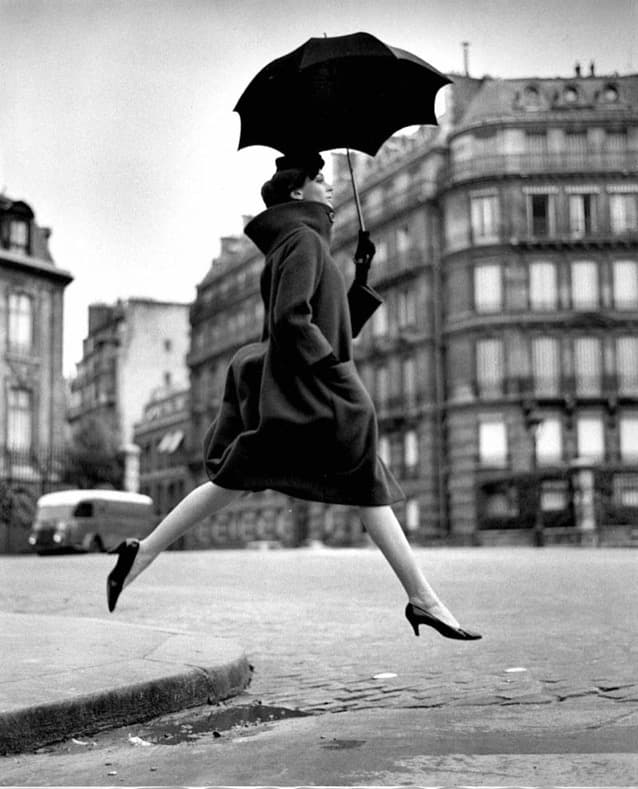
Carmen (Homage to Munkasci), Coat by Cardin, Place François-Premier, Paris, August 1957
A woman in a dark coat is caught in mid-air above a wet Paris street, both feet clear of the ground, holding a large black umbrella open behind her head. Richard Avedon made the photograph in the place François-Premier in August 1957 and named it for another photographer. The Metropolitan Museum of Art holds this print as 1979.512.4.
- August 1957, printed 1978
- Gelatin silver print
- The Metropolitan Museum of ArtNew York, United States
What the photograph shows
The woman is in profile, facing right, at full stride and entirely off the ground. Her trailing foot points behind her and her leading heel has already begun to drop. Both shoes are dark, low-heeled and sharply pointed. Her legs are bare or lightly stockinged, and the coat's hem swings clear of her knees.
She holds a black umbrella open above and behind her head, tilted back so that the scalloped ends of its ribs read as a dark disc against a blank white sky. The shaft runs down at an angle to her gloved right hand. A dark angular bag hangs from the same hand.
A small dark cap sits back on the crown of her head, with her hair showing in front of it. Her expression is level and her mouth is closed. Nothing about her face registers effort.
Behind her, out of focus, is a Paris street corner: a tall stone building with a mansard roof, dormers and long windows, a lower range to the left, and a pale van parked at the kerb. The foreground is the roadway itself, running diagonally, with a kerb edge and a standing puddle at the bottom left. The pavement is wet and the light is flat and grey.
The photographer the title names
Martin Munkácsi, 1896 to 1963, was a Hungarian photographer. The International Center of Photography records that his 1933 pictures revolutionised fashion photography with their informality and vitality, and that the editor Carmel Snow hired him for Harper's Bazaar afterwards.
The photograph that did it showed the model Lucile Brokaw running on a Long Island beach in a one-piece swimsuit with a cape. Before it, fashion was photographed standing still. Martin Munkácsi photographed a woman in motion and the magazine ran it.
Carmel Snow is the link between the two men. She hired Martin Munkácsi in the 1930s, and she was the editor at Harper's Bazaar when Richard Avedon joined the staff in 1946. The homage is therefore made inside the same magazine, by the man who inherited the problem Martin Munkácsi had opened.
The coat, and how it is built
The Metropolitan Museum of Art's title credits the coat to Cardin. It is cut very full and hangs free from the shoulders rather than from the waist, so the body of it swings out behind her as she moves.
A deep soft collar rolls up around the neck and stands away from it at the back, closed high near the throat. The armholes are cut wide and deep, and the sleeves are shortened to the forearm with the cuffs turned back, which is what leaves her dark gloves visible. A shaped seam and a welt run across the hip on the side turned towards the camera.
The construction is the reason the picture works. A fitted coat would have held its shape in the air and told the viewer nothing. This one reads the movement, because the hem and the collar are both free to lag behind the body carrying them.
What is documented about the making, and what is not
The camera, lens, film stock and exposure are not stated by the Metropolitan Museum of Art or by the Richard Avedon Foundation's published gallery. Whether the leap was made once or many times is not recorded either, and nothing here infers it.
The photograph carries its own evidence about the exposure. Her feet, the umbrella ribs and the hem of the coat are all sharp, so the shutter was fast enough to stop a jump. The background is soft, which places the focus on her and suggests a wide aperture rather than a long lens.
The street is genuinely wet. There is standing water along the kerb in the foreground and the road surface carries reflections. The sky behind her is featureless white, which is what a heavy overcast gives, and it is also what makes the black umbrella read as a flat shape rather than an object.
The place in the title
The place François-Premier is a small square in the 8th arrondissement of Paris, in the streets between the Champs-Élysées and the Seine where the couture houses stood. Richard Avedon was in the city for the August collections, as he was every season.
He worked outdoors on principle. The pictures he made for Harper's Bazaar in these years were taken in cafés, on pavements, in nightclubs and in the street, rather than against a studio wall, and that was the break with everything before him. The Metropolitan Museum of Art's own Paris holdings from the same gift show the pattern: a café, a nightclub, a casino, the Marais, the Pré-Catelan, the Ritz.
How the name is spelled
The two bodies that publish this title spell the dedicatee differently. The Metropolitan Museum of Art writes Munkasci. The Richard Avedon Foundation writes Munkacsi. The photographer's own name was Munkácsi.
The Metropolitan Museum of Art's wording is reproduced above because it is the title of the print held there. The difference is orthographic and neither institution disputes who is meant.
Close reading
Reading the work, detail by detail
The Richard Avedon Foundation's own web copy is reproduced whole. The grain is coarse and the sky behind the leap is blank white, so the open umbrella reads as a flat black shape rather than an object. Everything in the background is soft; everything on the figure is sharp.
1.The canopy reads as a flat black disc
Seen from below against an empty overcast sky, the canopy loses almost all internal detail and flattens into a single black form. Only the faint seams between panels survive. That flattening is what makes the umbrella the heaviest object in the frame despite weighing almost nothing.
2.The rib ends scallop the edge
The cloth dips between each rib and is pulled out to a small point at every tip, giving the silhouette a scalloped edge. Several rib ends project clear of the fabric. The umbrella is tilted back from the vertical, which is why the ellipse of its rim is wide rather than narrow.
3.The face registers no effort at all
She is in full profile, facing the direction of travel, with her mouth closed and her gaze level. There is no strain around the jaw or the eye. The picture is of a woman in mid-air, and the one part of her that could have shown the exertion does not.
4.A small cap sits back off the forehead
The hat is a small dark brimless cap, pushed back so that it sits on the crown with hair showing in front of it. It is held on through a jump, which means it is pinned. Its darkness ties it to the umbrella above and separates the head from the white sky behind.
5.A deep collar rolls up and stands off the neck
The collar is a deep soft roll that closes high near the throat and stands clear of the neck behind. A collar will only do that if it is cut on a curve and interlined. It is the coat's one piece of structure, and everything below it is deliberately unstructured.
6.A gloved hand grips the shaft low
The hand is gloved in dark leather and holds the umbrella low on the shaft rather than at a handle, which is what lets the canopy sit so far back. The coat sleeve is turned back well above the wrist. Shortening the sleeve is what makes the glove visible at all.
7.A dark angular bag hangs from the same hand
A dark bag hangs from the same hand that grips the umbrella, keeping its angular shape rather than swinging loose. Its straight top edge and pointed lower corner mark it as a structured frame bag. She is carrying two objects through the jump and neither is adjusted for it.
8.The coat hangs from the shoulders, not the waist
The body of the coat flares from the shoulder line with no waist seam to interrupt it, and it lags behind the wearer so the hem trails. A shaped seam and a welt cross the hip on the side facing the camera. A fitted coat would have held its outline and told you nothing about speed.
9.The back foot is fully pointed
The trailing leg is extended straight back and the foot is pointed hard, in the way a dancer points rather than the way a walker pushes off. The shoe is dark, low-heeled and sharply pointed at the toe. There is clear daylight between it and the road surface.
10.The front heel has already started to drop
The leading foot is thrown forward with the heel beginning to tip towards the ground, so the frame catches the instant before landing rather than the top of the arc. The shoe is the same dark pointed court shoe. Both feet are sharp, which fixes the shutter speed as short.
11.There is standing water along the kerb
A kerb crosses the bottom of the frame on a diagonal and a shallow pool of water lies against it, holding reflections. The road behind is dark and evenly damp. The umbrella is not a prop: it had been raining, and the flat white sky overhead is the same weather.
12.A pale van is parked at the left edge
A small pale van stands at the kerb behind her, so far out of focus that its panels merge. It is the one object in the frame that dates the street, and it is deliberately unreadable. The depth of field is shallow enough to dissolve everything more than a few metres past her.
Timeline
1933
Martin Munkácsi photographs Lucile Brokaw running on a Long Island beach; the International Center of Photography credits the resulting pictures with revolutionising fashion photography, and Carmel Snow hires him for Harper's Bazaar.
1946
Richard Avedon joins the staff of Harper's Bazaar, where Carmel Snow is editor and Alexey Brodovitch art director.
1957
Photographs Carmen leaping in the place François-Premier in August, during the Paris collections, in a coat credited to Cardin.
1963
Martin Munkácsi dies.
1978
The print now at the Metropolitan Museum of Art is made.
1979
Enters the Metropolitan Museum of Art as 1979.512.4, one of eleven Paris fashion photographs given by Parfums Nina Ricci.
2004
Richard Avedon dies on 1 October. The Richard Avedon Foundation holds the copyright.
Where to see it
The Metropolitan Museum of Art
1000 Fifth Avenue, New York, NY 10028, United States
One of eleven Paris fashion photographs by Richard Avedon given to the museum by Parfums Nina Ricci in 1979. The museum publishes no reproduction of any of them.
Plan your visit on the museum’s official website (opens in a new tab)Frequently asked questions
Who is Carmen in Richard Avedon's photograph?
The title gives only her working name, Carmen, which is how Richard Avedon titled his fashion pictures. The Metropolitan Museum of Art's record adds nothing further about the sitter, and no fuller identification appears on the Richard Avedon Foundation's published gallery.
Who was Munkácsi?
Martin Munkácsi, 1896 to 1963, a Hungarian photographer. The International Center of Photography records that his 1933 photographs of a model running on a Long Island beach revolutionised fashion photography through their informality and vitality, after which Carmel Snow hired him for Harper's Bazaar.
Where is the place François-Premier?
In the 8th arrondissement of Paris, in the streets between the Champs-Élysées and the Seine. Richard Avedon photographed there in August 1957 while covering the couture collections, which is when the Paris houses showed.
Is she really in the air?
Both her feet are clear of the ground in the frame, with the trailing foot pointed and the leading heel dropping. Whether the leap was repeated for the camera is not recorded by the Metropolitan Museum of Art or by the Richard Avedon Foundation.
Who made the coat?
The Metropolitan Museum of Art's title credits Cardin. It is a full, swinging coat with a deep rolled collar and wide armholes, cut to hang from the shoulders, with the sleeves shortened to the forearm and the cuffs turned back.
Where can you see this photograph?
The Metropolitan Museum of Art holds a 1978 print as accession number 1979.512.4, given by Parfums Nina Ricci. The museum does not publish an image of it, and holding a print is not a promise of display, so check before travelling.
More by Richard Avedon
References
The sources below include collection records, catalogues, scholarly research, and primary materials that informed this page. They document Carmen (Homage to Munkasci), Coat by Cardin, Place François-Premier, Paris, August 1957, its making, and its place in cultural history.


1Richard Avedon, Carmen (Homage to Munkasci), Coat by Cardin, Place François-Premier, Paris, August 1957 (accession 1979.512.4)
WebsiteThe Metropolitan Museum of ArtUsed forThe holding institution, and the source for the title, date, medium, dimensions and credit line.
2Martin Munkácsi: Think While You Shoot! — exhibition record
WebsiteInternational Center of PhotographyUsed forUsed for Martin Munkácsi's dates and for the 1933 Harper's Bazaar photographs the title honours.
3The Work — the Foundation's published gallery of Richard Avedon's photographs
WebsiteThe Richard Avedon FoundationUsed forThe Foundation's published gallery, the source of the reproduction and of its own wording of the title.
4Magazines — Richard Avedon's magazine work for Harper's Bazaar, Vogue and The New Yorker
WebsiteThe Richard Avedon FoundationUsed forThe Foundation's account of the Harper's Bazaar years under Alexey Brodovitch.
5Richard Avedon, Elise Daniels with Street Performers, Suit by Balenciaga, Le Marais, Paris, August 1948 (accession 1979.512.1)
WebsiteThe Metropolitan Museum of ArtUsed forOne of the other ten Paris photographs in the same 1979 gift, cited for the pattern of locations.
These references provide the documented foundation for this work's history and interpretation. Claim-level citations remain attached to the specific claims they support.
 Explore more resources