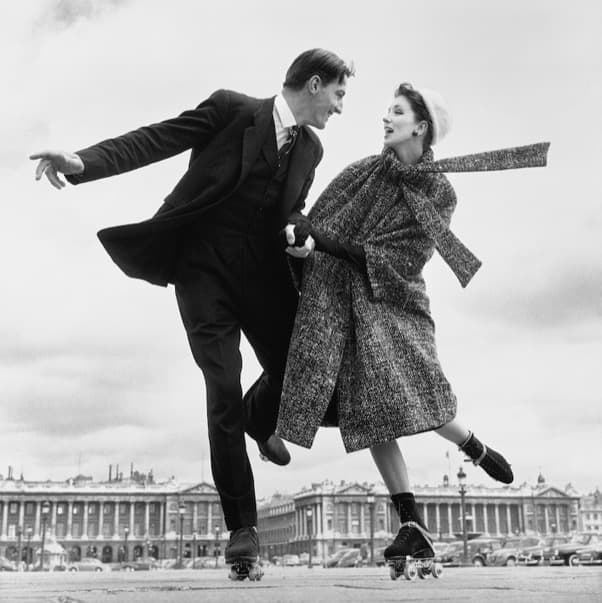
Suzy Parker and Robin Tattersall, coat by Dior, Place de la Concorde, Paris, August 1, 1956
A man and a woman skate across the Place de la Concorde on clamp-on roller skates, laughing at each other with their hands joined. She wears a full tweed coat by Dior with a long stole flying out horizontally behind her. Richard Avedon dated the photograph to 1 August 1956, at the start of the Paris couture season.
- 1 August 1956
- Gelatin silver print
What the photograph shows
Two figures cross the open paving of the square from left to right, both on roller skates, both caught mid-stride. Suzy Parker is on the right and Robin Tattersall on the left, and their inner hands are joined at the centre of the frame. They are looking at each other and both are laughing openly.
Robin Tattersall wears a dark three-piece suit with the jacket open over a buttoned waistcoat, a white shirt and a dark tie. His hair is combed back. He leans steeply away to the left with his free arm flung out behind him, fingers spread, and his back leg bent up so that only one skate is on the ground.
Suzy Parker wears a pale hat set far back on her head and dark gloves. Her coat is a heavy tweed with a bold flecked weave, cut full and hanging open. A wide band of the same tweed wraps her shoulders and throat, and a long panel of it streams out horizontally to the right, held straight by the speed.
Both wear four-wheel roller skates strapped over ordinary street shoes, with the metal plates and wheels plainly visible. She has dark ankle socks pulled over her stockings. One of her skates is planted and the other is kicked up behind her with the strap and buckle showing.
Behind them stand two matching palace fronts with giant colonnades raised over a rusticated ground storey, balustrades along the roofline, and a street opening between them. A tall ornate lamp standard rises at the right with a mast above it, and a row of parked 1950s cars runs along the base of the buildings. The sky is a flat pale overcast.
The coat, and how it is built
The Richard Avedon Foundation credits the coat to Dior. It is cut on a swing line, wide at the hem and hanging from the shoulders rather than fitted at the waist, which is why it holds a bell shape even with the wearer leaning hard to one side.
The cloth is doing most of the work. It is a thick, nubby tweed, woven with a strong contrast fleck that the black-and-white film renders as a dense salt-and-pepper texture. That texture is legible at every scale in the frame, from the shoulder to the flying end of the stole.
The stole is the reason the photograph exists in this form. It is a long straight panel, wrapped once around the neck and shoulders and left loose, and at this speed it lifts to the horizontal and stays there. A shorter scarf, or a lighter one, would have wrapped around her instead.
What is documented about the making, and what is not
No camera, lens, film stock, lighting or exposure is recorded by the Richard Avedon Foundation, which is the only body publishing this photograph among the sources consulted. Whether the square was closed, how many passes were skated, and who else was present are not recorded either.
The frame carries some evidence of its own. Both skaters are sharp, including the flying stole and the spokes of the skate wheels, so the shutter was fast. The buildings behind are slightly soft but legible, and the cars along their base are readable as separate vehicles, which suggests a moderate aperture rather than a wide one.
The camera is low, at roughly waist height, looking slightly up. That is what lifts both figures clear of the roofline of the buildings and sets their heads against blank sky. The horizon of the square sits low in the frame, and the paving occupies only the bottom fifth.
The light is flat and comes from a white overcast sky, with no hard shadow on the ground under either skater. It is the kind of light that renders tweed well and faces poorly, and the exposure is held for the coat rather than for the faces.
The square, and why it is in the picture
The Place de la Concorde is the large open square at the east end of the Champs-Élysées, in the 8th arrondissement of Paris. It is among the busiest traffic interchanges in the city, which is visible here in the rank of cars drawn up along the far side.
Richard Avedon used it as a stage rather than a backdrop. The two colonnaded fronts are set behind the skaters as a flat classical screen, and the skaters cut across it on a diagonal. The formality of the architecture is the thing the picture is playing against.
He returned to the square across the Paris years. The Metropolitan Museum of Art holds his August 1947 photograph of the model Renée in the New Look of Dior, also made in the Place de la Concorde, from the first season he covered for Harper's Bazaar.
A photograph with a day on it
Most of Richard Avedon's Paris fashion titles give only a month, because the collections ran through August and the pictures were made across the weeks. This one carries a date: 1 August 1956.
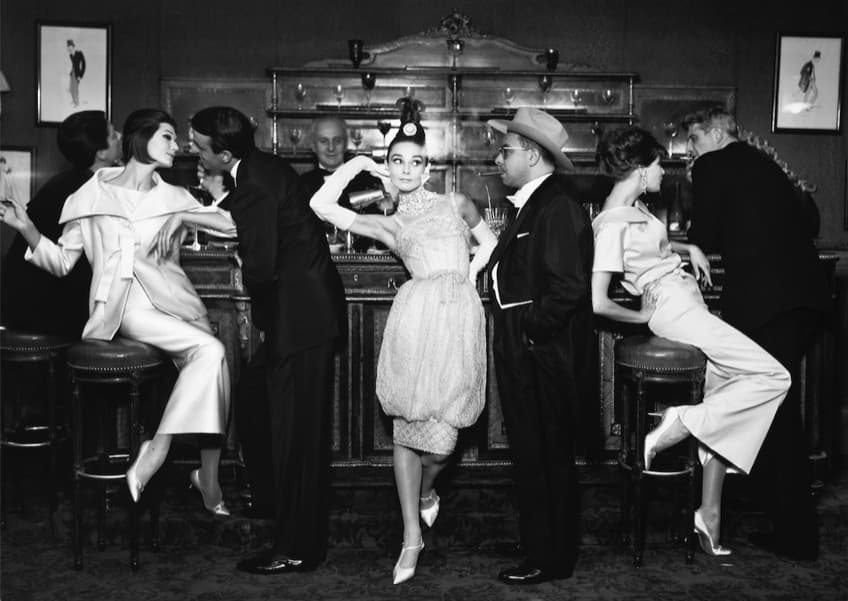
Robin Tattersall appears again in his Paris work the following August, at a nightclub with Suzy Parker, in the photograph the Richard Avedon Foundation titles for an evening dress by Grès. Suzy Parker was photographed repeatedly across the same seasons, including at the Café des Beaux-Arts and in his Paris studio, both in August 1956, and both prints are at the Metropolitan Museum of Art.
Close reading
Reading the work, detail by detail
The Richard Avedon Foundation's own web copy is reproduced whole, in a nearly square frame. The camera is low and looking slightly up, which lifts both skaters clear of the rooflines behind them and pushes the horizon of the square down into the bottom fifth of the picture. The light is flat overcast, with no hard shadow under either skater.
1.Their hands are joined at the centre of the frame
The two hands meet almost exactly at the centre of the square frame, and everything else in the picture swings out from that point. Hers is gloved in dark leather and his is bare. A pale rounded object is caught between them, most likely his other glove.
2.She laughs at him, not at the camera
Her head is turned away from the lens and towards him, and the laugh is open-mouthed. Neither skater acknowledges the camera anywhere in the frame. The flat overcast light gives her face almost no modelling, which is the cost of the light that renders the tweed so well.
3.He leans past the point of balance
Robin Tattersall is tipped well past the angle a person could hold at rest, held up only by speed and by her hand. The jacket hangs open over a buttoned waistcoat, and the whole suit is dark enough to print as a single mass. His outline is what gives the picture its diagonal.
4.The free arm is thrown back with the fingers spread
His free arm is thrown straight out behind him and the fingers are spread apart rather than curled. Against the blank sky the hand reads as a separate small shape. It is the counterweight to the lean, and it marks the left edge of the composition.
5.A pale hat sits far back on the head
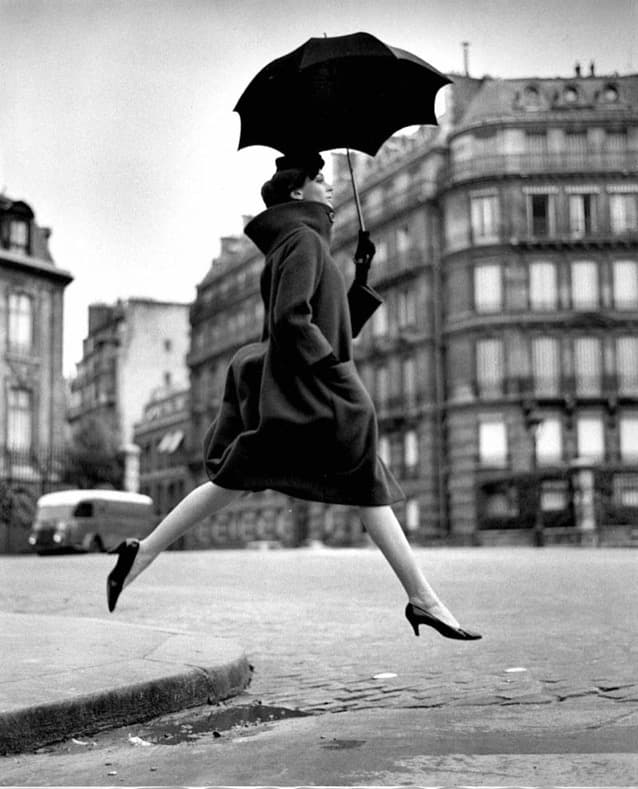
The hat is small, pale and set right at the back of the crown, with the hair swept up in front of it. It reads almost white against the grey sky and marks the top right corner of the figure group. Like the cap in the umbrella photograph, it stays on through hard movement, so it is pinned.
6.The tweed prints as dense salt and pepper
The cloth is a thick nubby tweed with a strong contrast fleck, and the black-and-white film turns that fleck into a dense salt-and-pepper speckle. The texture stays legible from the shoulder to the flying end of the stole. Flat overcast light is exactly what renders a surface like this without losing it to glare.
7.The stole is held out horizontal by speed
A long straight panel of the same tweed streams out level to the right, neither drooping nor wrapping. It reaches that angle only at speed, and it is sharp along its whole length, which fixes the shutter as fast. A lighter or shorter scarf would have curled back round her instead.
8.The coat keeps its bell through the lean
The coat flares from the shoulders to a wide hem with no waist seam anywhere in the line, so it keeps a bell shape even while the wearer is tilted. A wrapped band of the same cloth sits at the throat. The cut is doing the same job as the stole: making movement visible in still cloth.
9.A skate clamped over an ordinary shoe
The skate is a four-wheel plate clamped and strapped beneath an ordinary leather street shoe, not a boot skate. The metal plate, the axle blocks and all four wheels are separately resolved. Neither skater has changed anything else about their clothes for it.
10.Dark ankle socks pulled over stockings
She wears dark ankle socks pulled over her stockings, which is a practical measure against the skate straps and not a styling one. One skate is planted and the other is kicked up behind, with its ankle strap and buckle plainly visible. The raised skate is as sharp as the planted one.
11.Two matching palace fronts close the square
Behind the skaters stand two matching fronts with giant colonnades raised over a rusticated ground storey, balustrades along the roofline, and a street opening between them. They are set almost square to the camera and read as one flat classical screen. The skaters cut across that screen on a diagonal, which is the whole joke of the composition.
12.A lamp standard and a rank of parked cars
A tall ornate lamp standard rises at the right with a mast above it, and a rank of 1950s cars is drawn up along the base of the buildings. The cars are readable as separate vehicles rather than a blur, which places the aperture as moderate. The square is in ordinary working use throughout.
Timeline
1946
Richard Avedon joins Harper's Bazaar as a staff photographer under the art director Alexey Brodovitch.
1947
Photographs the model Renée in the New Look of Dior in the Place de la Concorde in August; the print is now at the Metropolitan Museum of Art as 1979.512.2.
1956
Photographs Suzy Parker and Robin Tattersall on roller skates in the same square on 1 August, in a tweed coat credited to Dior.
1956
Photographs Suzy Parker again that August at the Café des Beaux-Arts and in his Paris studio; both prints are at the Metropolitan Museum of Art.
1957
Photographs Suzy Parker with Robin Tattersall again, at a Paris nightclub, the following August.
2004
Richard Avedon dies on 1 October. The Richard Avedon Foundation holds the copyright.
Where to see it
A viewing location has not yet been listed for this work.
Frequently asked questions
Where was this photograph taken?
The Place de la Concorde in the 8th arrondissement of Paris, at the east end of the Champs-Élysées. The two colonnaded palace fronts behind the skaters, with a street opening between them, stand on the north side of the square.
Are they really on roller skates?
Yes, and the skates are clearly visible. Both wear four-wheel clamp-on skates strapped over ordinary street shoes, with the metal plates and wheels in view. Suzy Parker also wears dark ankle socks pulled over her stockings.
Who designed the coat?
The Richard Avedon Foundation credits Dior. It is a swing-cut coat in a heavy flecked tweed, hanging from the shoulders rather than fitted at the waist, with a long stole of the same cloth that streams out horizontally on the move.
Who is the man in the photograph?
Robin Tattersall, named in the Richard Avedon Foundation's title. He appears in several of Richard Avedon's Paris photographs, including one made with Suzy Parker at a nightclub the following August.
Why is the date so precise?
Richard Avedon's Paris fashion titles usually give only the month, because the couture collections ran across weeks in August. This title carries a full date, 1 August 1956, which places it at the very start of that season.
Is there a museum print of this photograph?
None was found among the records consulted. The Metropolitan Museum of Art holds other Suzy Parker photographs from August 1956, at the Café des Beaux-Arts and in the Paris studio, but not this one. The Richard Avedon Foundation publishes it in its own gallery.
More by Richard Avedon
References
The sources below include collection records, catalogues, scholarly research, and primary materials that informed this page. They document Suzy Parker and Robin Tattersall, coat by Dior, Place de la Concorde, Paris, August 1, 1956, its making, and its place in cultural history.


1The Work — the Foundation's published gallery of Richard Avedon's photographs
WebsiteThe Richard Avedon FoundationUsed forThe Foundation's published gallery, the source of the title, the full date and the reproduction.
2Richard Avedon, Renée, The New Look of Dior, Place de la Concorde, Paris, August 1947 (accession 1979.512.2)
WebsiteThe Metropolitan Museum of ArtUsed forRichard Avedon's August 1947 photograph in the same square, cited for his return to the location.
3Richard Avedon, Suzy Parker, Evening Dress by Lanvin-Castillo, Café des Beaux-Arts, Paris, August 1956 (accession 1979.512.10)
WebsiteThe Metropolitan Museum of ArtUsed forSuzy Parker photographed at the Café des Beaux-Arts in the same August 1956 season.
4Richard Avedon, Suzy Parker, Evening Dress by Dior, Paris Studio, August 1956 (accession 1981.1137.12)
WebsiteThe Metropolitan Museum of ArtUsed forSuzy Parker photographed in the Paris studio in the same August 1956 season.
5Magazines — Richard Avedon's magazine work for Harper's Bazaar, Vogue and The New Yorker
WebsiteThe Richard Avedon FoundationUsed forThe Foundation's account of the Harper's Bazaar years under Alexey Brodovitch.
6Richard Avedon, Christian Bérard and Renée, Suit by Dior, Le Marais, Paris, August 1947 (accession 1981.1137.1)
WebsiteThe Metropolitan Museum of ArtUsed forThe other August 1947 photograph of the model Renée, made in the Marais in his first Paris season.
These references provide the documented foundation for this work's history and interpretation. Claim-level citations remain attached to the specific claims they support.
 Explore more resources