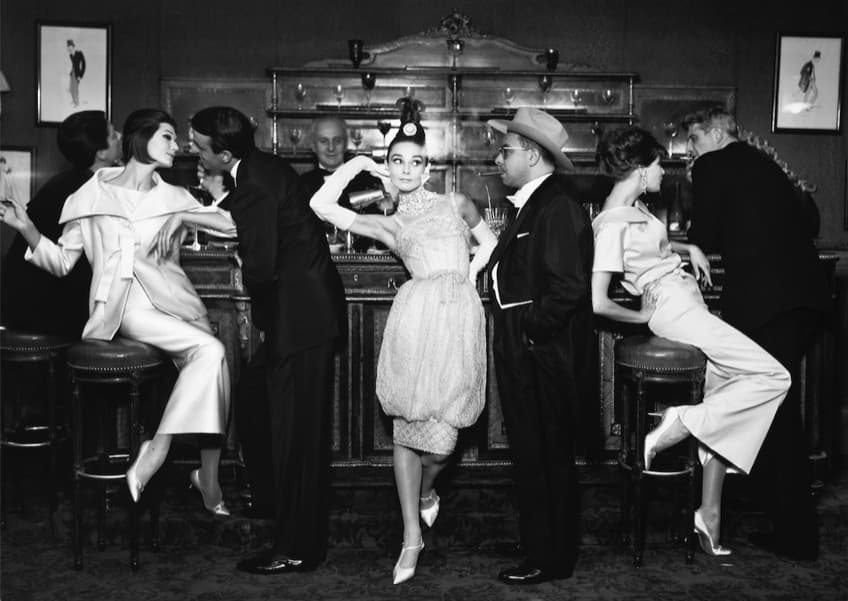
Audrey Hepburn and Art Buchwald, with Simone D'Aillencourt, Frederick Eberstadt, Barbara Mullen, and Dr. Reginald Kernan, evening dresses by Balmain, Dior, and Patou, Maxim's, Paris, August 1959
Eight people are arranged along a carved and mirrored bar, three of them women in pale evening clothes held in postures no one would hold at rest. Audrey Hepburn stands at the centre in a beaded dress with a jewelled collar, and the columnist Art Buchwald is beside her in a wide pale hat with a cigar. Richard Avedon made the photograph at Maxim's in Paris in August 1959.
- August 1959
- Gelatin silver print
What the photograph shows
The frame holds eight figures, spread almost evenly across it and lit so that the pale clothes carry all the light. Behind them runs a bar with a carved counter and a tall mirrored back fitting, crested with a scrolled pediment and shelved with rows of stemmed glasses. Framed drawings hang on the panelled walls at both sides, and five round leather-topped stools with brass stud trim stand along the counter.
Audrey Hepburn stands at the centre. Her hair is drawn up into a tall topknot with a pale round ornament pinned at its front. She wears a sleeveless beaded dress with a jewelled band standing high at the throat, a gathered bodice, and a bubble hem drawn in over a narrow beaded underskirt. Long white gloves reach above the elbow. Her right hand is raised to her hair and her left rests on her hip, and she looks sharply away to her left.
Art Buchwald stands immediately to her right in a dark tuxedo with white-edged lapels and a white bow tie. He wears a pale wide-brimmed hat and dark-framed spectacles, and a lit cigar juts from his mouth with the smoke visible against the mirror. His hands are behind his back and he is turned towards her in profile.
At the left, a woman perches on a stool in a pale suit. Its collar is the largest thing in the picture, a stand-away portrait collar sweeping from shoulder to shoulder, fastened at the front by one covered button on a tab. Her sleeves are turned back at the forearm and her trousers are narrow. She leans back with one arm flung out to the left and looks over her shoulder. A man in a dark suit bends towards her face, and a fourth head shows at the extreme left edge.
At the right, a second woman arches backwards over a stool with her spine curved and one foot on the footrest, in a pale short-sleeved top with a wide open collar and a long pale skirt. A pendant earring swings clear of her neck. A man in a dark dinner jacket leans over her onto the bar, seen from behind.
Behind the counter stands an older man with grey hair in a white shirt, black bow tie and dark jacket. He is the only person in the room who is working, and he looks straight out of the picture.
The title names six of the eight
Richard Avedon's title lists Audrey Hepburn, Art Buchwald, Simone D'Aillencourt, Frederick Eberstadt, Barbara Mullen and Dr. Reginald Kernan. Eight people are in the frame. The barman behind the counter is not named, and neither is the head at the extreme left edge.
The title also lists three couture houses — Balmain, Dior and Patou — without saying which woman wears which. The Richard Avedon Foundation's gallery, the only published source consulted for this photograph, adds nothing further. No attribution of a particular dress to a particular house is made here.
Art Buchwald was a newspaper columnist rather than a model, and he is dressed as a joke on the setting: black tie under a pale ranch hat, with a cigar. Placing a working humorist at the centre of a couture picture is the photograph's one openly comic decision.
How the clothes are built
Audrey Hepburn's dress is worked in small beads over a sheer ground, so the surface reads as a dense sparkle rather than as cloth. The bodice is gathered softly onto a beaded band at the waist. The overskirt is a pouf: the hem is turned under and drawn in tightly beneath the knee, which makes the skirt balloon and then stop, over a straight beaded underskirt that shows below it.
The jewelled band at her throat is structural rather than ornamental. It stands upright and holds the neckline high and stiff, and everything below it is soft. That contrast is what makes the raised arm read as a deliberate pose rather than a fidget.
The pale suit at the left is cut for the collar. A collar that size needs weight and a firm interlining to stand away from the neck without collapsing, and the rest of the jacket is kept plain so that nothing competes with it. The single covered button on its tab is the only fastening visible anywhere on the garment.
What is documented about the making, and what is not
No camera, lens, film stock, lighting or exposure is recorded by the Richard Avedon Foundation, and no museum consulted holds a print of this photograph. Whether the restaurant was closed for the session, and how long it took, are not recorded either.
The picture shows what was done to the light. The room's own fittings are dim, and the bracket lamps on the back bar are not doing the work. The people are lit hard from the front, which throws their pale clothes to near-white and leaves the panelling, the carpet and the dinner jackets in deep shadow. That is added light, not available light.
Everyone is sharp, including the smoke from the cigar and the beadwork on the dress, so the exposure was short. The camera is at standing height and square to the bar, which is what makes the back fitting read as a flat decorated screen and the eight figures as a frieze across it.
The composition is built on alternation. Pale, dark, pale, dark runs the length of the frame, and every woman is in a posture off the vertical while every man stands or leans upright. Nothing about the arrangement is accidental.
Made in the restaurant, at the end of a run of Paris years
The setting is Maxim's, the Paris restaurant named in the title. Richard Avedon had been photographing the Paris collections since August 1947, and by 1959 the method was fixed: take the clothes into a real room with real fittings and real staff, and let the room be half the photograph.
The rooms from those years are a list of Paris addresses rather than a studio. The Metropolitan Museum of Art's Paris holdings alone record the Café des Beaux-Arts, the Pré-Catelan, the Ritz, the Marais, the avenue Montaigne, the place du Trocadéro and the workroom of the house of Dior.
Richard Avedon left Harper's Bazaar for Vogue in 1965, six years after this photograph, and stayed there for more than twenty years. The Richard Avedon Foundation records that he later became the first staff photographer at The New Yorker, in 1992.
Close reading
Reading the work, detail by detail
The Richard Avedon Foundation's own web copy is reproduced whole. Eight people are in the frame and the title names six of them. The room's own bracket lamps are not doing the work: the figures are lit hard from the front, so pale clothes run to near-white while the panelling, the carpet and the dinner jackets fall away to deep shadow.
1.The topknot is built tall and pinned with an ornament
The hair is drawn up smooth and gathered into a tall knot standing clear of the crown, with a pale round ornament pinned at its front edge. It adds several inches of height to the central figure. Against the carved crest of the back bar behind, the two shapes line up almost exactly.
2.A jewelled band stands upright at the throat
A wide jewelled band stands upright round the throat, rigid where everything below it is soft. It is structural rather than ornamental: it holds the neckline high and fixed, and it gives the raised arm something to be posed against. The beadwork on it is resolved bead by bead.
3.Beads over a sheer ground, under gloves to the elbow
The dress is worked in small beads over a sheer ground, so the surface reads as dense sparkle rather than as cloth, and the shoulder beneath shows faintly through it. The gloves reach above the elbow and are smooth, not ruched. The raised right hand is brought up to the hair, which lifts the whole line of the arm.
4.The overskirt balloons and then stops
The overskirt is turned under and drawn in hard beneath the knee, so it balloons and then stops abruptly, with a straight beaded underskirt showing below. That is a pouf hem, and it needs the hem cord to carry the whole weight of the beading. It is the widest point of the central figure.
5.A pale ranch hat, spectacles and a lit cigar
Art Buchwald wears a pale wide-brimmed hat and heavy dark-framed spectacles, with a lit cigar clamped in his mouth and its smoke visible against the mirror behind. He is a newspaper columnist standing in a couture photograph, dressed as a joke on it. The smoke is sharp, so the exposure was short.
6.White-edged lapels against near-black cloth
His tuxedo lapels are outlined with a narrow white edging that survives as a clean line where the rest of the jacket prints to near-black. With the white bow tie, that edging is the only thing separating his torso from the shadow behind him. His hands are clasped out of sight behind his back.
7.The largest collar in the picture stands unsupported
The collar sweeps from shoulder to shoulder and stands well clear of the neck, which takes a firm interlining and real weight of cloth to hold. One covered button on a tab is the only fastening visible on the entire garment. The rest of the jacket is kept plain so that nothing competes with it.
8.An arm thrown out to the frame's edge
The seated woman throws her left arm straight out to the edge of the frame with the hand open, reaching past a framed drawing on the panelling. The gesture stops the composition from drifting off to the left. Her sleeve is turned back at the forearm, matching the cuff treatment on the right-hand figures.
9.The only person in the room who is working
An older man with grey hair stands behind the counter in a white shirt, black bow tie and dark jacket, looking straight out of the photograph. He is the only figure not in a posture, and the only one at work. The title names six people and he is not among them.
10.Rows of stemmed glasses under a scrolled crest
The back bar is a tall mirrored fitting, shelved with rows of stemmed glasses and crowned by a carved scrolled pediment. Small bracket fittings project from it at intervals. The mirror doubles the glassware and gives the upper third of the frame its only fine detail.
11.A spine arched backwards over a stool
The woman at the right is arched backwards over a stool with her spine curved and one foot braced on the footrest, held by a hand on the bar behind her. Her top has a wide open collar and short sleeves, over a long pale skirt that falls in a single sweep. Every woman in the frame is off the vertical and every man is upright.
12.A pendant earring swings clear of the neck
Because her head is thrown back, the long pendant earring hangs clear of the neck instead of against it, and its full drop is legible. The hair above is dressed up into an elaborate roll. The earring is the one piece of jewellery in the right-hand group that the light finds.
Timeline
1946
Richard Avedon joins Harper's Bazaar as a staff photographer under the art director Alexey Brodovitch.
1947
Covers his first Paris couture season in August, photographing the model Renée in the New Look of Dior and the workroom of the house of Dior.
1959
Photographs Audrey Hepburn, Art Buchwald and four others at the bar of Maxim's in Paris in August.
1965
Leaves Harper's Bazaar for Vogue, where he works for more than twenty years.
1992
Becomes the first staff photographer at The New Yorker, per the Richard Avedon Foundation.
2004
Richard Avedon dies on 1 October. The Richard Avedon Foundation holds the copyright.
Where to see it
A viewing location has not yet been listed for this work.
Frequently asked questions
How many people are in this photograph?
Eight. Richard Avedon's title names six of them — Audrey Hepburn, Art Buchwald, Simone D'Aillencourt, Frederick Eberstadt, Barbara Mullen and Dr. Reginald Kernan. The barman behind the counter and a figure at the extreme left edge are unnamed.
Who is the man in the cowboy hat?
Art Buchwald, the newspaper columnist, named second in the title. He wears a dark tuxedo with white-edged lapels and a white bow tie under a pale wide-brimmed hat, with a lit cigar and dark-framed spectacles, standing to Audrey Hepburn's right.
Who designed Audrey Hepburn's dress?
The title lists Balmain, Dior and Patou for the evening dresses in the photograph without saying which woman wears which. No source consulted assigns a house to a particular wearer, so no attribution is made here.
Where is Maxim's?
Maxim's is a restaurant in Paris, named in Richard Avedon's own title for the photograph. He worked in real Paris rooms throughout the couture seasons rather than in a studio, and the bar with its mirrored back fitting is the restaurant's own.
Is the room lit by its own lamps?
No. The bracket lamps on the back bar are not carrying the picture. The people are lit hard from the front so their pale clothes run to near-white while the panelling, the carpet and the dinner jackets fall to deep shadow, which is the signature of added light.
Is there a museum print of this photograph?
None was found among the records consulted, which covered the Metropolitan Museum of Art, the Art Institute of Chicago and the Cleveland Museum of Art. The Richard Avedon Foundation publishes the photograph in its own gallery.
More by Richard Avedon
References
The sources below include collection records, catalogues, scholarly research, and primary materials that informed this page. They document Audrey Hepburn and Art Buchwald, with Simone D'Aillencourt, Frederick Eberstadt, Barbara Mullen, and Dr. Reginald Kernan, evening dresses by Balmain, Dior, and Patou, Maxim's, Paris, August 1959, its making, and its place in cultural history.

1The Work — the Foundation's published gallery of Richard Avedon's photographs
WebsiteThe Richard Avedon FoundationUsed forThe Foundation's published gallery, the source of the title, the sitters' names and the reproduction.
2Magazines — Richard Avedon's magazine work for Harper's Bazaar, Vogue and The New Yorker
WebsiteThe Richard Avedon FoundationUsed forThe Foundation's account of the Harper's Bazaar years, the move to Vogue in 1965 and The New Yorker appointment in 1992.
3Richard Avedon, Workroom, House of Dior, Paris, August 1947 (accession 1981.1137.2)
WebsiteThe Metropolitan Museum of ArtUsed forOne of the August 1947 photographs from his first Paris season, cited for the range of rooms he worked in.
4Richard Avedon, Renée, The New Look of Dior, Place de la Concorde, Paris, August 1947 (accession 1979.512.2)
WebsiteThe Metropolitan Museum of ArtUsed forThe other August 1947 photograph cited for the start of the Paris years.
5Richard Avedon, Marlene Dietrich, Turban by Dior, The Ritz, Paris (accession 1979.512.11)
WebsiteThe Metropolitan Museum of ArtUsed forAnother Paris photograph made in a working room rather than a studio.
6Copyright and usage — licensing Richard Avedon's photographs
WebsiteThe Richard Avedon FoundationUsed forThe Foundation's licensing statement, used for the rights position.
These references provide the documented foundation for this work's history and interpretation. Claim-level citations remain attached to the specific claims they support.
 Explore more resources