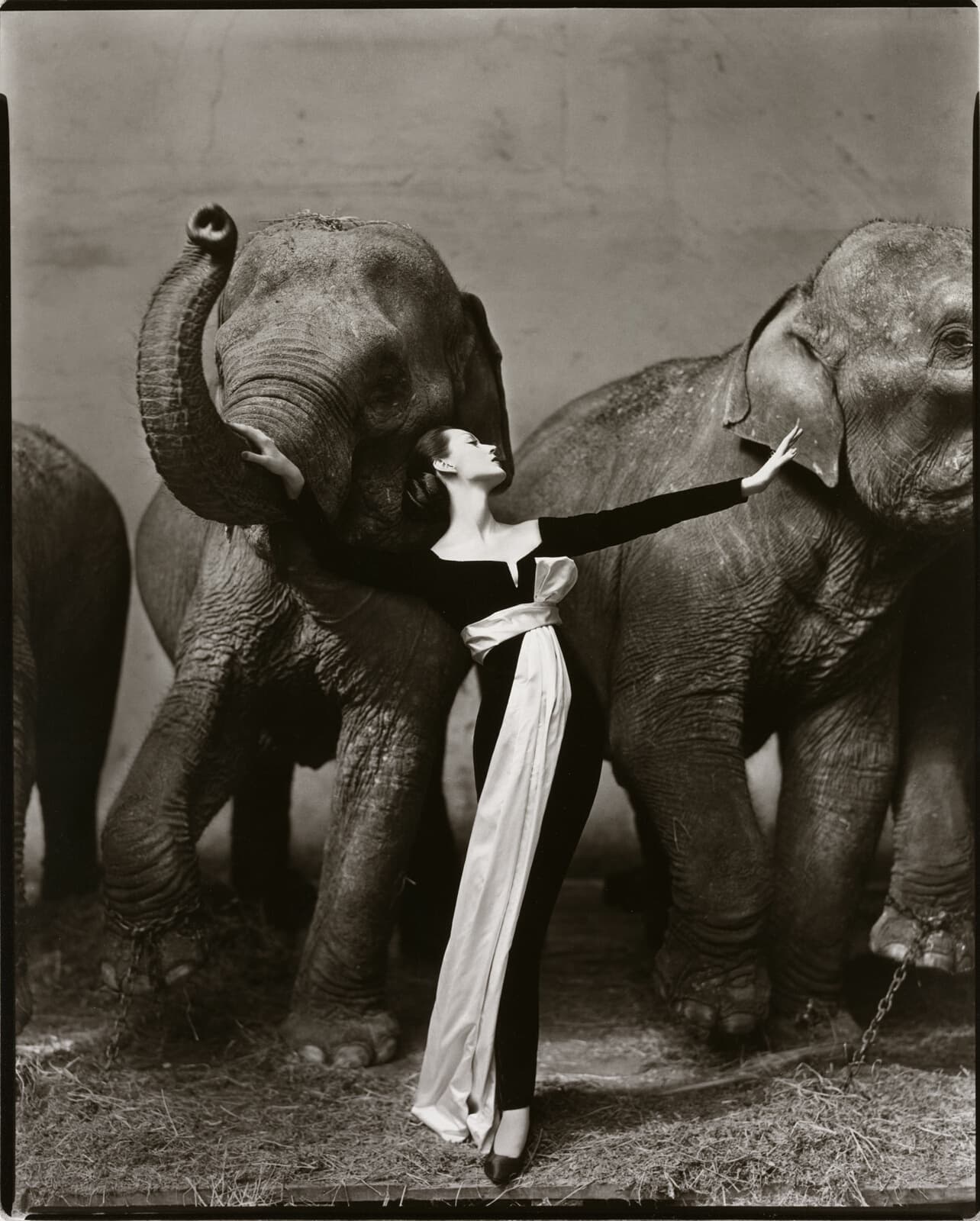
Dovima with Elephants, Evening Dress by Dior, Cirque d'Hiver, Paris
A woman in a black evening dress stands between three elephants, one hand flat against the nearest animal's jaw and the other reaching towards a second without touching it. Richard Avedon made the photograph at the Cirque d'Hiver in Paris in August 1955, on assignment for Harper's Bazaar. The Art Institute of Chicago holds this print as 2014.680; the Metropolitan Museum of Art holds a much larger one.
- August 1955, printed 1979
- Gelatin silver print
- Art Institute of ChicagoChicago, United States
What the photograph shows
Three elephants stand in a shallow band across the frame. The one at the far left is cut by the edge, so only its back and one foreleg are in view. The central animal turns its head towards the woman and lifts its trunk, which curls at the tip into a tight spiral. The third stands at the right with its ear spread open and its eye clearly visible.
The woman stands upright between them with her weight on the balls of her feet. Her head is tipped back, her eyes are closed and her face is in profile. Her left hand lies flat against the central elephant's lower jaw, fingers together. Her right arm reaches out level to the right, and that hand stops short of the third elephant's cheek without touching it.
She wears a black dress with long sleeves to the wrist and a skirt that falls straight to the floor. The neckline is cut wide and straight, then notched at the centre with a small sharp V. A white satin sash is wrapped and knotted at the waist, one loop standing stiff, with a long panel dropping unbroken down the front of the skirt and breaking on the ground.
The ground is a bed of straw over dark earth, edged by a wooden board that runs across the bottom of the frame. A heavy chain is shackled to the right-hand elephant's foreleg and runs out of the picture. Behind everything is a plain pale wall with a faint vertical seam. The print carries the black film rebate down both edges and along the bottom.
He found the elephants first and the dress afterwards
Richard Avedon's own account reverses the order a fashion photograph is usually made in. The Art Institute of Chicago prints his words: he saw the elephants under an enormous skylight, then had to find the right dress, knowing there was a potential there for a kind of dream image.
The garment he found was new. The Art Institute of Chicago states that the dress chosen was in fact the first design for the house of Christian Dior by the nineteen-year-old Yves Saint Laurent. Yves Saint Laurent had joined the house that year, and Christian Dior was still alive and running it. Most accounts of the picture credit the dress to Christian Dior alone.
The setting was a working circus building in the 11th arrondissement of Paris. The Art Institute of Chicago records that Richard Avedon photographed Dovima in a studio and at various Paris locations for the same assignment, and that the Cirque d'Hiver was where this frame was made.
Who Dovima was
The model was born Dorothy Virginia Margaret Juba, and the Art Institute of Chicago gives that name in full on its object record. Dovima is a working name built from the first two letters of each of her three given names.
She was among the highest-paid models of the 1950s and worked repeatedly with Richard Avedon. The pose she holds here is not a fashion stance. It is closer to a dancer's, with the spine arched, the throat exposed and the arms held in opposite directions at two different heights.
How it was published
The photograph was made on assignment. Richard Avedon was staff photographer at Harper's Bazaar from 1946 to 1965, working under the art director Alexey Brodovitch, and the Richard Avedon Foundation records that he became the magazine's lead photographer.
The Art Institute of Chicago states that the picture first appeared in a fourteen-page story on Paris fashions in the September 1955 issue of Harper's Bazaar. How the magazine cropped or captioned it on the page, and how that differs from the print a museum hangs, is not recorded by either institution holding it.
The prints themselves came later and at very different sizes. The Art Institute of Chicago's sheet was printed in 1979 and measures 59.5 by 47.9 centimetres in the image. The Metropolitan Museum of Art's was printed in 1981 and measures 127 by 101.6 centimetres, more than twice as wide.
What is documented about the making, and what is not
The camera, lens, film stock, lighting and exposure are not stated by the Art Institute of Chicago, by the Metropolitan Museum of Art, or by the Richard Avedon Foundation's published gallery. Nothing here infers them.
The photograph itself carries some evidence. The whole depth of the frame is sharp, from the near elephant's hide to the wall behind, and the animals are not blurred, so the exposure was short enough to hold three shifting bodies still. The light falls from high and slightly in front, which is consistent with his account of an enormous skylight, and it leaves her hands, throat and the satin sash as the brightest things in the picture.
The black border on all three visible edges is the film rebate, printed in. It shows the frame was printed full, without cropping. Who owned the elephants, whether they were performing that season, and whether anyone from the circus is in the room are not recorded on any source consulted. The chain on the right-hand animal's leg is simply visible in the picture.
Two museums, two titles
The Art Institute of Chicago catalogues the photograph as Dovima with Elephants, Evening Dress by Dior, Cirque d'Hiver, Paris, and carries the month and year in its date field instead. The Metropolitan Museum of Art runs the date into the title: Dovima with Elephants, Evening dress by Dior, Cirque d'Hiver, Paris, August 1955. The Richard Avedon Foundation's own gallery uses a third variant, with a lower-case e on elephants.
The differences are worth noticing because Richard Avedon's titles are not labels. Each one names the sitter, the garment, the designer, the place and the month, and the whole string is the title. Where institutions disagree, they disagree about punctuation and capitals rather than about facts.
Close reading
Reading the work, detail by detail
The Art Institute of Chicago's print is reproduced whole, with the black film rebate down both edges and along the bottom. Three elephants are in the frame, not two, and the third is cut by the left edge. The light falls from high and in front, leaving the model's hands, throat and satin sash as the brightest things in the picture.
1.The raised trunk curls to a tight spiral
The near elephant lifts its trunk clear above its own head, and the tip turns over into a closed spiral rather than reaching for anything. The ringed segments of skin are sharply resolved all the way up. That vertical is what holds the top-left quarter of the frame, which would otherwise be empty wall.
2.Her left palm lies flat against the jaw
The left hand is placed, not resting. The fingers are held together and straight, the thumb slightly apart, and the whole palm makes contact with the animal's lower jaw. It is the brightest single shape in that half of the picture, and it reads white against hide that falls almost to black.
3.The head goes back and the eyes close
Her chin is lifted and her eyes are shut, so she is not looking at either animal or at the camera. The hair is pulled back flat and gathered into a smooth knot low at the nape, with no loose strand anywhere. The throat is fully exposed, and it carries the second-brightest highlight in the frame.
4.A small sharp V cut into a wide neckline
The neckline runs straight across from shoulder to shoulder, then drops into one narrow pointed notch at the centre front. It is the only shaping visible anywhere on the bodice. At this magnification the black cloth holds just enough tone to separate it from the shadow behind, which is a printing decision rather than an exposure one.
5.The sash is knotted with one loop left standing
The satin is wound twice round the waist and tied off to one side. A single loop stands up stiff above the knot and holds its own shape, which tells you the cloth is heavy and finished rather than soft. The highlight rolls along each fold without blowing out, so the print is holding detail at the top of its range.
6.The panel drops unbroken to the floor
From the knot the sash falls as one uninterrupted panel down the front of the skirt, creased into long vertical folds. It splits the black column in two and gives the standing figure its whole vertical emphasis. Nothing crosses it between the waist and the ground.
7.The right hand stops short of the second elephant
The right arm is held out level and the hand is turned palm-forward with the fingers spread and slightly curved. There is a visible gap between the fingertips and the animal's skin. One hand touches and the other does not, and the asymmetry is the whole architecture of the pose.
8.The second elephant's eye is open and lashed
The right-hand animal's eye is small, clearly open, and ringed by deep folds, with the lashes resolved. Its ear is spread wide and carries scattered pale flecks across the skin. This is the only animal in the frame whose eye is legible, and it is looking forward rather than at the woman.
9.A third elephant is cut by the frame
Beyond the black rebate at the left stands a third animal, softer in focus, with only its back and one foreleg inside the picture. Accounts of the photograph usually describe two elephants. There are three, and the cropping of the third is what makes the group read as a herd rather than a pair.
10.A chain is shackled to a foreleg
A heavy chain is fastened round the right-hand elephant's foreleg above the foot and runs out of the frame to the right. Neither museum record mentions it, and nothing published says whose animals these were or whether they were performing that season. The chain is simply in the photograph, and it is in focus.
11.One dark shoe on the edge of a plank
The hem lifts just enough to show a single dark pointed shoe, set on a wooden board that runs across the bottom of the frame. Behind the board is loose straw over dark earth. The floor is a working animal enclosure, and the photograph does not tidy it.
12.The black border is the negative's own edge
A solid black band runs down the edge of the sheet and along the bottom. It is the unexposed rebate of the negative, printed in rather than trimmed off, and it is the evidence that the frame was printed complete. The tonal jump from that black to the pale wall is the widest in the print.
Timeline
1946
Richard Avedon joins Harper's Bazaar as a staff photographer, working under the art director Alexey Brodovitch. He stays until 1965.
1955
Photographs Dovima between elephants at the Cirque d'Hiver in Paris in August, during the couture collections, wearing an evening dress the Art Institute of Chicago attributes to the nineteen-year-old Yves Saint Laurent for the house of Christian Dior.
1955
Published in a fourteen-page story on Paris fashions in the September issue of Harper's Bazaar, per the Art Institute of Chicago.
1979
The print now at the Art Institute of Chicago is made, at 59.5 by 47.9 centimetres.
1981
A much larger print, 127 by 101.6 centimetres, is made and given by Richard Avedon to the Metropolitan Museum of Art as 1981.1137.11.
2004
Richard Avedon dies on 1 October. The Richard Avedon Foundation, established during his lifetime, holds the copyright.
2014
The 1979 print enters the Art Institute of Chicago as 2014.680, a gift of the David C. and Sarajean Ruttenberg Arts Foundation.
Where to see it
Art Institute of Chicago
111 South Michigan Avenue, Chicago, IL 60603, United States
The Metropolitan Museum of Art holds a second, much larger print of the same photograph, 127 by 101.6 centimetres, as 1981.1137.11, given by Richard Avedon in 1981.
Plan your visit on the museum’s official website (opens in a new tab)Frequently asked questions
Where can you see Dovima with Elephants?
Two American museums hold prints. The Art Institute of Chicago has a 1979 print as reference number 2014.680, and the Metropolitan Museum of Art has a much larger 1981 print as accession number 1981.1137.11. Neither museum promises it is on display, so check before travelling.
Who designed the dress in Dovima with Elephants?
The Art Institute of Chicago states that it was the first design for the house of Christian Dior by Yves Saint Laurent, who was nineteen. The title credits the house rather than the designer, which is why the picture is usually described as a Dior dress.
What was Dovima's real name?
Dorothy Virginia Margaret Juba. The Art Institute of Chicago gives the name in full on its object record. Dovima is a working name assembled from the first two letters of each of her three given names.
How many elephants are in the photograph?
Three. One stands at the centre with its trunk raised and curled, and a second at the right with its ear spread open. A third at the far left is cut by the edge of the frame, so only its back and one foreleg show.
Where is the Cirque d'Hiver?
In the 11th arrondissement of Paris, near the boulevard du Temple. It is a working circus building, and Richard Avedon photographed the elephants there in August 1955 while covering the Paris couture collections for Harper's Bazaar.
Did Richard Avedon plan the picture around the dress?
No, and he said so. The Art Institute of Chicago quotes him describing seeing the elephants under an enormous skylight first, then having to find the right dress, knowing there was a potential there for a kind of dream image.
Why does the print have a black border?
It is the film rebate, the unexposed edge of the negative, printed in rather than cropped out. It runs down both sides and along the bottom of the sheet, and it shows the frame was printed complete.
More by Richard Avedon
References
The sources below include collection records, catalogues, scholarly research, and primary materials that informed this page. They document Dovima with Elephants, Evening Dress by Dior, Cirque d'Hiver, Paris, its making, and its place in cultural history.

1Richard Avedon, Dovima with Elephants, Evening Dress by Dior, Cirque d'Hiver, Paris (reference number 2014.680)
WebsiteArt Institute of ChicagoUsed forThe holding institution for the print reproduced here, and the source for the Yves Saint Laurent attribution, the Harper's Bazaar publication and Dovima's full name.
2Richard Avedon, Dovima with Elephants, Evening dress by Dior, Cirque d'Hiver, Paris, August 1955 (accession 1981.1137.11)
WebsiteThe Metropolitan Museum of ArtUsed forThe Metropolitan Museum of Art's much larger print of the same photograph, and its own wording of the title.
3The Work — the Foundation's published gallery of Richard Avedon's photographs
WebsiteThe Richard Avedon FoundationUsed forThe Foundation's published gallery, which carries its own title for the photograph.
4Magazines — Richard Avedon's magazine work for Harper's Bazaar, Vogue and The New Yorker
WebsiteThe Richard Avedon FoundationUsed forThe Foundation's account of the Harper's Bazaar years and the art director Alexey Brodovitch.
5Copyright and usage — licensing Richard Avedon's photographs
WebsiteThe Richard Avedon FoundationUsed forThe Foundation's licensing statement, used for the rights position.
6Richard Avedon, Paris, 1954 (accession 2000.88)
WebsiteThe Cleveland Museum of ArtUsed forA third institution printing the same copyright holder, checked so the licensor was confirmed rather than assumed.
These references provide the documented foundation for this work's history and interpretation. Claim-level citations remain attached to the specific claims they support.
 Explore more resources