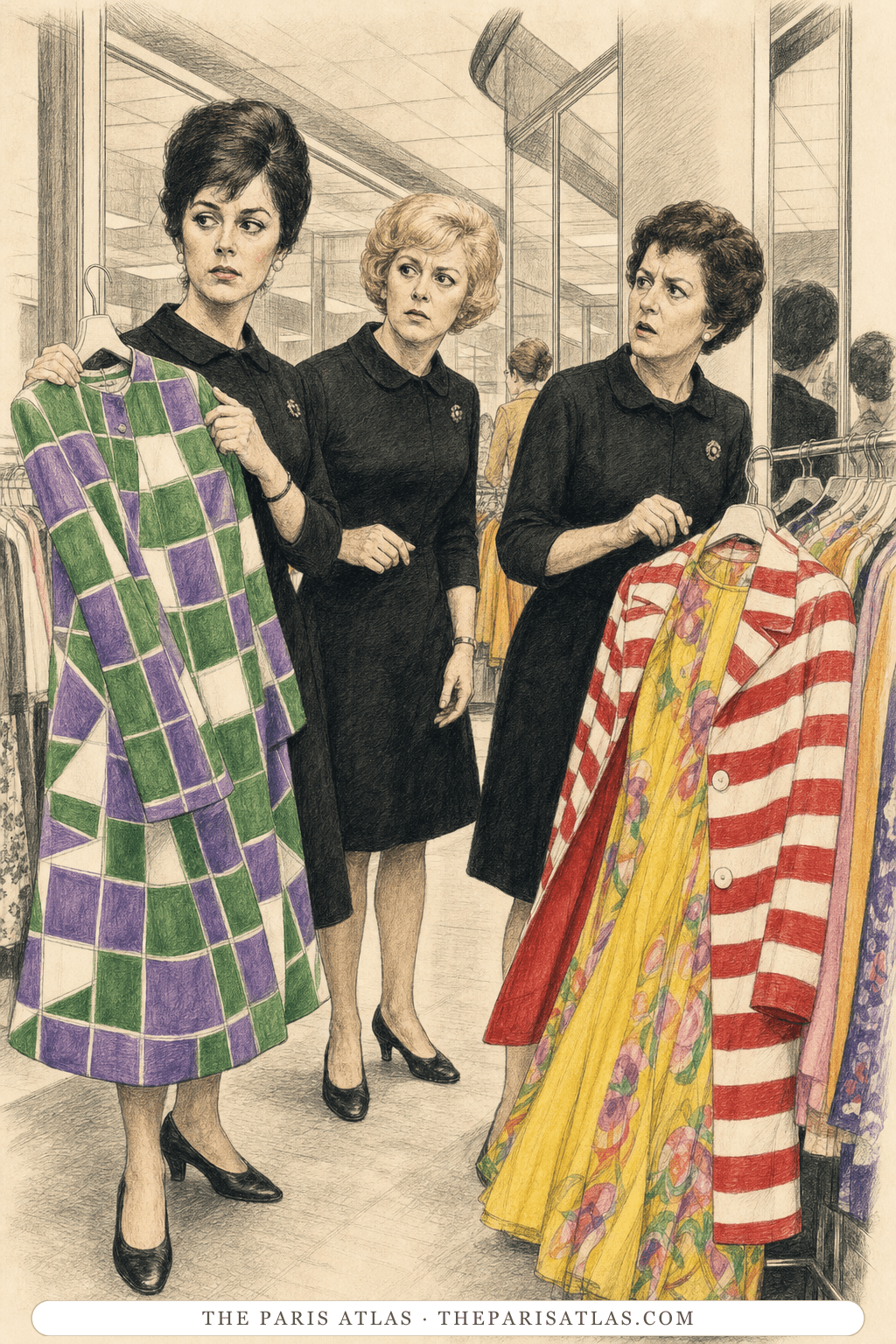
The saleswomen
Shop workers who remember Lise's clothes, arguments, and purchases and later supply the investigation with exact details.
The book

At a glance
- Retail workers in clothing and department stores
- Lise's appearance, speech, and purchases
- Brief service encounters
- Police witnesses
Who they are in the book
Spoiler-freeSeveral saleswomen meet Lise before and during the trip. The first tries to explain the practical advantages of a stain-resistant dress and becomes the target of Lise's anger. Others help with the vivid outfit, scarf, blender, bag, slippers, and paper knife that enter the evidence trail.
The women do not know that Lise wants to be memorable. They are doing routine service work with a difficult customer. Later, their professional attention to clothing, color, size, payment, and merchandise makes them unusually exact witnesses.
Spark uses them as more than background. Their ordinary point of view shows the difference between how Lise presents each encounter and how an outsider records it. Together they help turn a private plan into a public case.
How The saleswomen Is Portrayed
- Plain store uniformsThe shop staff wear simple dark dresses that place attention on the merchandise and customer.
- Practiced patienceThey begin with the controlled courtesy expected in retail even when Lise treats a neutral suggestion as an insult.
- Attention to fabricThey notice color, pattern, stain resistance, fit, and the practical qualities that Lise rejects or selects.
- Witnesses to exact colorsTheir work lets them describe the lemon, orange, mauve, blue, red, and white of Lise's clothing precisely.
- Alarm beneath politenessLise's sudden fury leaves staff uncertain whether to defend themselves, reassure her, or end the exchange.
- Memory organized by objectsThey recall Lise through dresses, a scarf, appliances, luggage, slippers, and a paper knife rather than through knowledge of her life.
After Lise's death, shop staff can identify her conspicuous clothes and trace several purchases. Their ordinary sales records and memories help reconstruct a route whose purpose they could not have understood at the time.
If you like The Driver’s Seat


If you like Muriel Spark
Explore authors with a similar voice, perspective, and influence.

Albert Camus
French Algerian novelist, essayist, journalist and playwright who used the absurd and revolt to ask how people should live without false consolation.
View author
Simone de Beauvoir
French writer and philosopher whose novels, memoirs, and social analysis examined freedom, gender, responsibility, aging, and the material conditions that shape a life.
View author
John Steinbeck
American novelist of the California fields and of the Dust Bowl migration — the exodus of farming families driven off the drought-ruined southern plains in the 1930s — awarded the Nobel Prize in Literature in 1962. In the summer of 1954 he moved into 1 avenue de Marigny in Paris and wrote for the Paris daily newspaper Le Figaro. Some of that work reached French readers in translation long before it was ever printed in his own English: one story waited sixty-five years.
View author