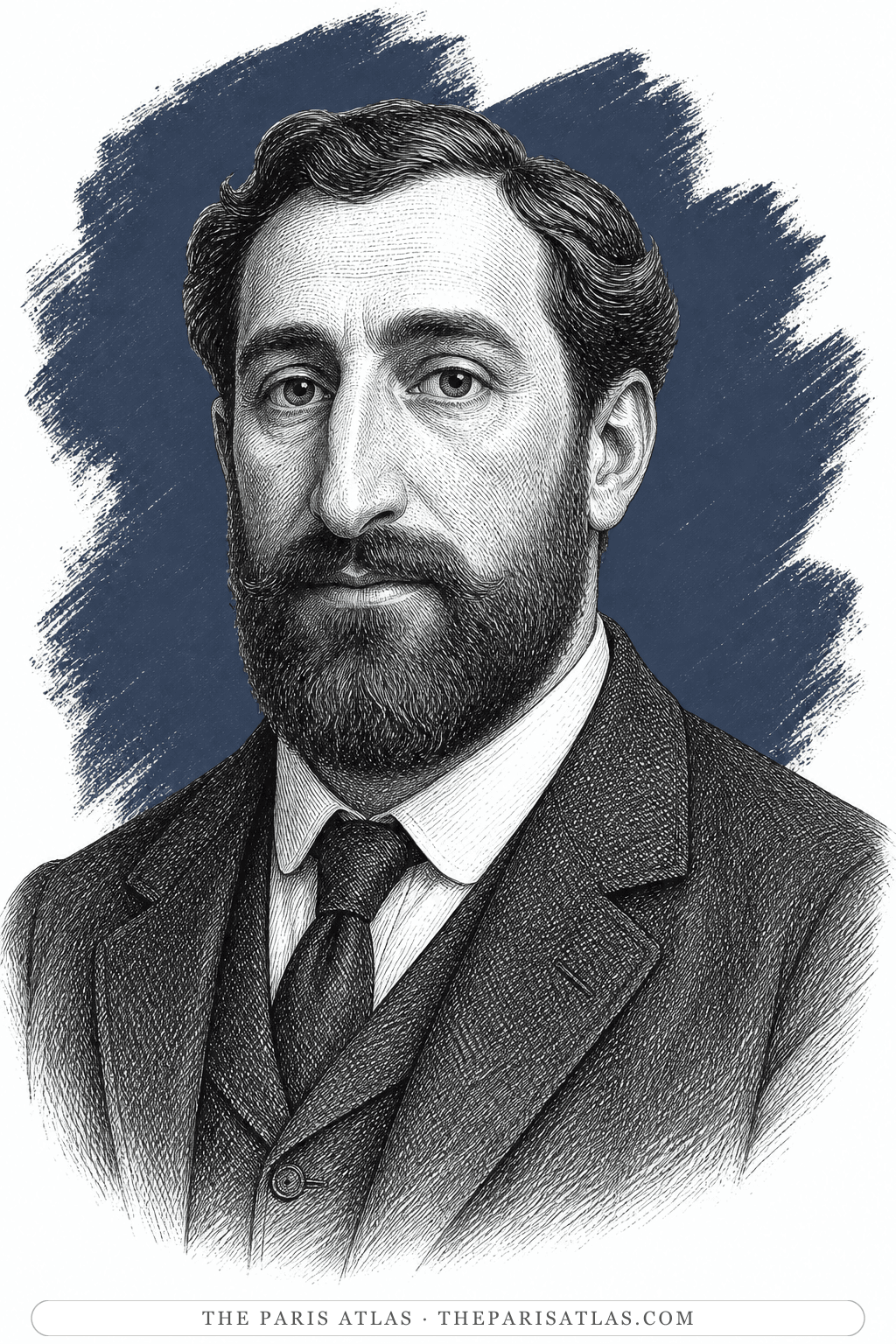
Antoine
Minne's devoted cousin and husband — the steady love that cannot satisfy the freedom she is reaching for.
For Minne to love him, and to ask him for things. He asks her outright at eighteen whether she loves him enough to marry him one day, and years later he asks her to bring him anything she wants, including the things a wife does not normally ask a husband for.
The book

At a glance
- Minne's cousin and constant companion in the first half; her husband in the second
- Seventeen when he first appears — three years older than Minne, the book says — and eighteen when he proposes
- Son of uncle Paul, a doctor who worked in the tropics and came home with a wrecked liver and rare fevers; uncle Paul is the brother of Minne's mother
- Accounts at Pleyel, the Paris piano-makers, plus reconstructions of ancient Greek and Egyptian instruments on the side
- A new building on the avenue de Villiers in Paris, near the place Pereire
- Sunday lunches on the boulevard Berthier, his father's country house the Maison Sèche, Paris, and Monte Carlo
Who they are in the book
Spoiler-freeAntoine is Minne's first cousin, and he is in love with her from his first scene to the last page of the book. He is seventeen when he appears: a boarding-school boy in a black uniform with small gold buttons, with a long bony nose the book keeps comparing to a horse's, grey eyes set well apart, a wide mouth full of square teeth, spots on his chin and enough down on his lip that people cannot tell whether he needs a shave or a wash. His father, a sallow, hypochondriac doctor called uncle Paul, corrects his eating at the table in front of the whole family.
Minne is fourteen and handles him like a piece of furniture. She kneels down in the orchard, takes his hat off and combs his hair forward to make him look like a street tough; she tells him to pull his socks up so that not everybody has to know he wears mauve underpants; she allows him to kiss her once, on condition that she may shut her eyes first. He proposes at eighteen and is turned down. She tells him she is engaged to somebody else, and then, from her sickbed, asks him to write that man a love letter for her. He writes it.
By the second half of the novel he has grown into a large bearded man with the same nose, and he is married to her. He keeps the accounts at Pleyel, the Paris piano-makers, and spends whatever hours his employer will spare on reconstructing ancient Greek and Egyptian instruments, mainly to be more interesting to his wife.
He is the one person in the book who never lies. He tells Minne he loves her at every opportunity and means it absolutely, without shading or reserve, which she finds tiresome and which makes him very easy to deceive. Most of what happens to him in the second half is watching his wife turn into a stranger and trying to decide what a husband is supposed to do about it.
How Antoine Is Portrayed
- Seventeen at the family lunchHe would like more ham and salad and does not dare take it, because his father will remark in front of everyone that stuffing himself with cured meat is why his spots never clear. He drinks large glasses of water instead and watches Minne sideways, and when her eyes land on him his ears catch fire. When he leaves the table to eat plums, his father tells the room it will do him good as a laxative, and he goes out scarlet.
- Handled like a mannequinMinne drops to her knees in the orchard, pulls off his straw hat and combs his hair forward with a pocket comb, arranging him into the cycling cap and striped jersey she has only imagined. He tells her to leave him alone and does not make her. She works on him without pleasure and without embarrassment, as if he were a dummy, and then loses interest and sits down without a word.
- The stormThunderstorms terrify him. He lies face down with his jaw clenched hard enough to crack the enamel on his teeth, then decides to run to Minne's room and save her, then catches sight of his own bare hairy legs and gives up the idea, on the grounds that nobody is a hero in a nightshirt. When the rain finally comes he gets back into bed and adds Minne to the imaginary harem he keeps, which already holds the family maid, the actress Polaire, a laundry queen from the Saint-Ambroise washhouse, and Dido, queen of Carthage.
- The afternoon in the dining roomLeft alone with her on a hot afternoon, he gets her cornered against a door, holds both her wrists and presses himself against her. She twists free, calls him brutal, and then bursts into tears, which frightens him more than anything else; his first coherent thought is that his aunt may walk in. When Minne sobs that she will tell, he throws his handkerchief on the floor and says girls are all the same, they only know how to sneak. That is the insult that ends the scene, and both of them are still on their feet, glaring, when her mother comes in with two plates of plums.
- The proposalAt eighteen he knocks on her door, asks her twice whether she loves him, and then asks whether she would love him enough to marry him later on. She says no. Pressed for a reason, she bites a fingernail, thinks about it, and tells him she is engaged. No further questioning gets another word out of her, and he spends the night deciding that he cannot tell which would be worse, that she is lying or that she is not.
- The letter he agrees to writeIll in bed, she asks him to write a letter for her, because her mother would ask questions if she saw her writing. It is to her fiancé. He sits down at the table, and she dictates: my beloved, do not be surprised by handwriting that is not mine, someone devoted is sending you my news so that you can give yourself to your dangerous career. His private plan is to write it, find out who the man is, and kill him. He gets a few lines in and puts the pen down.
- The barbytosIn adult life he keeps the books at Pleyel, the piano-makers, and reconstructs ancient Greek and Egyptian instruments with his employer's permission. His model eight is a barbytos, a long-armed Greek lyre, and the theatre director Lugné-Poe wants one built for Isadora Duncan's dances. He admits to himself that he could just as well have taken up cars, and that what he is really after is a decoration. His chief eventually calls him an instrument-maker for mummies, and he walks home miserable about it.
- The photographs in his briefcaseTrying to work out when his wife changed, he takes photographs of Minne at every age to the office and lays them out to compare: seven, with the pointed face of a thin kitten; twelve, with long ringlets and already those eyes; and the year they found her unconscious at the front door with her hair full of mud. His conclusion is that anyone would have had to be an idiot not to be worried by eyes like that.
- The detective agencyConvinced she is lying to him, he takes an afternoon off work and climbs to a third-floor office on the rue des Dames, where a man in a plum velvet waistcoat is shouting at his one investigator for losing a client inside a department store. Antoine hires him anyway, agrees to whatever fee is asked, and goes back down the stairs certain it will come to nothing.
- The boltThe first real quarrel of the marriage ends with him shouting at her to tell him where she has been and Minne refusing, then telling him she is going to bed. He points at the door and says she should go to her room, because he knows she will not give in and he does not want to break her before he knows anything. She walks out slowly, trailing her long skirt. He stands listening, and hears her bolt slide across with the dry click of a revolver being cocked.
The detective is the low point, and he knows it while he is paying for it. He spends the night before the surveillance begins wanting to warn his own wife that a man will be following her, and after she catches the man out and recites her whole route back at him, he stops trying to police her. What he decides instead is that she is alone in the world and belongs to him even if she deceives him, that he promised to make her happy, and that he will keep his hands behind her the way mothers walk behind a toddler, ready only for the moment she falls. He puts it to himself more bluntly in the middle of that night: «Je veux bien qu'elle me fasse cocu, mais je ne veux pas qu'elle pleure!» He is willing to be cuckolded; he is not willing to have her cry.
Then he takes her to Monte Carlo. They have been sleeping apart since the night of the bolt, and he behaves like a nervous fiancé. On the last night in the book he tells her, groping for words he knows are too coarse for what he means, that he cannot stop her loving somebody any more than he can stop the earth turning, and that what he wants is for her to ask him for anything at all, and to come and complain to him — someone has done something to me, Antoine, tell him off, or kill him. She says she loves nobody, and then invites him into her bed. What follows is the thing four men have failed at, and he manages it by paying attention: he stops when she makes a sound he has never heard from her, and starts again only when she tells him to. In the morning she is delighted with him and with herself, and the search that has driven her since she was fourteen is simply over.
If you like The Innocent Libertine


If you like Colette
Explore authors with a similar voice, perspective, and influence.

Henry Miller
The Brooklyn dropout who arrived in Paris broke at thirty-eight and wrote the exuberant, banned books that ended American censorship.
View author
Louis-Ferdinand Céline
The doctor of the Paris slums who wrote the century's blackest, funniest novel — and changed the sound of French prose.
View author
Martha Gellhorn
War correspondent who covered the Spanish Civil War, D-Day, and conflicts across five more decades; Hemingway's third wife, 1940–1945.
View author