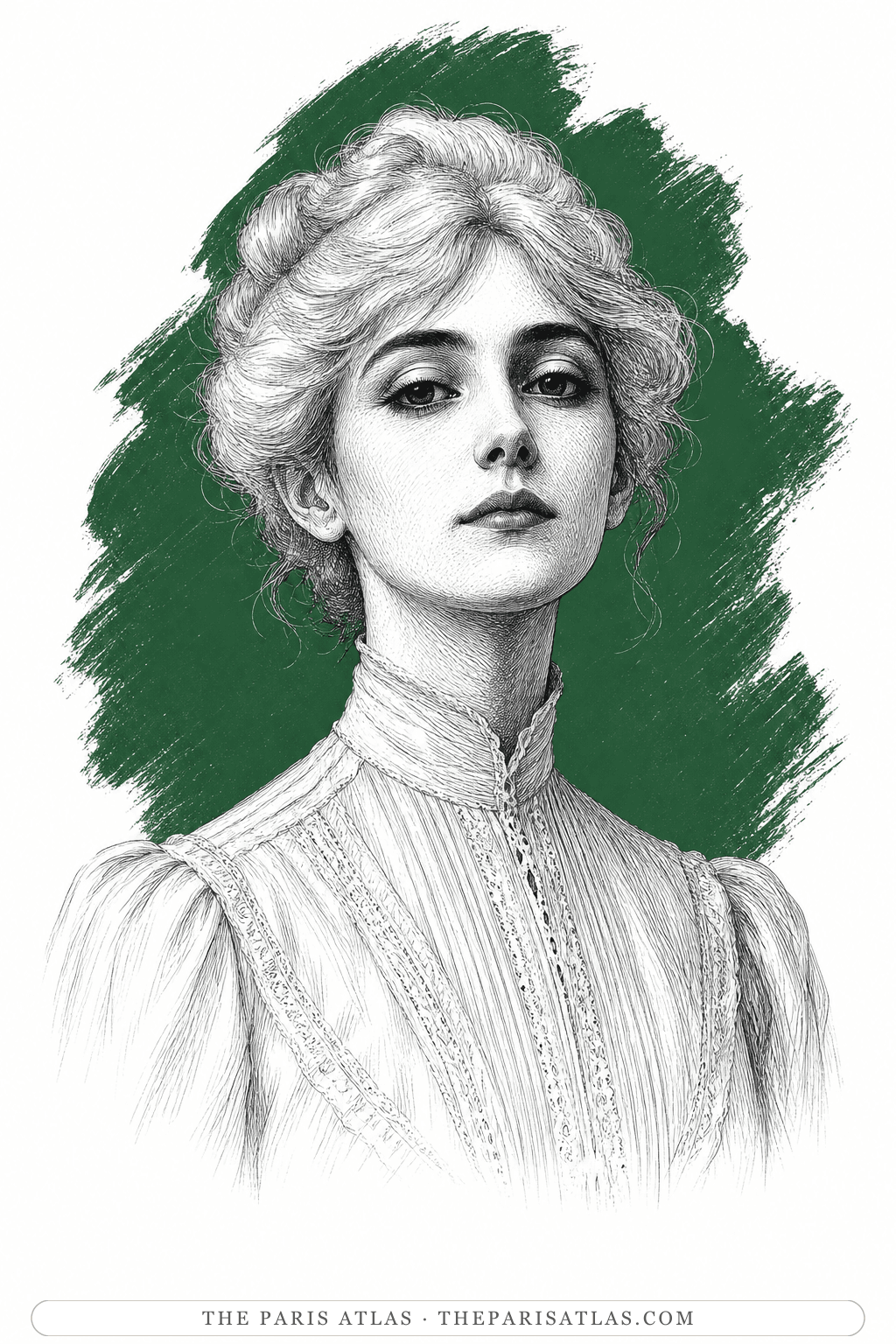
Minne
The 'innocent libertine' herself — a seeming ingénue whose appetite for liberty grows quietly beneath the innocence everyone takes at face value.
To feel what other people describe feeling. As a girl she waits for a criminal to carry her off; as a married woman she goes to bed with one man after another, feels nothing, and keeps looking for the one who will change that.
The book

At a glance
- The main character of both halves
- Fourteen years and eight months in the opening scene; fifteen and a half on the night she runs out; married two years when the second half begins
- A small house on the boulevard Berthier, on the northern edge of Paris; later a flat on the avenue de Villiers, near the place Pereire
- The cours des demoiselles Souhait on the boulevard Malesherbes, a fashionable day school that mothers choose for the address rather than the syllabus
- Her father died when she was about five. Her mother, a widow of thirty-three, is called only Maman in the book
- Antoine, her first cousin — the son of her mother's brother, uncle Paul
- Paris; her uncle's country house, called the Maison Sèche; the Palais de Glace skating rink; Monte Carlo
Who they are in the book
Spoiler-freeMinne is the central character of Colette's novel, a French schoolgirl in Paris at the beginning of the twentieth century. She is fourteen years and eight months old in the first scene, tall for her age and very thin, with hair so pale it looks silver and eyes dark enough to startle people who look at her closely. She lives alone with her widowed mother in a small house on the boulevard Berthier, at the northern edge of the city, and her mother believes she is a quiet, obedient child.
Her mother is mistaken about that. Under her history homework she is reading the crime column of an evening paper, which is reporting a knife fight between two street gangs over a sixteen-year-old girl with red hair. Out of that column Minne has built a private world. There is a tribe of criminals living on the grass embankments outside her window, sorted into two types — the thickset ones who swing their hands as they walk, and the slim ones who move without a sound in tennis shoes — and it has territories, whistled signals, a leader on the run whom the papers call Le Frisé, and a place in it for Minne as their queen. Almost nothing she believes about these people is true, and she believes all of it. The first half of the book is about what happens when she goes out at night to find them.
Then the book jumps several years. In the second half Minne is married to Antoine, the cousin she grew up with, and lives in a comfortable new flat near the place Pereire. She has been married two years and has been to bed with three other men, and not one of them, her husband included, has given her any physical pleasure at all. She does not know whether the fault is theirs or something wrong with her, and she is working through them to find out.
Colette is direct about this in a way that was unusual to publish in 1909. Minne undresses in a lover's rooms with the composure of a woman getting ready for bed alone, lays her two rings and her ruby collar stud on the mantelpiece, waits, and afterwards counts: another one, the third, no better. She tells nobody. When the women she knows compare notes on what they feel, she keeps quiet and lets them assume she is too young and too respectable to have anything to say.
How Minne Is Portrayed
- Fourteen, reading the crime pagesShe is introduced hiding a newspaper under her history exercise book. The column reports a fight between two Paris gangs in which five men were left for dead, over a sixteen-year-old girl with red hair whom the paper nicknames Casque-de-Cuivre, Copper Helmet. Minne reads it slowly, then goes up to bed and works out where the girl is probably hiding and who is bringing her food.
- Dressing up at the mirrorIn her petticoat she pins her hair up high, almost on her forehead, puts on her pink morning apron with the heart-shaped pockets, and adds a red ribbon in her hair and another knotted at the side of her neck. She looks at the result and gives it a one-word verdict: «Je suis sinistre.» She means she looks sinister, which is what she was trying for.
- What she says about the neighboursShe tells her cousin Antoine, quite calmly, that an old man who comes to dinner lures little girls into his hunting hut, abuses them and strangles them, and that this is why a local child disappeared. When Antoine objects that the girl's parents said she went off to Paris with a travelling salesman, Minne explains that the old man paid them to say so. She will not tell him who told her, because nobody did.
- The word she got wrongWrecking a neighbour's vegetable patch with a penknife she has taken out of Antoine's pocket, she announces that they will drag the enemy's corpses away and rape them. Antoine, appalled, asks whether she knows what she has just said. She does not. She once read a line about graves being violated, asked her mother what it meant, was told it meant opening one without permission, and has used the word that way ever since.
- The night she went out to find himCertain that the man who sleeps on the corner of the avenue Gourgaud is the gang leader the police cannot catch, she puts her costume back on, unbolts the front door after her mother has gone to bed, and follows a stranger up the boulevard. She spends most of the night asking people where to find Le Frisé: two women sitting under a railway bridge, a small hunchbacked man who tells her the name is his, and a furious older woman who chases her away. A drunk in a fur coat follows her for streets. She loses the heel off a red slipper, falls, and is found unconscious inside the front door at first light with her hair full of dried mud. Her uncle, who is a doctor, examines her and reports that nothing has happened to her at all.
- Married to her cousinHer mother's last piece of advice was to marry Antoine, because he loved her and there was hardly anyone else she could marry: «Épouse Antoine, ma chérie: il t'aime, et tu ne peux guère en épouser un autre...» Minne took it. Her memory of the wedding night is exact and cold — the shape his shadow threw on the wall, her one cry of pain, his cheerful gratitude afterwards, and then the rest of the night lying still with her hair caught in his fingers, working out that she had married the wrong man.
- CountingTwo years married, she has been to bed with a hospital doctor, an Italian composer named Diligenti, and a twenty-two-year-old aristocrat called Jacques Couderc. She feels nothing with any of them. Riding home in a cab from Couderc's rooms she thinks: another one, the third, no success, time to give it up. Her only evidence that the problem is not hers is that the first of the three told her she was perfectly made for it.
- The answer she gives at the tea tableAt a skating rink, Irène Chaulieu — a Paris hostess who introduces herself as the most malicious woman in the city — goes round the table making everyone describe what an orgasm feels like. When Minne's turn comes, she says she cannot help, because she has never had anybody but Antoine. It gets a laugh. She has had three men besides her husband and none of the sensation the others have just been describing.
- The afternoon she was turned downShe calls on Henry Maugis, a fat, hard-drinking journalist of about forty, and starts taking her clothes off before he has asked her to. Then she bursts into tears. He lays her on the divan, pulls her chemise back over her, slides a cushion under her, pours her a glass of port and refuses to sleep with her, on the grounds that he is an old man and would only be one more disappointment. She leaves telling him she is sorry to go, and that he is the only friend she has.
- Walking the detective off his feetAntoine hires a private agency to follow her. She spots the man within a few streets and spends the afternoon marching him across Paris: the parc Monceau, the avenue de Messine, a saddler's window in the rue de Miromesnil where she stops long enough to count the dog collars, then the torn-up roadworks of the rue du Quatre-Septembre, with its trenches and footbridges. She finishes by walking into a building on the place de la Bourse and out of it by a different street into a taxi. Then she goes home and recites the whole route to her husband, junction by junction.
Antoine takes her to Monte Carlo for a fortnight. On the last night in the book he tells her, in the dark, that he cannot stop her loving somebody any more than he can stop the earth turning, and asks only that she come to him if anyone hurts her. She says she loves nobody, and then calls him into her bed — out of gratitude, and because her body is the only thing she has to pay with. She intends to fake it, using the noises Irène Chaulieu says are enough to satisfy a man, and gets as far as two of them before she stops, ashamed. Then, for the first time in her life, she does not have to pretend.
She wakes contented and stops looking. Colette gives the state plainly: she is pleased with herself, a little contemptuous of the dry, demanding girl she was yesterday, and full of the vanity of being a woman like any other. Over breakfast Antoine brings her the Paris papers with the news that Jacques Couderc has been found at home with a bullet in his lung, officially while cleaning his revolver. He will live. Minne says poor boy, and privately thinks the pity of it is that he will recover and go back to being a cheerful little rake, cured of the one real love he might have died of. Antoine asks whether Couderc had been courting her lately. She says perhaps, she has forgotten.
If you like The Innocent Libertine


If you like Colette
Explore authors with a similar voice, perspective, and influence.

Henry Miller
The Brooklyn dropout who arrived in Paris broke at thirty-eight and wrote the exuberant, banned books that ended American censorship.
View author
Louis-Ferdinand Céline
The doctor of the Paris slums who wrote the century's blackest, funniest novel — and changed the sound of French prose.
View author
Martha Gellhorn
War correspondent who covered the Spanish Civil War, D-Day, and conflicts across five more decades; Hemingway's third wife, 1940–1945.
View author