The Lovers
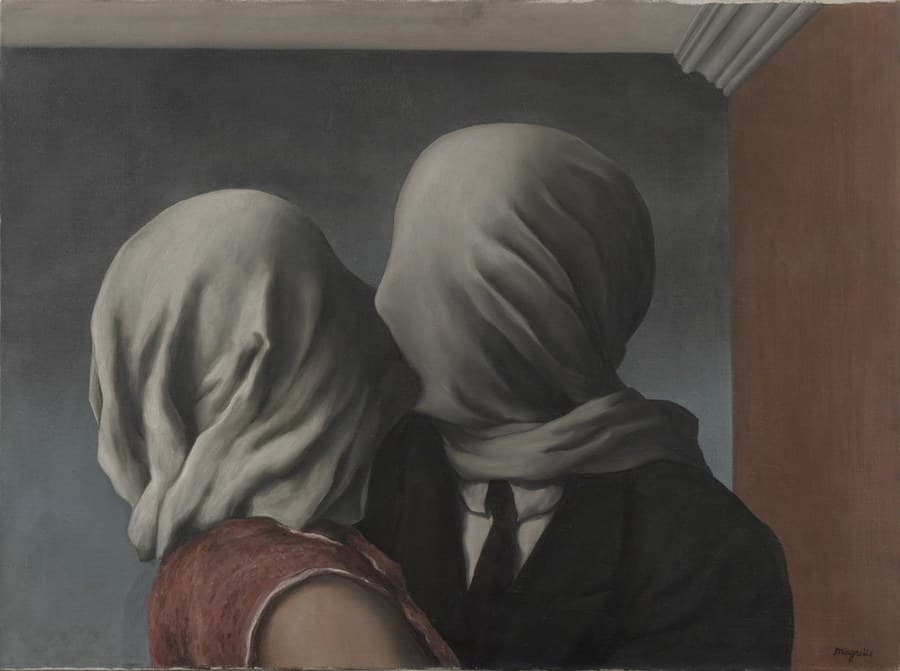
Two people kiss with their heads wrapped in pale grey cloth, so that the cloth touches where the mouths would. René Magritte painted it in Paris in 1928, in the first full year of the three he spent in France. The Museum of Modern Art has held it since 1998 as object number 530.1998, and a second canvas of the same title and year belongs to the National Gallery of Australia.
- Paris 1928
- Oil on canvas
- The Museum of Modern ArtNew York, United States
What the painting shows
Two heads lean together, each covered by a pale grey cloth that follows the skull and jaw and gathers in soft folds at the neck. The cloths meet where the two faces press against each other. Nothing of either face shows.
The figure at the left is bare-shouldered in a dusty rose sleeveless top with a pale piped edge at the neckline, and the cloth over the head falls to a point below the shoulder. The figure at the right wears a dark jacket over a white collar and a dark tie, and the loose end of the cloth crosses the chest like a scarf.
The room behind them is shallow and plain. A grey-blue wall fills the space above and between the heads, a moulded cornice runs across the top, a fluted column head sits in the upper right corner, and a panel of rust brown closes the right edge.
Light falls from the left. The cloths are modelled in grey and cream with no pattern and no seam, and the signature, Magritte, sits pale at the lower right. The canvas measures 54 by 73.4 centimetres, about 21 3/8 by 28 7/8 inches.
Which version this is
René Magritte painted two canvases called Les Amants in 1928. The Museum of Modern Art holds the one in which the two heads turn towards each other and kiss through the cloth. The National Gallery of Australia in Canberra holds the other, which it catalogues as Les Amants [The lovers].
David Sylvester and Sarah Whitfield number the New York canvas 250 in the first volume of their catalogue raisonné of the oil paintings, published in 1992. The Museum of Modern Art cites that entry in its own provenance note and records the painting exhibited at Charleroi in 1956 as Les amants [I].
The Canberra record could not be read in full. What its museum prints is the title form and the object number, and only that is repeated here.
What the museum says, and what the artist said
The Museum of Modern Art's gallery label calls thwarted desires a common theme in his work, and describes a barrier of fabric dividing the intimate embrace of two lovers, turning an act of passion into one of isolation and frustration.
The label then reports the biographical reading and the artist's answer to it. Some have speculated that the death of his mother, by suicide, inspired a series of works in which he obscured his subjects' faces. He was fourteen when her body was found in the River Sambre at Lessines, her wet nightgown purportedly wrapped around her face.
The museum records that René Magritte disagreed with such interpretations, and prints his own line beside the painting.
“"What does it mean?" It does not mean anything, because mystery means nothing either, it is unknowable.”
The museum's own account of the 1928 pictures puts the device in film terms. Its 2013 exhibition text says he invokes the cinematic cliché of a close-up kiss, then subverts its voyeuristic pleasures by shrouding the faces in cloth.
How it reached New York
The Museum of Modern Art's Provenance Research Project publishes the chain and the sources behind each step. The painting was with Jean Bastien in Brussels by 1953, then with Edouard Léon Théodore Mesens in Brussels and London, then with Fernand Graindorge in Liège by 1955.
It passed to Hecker Jensen in Basel, was sold to the Richard L. Feigen Gallery in Chicago by 1958, and was sold in September 1958 to Richard S. Zeisler in New York. The museum acquired it in 1998.
The museum's own record uses two different words for the acquisition. Its credit line reads Gift of Richard S. Zeisler, while the closing line of the provenance note reads Bequest of Richard S. Zeisler. Both are printed on the same object record.
Close reading
Reading the work, detail by detail
Two heads wrapped in grey cloth lean together in a shallow room. The close views take the cloth first, then the clothes below it, then the wall and the moulding behind, which are the only things in the picture that state where the two of them are.
1.The cloths meet where the mouths would
The two covered faces press together and the cloth flattens where they meet, leaving a shadowed crease running down between them. Neither cloth is pulled tight enough to show a nose or a mouth. The contact is between two fabrics, not two faces.
2.The left head is wrapped to a point
The cloth follows the skull, dips at the temple and the jaw, and falls away behind in long vertical folds to a soft point below the shoulder. The modelling is grey on cream with no pattern, no seam and no hem anywhere along it.
3.The right head is rounder and higher
The second head is set higher and its wrapping is rounder and smoother, with fewer creases across the crown. The fabric gathers into a thick fold at the neck before the loose end turns downward. Light falls on it from the left, as it does on everything else.
4.The loose end falls like a scarf
The loose end of the right-hand wrapping crosses the chest in a thick twisted fold and hangs free below it. It reads as one continuous piece of cloth from crown to chest. The fold catches the light along its upper edge and darkens underneath.
5.A white collar and a dark tie below the cloth
Under the wrapping there is ordinary dress. A white collar sits between the lapels of a dark jacket and a narrow dark tie hangs from it, its knot hidden by the cloth. The jacket is painted almost flat, with the lapel edge drawn as a single dark line.
6.A bare shoulder and a rose-coloured top
At the lower left a bare shoulder and upper arm show above a dusty rose sleeveless top. A pale piped edge runs along the neckline and over the shoulder. The rose is broken with darker mottling, the only textured passage of colour in the picture.
7.A cornice and a fluted column close the corner
A pale moulding runs along the top of the wall and turns at the right into a fluted column head, drawn with five or six vertical grooves and a stepped top. Below it a rust-brown panel closes the right edge of the picture. These are the only architectural facts given.
8.The signature is pale on the dark jacket
The name Magritte is written small in pale paint at the lower right, over the dark jacket rather than beside it. The letters are thin and joined, and the writing is light enough to be missed at normal viewing distance.
Timeline
1927
René Magritte moves to Paris in September to be nearer the centre of the Surrealist movement.
1928
Painted in Paris, in oil on canvas, 54 by 73.4 centimetres. A second canvas of the same title and year is now in Canberra.
1953
In the collection of Jean Bastien, Brussels, by this year; a canvas titled Les Amants is withdrawn from a Galerie Georges Giroux sale in Brussels on 17 October.
1955
With Fernand Graindorge in Liège, who lends it to L'Apport wallon au surréalisme at the Musée des Beaux-Arts, Liège, 13 October to 12 November.
1956
Shown at the 30th Salon of the Cercle royal artistique et littéraire de Charleroi, 3 to 22 March, as number 51, under the title Les amants [I].
1958
Sold by the Richard L. Feigen Gallery, Chicago, to Richard S. Zeisler, New York, in September.
1992
Catalogued by David Sylvester and Sarah Whitfield as number 250 in the first volume of the catalogue raisonné of the oil paintings.
1998
Acquired by the Museum of Modern Art on 13 October as 530.1998, from Richard S. Zeisler.
2026
On view on Floor 5, gallery 517, in the Alfred H. Barr, Jr. Galleries, in the hang called A Surreal Lens.
Where to see it
The Museum of Modern Art
11 West 53 Street, New York, NY 10019, United States
On view on Floor 5, gallery 517, in the Alfred H. Barr, Jr. Galleries as of September 2026. The museum's provenance note closes with Bequest of Richard S. Zeisler where its credit line reads Gift.
Plan your visit on the museum’s official website (opens in a new tab)Frequently asked questions
Where is The Lovers by René Magritte?
The Museum of Modern Art in New York, object number 530.1998, on view on Floor 5 in gallery 517 in the Alfred H. Barr, Jr. Galleries. A second 1928 canvas of the same title belongs to the National Gallery of Australia in Canberra.
How many versions of The Lovers did René Magritte paint in 1928?
Two. The Museum of Modern Art holds the one in which the two wrapped heads turn together and kiss through the cloth, catalogued by David Sylvester and Sarah Whitfield as number 250. The National Gallery of Australia holds the other, which it lists as Les Amants [The lovers].
Why are their faces covered in The Lovers?
The Museum of Modern Art describes a barrier of fabric dividing an intimate embrace. Its label reports the speculation that his mother's suicide, when he was fourteen, prompted the series of pictures with covered faces, and records that René Magritte disagreed with such readings.
How big is The Lovers?
54 by 73.4 centimetres, about 21 3/8 by 28 7/8 inches, in oil on canvas. It is a landscape-format picture, wider than it is tall, signed at the lower right.
Was The Lovers painted in Paris?
The Museum of Modern Art dates it Paris 1928. René Magritte had moved there in September 1927 to be nearer the centre of the Surrealist movement, and returned to Brussels in July 1930.
Who owned The Lovers before the museum?
Jean Bastien in Brussels by 1953, then Edouard Léon Théodore Mesens, then Fernand Graindorge in Liège by 1955, then Hecker Jensen in Basel, then the Richard L. Feigen Gallery in Chicago, then Richard S. Zeisler in New York from September 1958.
More by René Magritte
References
The sources below include collection records, catalogues, scholarly research, and primary materials that informed this page. They document The Lovers, its making, and its place in cultural history.


1René Magritte, The Lovers, Paris 1928
WebsiteThe Museum of Modern Art, New YorkUsed forThe museum's object record — title, date, medium, dimensions, credit line, gallery label, Provenance Research Project entry and copyright notice.

2The Museum of Modern Art collection dataset (Artworks.csv)
ArchiveThe Museum of Modern Art, New YorkUsed forThe museum's own published collection dataset, which corroborates the catalogue row and supplies the 13 October 1998 acquisition date.

3René Magritte: Catalogue raisonné I — Oil Paintings 1916–1930
NonfictionMenil Foundation and Philip Wilson Publishers, Houston and London, 1992Used forThe catalogue raisonné entry the museum cites for the ownership chain and for the numbering of the two 1928 canvases.
4René Magritte, Les Amants [The lovers] — Search the Collection
WebsiteNational Gallery of Australia, CanberraUsed forThe National Gallery of Australia's record for the second 1928 canvas, cited for its title form and object number only.
5Magritte: The Mystery of the Ordinary, 1926-1938, press release
WebsiteThe Museum of Modern ArtUsed forThe Museum of Modern Art's 2013 press release, for the September 1927 move to Paris and its reading of the covered kiss.
These references provide the documented foundation for this work's history and interpretation. Claim-level citations remain attached to the specific claims they support.
 Explore more resources