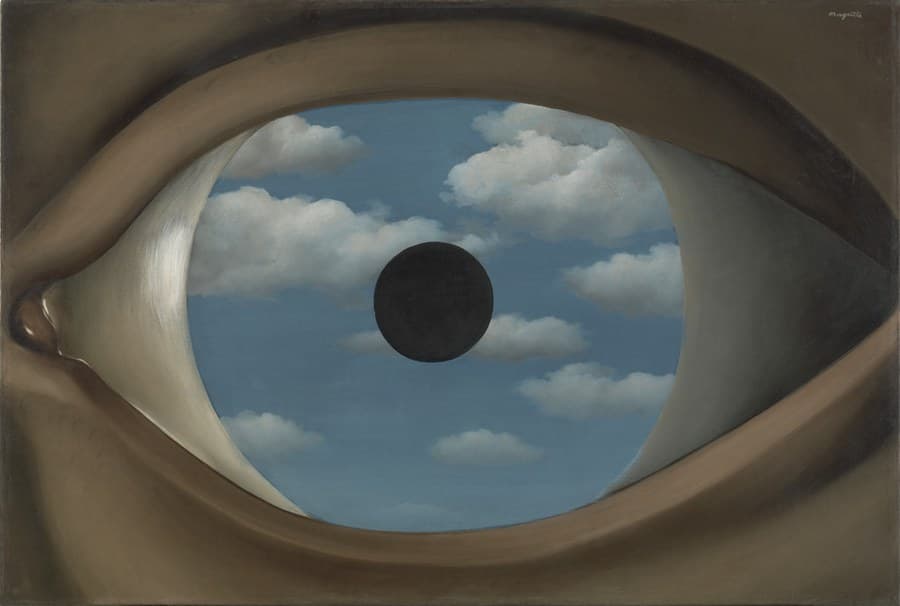
The False Mirror
One enormous eye fills the canvas, its iris a blue sky with white clouds and its pupil a flat black disc. René Magritte painted it in Paris in 1929, and the Belgian writer Paul Nougé supplied the title. Man Ray owned it from 1933 to 1936, and the Museum of Modern Art has held it since December 1937 as object number 133.1936.
- Paris 1929
- Oil on canvas
- The Museum of Modern ArtNew York, United States
What the painting shows
A single eye occupies the whole canvas, seen straight on and cropped by all four edges. It has no lashes and no brow. The lids are painted as smooth bands of warm brown and grey-brown, the upper one thicker, the lower one narrowing towards the outer corner at the right.
The inner corner sits at the left, drawn as a small pink-brown pocket with a wet highlight on it. A pale grey-cream wedge of the white of the eye shows on each side of the iris, broad at the right and narrow at the left.
Inside the iris there is sky. Cumulus clouds, white and softly lit, are spread across a flat mid-blue that runs to a clean circular edge where the iris meets the white. The clouds are modelled in light and shade; the blue behind them is not, so the circle reads as an opening rather than a curved surface.
At the centre, slightly left of the middle of the iris, sits a matte black disc with no highlight and no modelling. The signature, Magritte, is small and pale at the upper right. The canvas measures 54 by 80.9 centimetres, about 21 1/4 by 31 7/8 inches.
Paul Nougé supplied the title
The Museum of Modern Art credits the title to Paul Nougé, the Belgian Surrealist writer, and reads it as insinuating limits to the authority of optical vision. A mirror gives a mechanical reflection, the museum's label argues, while an eye is selective and subjective.
Paul Nougé worked with René Magritte on titles for years and led the Brussels group the painter belonged to before and after the French years. The Museum of Modern Art calls him the artist's accomplice in its account of the same period.
The museum's 2013 gallery label uses the French form, Le Faux Miroir, where its object record prints the English. Both forms come from the same institution, and the object record's form is the one used here.
Man Ray owned it for three years
The Museum of Modern Art records that Man Ray, the American artist and photographer then working in Paris, owned the painting from 1933 to 1936. The museum quotes his description of it on two separate labels.
“sees as much as it itself is seen”
The museum reads the same duality in the painting itself: the viewer looks through the eye as through a window and is looked at by it at the same time. Its 2019 collection book adds that the pupil opens onto a void, and that the sky appears as though seen through a circular window rather than mirrored in the surface of an eye.
How it reached New York
The Museum of Modern Art bought the painting outright. Its credit line is a single word, Purchase, and its object number is 133.1936.
The number and the acquisition date do not match. The accession prefix places the object in the museum's 1936 sequence, while the museum's own published collection dataset gives the acquisition date as 3 December 1937. Both figures come from the museum and neither is adjusted here.
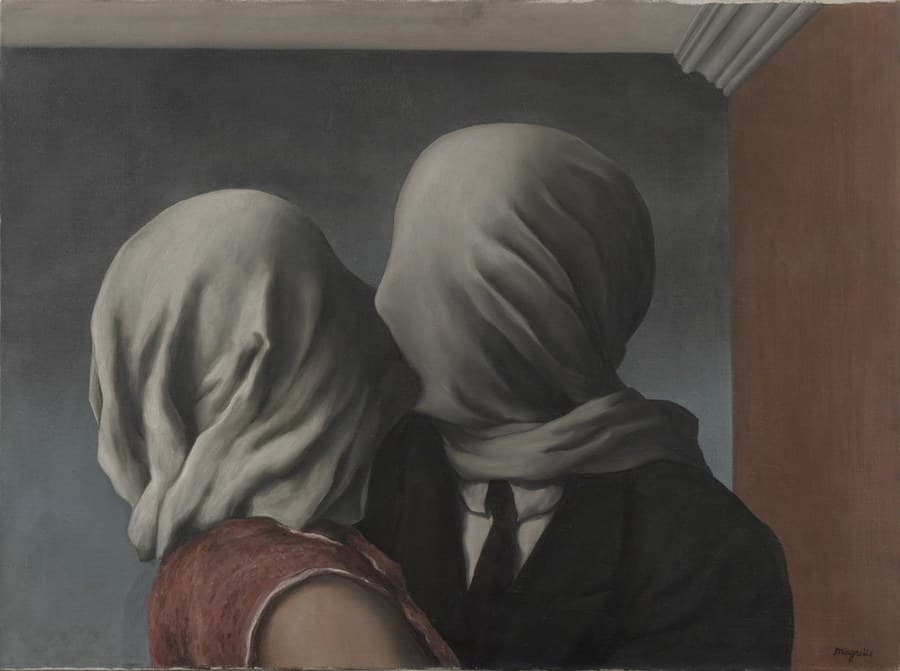
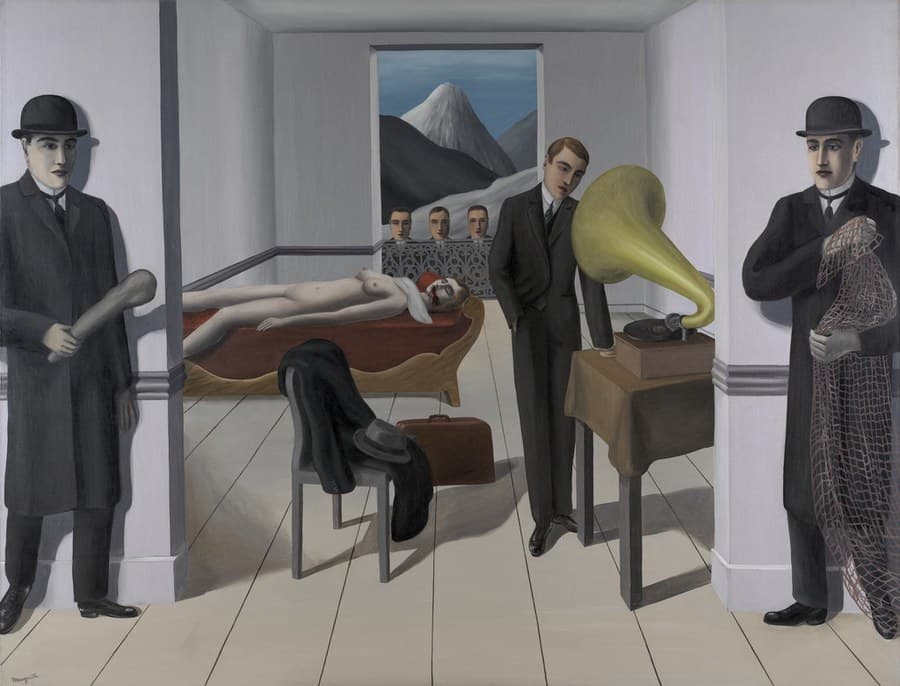
It hangs on Floor 5 in gallery 517, in the Alfred H. Barr, Jr. Galleries, alongside The Lovers and The Menaced Assassin.
Close reading
Reading the work, detail by detail
One eye fills the canvas, cropped by all four edges, with clouds inside the iris and a flat black disc at the centre. The close views work outward from the pupil to the lids, and stop at each place where the painting stops behaving like an eye.
1.The pupil is flat black with no highlight
The pupil is a matte black disc with a clean edge and no highlight anywhere on it. Nothing is reflected in it and nothing is modelled inside it. Beside the shaded clouds around it, it is the only passage in the picture that has no light on it at all.
2.The clouds are shaded, the blue is not
The clouds are modelled, with lit tops and grey undersides, and they overlap as they would in a sky. The blue behind them is flat, with no gradient and no sign of a curved surface. The iris therefore reads as an opening rather than as something reflecting a sky.
3.The sky ends at a clean circular edge
At the lower left the sky stops at a sharp circular boundary. Clouds are cut straight through by it. There is no rim, no shadow and no thickness at the join, so the boundary looks cut rather than enclosed.
4.The inner corner is the one wet passage
The inner corner sits at the left edge, painted as a small pink-brown pocket of flesh with a bright highlight on it. It is the only part of the picture that looks wet. Everything to the right of it is either flat colour or evenly modelled skin.
5.The upper lid is a smooth band with no lashes
The upper lid is a broad band of warm brown that darkens towards the top edge of the canvas. It carries no lashes, no crease and no brow. Its lower edge is a single clean curve where it meets the white of the eye.
6.The lower lid narrows towards the right
The lower lid is a narrower band of grey-brown that thins as it runs to the right, with a soft shadow under it. It is painted with the same even modelling as the upper lid. Nothing distinguishes the flesh as belonging to one person rather than another.
7.A wedge of the white of the eye at the right
A broad pale grey-cream wedge fills the space between the iris and the outer corner at the right. It is shaded slightly darker where it meets the lids above and below. The matching wedge on the left side of the iris is much narrower.
8.The signature sits in the upper right
The name Magritte is written small in pale paint in the upper right corner, on the dark brown of the upper lid. It is placed unusually high for a signature, above the eye rather than below it, and is easy to miss against the brown.
Timeline
1927
René Magritte moves to Paris in September to be nearer the centre of the Surrealist movement.
1929
Painted in Paris, in oil on canvas, 54 by 80.9 centimetres. Paul Nougé supplies the title.
1933
Owned by Man Ray, who keeps it until 1936.
1937
Acquired by the Museum of Modern Art on 3 December by purchase, under object number 133.1936.
2013
Shown in Magritte: The Mystery of the Ordinary, 1926–1938 at the Museum of Modern Art, 28 September to 12 January 2014, labelled Le Faux Miroir.
2019
Printed in MoMA Highlights: 375 Works from The Museum of Modern Art, New York.
2026
On view on Floor 5, gallery 517, in the Alfred H. Barr, Jr. Galleries.
Where to see it
The Museum of Modern Art
11 West 53 Street, New York, NY 10019, United States
On view on Floor 5, gallery 517, in the Alfred H. Barr, Jr. Galleries as of September 2026. The museum publishes no provenance for the object.
Plan your visit on the museum’s official website (opens in a new tab)Frequently asked questions
Where is The False Mirror by René Magritte?
The Museum of Modern Art in New York, object number 133.1936, on view on Floor 5 in gallery 517 in the Alfred H. Barr, Jr. Galleries. The museum bought it, and its own dataset gives the acquisition date as 3 December 1937.
What is inside the eye in The False Mirror?
A sky. The iris is a flat mid-blue filled with white cumulus clouds, and the pupil is a matte black disc with no highlight. The clouds are modelled in light and shade while the blue is not, so the circle reads as an opening rather than a curved eye.
Who named The False Mirror?
Paul Nougé, the Belgian Surrealist writer, according to the Museum of Modern Art. The museum reads the title as insinuating limits to the authority of optical vision: a mirror reflects mechanically, while an eye selects.
Did Man Ray own The False Mirror?
Yes, from 1933 to 1936, as the Museum of Modern Art records. He described the painting as one that sees as much as it itself is seen, a line the museum quotes on its labels.
How big is The False Mirror?
54 by 80.9 centimetres, about 21 1/4 by 31 7/8 inches, in oil on canvas. It is a landscape-format picture, wider than it is tall, and signed at the upper right.
Why is the object number 133.1936 when it was acquired in 1937?
The museum prints both. The accession prefix places the painting in the 1936 sequence, while the Museum of Modern Art's own published collection dataset gives the acquisition date as 3 December 1937. Neither figure is adjusted here.
More by René Magritte
References
The sources below include collection records, catalogues, scholarly research, and primary materials that informed this page. They document The False Mirror, its making, and its place in cultural history.

1René Magritte, The False Mirror, Paris 1929
WebsiteThe Museum of Modern Art, New YorkUsed forThe museum's object record — title, date, medium, dimensions, credit line, two gallery labels, the 2019 collection-book text and the copyright notice.

2The Museum of Modern Art collection dataset (Artworks.csv)
ArchiveThe Museum of Modern Art, New YorkUsed forThe museum's own published collection dataset, which corroborates the catalogue row and gives the 3 December 1937 acquisition date.
3Magritte: The Mystery of the Ordinary, 1926-1938, press release
WebsiteThe Museum of Modern ArtUsed forThe Museum of Modern Art's 2013 press release, for the Paris years and for Paul Nougé's place in the Brussels group.
4René Magritte 1898–1967 — artist record and collection works
WebsiteTateUsed forTate's artist record, which prints a rights line naming ADAGP and DACS rather than the Artists Rights Society.
These references provide the documented foundation for this work's history and interpretation. Claim-level citations remain attached to the specific claims they support.
 Explore more resources