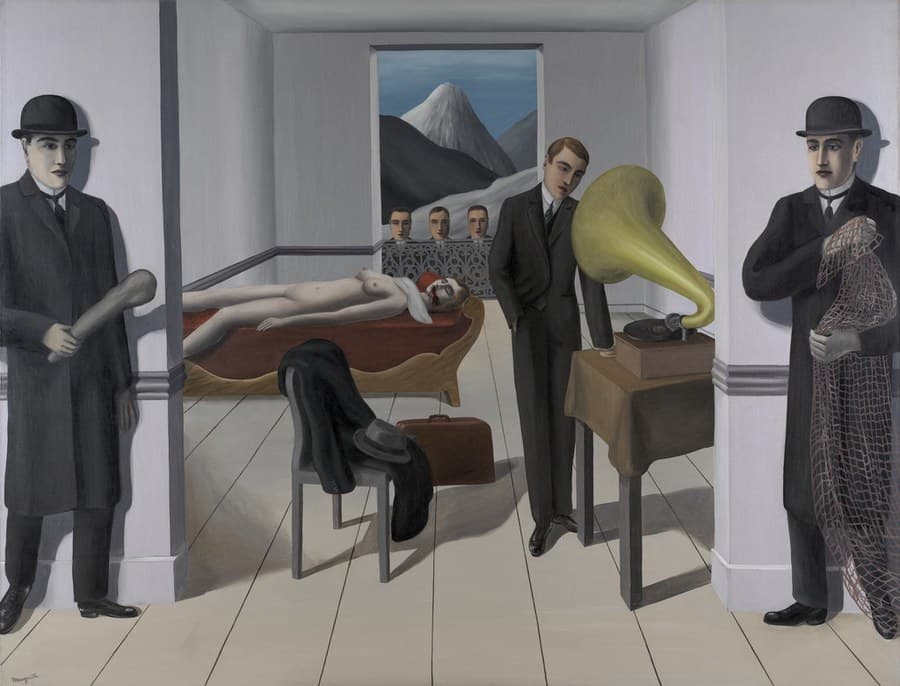
The Menaced Assassin
A woman lies dead on a couch while a young man in a suit stands listening to a gramophone, two men wait at the doorway with a club and a net, and three more watch from a balcony. René Magritte painted it in Brussels in 1927, the year he moved to France. It is one of his largest canvases and has belonged to the Museum of Modern Art since 1966, as object number 247.1966.
- Brussels 1927
- Oil on canvas
- The Museum of Modern ArtNew York, United States
What the painting shows
The room is pale and almost empty. Its floor is bare pale boards and its walls are grey-white, with a dark grey rail running round them at waist height. A wide opening in the back wall shows a dark mountain landscape, with a snow-covered peak under a blue sky.
A naked woman lies on her back on a low couch at the left, on a red-brown cover over a pale carved wooden frame. Her arms rest at her sides, her blonde hair is spread behind her, a red band sits on her head, and a white cloth is bunched at her shoulder. Blood runs from her mouth down her chin and neck.
A young man stands in the middle of the room in a dark three-piece suit, a white collar and a patterned tie, his hand at his jacket, looking slightly to his left. Beside him a gramophone stands on a table under a brown cloth, its horn a large pale yellow-green trumpet turned up and to the left.
In front of them a grey chair holds a black overcoat, a grey-brown hat and, on the floor beside it, a tan suitcase.
Two men in bowler hats and dark overcoats wait at the edges of the doorway, one at each side, in front of the wall. The one at the left holds a grey-green club in his right hand, thick at the top, raised at an angle across his body. The one at the right holds an open-meshed net of brown cord in both hands, gripping it above and below.
Three men look into the room over an ornamental grey railing at the back, their heads and shoulders above it. All three wear white collars and dark jackets, and their faces are near-identical. The signature, Magritte, sits at the lower left. The canvas measures 150.4 by 195.2 centimetres.
Painted in Brussels, not in France
The Museum of Modern Art dates the painting Brussels 1927, and the distinction matters for the year. René Magritte moved to Paris that September, so the canvas belongs to the months before the move rather than to the French years.
The Museum of Modern Art states what it was made for: his exhibition at the Galerie Le Centaure in Brussels, the first one-person show of his work and the one that established him as Belgium's leading Surrealist painter.
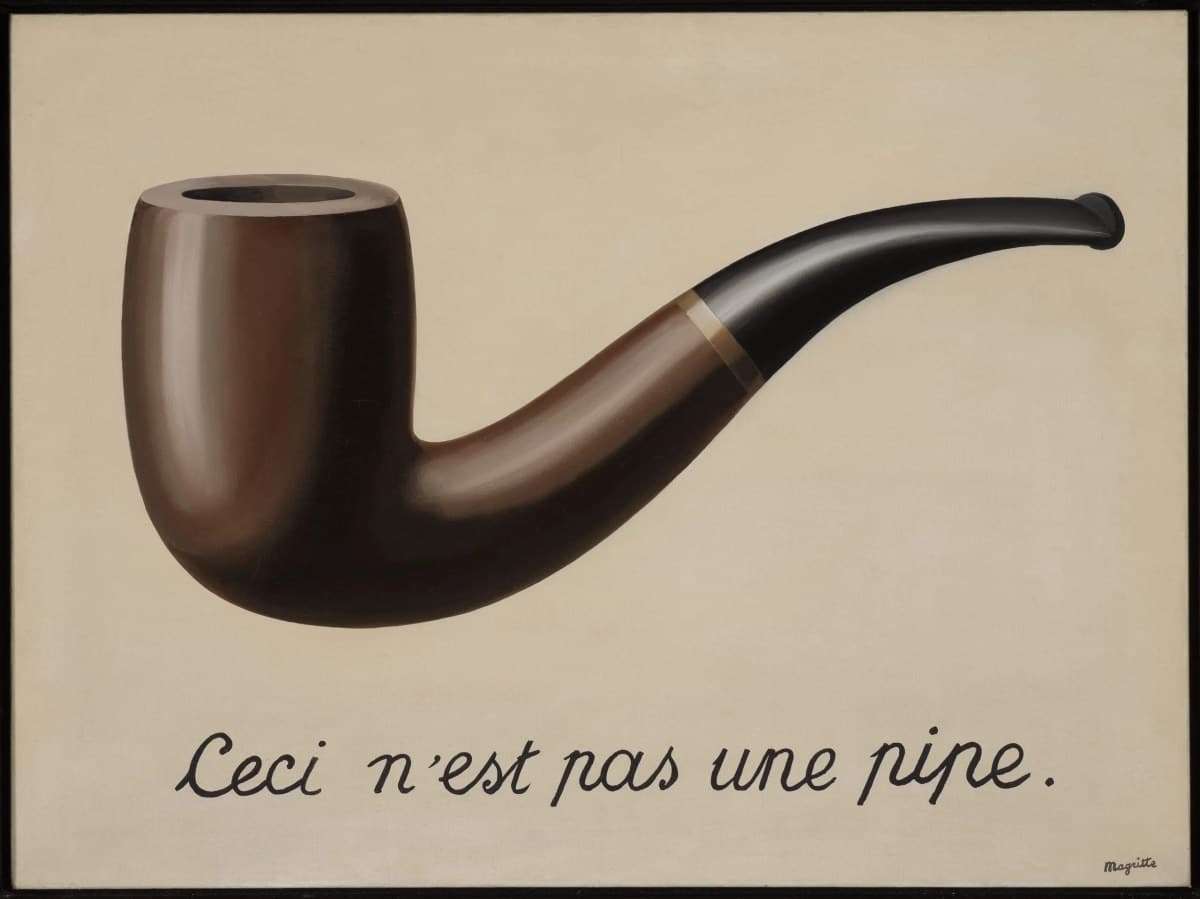
The same gallery handled a later canvas. The Los Angeles County Museum of Art's provenance for The Treachery of Images, painted in 1929, records the Galerie Le Centaure selling it on in 1932.
What the museum traces it to
The Museum of Modern Art calls the painting one of the artist's largest and most theatrical compositions, and names a specific source for its staging. René Magritte was an avid follower of Fantômas, the pre-war French crime series.
The museum records that he borrowed the placement of the two detectives flanking the door frame from Le Mort qui tue, a film in the series first released in 1913. The rest, the museum says, is an unsolvable narrative.
The museum's account of the 1927 pictures adds a phrase from a contemporary. It reports that the Belgian abstract painter Pierre Flouquet characterised the scene as a banal crime, and reads the vacant stares and everyday objects as underscoring that.
How it reached New York
The Museum of Modern Art acquired the painting on 12 April 1966, and its credit line names the Kay Sage Tanguy Fund. The same fund is the credit line on the museum's Magritte portrait of 1935, which it records as a gift of Kay Sage Tanguy.
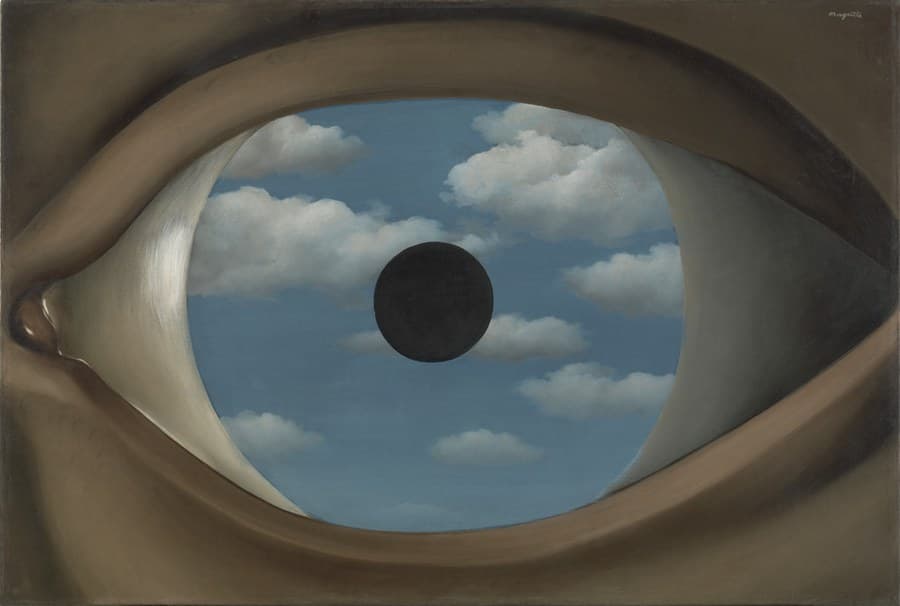
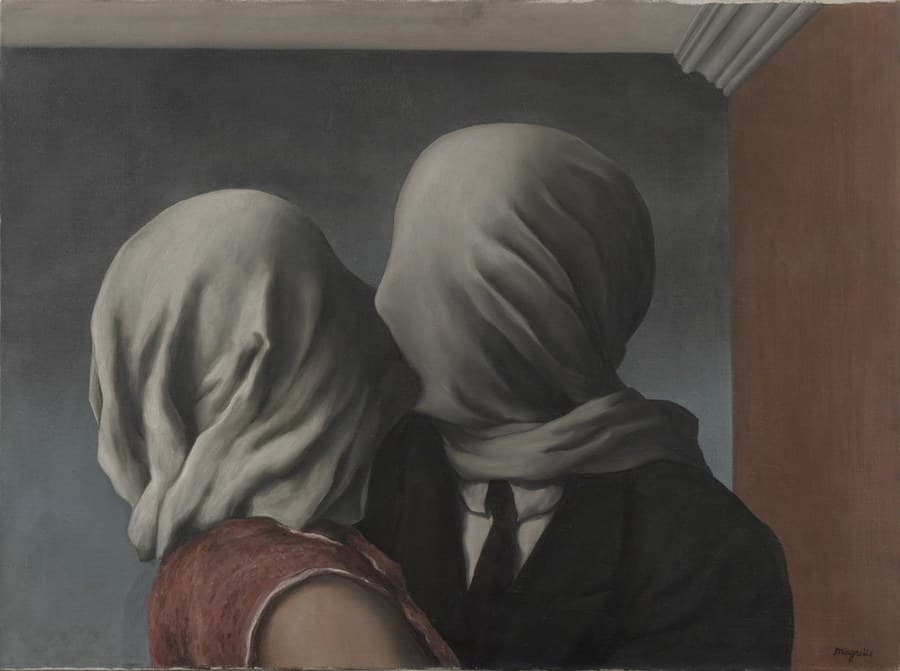
The object number is 247.1966 and the department is Painting and Sculpture. It hangs on Floor 5 in gallery 517, in the Alfred H. Barr, Jr. Galleries, with The Lovers and The False Mirror.
The museum publishes no provenance for the object and no exhibition history on its record.
Close reading
Reading the work, detail by detail
Eleven people are in or at the edges of one pale room, and each is doing something specific. The close views take them one at a time, name what each is holding, and record the objects left on the floor between them.
1.The body lies flat on a low couch
The figure lies flat on her back on a red-brown cover over a pale carved wooden frame. Her arms rest straight at her sides and her hands are open. She is painted in even pinkish greys with no shadow under her, so she sits on the couch without pressing into it.
2.Blood runs from the mouth
The head is turned slightly towards the viewer, the eyes closed and the mouth open. Blonde hair is spread behind it and a red band sits on the crown. A white cloth is bunched at the shoulder, and blood runs from the mouth down the chin and onto the neck.
3.The gramophone horn is yellow-green
The gramophone stands on a table under a brown cloth. Its horn is a pale yellow-green trumpet that flares up and to the left, the largest single shape in the right half of the picture. The dark case and the turntable below it are painted small and plain.
4.The man at the gramophone is dressed to leave
The young man stands upright in a dark three-piece suit, a white collar and a patterned tie, one hand at his jacket. He faces slightly to his left, away from the couch, and looks at nothing in particular. His coat, hat and case are already packed on the chair in front of him.
5.The man at the left holds a club
The figure at the left holds a grey-green club in his right hand, fingers closed round the narrow end, the thick rounded end raised at an angle across his body. The club is painted the same grey-green as the wall shadows and carries a single soft highlight.
6.The man at the right holds a net
The figure at the right holds an open-meshed net of brown cord in both hands, one above and one below. The mesh is drawn knot by knot and hangs loose below his lower hand. His other forearm is bent across his chest behind it.
7.Three near-identical men watch over a railing
Three men look into the room over an ornamental grey railing at the back. Each wears a white collar and a dark jacket, and the three faces are almost identical: short dark hair, level brows, no expression. None of them is looking at the couch.
8.A coat, a hat and a suitcase are set down
A black overcoat is draped over a grey chair with its sleeve hanging to the floor, and a grey-brown hat rests on the seat. A tan leather suitcase stands upright on the boards beside it. These are the only objects in the room that belong to somebody.
9.The back wall opens on a snow-capped mountain
The opening in the back wall shows a dark mountain range with one snow-covered peak, under a blue sky with thin cloud. It is painted flatly and framed by a plain grey surround, so it could be read as a window or as a picture on the wall.
10.The signature is on the floorboards
The name Magritte is written small in dark paint at the lower left, directly across the pale floorboards. It follows the line of the boards rather than the bottom edge of the canvas. Nothing else occupies that corner.
Timeline
1927
Painted in Brussels for his first one-person exhibition, at the Galerie Le Centaure. Oil on canvas, 150.4 by 195.2 centimetres.
1927
René Magritte moves to Paris in September, after the painting was made, and stays until July 1930.
1966
Acquired by the Museum of Modern Art on 12 April through the Kay Sage Tanguy Fund, as 247.1966.
2013
Shown in Magritte: The Mystery of the Ordinary, 1926–1938 at the Museum of Modern Art, 28 September to 12 January 2014.
2026
On view on Floor 5, gallery 517, in the Alfred H. Barr, Jr. Galleries.
Where to see it
The Museum of Modern Art
11 West 53 Street, New York, NY 10019, United States
On view on Floor 5, gallery 517, in the Alfred H. Barr, Jr. Galleries as of September 2026. The museum publishes no provenance or exhibition history for the object.
Plan your visit on the museum’s official website (opens in a new tab)Frequently asked questions
Where is The Menaced Assassin by René Magritte?
The Museum of Modern Art in New York, object number 247.1966, on view on Floor 5 in gallery 517 in the Alfred H. Barr, Jr. Galleries. The museum acquired it on 12 April 1966 through the Kay Sage Tanguy Fund.
What is happening in The Menaced Assassin?
A naked woman lies dead on a couch with blood running from her mouth. A young man stands listening to a gramophone beside his coat, hat and suitcase. Two men in bowler hats wait at the doorway with a club and a net, and three more watch from a balcony. The Museum of Modern Art calls the narrative unsolvable.
Was The Menaced Assassin painted in Paris?
No. The Museum of Modern Art dates it Brussels 1927 and records that it was painted for his exhibition at the Galerie Le Centaure there. He moved to Paris in September of the same year.
What are the two men in bowler hats holding?
The man at the left holds a grey-green club, thicker at the top, raised at an angle in his right hand. The man at the right holds an open-meshed net of brown cord in both hands. The Museum of Modern Art calls them detectives.
What is the Fantômas connection in The Menaced Assassin?
The Museum of Modern Art records that René Magritte followed the pre-war French crime series Fantômas. It states that he borrowed the placement of the two detectives flanking the door frame from Le Mort qui tue, a film in the series first released in 1913.
How big is The Menaced Assassin?
150.4 by 195.2 centimetres, or 59 1/4 inches by 6 feet 4 7/8 inches, in oil on canvas. The Museum of Modern Art calls it one of his largest and most theatrical compositions.
More by René Magritte
References
The sources below include collection records, catalogues, scholarly research, and primary materials that informed this page. They document The Menaced Assassin, its making, and its place in cultural history.

1René Magritte, The Menaced Assassin, Brussels 1927
WebsiteThe Museum of Modern Art, New YorkUsed forThe museum's object record — title, date, medium, dimensions, credit line, gallery label and copyright notice.

2The Museum of Modern Art collection dataset (Artworks.csv)
ArchiveThe Museum of Modern Art, New YorkUsed forThe museum's own published collection dataset, which corroborates the catalogue row and supplies the 12 April 1966 acquisition date.
3Magritte: The Mystery of the Ordinary, 1926-1938, press release
WebsiteThe Museum of Modern ArtUsed forThe Museum of Modern Art's 2013 press release, for the Galerie Le Centaure exhibition the painting was made for and for Pierre Flouquet's phrase.
4Rene Magritte, The Treachery of Images (Ceci n'est pas une pipe), 1929 (78.7)
WebsiteLos Angeles County Museum of ArtUsed forThe Los Angeles County Museum of Art's record, whose provenance places a later canvas with the same Brussels gallery.
These references provide the documented foundation for this work's history and interpretation. Claim-level citations remain attached to the specific claims they support.
 Explore more resources