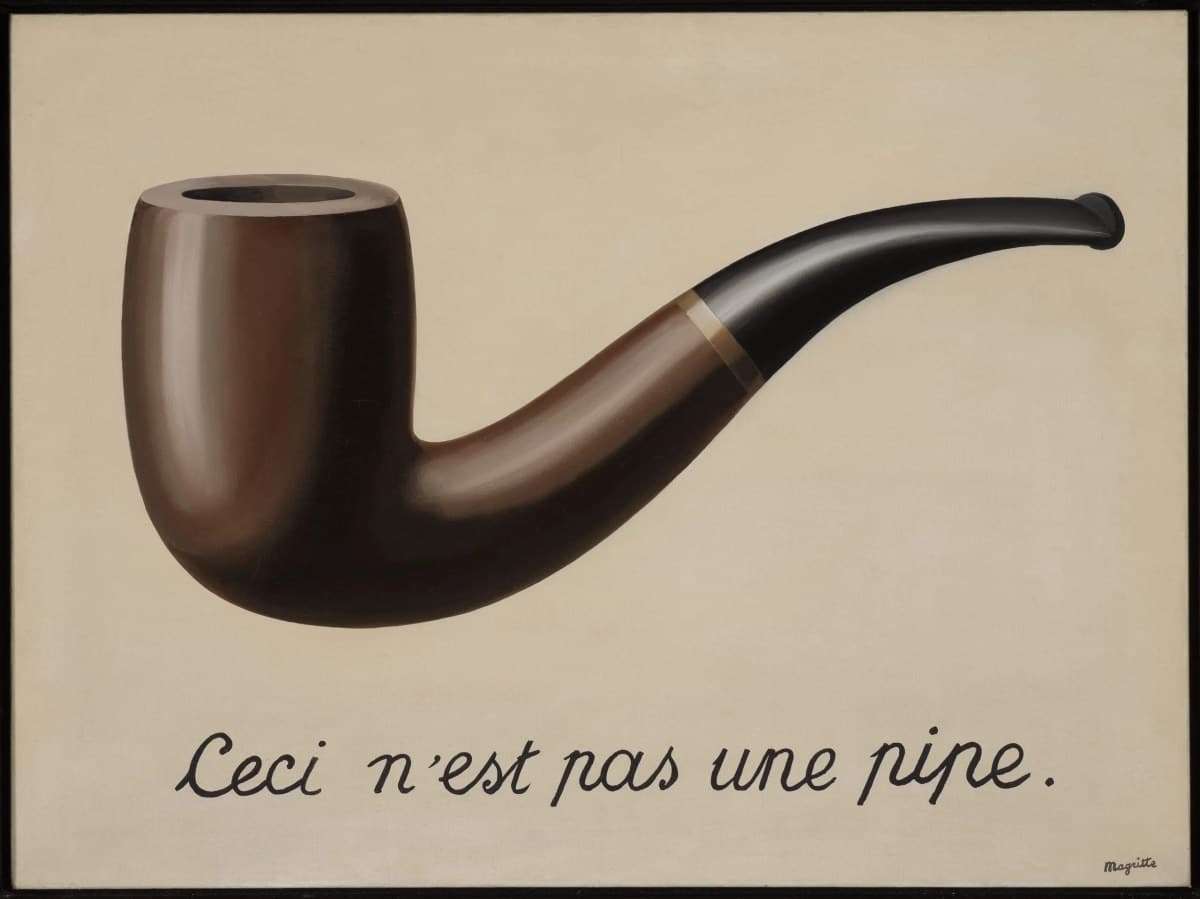
The Treachery of Images (This is Not a Pipe)
A brown pipe floats on a pale cream ground, and under it, in joined cursive, runs the line Ceci n'est pas une pipe. René Magritte painted it in 1929, during the three years he was living in France. The Los Angeles County Museum of Art bought it at auction in 1978 and shows it as accession number 78.7.
- 1929
- Oil on canvas
- Los Angeles County Museum of ArtLos Angeles, United States
What the painting shows
A single pipe fills the upper two-thirds of the canvas. The bowl sits at the left, its rim a flattened oval with a dark opening, and the light falls on it from the upper left so that a broad highlight runs down the front of the bowl. The shank runs right and curves gently upward. A narrow ivory band marks where the brown shank meets the black mouthpiece, and the mouthpiece tapers to a rounded bit at the right edge.
Nothing supports the pipe. It casts no shadow, sits on no surface, and the ground behind it is an even pale cream that lightens slightly towards the centre. There is no room, no table and no edge of anything.
The lower third carries the writing. In joined cursive, in black, it reads: Ceci n'est pas une pipe. The letters are joined inside each word and separated by wide gaps between words, the capital C opens with a broad loop, and a full stop closes the line. The signature, Magritte, sits small and dark at the lower right.
The canvas measures 23 3/4 by 31 15/16 inches, about 60.3 by 81.1 centimetres. The Los Angeles County Museum of Art also records a depth of one inch.
The hand the sentence is written in
The script is schoolroom cursive rather than a painter's flourish. Every letter is the same weight, the strokes do not thicken and thin, and the line sits flat and level under the pipe with no ornament at either end.
The Los Angeles County Museum of Art reads that plainness as a layout. Its wall label of 2021 describes the work as presented in the style of an advertisement, with the neat cursive text forming a slogan-like caption under the image of the pipe.
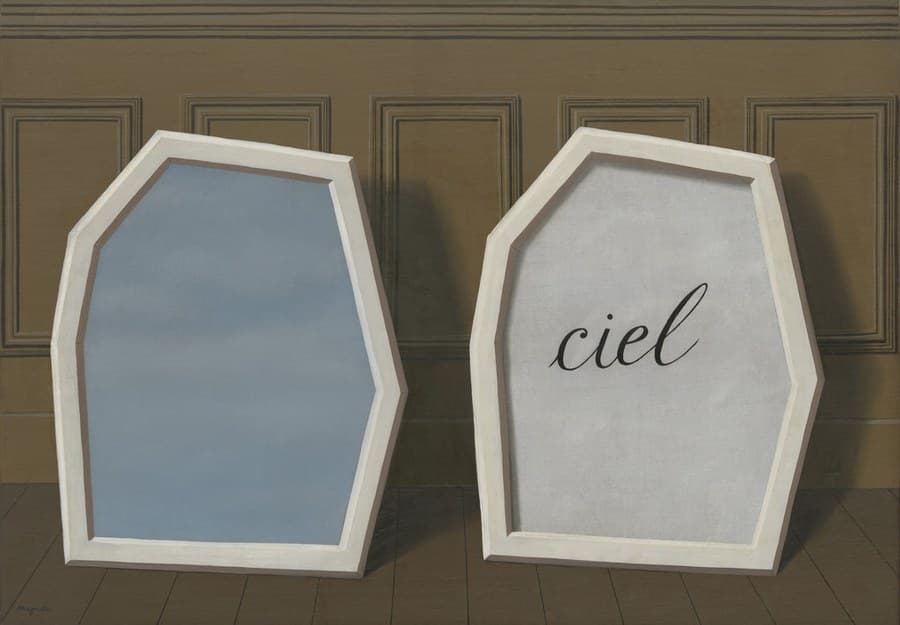
René Magritte used a different hand a year earlier. The Palace of Curtains, III, painted in Paris in 1928 and 1929, carries the single word ciel in a formal copperplate with thick downstrokes and hairline upstrokes. The two pictures set a word against a picture by two different kinds of writing.
Where it was painted, and who disagrees
René Magritte moved to Paris in September 1927 to be closer to the centre of the Surrealist movement, and went back to Brussels in July 1930 after the stock market crash and the closing of the Galerie Goemans. The Museum of Modern Art states both dates in its account of the years the painting belongs to.
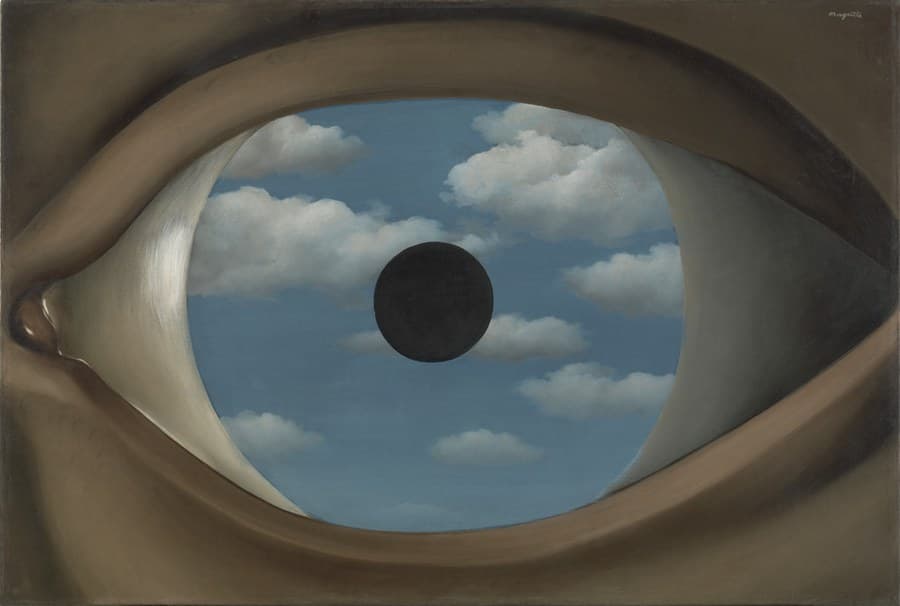
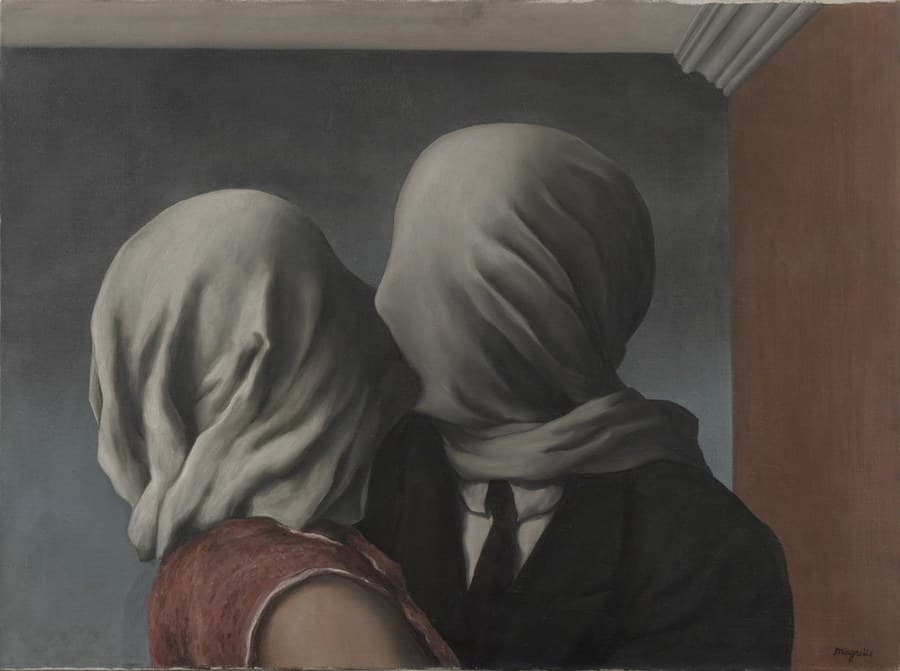
The two museums that hold his 1929 canvases record the place differently. The Los Angeles County Museum of Art gives Place Made as Belgium. The Museum of Modern Art dates its own canvas of the same year, The False Mirror, as Paris 1929, and dates The Lovers as Paris 1928.
Neither museum shows its working. The disagreement is recorded here rather than resolved, and the French years are given as the Museum of Modern Art states them.
How it reached Los Angeles
The Los Angeles County Museum of Art publishes the chain. The painting went from René Magritte to the Galerie Le Centaure in Brussels, which sold it in 1932 to Edouard Léon Théodore Mesens, the Belgian dealer and collector then working in London.
Mesens sold it in 1957 to William Copley and Noma Copley. It came up at Sotheby Parke-Bernet in New York on 17 May 1978, sale number 4124, lot 70, and the museum bought it there.
The accession number records the year: 78.7. The credit line reads Purchased with funds provided by the Mr. and Mrs. William Preston Harrison Collection, and the museum shows the painting on the third floor of the Broad Contemporary Art Museum, in the Modern Art galleries.
What the museum says it does
The Los Angeles County Museum of Art calls the painting a treatise on the impossibility of reconciling word, image, and object, and says it challenges the convention of identifying an image of an object as the thing itself.
The museum also names the debt it left behind. It records that René Magritte's use of text influenced a younger generation of artists, listing John Baldessari, Marcel Broodthaers, Jasper Johns, Roy Lichtenstein and Ed Ruscha.
The Museum of Modern Art, describing the same painting for its 2013 exhibition, calls the pipe a skillfully realistic simulacrum rendered with the direct clarity of a shop sign or school primer.
Close reading
Reading the work, detail by detail
René Magritte painted a pipe, left the ground behind it empty, and wrote a sentence under it in joined cursive. The close views take the pipe along its length, then the writing word by word, and record the lettering exactly as it is painted.
1.The bowl carries one broad highlight
The bowl is painted in three or four browns with no visible brushwork. A wide pale highlight runs down the front of it, the wood darkens to near-black at the lower left, and the outline is a clean unbroken curve. Nothing supports it and nothing touches it.
2.The rim is a flattened oval
The top of the bowl is a flattened oval seen from slightly above, a pale brown band enclosing a dark opening. The opening is filled with a single flat dark tone. There is no ash, no char and no depth painted inside it.
3.An ivory band joins shank to mouthpiece
A narrow ivory band marks the joint between the brown shank and the black mouthpiece. The band is the lightest tone in the pipe and is painted as a clean vertical stripe about the width of the shank. The brown stops at it and the black begins on the other side.
4.The mouthpiece tapers and lifts
The mouthpiece curves up as it runs right and narrows to a rounded tip near the edge of the canvas. A thin highlight runs along its upper edge and fades before the end. The tip stops short of the picture's border with a hand's width of empty ground beyond it.
5.The ground is empty and lit from nowhere
The ground is a pale warm cream, slightly lighter towards the middle of the canvas and slightly cooler at the edges. There is no horizon, no cast shadow under the pipe and no indication of a surface. The weave of the canvas shows faintly through the paint.
6.The sentence opens with a looped capital
The first word is Ceci. The capital C opens with a wide loop that rises above the other letters, and the e, c and i are joined at the baseline in a single stroke. The i carries a round dot. Every stroke is the same weight, thick and thin nowhere.
7.Transcribed exactly: Ceci n'est pas une pipe.
The line as painted reads: Ceci n'est pas une pipe. It runs across the lower third of the canvas, below the pipe and clear of it. Letters are joined inside each word and the words are separated by wide gaps, with the widest between Ceci and n'est. An apostrophe sits between the n and the est.
8.The line ends in a full stop
The final word is pipe, its p descending below the baseline and its e closing with a short upward flick. A small round full stop follows, set slightly apart and sitting on the baseline. The sentence is punctuated like a caption rather than left open.
9.The signature is small and level
The name Magritte is written small in dark paint in the lower right corner, well below the end of the sentence. The letters are upright and much smaller than the cursive line above. It sits level with the bottom edge and does not touch the frame.
Timeline
1927
René Magritte moves to Paris in September to be nearer the centre of the Surrealist movement, and stays until 1930.
1929
Painted, in oil on canvas, 23 3/4 by 31 15/16 inches.
1932
Sold by the Galerie Le Centaure in Brussels to Edouard Léon Théodore Mesens, then in London.
1957
Sold by Mesens to William Copley and Noma Copley.
1978
Sold at Sotheby Parke-Bernet, New York, on 17 May, sale 4124, lot 70, and bought by the Los Angeles County Museum of Art as 78.7.
2006
Lends its subtitle to René Magritte and Contemporary Art: The Treachery of Images at the Los Angeles County Museum of Art, 19 November to 4 March 2007.
2013
Shown in Magritte: The Mystery of the Ordinary, 1926–1938 at the Museum of Modern Art, which travels to the Menil Collection and the Art Institute of Chicago through 2014.
Where to see it
Los Angeles County Museum of Art
5905 Wilshire Boulevard, Los Angeles, CA 90036, United States
Closed on Wednesdays. The museum's collection records state whether a work is on view; check the record before travelling for one painting.
On view on the third floor of the Broad Contemporary Art Museum, in the Modern Art galleries, as of September 2026.
Plan your visit on the museum’s official website (opens in a new tab)Frequently asked questions
Where is The Treachery of Images by René Magritte?
The Los Angeles County Museum of Art, accession number 78.7, on view on the third floor of the Broad Contemporary Art Museum in the Modern Art galleries. The museum bought it at Sotheby Parke-Bernet in New York on 17 May 1978.
What does Ceci n'est pas une pipe mean?
This is not a pipe. The words are painted across the lower third of the canvas in joined cursive, with a full stop at the end. The Los Angeles County Museum of Art reads the picture as a treatise on the impossibility of reconciling word, image, and object.
Why is it called The Treachery of Images?
That is the title René Magritte gave it: La trahison des images. The Los Angeles County Museum of Art prints the full form as The Treachery of Images (This is Not a Pipe), with the French as La trahison des images [Ceci n'est pas une pipe]. The sentence on the canvas is not the title.
How big is The Treachery of Images?
23 3/4 by 31 15/16 inches, roughly 60.3 by 81.1 centimetres, in oil on canvas. It is a landscape-format picture, wider than it is tall, and the museum records a depth of one inch.
When did René Magritte paint The Treachery of Images?
1929, during the three years he spent in France. The Museum of Modern Art dates his move to Paris to September 1927 and his return to Brussels to July 1930. The Los Angeles County Museum of Art nevertheless gives the painting's place of origin as Belgium.
Who owned The Treachery of Images before the museum?
The Galerie Le Centaure in Brussels, then Edouard Léon Théodore Mesens from 1932, then William Copley and Noma Copley from 1957. The museum bought it out of the 1978 Sotheby Parke-Bernet sale in New York.
More by René Magritte
References
The sources below include collection records, catalogues, scholarly research, and primary materials that informed this page. They document The Treachery of Images (This is Not a Pipe), its making, and its place in cultural history.

1Rene Magritte, The Treachery of Images (Ceci n'est pas une pipe), 1929 (78.7)
WebsiteLos Angeles County Museum of ArtUsed forThe museum's object record — title, date, medium, dimensions, credit line, provenance, wall label of 2021 and copyright notice.
2Magritte: The Mystery of the Ordinary, 1926-1938, press release
WebsiteThe Museum of Modern ArtUsed forThe Museum of Modern Art's press release for its 2013 exhibition, for the September 1927 move to Paris, the July 1930 return to Brussels, and its description of the pipe.
3René Magritte, The False Mirror, Paris 1929
WebsiteThe Museum of Modern Art, New YorkUsed forThe Museum of Modern Art's record for a canvas of the same year, which it dates Paris 1929 where the Los Angeles County Museum of Art gives Belgium.
4René Magritte, The Palace of Curtains, III, Paris 1928-29
WebsiteThe Museum of Modern Art, New YorkUsed forThe Museum of Modern Art's record for the other Paris-years painting that carries a painted word.
5René Magritte 1898–1967 — artist record and collection works
WebsiteTateUsed forTate's artist record, which prints a rights line naming ADAGP and DACS rather than the Artists Rights Society.
6René Magritte — œuvres dans la collection du Musée national d'art moderne
WebsiteCentre PompidouUsed forThe Centre Pompidou's collection records, which print the rights line as ADAGP, Paris alone.
These references provide the documented foundation for this work's history and interpretation. Claim-level citations remain attached to the specific claims they support.
 Explore more resources