The Palace of Curtains, III
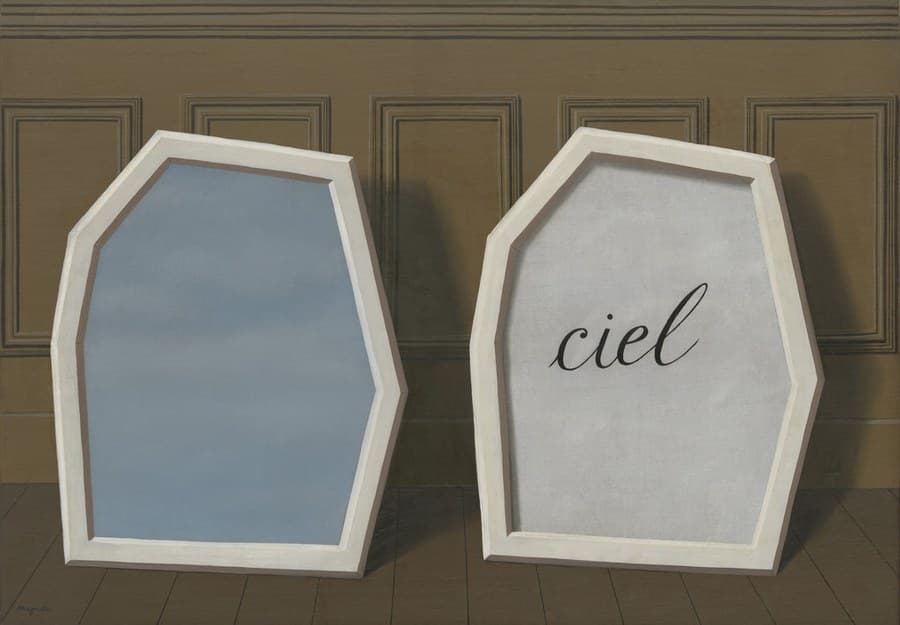
Two irregular frames lean side by side against a panelled wall. The left one holds a pale blue sky; the right one holds the word ciel, written in black on grey. René Magritte painted it in Paris across 1928 and 1929. The Museum of Modern Art has held it since 1967 as object number 631.1967, in the Sidney and Harriet Janis Collection.
- Paris 1928–29
- Oil on canvas
- The Museum of Modern ArtNew York, United States
What the painting shows
Two objects stand on a wooden floor against a wall. Each is a thick cream-white surround with a bevelled inner edge, cut to an irregular seven-sided outline. The sides run vertically, the top corners angle in to a flat top, and the bottom corners angle in again to a flat base.
The one at the left holds a pale blue field, slightly warmer towards the bottom, with the faintest suggestion of cloud in it. The one at the right holds a flat grey field, and across it, a little above centre and a little right of centre, the word ciel is written in black.
The wall behind them is olive-brown, divided into flat rectangular panels by thin dark mouldings, with three horizontal bands running across the top. The floor is bare boards in the same olive-brown, the joints drawn as thin dark lines running towards the viewer.
Both objects lean back slightly, and both cast a soft grey shadow up and to the right across the wall behind them. The signature, Magritte, sits small and dark at the lower left. The canvas measures 81.2 by 116.4 centimetres, about 32 by 45 7/8 inches.
The word, exactly as painted
The word is ciel, French for sky, lowercase throughout and with no full stop. It is written in a formal round hand with thick downstrokes and hairline upstrokes, the sort of script used for engraved copperplate. The c opens with a small curled entry stroke and the i carries a round dot. The e is looped, and the l rises into a tall narrow loop that is the highest point of the word.
The lettering sits inside the right-hand frame, not on the wall and not across the whole canvas. It occupies about the middle third of the grey field, ending well short of the frame on both sides.
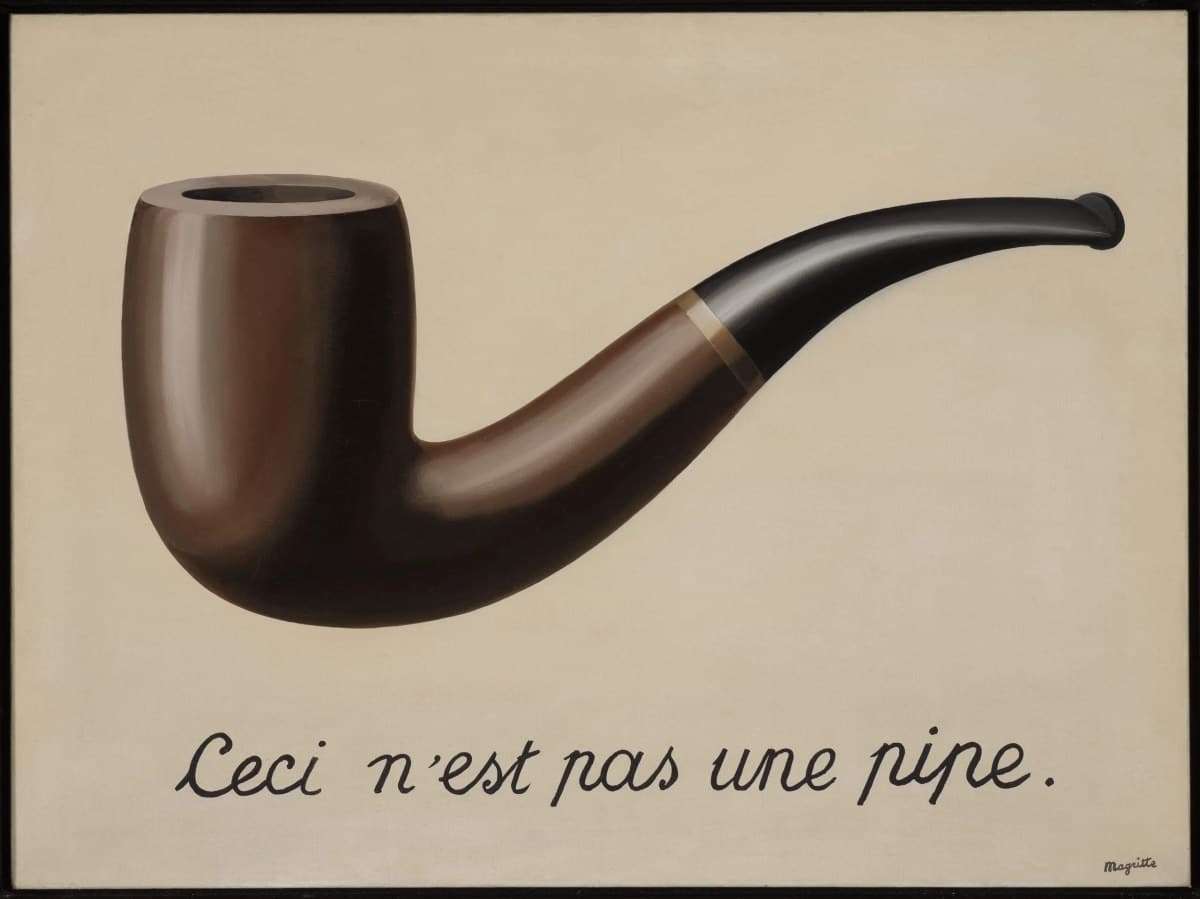
The hand is not the one René Magritte used a year later. The Treachery of Images of 1929 carries its sentence in even-weight schoolroom cursive, flat and unshaded. Here the strokes swell and taper, and the writing is calligraphy rather than handwriting.
Two frames, one substitution
The two objects are the same size, the same shape and the same colour, and they stand at the same angle on the same floor. One holds a picture of the sky and one holds the word for it, and nothing else in the canvas differs.
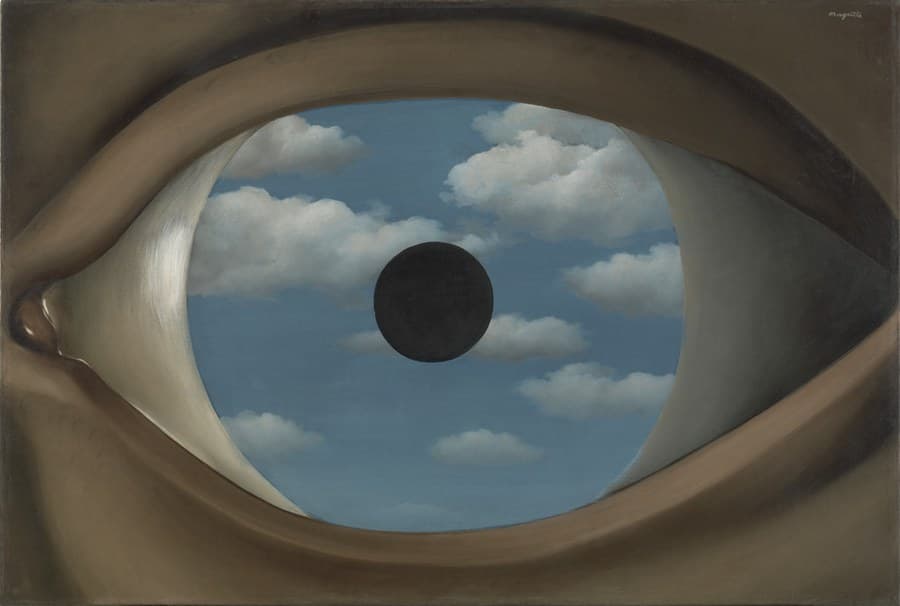
The Museum of Modern Art's account of the years in France says that while in Paris he explored the slippery relationship between words and images. Two of the paintings that do so belong to the museum's own collection, The Palace of Curtains, III and The False Mirror. A third, The Treachery of Images, is in Los Angeles.
The Roman numeral in the title records that it is not the only version. The museum prints the title as The Palace of Curtains, III, with the comma and the numeral.
How it reached New York
The Museum of Modern Art acquired the painting on 18 October 1967. Its credit line is The Sidney and Harriet Janis Collection, the group of works the New York dealer Sidney Janis and his wife gave to the museum, and its object number is 631.1967.
The painting is not on view. The on-view field in the museum's published collection dataset is empty for this object, where it names a gallery for the other three Magritte paintings of the same period.
The museum's own related-works lists show the painting with the note Image not available, while the dataset it publishes names an image file for the same object. Both come from the museum, and the reproduction shown here is the file the dataset names.
Close reading
Reading the work, detail by detail
Two frames of the same size and shape lean against a panelled wall, one holding a sky and one holding the word for it. The close views record the lettering exactly as it is painted, then the bevels, the shadows and the floor that make both objects solid.
1.Transcribed exactly: ciel
The word as painted is ciel, lowercase throughout and with no full stop. It is written in a formal round hand. The c opens with a small curled entry stroke and the i carries a round dot. The e is looped, and the l rises into a tall narrow loop that is the highest point of the word. The downstrokes are thick and the upstrokes are hairlines.
2.The word sits in the middle third of the grey
The grey field is flat and slightly uneven, with the canvas weave showing through. The writing occupies about the middle third of it, set a little above centre and a little right of centre, and stops well short of the frame on both sides. Nothing else is in the field.
3.The left frame holds a painted sky
The left field is a pale blue that warms very slightly towards the bottom, with the faintest suggestion of cloud in it and no horizon. It is painted as thinly as the grey beside it. The two fields are the same size and are given equal weight.
4.The frames are cut with angled corners
The outline runs vertically up the side, then turns in at an angle to a flat top. The inner edge is bevelled, showing a narrow grey-brown slope between the white face and the field it encloses. The same cut is repeated at the bottom corners.
5.Both objects cast a shadow to the right
Each object throws a soft grey shadow up and to the right across the wall behind it, widening as it rises. The shadows put the light source low and to the left. They are the only thing that fixes the two objects in the room rather than on the picture surface.
6.The wall is panelled and banded at the top
The wall is olive-brown, divided into flat rectangular panels by thin dark mouldings drawn as double lines. Three horizontal bands run across the very top of the canvas. The panelling is regular and evenly lit, with no fittings, no door and no picture on it.
7.The bases rest on bare boards
The flat base of each object rests on bare boards, tilted back a few degrees so the lower edge stands slightly forward. The plank joints are drawn as thin dark lines running towards the viewer. No skirting board separates the floor from the wall.
8.The signature is on the floor at the left
The name Magritte is written small in dark paint at the lower left, on the floorboards and clear of both objects. It is much smaller than the word inside the right-hand frame and is written in a plain joined hand rather than the formal script used there.
Timeline
1927
René Magritte moves to Paris in September to be nearer the centre of the Surrealist movement.
1928
Begun in Paris, in oil on canvas, 81.2 by 116.4 centimetres.
1929
Completed, in the same years as The Treachery of Images.
1930
René Magritte returns to Brussels in July.
1967
Acquired by the Museum of Modern Art on 18 October as 631.1967, in the Sidney and Harriet Janis Collection.
2026
Not on view. The museum's published dataset records no gallery for the object.
Where to see it
The Museum of Modern Art
11 West 53 Street, New York, NY 10019, United States
Not on view as of September 2026. The on-view field in the museum's published collection dataset is empty for this object.
Plan your visit on the museum’s official website (opens in a new tab)Frequently asked questions
Where is The Palace of Curtains, III by René Magritte?
The Museum of Modern Art in New York, object number 631.1967, in the Sidney and Harriet Janis Collection. It is not on view: the museum's published collection dataset records no gallery for the object.
What does the word in The Palace of Curtains, III say?
Ciel, French for sky, lowercase and with no full stop. It is written in black in a formal round hand with thick downstrokes and hairline upstrokes, inside the right-hand frame, a little above and right of the centre of the grey field.
What are the two shapes in The Palace of Curtains, III?
Two thick cream-white surrounds with bevelled inner edges, cut to the same irregular seven-sided outline and leaning back against a panelled olive-brown wall. The left one holds a pale blue sky, the right one the word ciel, and both cast a soft shadow up and to the right.
Why is it numbered III?
Because it is one of a series. The Museum of Modern Art prints the title as The Palace of Curtains, III, with the comma and the Roman numeral, and dates this canvas Paris 1928-29.
How big is The Palace of Curtains, III?
81.2 by 116.4 centimetres, about 32 by 45 7/8 inches, in oil on canvas. It is a landscape-format picture, wider than it is tall, and signed at the lower left.
Was The Palace of Curtains, III painted in Paris?
The Museum of Modern Art dates it Paris 1928-29. René Magritte moved there in September 1927 to be nearer the centre of the Surrealist movement, and returned to Brussels in July 1930.
More by René Magritte
References
The sources below include collection records, catalogues, scholarly research, and primary materials that informed this page. They document The Palace of Curtains, III, its making, and its place in cultural history.

1René Magritte, The Palace of Curtains, III, Paris 1928-29
WebsiteThe Museum of Modern Art, New YorkUsed forThe museum's object record, cited for the object URL and the title form; the page itself could not be read directly.

2The Museum of Modern Art collection dataset (Artworks.csv)
ArchiveThe Museum of Modern Art, New YorkUsed forThe museum's own published collection dataset — title, date, medium, dimensions, credit line, acquisition date, empty on-view field and image file.
3Magritte: The Mystery of the Ordinary, 1926-1938, press release
WebsiteThe Museum of Modern ArtUsed forThe Museum of Modern Art's 2013 press release, for the Paris years and for its statement that he explored the relationship between words and images there.
4Rene Magritte, The Treachery of Images (Ceci n'est pas une pipe), 1929 (78.7)
WebsiteLos Angeles County Museum of ArtUsed forThe Los Angeles County Museum of Art's record for the 1929 painting whose lettering is written in a different hand.
These references provide the documented foundation for this work's history and interpretation. Claim-level citations remain attached to the specific claims they support.
 Explore more resources