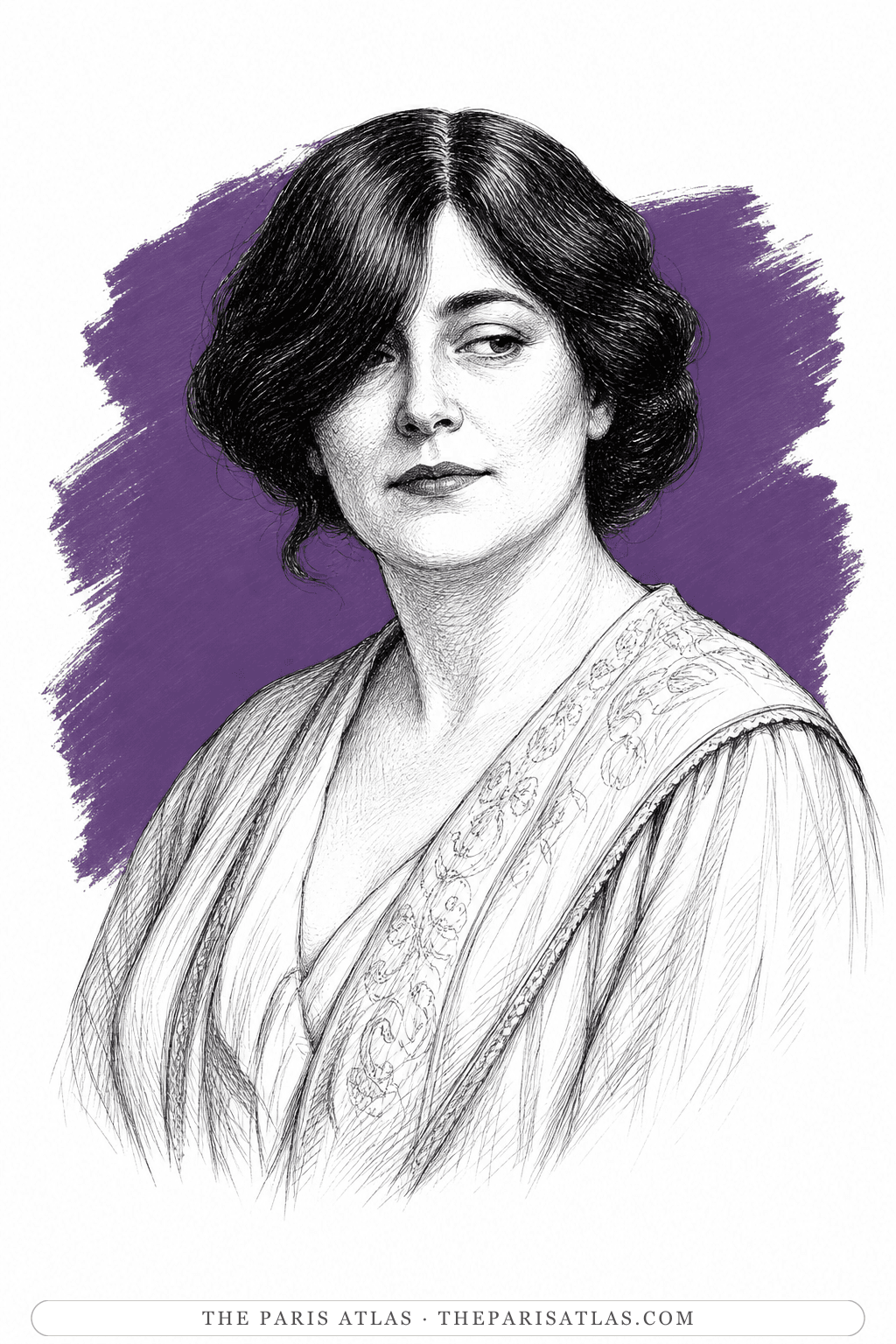
Fanny
Farou's comfortable, unsuspicious wife, whose discovery of the affair turns into a cold, searching appraisal of what she actually wants to keep.
To keep her marriage and her household exactly as they are, and to be spared a scene. When Jane says she could never accept a husband who sleeps with the actresses on tour, Fanny answers that if she refused to accept it, precisely the same thing would happen.
The book

At a glance
- The wife, and the character the novel follows from beginning to end
- Twelve years to Farou, a Paris playwright; they met at a rehearsal of his play Le Logis sans Femme
- Never given directly. She is seven years older than Jane, who is around thirty
- A Paris flat whose windows look onto the trees of the Champ-de-Mars, plus a rented summer house — two summers running at the Villa Déan, in the dry hills of the Franche-Comté
- Jean, Farou's son by an earlier woman. She has raised him for more than ten years and he calls her Mamie
- Handsome Farou, wicked Farou, intolerable Farou — a litany she set to her own words and music in the early years
Who they are in the book
Spoiler-freeFanny is the wife in Colette's novel The Other One, published in French in 1929 as La Seconde, and she is the person the book stays with from the first page to the last. She is married to Farou, a Paris playwright who makes a good living writing for the big commercial theatres, and they have been married twelve years. Two other people live with them: Farou's son Jean, who is sixteen, and Jane, who types Farou's plays, answers his telephone, runs the household and has a bedroom of her own down the corridor. Fanny is fond of Jane and leans on her heavily.
The marriage began abruptly. Farou noticed her at a rehearsal of one of his plays, where she was playing the piano offstage, and told her she looked like a half-shelled hazelnut between her black hair-bands. A week later he told her to come away with him. Fanny said, frightened, that she was an unmarried girl still living with her parents; he said that was a nuisance and they had better get married then. She has never been with any other man.
She does very little. She cannot type, so she has no part in his work. She reads, plays patience, sleeps after lunch, eats more than she means to, and holds off the creditors in the lean stretches between productions. Farou's affairs with actresses are an old fact of the marriage and she has decided in advance not to mind them. When Jane says she could never put up with such a thing, Fanny points out that refusing to put up with it would change nothing whatsoever.
What she has not allowed for is a woman inside the house. One evening she hides in a shrub on the terrace with her stepson beside her, watches her husband and Jane talking on the level below, and recognises the particular shrug her husband uses on a wife who offers him a tie or a comb. She does not shout, and she says nothing to anyone for weeks. She lies awake instead, listing his previous mistresses to see whether they still hurt, and works out slowly that what she cannot bear is not the sex. It is that it is happening in her own house, with the one person she has ever been able to talk to and be understood by.
How Fanny Is Portrayed
- What she looks likeWhite skin, long black hair parted into heavy bands, one of which usually covers an eye. Colette says she is better-looking lying down than standing, and that the only feature Fanny is proud of is her short silvery nose with its round nostrils.
- How Farou proposedHe saw her at a rehearsal of his play Le Logis sans Femme, where she was playing the piano offstage, and opened with the remark about the half-shelled hazelnut. A week later he told her to come with him. She admitted she was an unmarried girl still at home; he said that was a nuisance and that they would have to get married.
- She eats, and then she sleepsShe peels a dripping peach at the table, complains about the cream cheese she has already eaten, and goes straight to the divan. Asked when she is going to start wearing a girdle, she says it is a question of temperature: at five degrees above zero she wears one, and Jane can consult the thermometer. She adds that she always puts on weight when it is hot and there is more than ten thousand francs in the house.
- She has no part in his workShe cannot type his manuscripts. She tried to be his secretary in the first years of the marriage and he discouraged her out of it. Once, sitting through the final dress rehearsal of Atalante at the Comédie-Française, she told him a scene ran long and suggested bringing someone on with a coffee tray or a telegram to break it up. He never asked her opinion again, which has never stopped her giving it.
- Money arrives in lumpsHer furs are named after the plays that paid for them: the otter from Atalante, the mink from Le Logis sans Femme, the blue foxes from Le Raisin volé that she sold when Le Troc failed. When a cheque for fifty thousand comes from America for the film rights to Atalante, she shrieks for the car, orders sweet grocer's champagne and hot pastry, and announces that she will throw the butcher his eighteen hundred francs in his face.
- The winter she nursed the boyFarou's son had paratyphoid fever, the maid ran off for fear of catching it, there was no money for a nurse, and Farou stayed behind a closed door complaining that his typist had chosen that month to give birth. Fanny squeezed lemons, boiled water and rinsed basins for weeks. One morning she decided she had had enough and would go and hand the child back to his father. Then the boy called for her in his delirium and she went back to the kitchen.
- How she takes his affairsShe reads his letters from the tour aloud at the lunch table, including the part where he explains that he and the young actress have put a stop to their scenes and fainting fits. Jane says that she could never live like that. Fanny says she has to, because if she refused, exactly the same thing would happen anyway.
- What she saw from the terraceHer stepson spots his father and Jane talking on the terrace below and slides his head under a flowering shrub on the parapet to watch. Fanny puts down her needlework and joins him. She cannot hear a word from that height, but she recognises the movement of the shoulder her husband uses to shrug off a tie, a comb or a caress offered by a wife's hand.
- She faints on purposeAfter she sees Farou kiss Jane in the bathroom, she cannot think what to say, so she gives her husband a small apologetic smile, shuts her eyes and slides full length onto the carpet. Lying with her eyes closed while the two of them argue above her about hot-water bottles and aspirin, she arranges her head at its best angle and enjoys the rest.
She waits until the new play has opened and the receipts are safe, puts on a new dark blue dress, and begins: she has found out that Jane, that Farou — Jane cuts her off and asks what we are going to do. The word we makes Fanny blush, and from that point Jane is running the conversation. It takes a whole December afternoon and neither of them raises her voice for long.
Farou comes home in the middle of it singing his usual line about all these women in his house. Fanny tells him flatly that Jane is his mistress, she is his wife, and nothing can be settled without him. He asks why, having hidden it so long, she does not simply go on hiding it; offers to accept full responsibility; and reminds her that twelve years of her tenderness guarantee she will be considerate towards the person who deserves consideration. Then he backs out of the room, collecting a promise that none of this will get out, and leaves for a preview at the Gymnase, shaved and powdered. Fanny's verdict on him afterwards is that he was beneath everything.
Jane offers to go. She proposes telephoning Delvaille, the old secretary, in the morning, and sits mending a pair of thick gloves that would be useful if she travels. Fanny says no to Delvaille and says there is no hurry. The novel ends with the two of them by the fire, one pretending to read and one pretending to sew, while Farou lets himself in at half past midnight, sees the light under the door and goes away again. Earlier that evening Fanny had worked out what she was keeping: « On n’est pas trop de deux pour être seule avec Farou… contre Farou… » — two women, she means, are not too many when the job is being alone with Farou, and against him.
If you like The Other One


If you like Colette
Explore authors with a similar voice, perspective, and influence.

Henry Miller
The Brooklyn dropout who arrived in Paris broke at thirty-eight and wrote the exuberant, banned books that ended American censorship.
View author
Louis-Ferdinand Céline
The doctor of the Paris slums who wrote the century's blackest, funniest novel — and changed the sound of French prose.
View author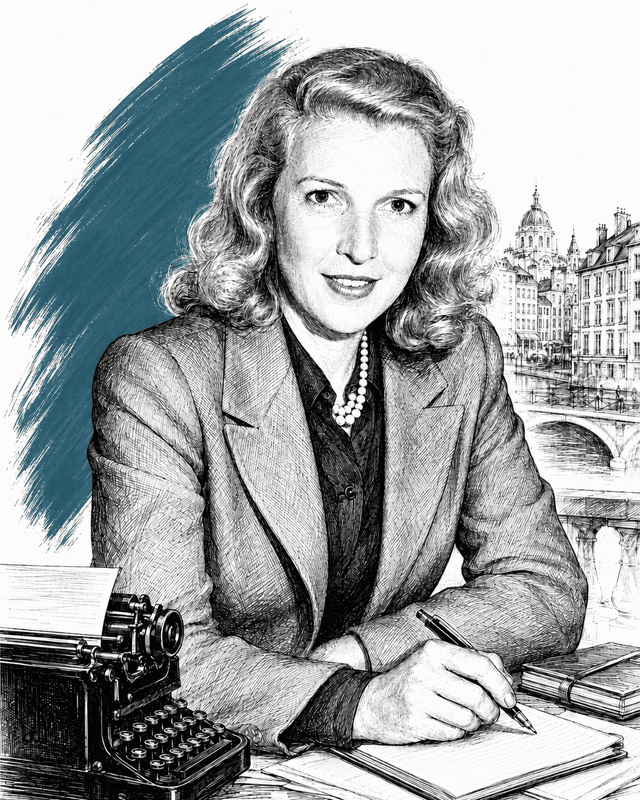
Martha Gellhorn
War correspondent who covered the Spanish Civil War, D-Day, and conflicts across five more decades; Hemingway's third wife, 1940–1945.
View author