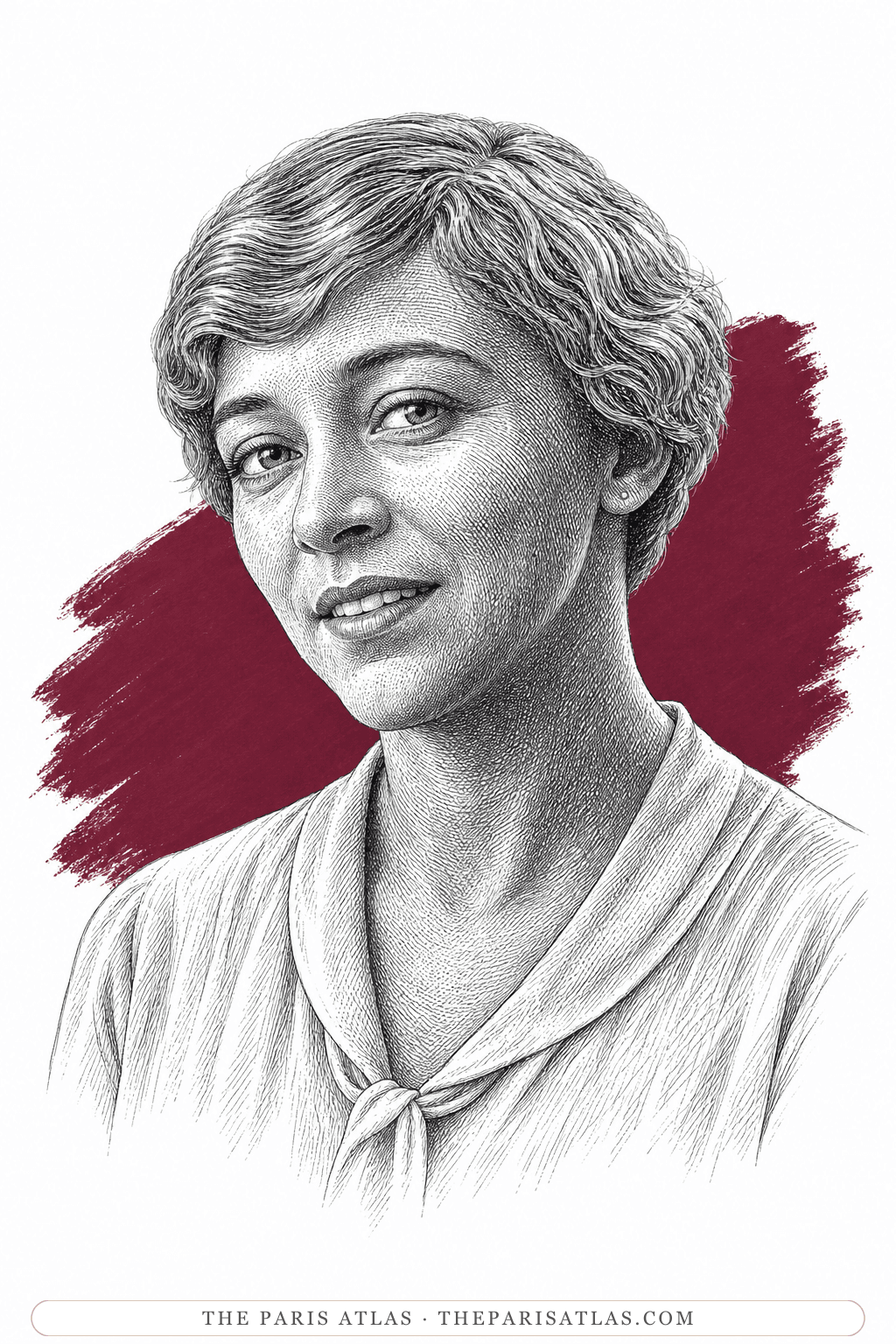
Jane
Farou's poised secretary and lover — 'the other one' of the title, and the woman Fanny finds she would rather keep than banish.
To stay in this house. When she thinks she has annoyed Fanny she asks, in as many words, to be kept — and what she is asking to keep is the household, not Farou.
The book

At a glance
- Farou's secretary and his mistress; the second woman of the French title, La Seconde
- Jane Aubaret
- About thirty — seven years younger than Fanny
- She counts it out herself during the argument: three and a half years, four, nearly four
- None. She lives on a small private income and refuses a salary
- Saint-Mandé, east of Paris. Her father taught drawing for the city and left her no dowry
- Antoine de Quéméré, Meyrowicz and Davidson — the three men she calls her misfortunes
Who they are in the book
Spoiler-freeJane is the other one of the title. In Colette's 1929 novel The Other One — La Seconde in French, meaning the second woman — she is the secretary of a Paris playwright called Farou. She lives in his flat, eats at his table, and has been sleeping with him for nearly four years. Farou's wife, Fanny, is the closest friend Jane has ever had, and for most of the book Fanny does not know.
She arrived four years ago as a stand-in. Farou's typist went into labour with his fourth act unfinished; Jane rang the doorbell, asked for the Master and offered to fill in. Within a week she was remaking the bed of the Farous' feverish son, beating egg yolks into port to get Fanny back on her feet, and cleaning a bath without scouring powder. When the job ended and Farou had a wristwatch bought for her as a leaving present, she burst into tears and asked to stay. She explained that a small income of her own spared her the choice between living at their expense and taking wages from them. She has been in the house ever since, unpaid.
Her work has no edges. She types, takes dictation, holds the theatre telephone numbers in her head, charms the women in the box offices and keeps Farou's paperwork in order. She also irons, sews, cooks, polishes shoes and nurses whoever is ill. Fanny once totals the post up privately: lady's maid, messenger, secretary, butler, and half an hour of love a day thrown in, and she is being generous about the half hour.
Colette gives her a past she is eager to tell and Fanny is quietly bored by. She was the dowerless daughter of a drawing master employed by the city, brought up in a small garden at Saint-Mandé on the eastern edge of Paris; one of his charcoals, Ânes à l'abreuvoir — donkeys at the drinking trough — hangs in a Paris lycée. She calls the men she has slept with her misfortunes. Fanny, who thinks the stories sound like a play she has already sat through, can nonetheless tell which man Jane is brooding on from what she does with her afternoon.
How Jane Is Portrayed
- What she looks likeShort hair the colour of fine ash, barely gilded at the nape and silver at the temples; Farou calls her Poudre-de-Lune, moon powder. Grey eyes flecked with a little gold, a darkish complexion, very small round ears, and four short white teeth she shows by lifting her upper lip whenever she wants to talk Fanny into something.
- How she got into the houseMadame Delvaille, Farou's shorthand typist, gave birth before his fourth act was written. Farou was raging behind a closed door, the boy had a fever and the maid had bolted. Jane turned up offering her services as a stand-in, was accepted with a nod, and made herself indispensable inside a fortnight.
- She takes no wagesShe told the Farous that a modest private income meant she need be neither a burden nor an employee. Fanny thinks of Jane's presence in the house as the one luxury she owns.
- Everything is her jobFarou dictates his rewrites at eleven at night and she takes them down. She sends the telegrams, books the seats, hunts down the actors, orders Esther Mérya's red roses and Marsan's cigars, and irons her own underwear in a servant's apron between telephone calls. When Farou wants a glass of mineral water he shouts for Jane, and when she is not in the room he stops and asks where she is.
- The tearOn a hot August afternoon Fanny wakes from a nap and sees Jane standing under the veranda with her forehead against the glass. A tear runs down her cheek to her bodice; Jane picks it off with two fingers and crushes it like a breadcrumb. Fanny goes back to sleep. Months later it is the one detail she cannot get out of her head.
- Her crisesFour days out of seven she is pale and absent. On one stormy evening she drops her head into Fanny's lap and shouts that she has nothing good about her, that she is worth nothing, and that she deserves to be hated, to have her head shaved and to be beaten. Fanny waits it out and puts it down to the weather.
- The men she calls her misfortunesAntoine de Quéméré came first: bored on the terrace, she took to dangling a flower over the garden wall, and one day let it drop between a horse's ears with a rider on top. Then Meyrowicz, a Polish collectivist she says beat her and burned her arm. Then Davidson, an English composer. Fanny dates her moods by them — English songs mean Davidson, a Polish dance taught to the boy means Meyrowicz, a fond memory of a Breton mare means Quéméré.
- She corrects Farou about his own wifeWhen Fanny turns her ankle on the path, it is Jane who tells Farou he would do better to give her his hand. When Farou carries the fainting Fanny to bed, Jane tells him not to bang her feet on the door and asks whether that is how a man carries a woman.
- What Farou tells Paris about herThe theatre gossip is that the pretty ash-blonde girl is sleeping either with Fanny or with Farou. Asked outright by Clara Cellerier, an old actress of the Comédie-Française, Farou answers that Jane is his natural daughter and that what goes on between them is only a nice, simple little bit of incest. Colette says the one line settled the matter.
She takes the conversation over within a sentence. She asks what we are going to do, sits down because she does not feel well standing, and thanks Fanny for having come to her first. Her position is that she is nothing: an ordinary Farou whim, kissed the way he would kiss the maid, worth less to him than the actresses he picks up, with whole weeks in which he does not treat her as anything at all.
Then she says the thing the book is built on. For four years she has thought far more about Fanny than about Farou. Farou is only a man, well known and attractive, and it took very little to get a girl like her into bed. Fanny is a better woman than Farou is a man; Jane tells her she was Jane's own self in a better form. What she held against Fanny all that time was her indulgence — the habit of praising Farou, excusing him, and effectively making him available to any woman who wanted him. Asked why she is speaking so badly of him now, Jane says it is spite, and leaves it there.
Her one general statement about men is that they are never available. A man always has a wife, another mistress, a mother, a servant, a secretary, some relative — some woman already in place. She says the women she has met arranged around a lover have been horrible, and that horrible is not too strong a word.
She offers to go, and proposes ringing Delvaille, the old secretary, in the morning; she sits mending a pair of thick leather gloves that would be useful if she travels. Fanny refuses Delvaille and says there is no hurry. Asked whether she wants to go to bed, Jane says not before Fanny. Asked whether she is waiting up for Farou, she says not without her. The last page leaves them by the fire, saying very little, letting the silence feed a security a few hours old.
If you like The Other One


If you like Colette
Explore authors with a similar voice, perspective, and influence.

Henry Miller
The Brooklyn dropout who arrived in Paris broke at thirty-eight and wrote the exuberant, banned books that ended American censorship.
View author
Louis-Ferdinand Céline
The doctor of the Paris slums who wrote the century's blackest, funniest novel — and changed the sound of French prose.
View author
Martha Gellhorn
War correspondent who covered the Spanish Civil War, D-Day, and conflicts across five more decades; Hemingway's third wife, 1940–1945.
View author