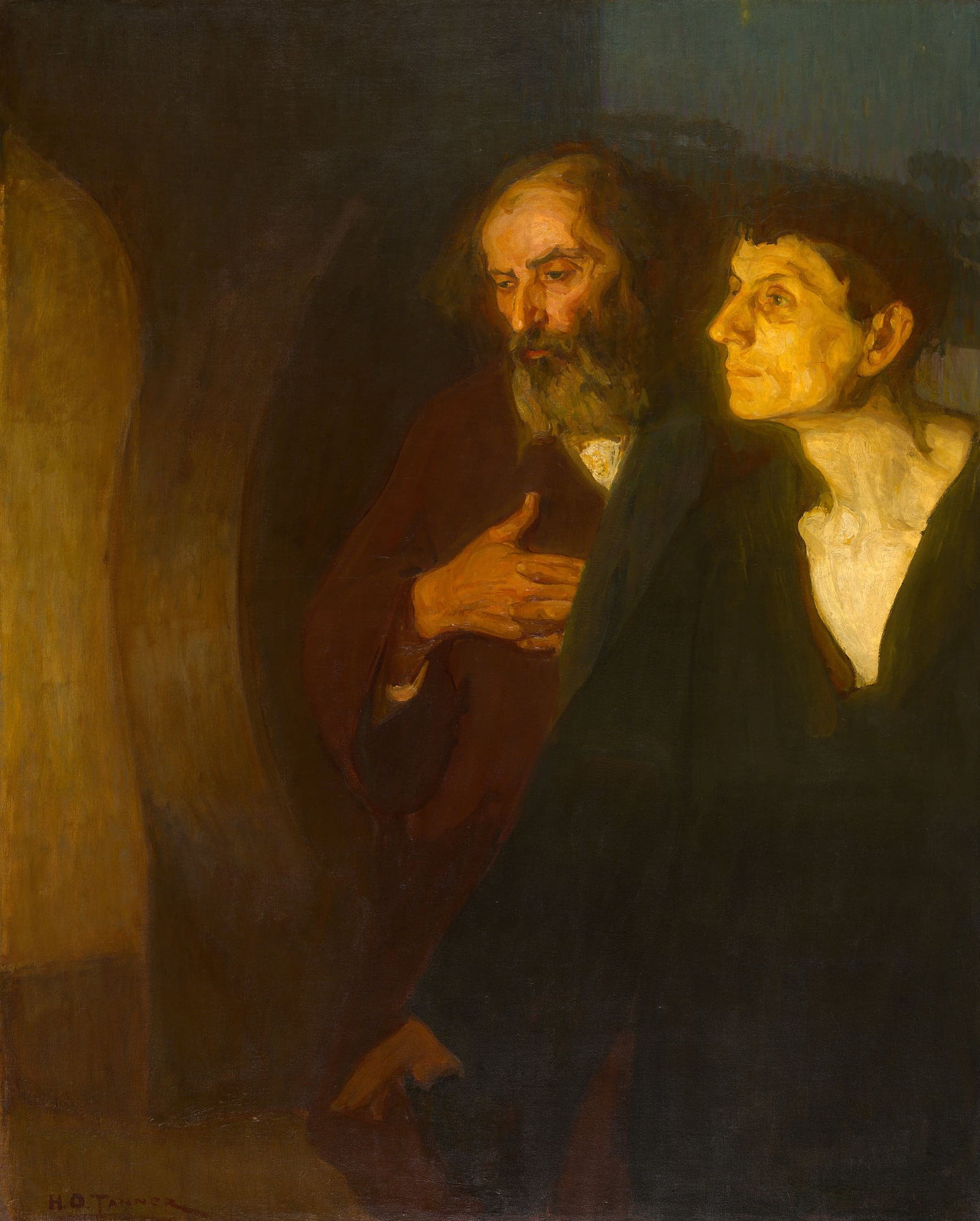
The Two Disciples at the Tomb
Two men stand side by side in the dark, looking into a light that falls from the left. The older one, bald and grey-bearded, clasps his hands and looks down; the younger one lifts his lit face towards the light. Henry Ossawa Tanner painted the scene in Paris around 1906, and the Art Institute of Chicago bought it from him that year after showing it in its annual exhibition of American art. It hangs in Gallery 273.
- c. 1906
- Oil on canvas
- Art Institute of ChicagoChicago, United States
About Henry Ossawa Tanner
What the painting shows
Two men fill the right two-thirds of a tall canvas, cut off at the waist by the bottom edge. Both look towards the left, where a band of golden light runs down the side of the picture. The older man, nearer the centre, has a bald crown, a long grey-brown beard and a furrowed brow. He wears a dark red robe and holds his hands clasped against his chest, his eyes cast down.
The younger man stands in front of him at the right, in a dark green robe over a white shirt open at the throat. His face, beardless and dark-haired, is turned up towards the light, which lays a flat yellow glow across his cheek, temple and neck. Everything else is brown, olive and black; the background is a bare wall in shadow.
The Art Institute of Chicago identifies the two as Peter and John at the empty tomb of Christ, from the Gospel of John. Lorinda Munson Bryant, writing in 1917, took the moment to be the one in which "that other disciple which came first to the sepulchre saw and believed".
The canvas is 129.5 by 105.7 centimetres, about fifty-one by forty-two inches, and is signed H.O. TANNER in brown paint at the lower left, on the ground.
Chicago, 1906
Henry Ossawa Tanner sent the painting from Paris to the Art Institute of Chicago's nineteenth annual exhibition of oil paintings and sculpture by American artists, which ran from 16 October to 29 November 1906. It was number 295 in the catalogue. The museum bought it directly from him the same year through the Robert A. Waller Fund and gave it the accession number 1906.300.
The Art Institute awarded it the Norman W. Harris prize, established that year with $500 for the best painting by an American artist in the annual exhibition, and bought it for the permanent collection. Dewey F. Mosby's 1991 catalogue quotes the citation: the prize was for the most impressive and distinguished work of art of the season. Two days after the exhibition opened, The Washington Post reported it under the headline Award for Negro Artist. The painting had been shown in Paris that summer at the American Art Students' Club, and it went to the Pennsylvania Academy of the Fine Arts in January 1907.
The picture went on to Henry Ossawa Tanner's exhibition of religious paintings at the American Art Galleries in New York in December 1908, as number 10. It was later lent to the Philadelphia Museum of Art's retrospective of 1991 and to Across Continents and Cultures at the Nelson-Atkins Museum of Art in Kansas City in 1995.
Paris around 1906
By 1906 Henry Ossawa Tanner had lived in France for fifteen years. He had married Jessie Macauley Olssen in 1899, their son Jesse Ossawa Tanner was born in 1903, and the family divided its time between Paris and Trépied, near Étaples on the Channel coast. In May 1906 the Salon gave a second-class medal to his Disciples at Emmaus, which the French government bought for the Luxembourg, and he was made hors concours, free to show at the Salon without passing the jury. Dewey F. Mosby calls the medal the highest recognition the jury could give him, since the first-class medal was reserved for French artists.
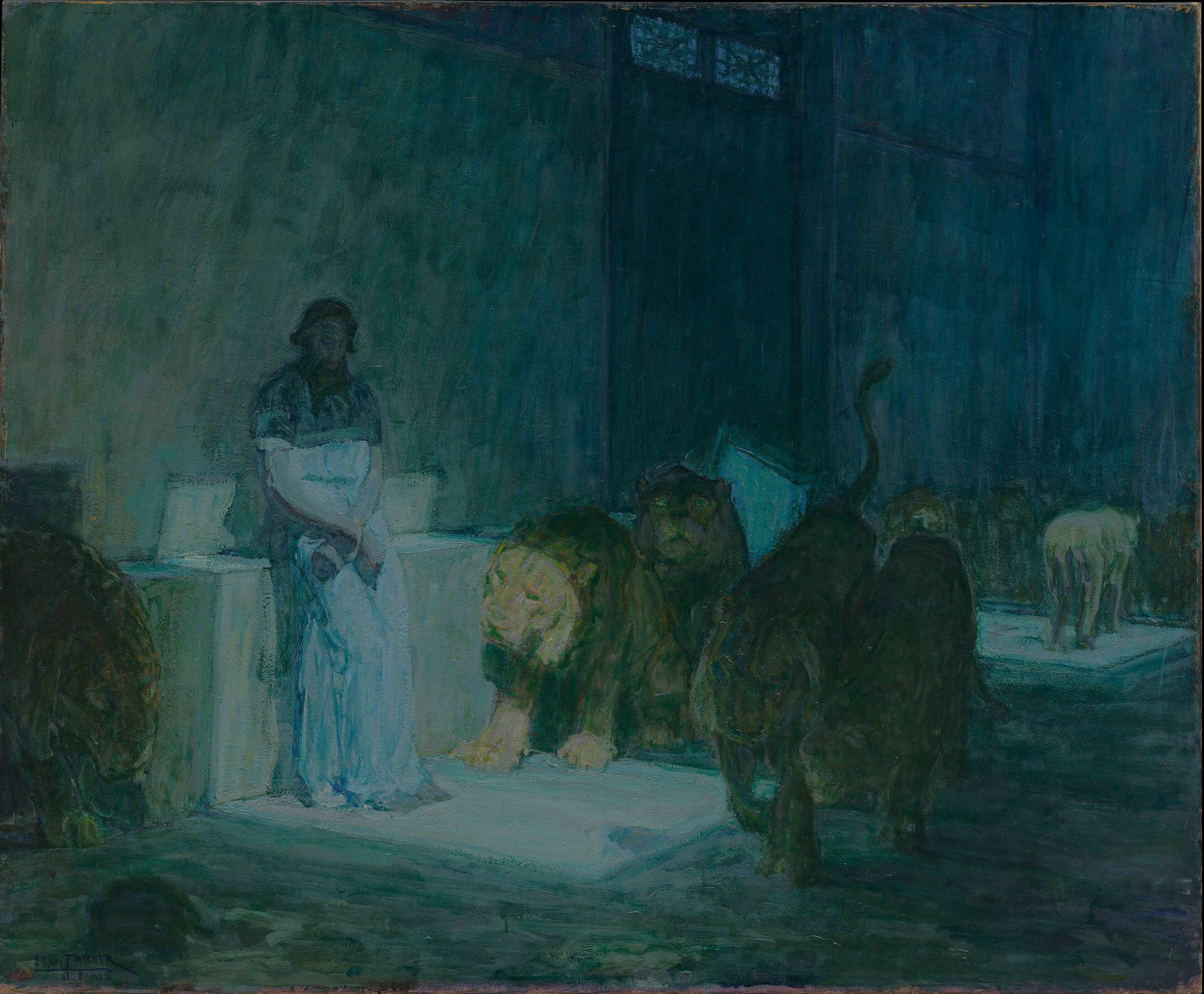
The Los Angeles County Museum of Art, writing about his Daniel in the Lions' Den, describes the style of these years. Colour and light were used to evoke the essence of a religious story, and experiments in pigments and glazing from about 1907 gave his pictures a soft, glowing light. The Two Disciples at the Tomb comes from the start of that period.
The Art Institute's record gives Paris as the place of origin and reads the picture through its two faces: "The bearded Peter looks downward with a somber gaze, but John appears transfixed, his face bathed in a golden light that signifies the presence of Christ's spirit." It adds that Henry Ossawa Tanner, the son of an African Methodist Episcopal minister, was perhaps the most renowned American painter of religious works at the turn of the century. He had moved to France in 1891, the record says, to escape the racism that limited his career at home. The art historian James A. Porter later called it a bold conception that depended, like a cinematic close-up, on the power of the human face to convey pathos. Porter called it the apogee of his religious paintings, in a passage Mosby quotes.
Close reading
Reading the work, detail by detail
Almost everything in the picture is dark except two faces and a band of light at the left. Close views take the lit face, the shadowed one, the clasped hands, the white shirt, the light itself and the signature.
1.John's face in the light
The light lands on his face flat, yellow and even, with almost no modelling. His eyes are open and his mouth is closed. The Art Institute of Chicago reads the golden light as signifying the presence of Christ's spirit.
2.Peter's face in shadow
He looks down, and the light reaches only the top of his head and the bridge of his nose. The furrow between his brows is the most worked passage of paint in the picture. Lorinda Munson Bryant, in 1917, took him for Peter.
3.Clasped hands
His hands are clasped high on his chest with the fingers interlaced. They are painted in the same orange-brown as his face, and they are the only other part of him the light finds.
4.The white shirt
The shirt is the brightest white in the picture, a wedge between the dark green robe and the lit neck. Henry Ossawa Tanner dressed his disciples plainly, in cloth that could be nineteenth-century as easily as ancient.
5.The light at the left edge
The source of the light is off the canvas, to the left, where the tomb would be. A band of gold runs down the edge in loose vertical strokes. Neither man is looking at anything the viewer can see.
6.A hand low in the picture
A third hand appears low in the canvas, fingers curled, against the dark red robe. It comes from the right, from the younger man's side, and reads most easily as John's right hand hanging at his side.
7.The signature on the ground
The museum records the inscription exactly: signed recto, bottom-left, on the ground, in brown paint, H.O. TANNER. It sits in the corner where the golden light meets the dark floor.
Timeline
c. 1906
Painted in Paris. Shown at the American Art Students' Club there in the summer of 1906.
1906
Shown as number 295 in the Art Institute of Chicago's nineteenth annual exhibition of American oil paintings and sculpture, 16 October to 29 November. Awarded the Norman W. Harris prize and bought from the artist through the Robert A. Waller Fund, 1906.300.
1907
Shown at the Pennsylvania Academy of the Fine Arts in January, with Return of the Holy Women.
1908
Number 10 in Religious Paintings by the Distinguished American Artist Mr. Henry O. Tanner at the American Art Galleries, New York, 15 to 25 December.
1991
Lent to the Henry Ossawa Tanner retrospective at the Philadelphia Museum of Art, which travelled to Detroit, Atlanta and San Francisco.
1995
Lent to Across Continents and Cultures: The Art and Life of Henry Ossawa Tanner at the Nelson-Atkins Museum of Art, Kansas City.
Where to see it
Art Institute of Chicago
111 South Michigan Avenue, Chicago, IL 60603, United States
On view in Gallery 273, according to the museum's record in September 2026.
Plan your visit on the museum’s official website (opens in a new tab)Frequently asked questions
Where is The Two Disciples at the Tomb?
At the Art Institute of Chicago, accession number 1906.300. As of September 2026 the museum lists it as on view in Gallery 273. It has belonged to the museum since 1906, when it was bought from the artist through the Robert A. Waller Fund.
Who are the two men in The Two Disciples at the Tomb?
Peter and John, according to the Art Institute of Chicago, at the empty tomb of Christ as described in the Gospel of John. The older, bearded man with clasped hands is Peter; the younger man with the lit face is John.
What moment does The Two Disciples at the Tomb show?
The two disciples looking into the empty tomb on Easter morning. Lorinda Munson Bryant, writing in 1917, read it as the moment in John's Gospel when the other disciple, who reached the tomb first, saw and believed.
Why is only one face lit in The Two Disciples at the Tomb?
The light comes from the left, from the direction of the tomb, and falls on the upturned face of the younger disciple, John, while Peter looks down in shadow. The Art Institute of Chicago reads the golden light as a sign of Christ's spiritual presence.
What prize did The Two Disciples at the Tomb win?
The Art Institute of Chicago's Norman W. Harris prize at its annual exhibition of American art in October 1906, a $500 award founded that year. Dewey F. Mosby's catalogue quotes the citation, for the most impressive and distinguished work of art of the season. The museum bought the painting at the same time.
How big is The Two Disciples at the Tomb?
129.5 by 105.7 centimetres, about fifty-one by forty-two inches, in oil on canvas. It is an upright picture, with the two figures cut off at the waist by the bottom edge.
When did the Art Institute of Chicago acquire The Two Disciples at the Tomb?
In 1906, the year it was shown in the museum's nineteenth annual exhibition of American art. The museum's provenance record reads simply: the artist; sold to the Art Institute of Chicago, 1906.
More by Henry Ossawa Tanner
If you like Henry Ossawa Tanner
Explore painters from the same movements and circles.
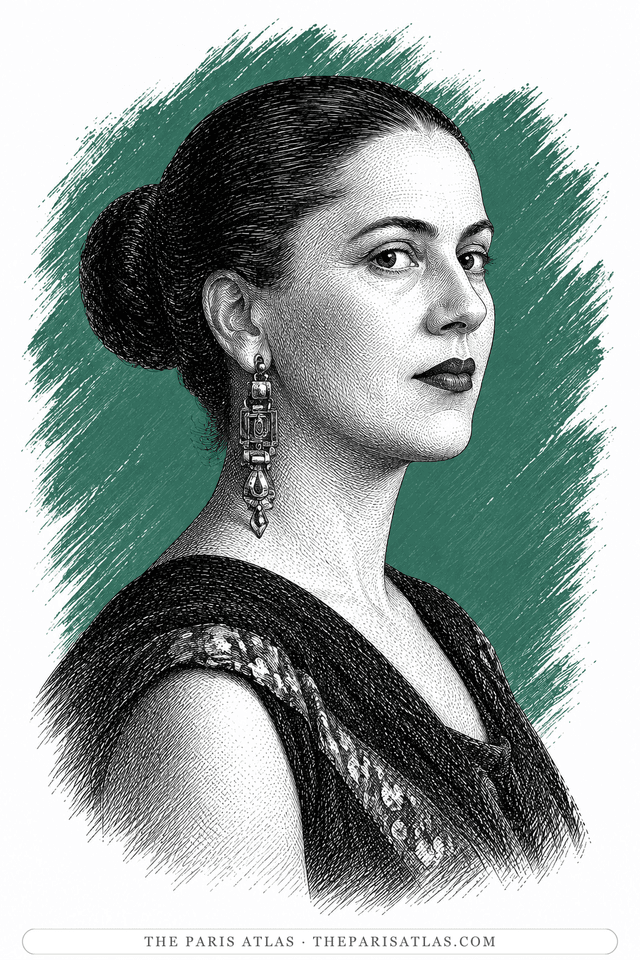
Tarsila do Amaral
Brazilian painter who spent the 1920s moving between São Paulo and Paris, studied Cubism under André Lhote, Albert Gleizes and Fernand Léger, and used what she learned to paint Brazilian towns, railways, plants and bodies. Her 1928 painting Abaporu prompted the manifesto that gave the Anthropophagic movement its name.
View artist
Arman
French-American artist, lifelong friend of Yves Klein, and a founder of New Realism.
View artist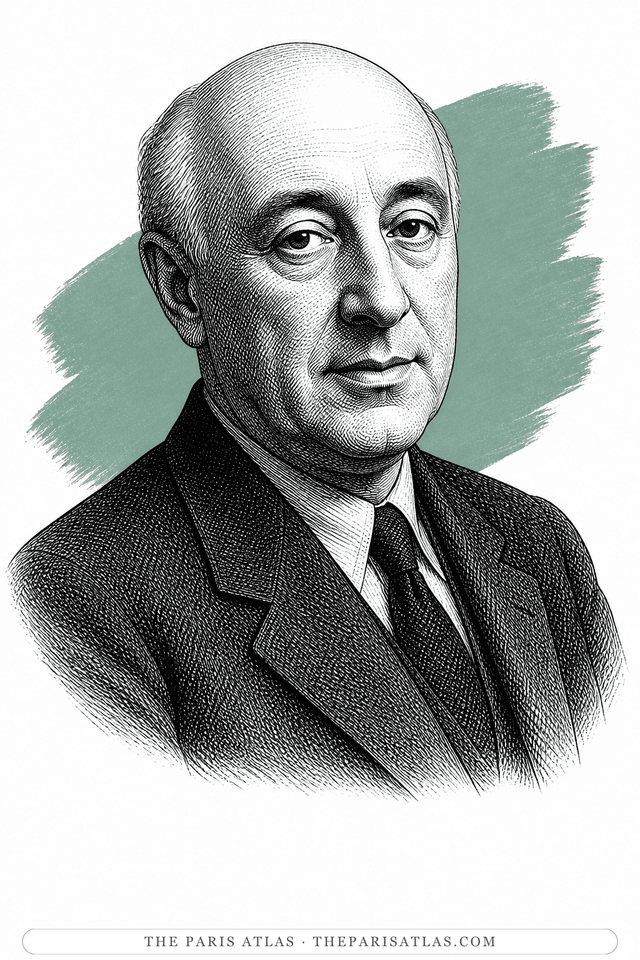
Jean Arp
Strasbourg-born sculptor and poet — Hans in German, Jean in French, both all his life — who co-founded Dada at the Cabaret Voltaire in 1916, composed collages by dropping torn paper 'according to the laws of chance', and settled at Meudon outside Paris in a house his wife Sophie Taeuber-Arp designed.
View artist
References
The sources below include collection records, catalogues, scholarly research, and primary materials that informed this page. They document The Two Disciples at the Tomb, its making, and its place in cultural history.


1The Two Disciples at the Tomb (Henry Ossawa Tanner, c. 1906) — Art Institute of Chicago
WebsiteArt Institute of ChicagoUsed forWeb source consulted for documented facts and historical context presented on the The Two Disciples at the Tomb page.

2Annual Report of the Art Institute of Chicago, 1906
Official recordArt Institute of Chicago, 1906Used forOfficial record used to verify names, dates, institutional details, or other factual information on this page.
3Henry Ossawa Tanner
Exhibition cataloguePhiladelphia Museum of Art; Rizzoli International Publications, New York, 1991Used forCatalogue scholarship used to verify attribution, provenance, chronology, and interpretive context for The Two Disciples at the Tomb.

4American Pictures and Their Painters
NonfictionJohn Lane Company, New York, 1917Used forPublished analysis and historical context used in preparing the The Two Disciples at the Tomb page.
5Daniel in the Lions' Den
WebsiteLos Angeles County Museum of ArtUsed forWeb source consulted for documented facts and historical context presented on the The Two Disciples at the Tomb page.
6Henry Ossawa Tanner Papers — Biographical Note
ArchiveArchives of American Art, Smithsonian InstitutionUsed forArchival evidence used to document the historical record connected to The Two Disciples at the Tomb.
7Henry Ossawa Tanner — artist biography
WebsiteNational Gallery of Art, WashingtonUsed forWeb source consulted for documented facts and historical context presented on the The Two Disciples at the Tomb page.
These references provide the documented foundation for this work's history and interpretation. Claim-level citations remain attached to the specific claims they support.
 Explore more resources