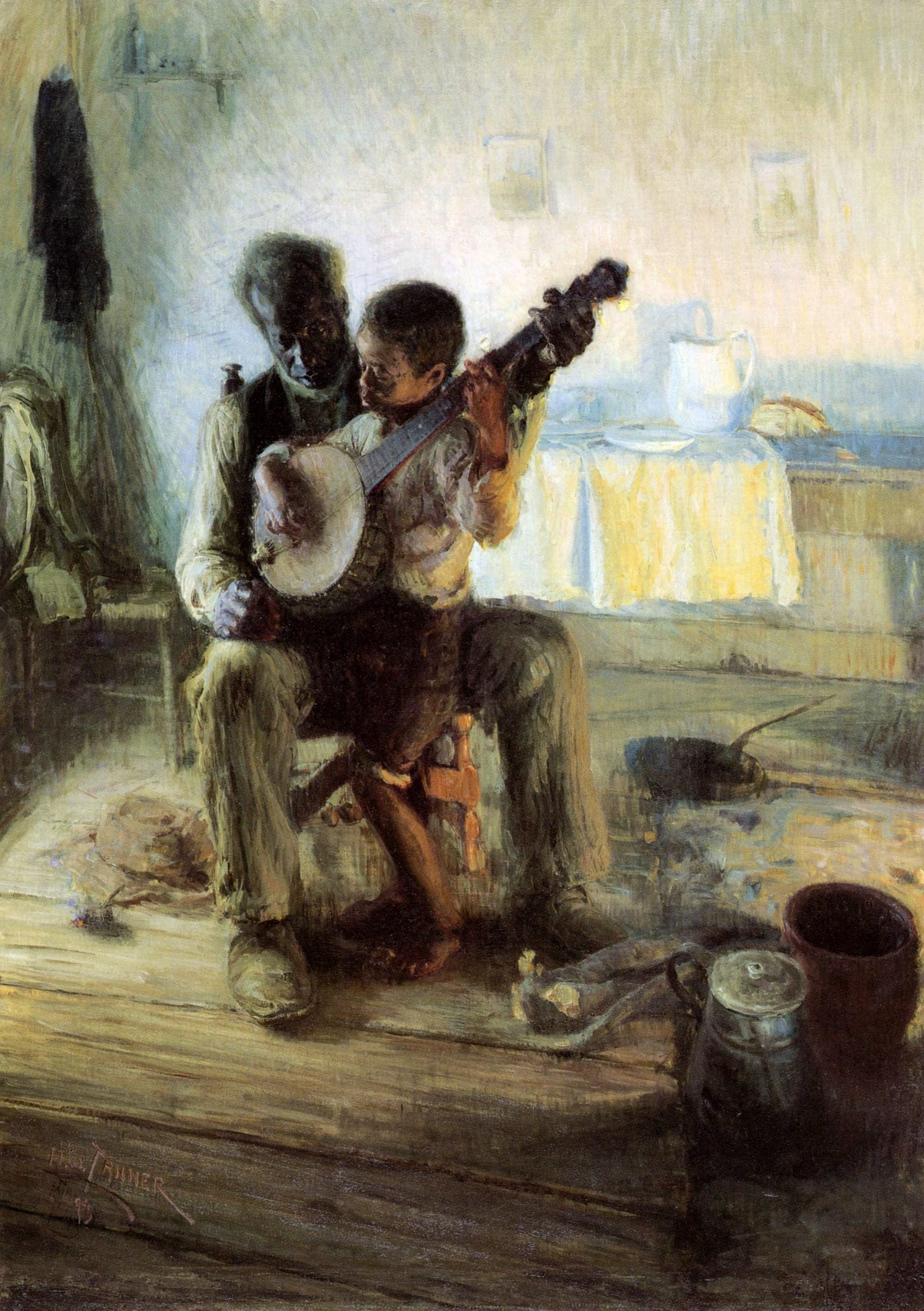
The Banjo Lesson
An old man sits on a wooden chair with a boy on his knee, steadying a banjo while the boy picks at the strings. Henry Ossawa Tanner painted it in 1893, and it is the best-known picture he made of Black American life before he turned to biblical subjects. It has belonged to Hampton University Museum in Virginia since 1894, when the trustee Robert C. Ogden gave it to the school.
- 1893
- Oil on canvas
- Hampton University MuseumHampton, Virginia, United States
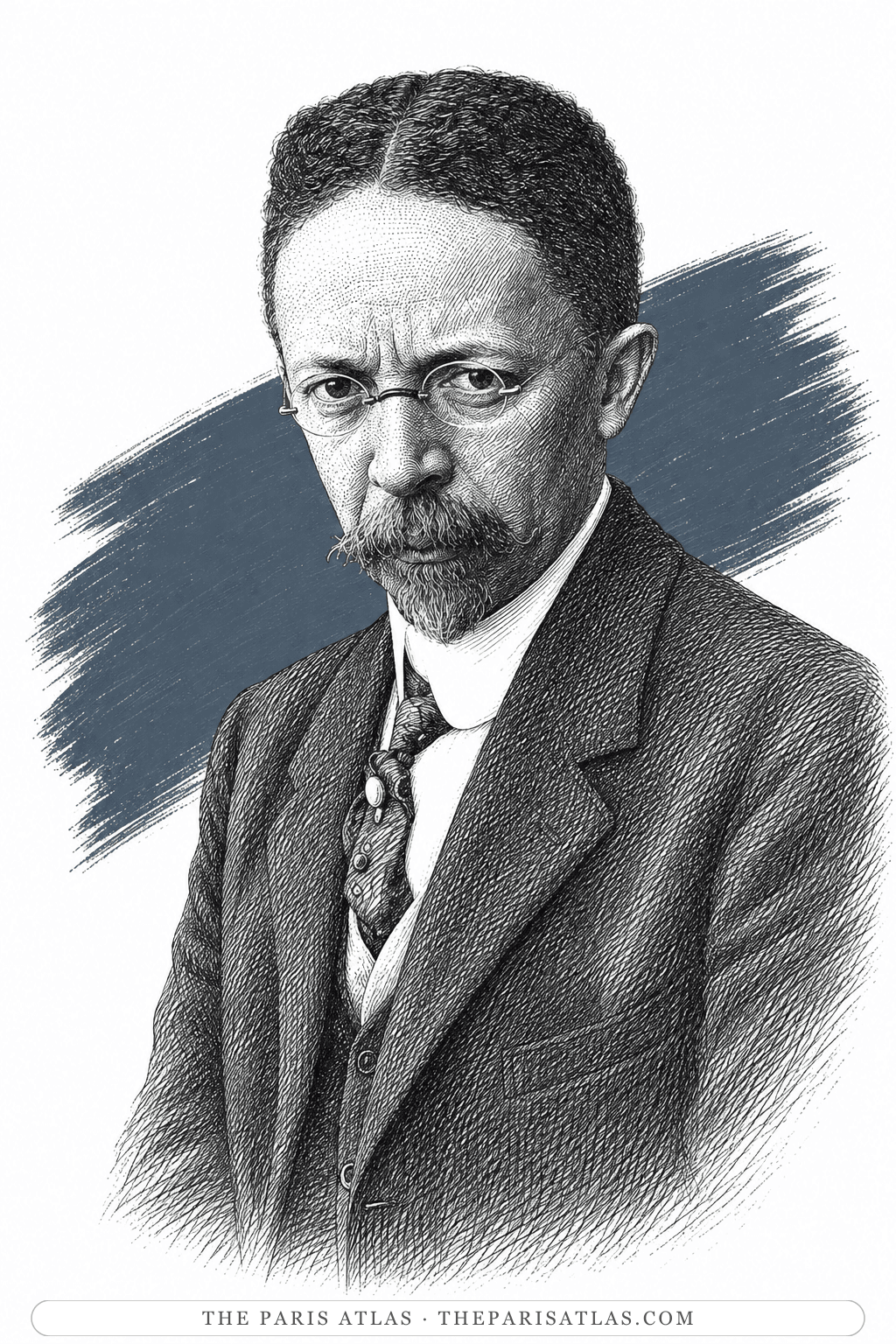
About Henry Ossawa Tanner
What the painting shows
An elderly man sits on a plain wooden chair in a bare room, a boy perched on his knee. The boy holds the neck of the banjo in his left hand and reaches across the strings with his right. The man's left hand cups the round body of the instrument from below, and he looks down at the boy's fingers. The boy looks down at the strings. He is barefoot, in a pale shirt and dark short trousers.
Two lights fall on the room. A cool blue-white light washes the wall behind the figures and the man's shirt, and a warm yellow light from the right, outside the picture, lands on the tablecloth and the floorboards. On the table stand a white jug, a plate and a loaf. Two small pictures are pinned to the wall, a dark coat hangs from a nail at the upper left, and a shelf above it holds a bottle and some jars.
The floor is crowded with the things of a working household. At the right, on the hearth, are an iron skillet with a long handle, a lidded tin coffee pot and a tall stoneware crock, with a bundle of cloth beside them. At the left a crumpled felt hat lies on its side, and next to it a pipe, its bowl giving off a flicker of blue and orange flame. Dewey F. Mosby's 1991 catalogue lists these objects the same way. Henry Ossawa Tanner signed the canvas H.O. Tanner 93 at the lower left.
The painting is oil on canvas, 124.5 by 90.2 centimetres, about forty-nine by thirty-five inches.
Highlands, Philadelphia and Harper's Young People
Henry Ossawa Tanner had spent the summer of 1888 at Highlands, North Carolina, in the Blue Ridge Mountains, trying to make a living with a camera. The Smithsonian American Art Museum records that he may have made sketches and photographs there of the region and its Black residents, and that some were later used in his most important early paintings.
He dated the canvas 1893. That year he was back in the United States, recovering in Philadelphia from typhoid fever caught in Paris, and in Chicago he read a paper called "The American Negro in Art" to the World's Congress on Africa. The painting was first shown in October 1893 at Earle's Galleries on Chestnut Street in Philadelphia, under the title The First Lesson. Dewey F. Mosby's catalogue quotes the Christian Recorder of 5 October, which found the life-size picture surrounded by a large crowd. The Smarthistory essay by Farisa Khalid traces the composition to photographs and an illustration he made in 1893 for the magazine Harper's Young People. The illustration accompanied Ruth McEnery Stuart's story "Uncle Tim's Compromise on Christmas", in which an old man gives his banjo to his grandson.
The catalogue of the Paris Salon of 1894 lists one painting by Henry Ossawa Tanner, number 1710, under the title La Leçon de musique. Dewey F. Mosby's catalogue identifies that entry as The Banjo Lesson and records that from 1894 to 1914 he showed at the Salon every year. The National Gallery of Art in Washington records that one of his paintings was accepted at that Salon after his return to Paris in 1894.
Hampton, since 1894
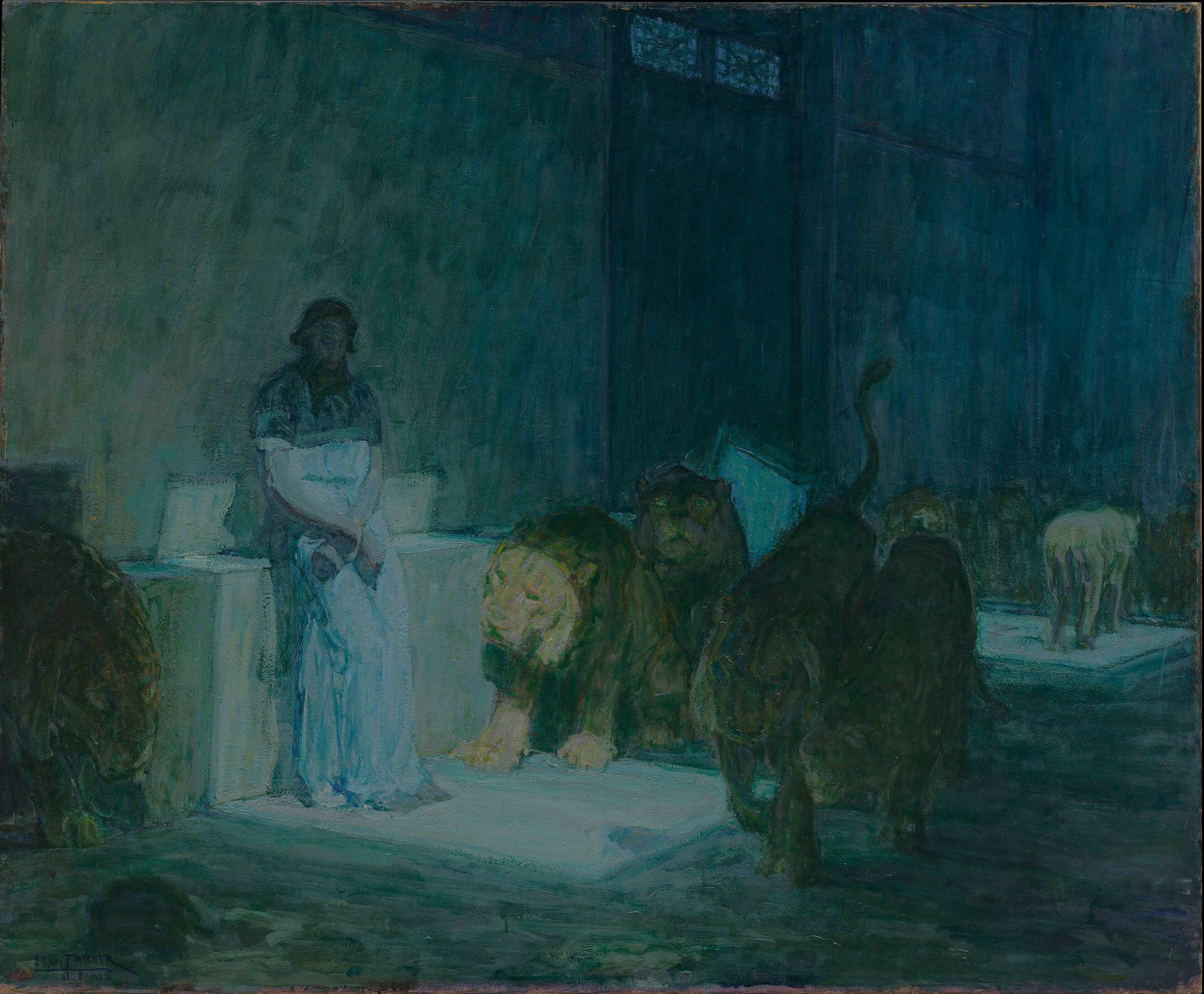
Robert C. Ogden, a trustee of what was then the Hampton Normal and Agricultural Institute in Virginia, gave the painting to the school in November 1894. Dewey F. Mosby's chronology describes him as an early Philadelphia benefactor of the painter and a partner in the Wanamaker firm. In May that year Henry Ossawa Tanner had attended Hampton's commencement in Ogden's company, when Ogden gave the institute a second Tanner canvas, Lion's Head. Hampton University Museum dates its collection of African American fine art, which it calls the world's first, from those two gifts, and describes The Banjo Lesson as the most admired work by an African American artist.
The museum publishes no online object record for the painting. Its galleries are on the university campus in Hampton, Virginia.
How it has been read
Farisa Khalid's Smarthistory essay reads the play of warm and cool light as the picture's argument: the boy in the glow of the fire, the old man in cool shadow, one generation's success built on the last. It also sets the painting against the banjo player of the minstrel show, a stock caricature of the 1890s, and against the earlier banjo pictures of William Sidney Mount and Thomas Eakins, who had taught Henry Ossawa Tanner in Philadelphia.
The essay points to older models too: Domenico Ghirlandaio's An Old Man and His Grandson at the Louvre, Johannes Vermeer's Woman with a Lute, and the peasant scenes of Jean-François Millet that Henry Ossawa Tanner had seen in France.
The National Gallery of Art records that after he returned to Paris in 1894 he abandoned genre works focusing on Black subjects and began painting the biblical scenes for which he became best known.
Close reading
Reading the work, detail by detail
The picture is quiet and the light does the work. Close views follow the two heads, the hands on the banjo, the table lit by the fire, the objects on the floor and the signature dated 93.
1.Two heads, both looking down
The man's face is in the cool shadow of the room and the boy's is turned down towards the strings. Neither looks at the viewer. Farisa Khalid's Smarthistory essay reads the shadow on the old man and the glow on the boy as the painting's argument about generations.
2.The boy's hand on the neck
The boy holds the neck near the pegs, his arm at full stretch. The instrument is nearly as long as he is tall, and the pegs catch a spark of the warm light from the right.
3.The man's hand under the banjo
The old man takes the weight. His left hand cups the drum from below so the boy's hands are free for the strings. The Smarthistory essay reads the gesture as a teacher holding the instrument up without playing it for the pupil.
4.The table in firelight
The warm light comes from the right, outside the picture, and it is warmest on the tablecloth. A white jug, a plate and a loaf stand on the table. Two small pictures are pinned to the wall above it, painted so thinly that they nearly dissolve into the plaster.
5.Pots on the floor
The right-hand corner holds the kitchen, on the hearth: a tin coffee pot with a lid, a tall stoneware crock, an iron skillet with a long handle and a bundle of cloth, as Dewey F. Mosby's catalogue lists them. The firelight lands on the boards between them. Nothing here is decorative, and the paint is loose and quick.
6.A hat and a pipe
A felt hat lies on its side on the boards, and beside it a pipe, its bowl giving off a flicker of blue and orange flame. Dewey F. Mosby's catalogue lists them as a hat and pipe on the floor at left, opposite the skillet, crock and coffee pot on the hearth. It is the only open flame in a room lit by a fire the viewer cannot see.
7.Signed and dated 93
Henry Ossawa Tanner signed the boards at the lower left and dated the picture 93. He was in the United States that year, recovering from typhoid fever, and the canvas went to the Paris Salon the following spring.
Timeline
1888
Henry Ossawa Tanner spends the summer at Highlands, North Carolina, in the Blue Ridge Mountains, working with a camera.
1891
Sails for Europe in January and settles in Paris to study at the Académie Julian.
1893
Painted and dated. Henry Ossawa Tanner is in the United States that year, convalescing from typhoid fever, and reads a paper on the American Negro in art in Chicago.
1893
First shown in October at Earle's Galleries on Chestnut Street, Philadelphia, as The First Lesson.
1893
An illustration of an old man teaching a boy the banjo appears with Ruth McEnery Stuart's story in Harper's Young People in December.
1894
Listed at the Paris Salon in May as number 1710, La Leçon de musique, the first of the annual Salon showings Henry Ossawa Tanner kept up until 1914.
1894
Given to the Hampton Normal and Agricultural Institute in November by its trustee Robert C. Ogden, who had given Lion's Head in May.
Where to see it
Hampton University Museum
200 William R. Harvey Way, Hampton University, Hampton, VA 23668, United States
On the university campus; enter by the main gate off William R. Harvey Way. Open Monday to Friday and Saturday afternoons, closed Sundays. The museum publishes no online display status for individual works, so confirm before travelling.
The museum publishes no online object record or display status for the painting. Confirm with the museum before travelling to see it.
Plan your visit on the museum’s official website (opens in a new tab)Frequently asked questions
Where is The Banjo Lesson by Henry Ossawa Tanner?
At Hampton University Museum in Hampton, Virginia, which has owned it since 1894. The museum publishes no online record of the painting or its display status, so contact it before travelling to see the picture.
Who are the man and the boy in The Banjo Lesson?
The painting does not name them, and the museum publishes no identification. The Smithsonian American Art Museum records that Henry Ossawa Tanner may have sketched and photographed Black residents of the Blue Ridge Mountains at Highlands, North Carolina, in 1888, and used such studies in his early paintings.
When was The Banjo Lesson painted?
In 1893; the signature at the lower left is dated 93. Henry Ossawa Tanner spent that year in the United States, recovering from typhoid fever, and the Smarthistory essay on the painting links it to an illustration he made for Harper's Young People the same year.
Was The Banjo Lesson shown at the Paris Salon?
Yes, in May 1894. The catalogue lists Henry Ossawa Tanner with one painting, number 1710, La Leçon de musique, which Dewey F. Mosby's catalogue identifies as The Banjo Lesson. It was his first Salon showing, and he exhibited there every year until 1914.
Why is The Banjo Lesson important?
Hampton University Museum calls it the most admired work by an African American artist, and its 1894 acquisition began the museum's collection of African American fine art. It shows a banjo, an instrument the minstrel shows of the 1890s used for caricature, as the centre of a patient lesson between an old man and a boy.
How big is The Banjo Lesson?
124.5 by 90.2 centimetres, about forty-nine by thirty-five inches, in oil on canvas. It is upright, with the two figures filling the lower two-thirds.
What is in the room in The Banjo Lesson?
A wooden chair, a table with a white cloth, a white jug, a plate and a loaf, two small pictures and a shelf on the wall, and a coat on a nail. On the hearth at the right are an iron skillet, a lidded tin coffee pot and a stoneware crock, with a bundle of cloth beside them. At the left a felt hat lies on the floor with a pipe beside it, a flicker of flame at its bowl.
More by Henry Ossawa Tanner
If you like Henry Ossawa Tanner
Explore painters from the same movements and circles.
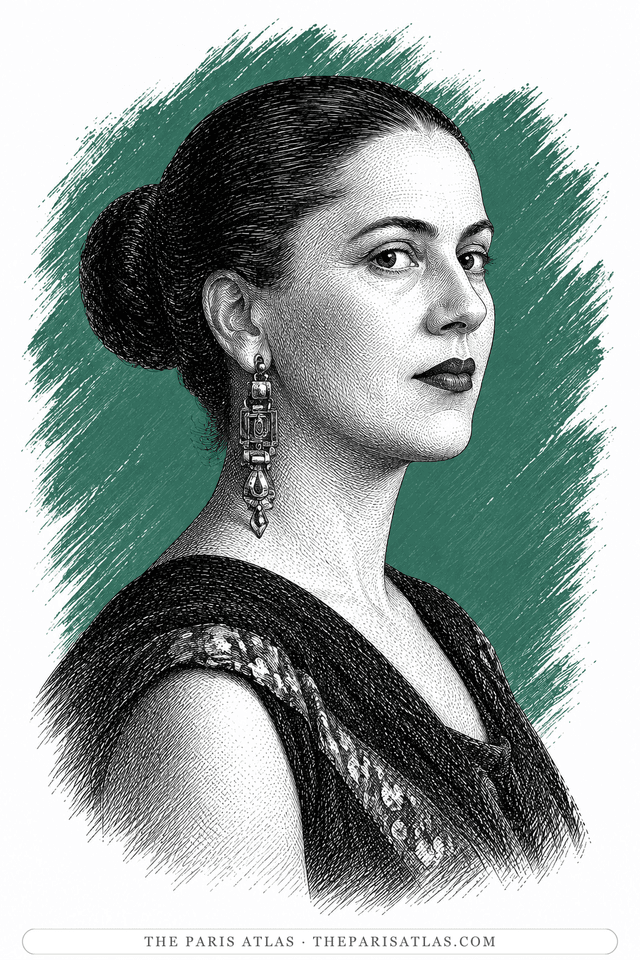
Tarsila do Amaral
Brazilian painter who spent the 1920s moving between São Paulo and Paris, studied Cubism under André Lhote, Albert Gleizes and Fernand Léger, and used what she learned to paint Brazilian towns, railways, plants and bodies. Her 1928 painting Abaporu prompted the manifesto that gave the Anthropophagic movement its name.
View artist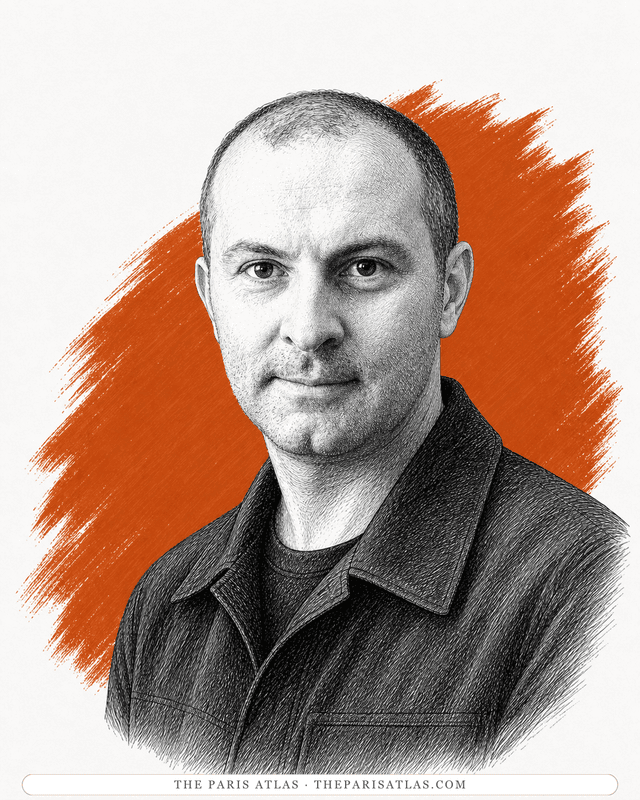
Arman
French-American artist, lifelong friend of Yves Klein, and a founder of New Realism.
View artist
Jean Arp
Strasbourg-born sculptor and poet — Hans in German, Jean in French, both all his life — who co-founded Dada at the Cabaret Voltaire in 1916, composed collages by dropping torn paper 'according to the laws of chance', and settled at Meudon outside Paris in a house his wife Sophie Taeuber-Arp designed.
View artist
References
The sources below include collection records, catalogues, scholarly research, and primary materials that informed this page. They document The Banjo Lesson, its making, and its place in cultural history.

1About Us — A Brief History
WebsiteHampton University MuseumUsed forWeb source consulted for documented facts and historical context presented on the The Banjo Lesson page.
2Collection History
WebsiteHampton University MuseumUsed forWeb source consulted for documented facts and historical context presented on the The Banjo Lesson page.
3Henry Ossawa Tanner, The Banjo Lesson
WebsiteSmarthistoryUsed forWeb source consulted for documented facts and historical context presented on the The Banjo Lesson page.

4Catalogue illustré de peinture et sculpture, Salon de 1894
Exhibition catalogueSociété des artistes français; Ludovic Baschet, Paris, 1894Used forCatalogue scholarship used to verify attribution, provenance, chronology, and interpretive context for The Banjo Lesson.
5Henry Ossawa Tanner
Exhibition cataloguePhiladelphia Museum of Art; Rizzoli International Publications, New York, 1991Used forCatalogue scholarship used to verify attribution, provenance, chronology, and interpretive context for The Banjo Lesson.
6Henry Ossawa Tanner — artist biography
WebsiteNational Gallery of Art, WashingtonUsed forWeb source consulted for documented facts and historical context presented on the The Banjo Lesson page.
7Henry Ossawa Tanner
WebsiteSmithsonian American Art MuseumUsed forWeb source consulted for documented facts and historical context presented on the The Banjo Lesson page.
8The Story of an Artist's Life, II: Recognition
MemoirThe World's Work, vol. 18, no. 3 (July 1909), pp. 11769–11775, 1909Used forFirst-person evidence and historical context used in preparing the The Banjo Lesson page.
These references provide the documented foundation for this work's history and interpretation. Claim-level citations remain attached to the specific claims they support.
 Explore more resources