Daniel in the Lions' Den
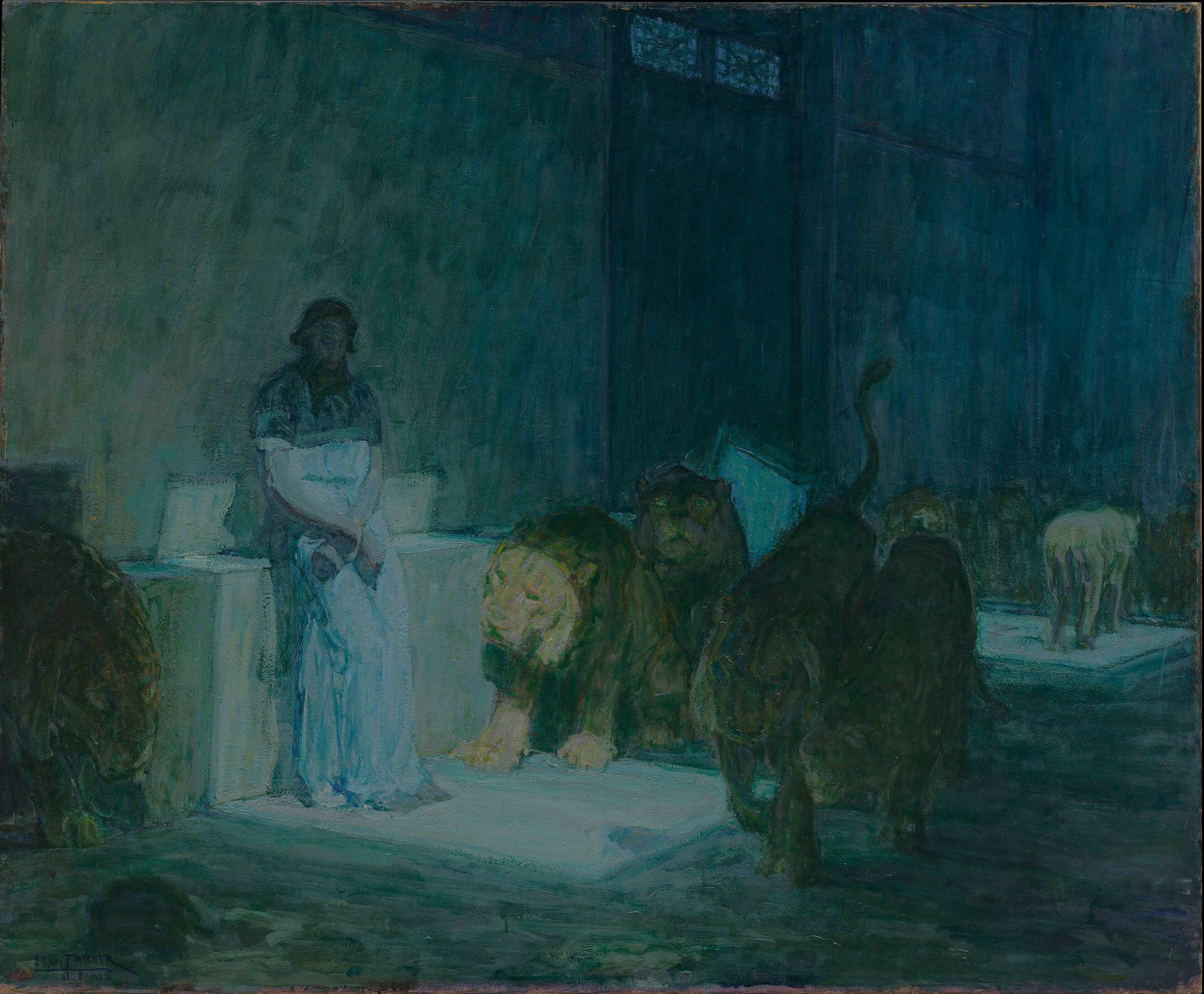
Daniel stands with his hands bound in a pool of pale light while lions pace and lie in the blue-green dark around him. Henry Ossawa Tanner painted this version in Paris between about 1907 and 1918, more than a decade after the Daniel in the Lions' Den that won him an honourable mention at the Salon of 1896. The Los Angeles County Museum of Art has owned it since 1922 and records that it is often mistaken for the earlier picture.
- 1907–1918
- Oil on paper mounted on canvas
- Los Angeles County Museum of ArtLos Angeles, United States
About Henry Ossawa Tanner
What the painting shows
The whole picture is painted in blue and green. Daniel stands at the left in a white robe with a dark garment over his shoulders, his hands bound in front of him and his head bent. His face is a few dark strokes. A shaft of light from a small grilled window high in the wall at the upper right falls on the lower half of his body and spreads across the floor in a pale rectangle.
Six lions can be made out. The nearest crouches at the centre facing the viewer, its mane lit yellow-green; a second lion behind it turns its head with two glinting eyes; two more walk away into the dark at the right, one with its tail raised. A pale lion stands on a stone ledge at the far right, and a dark one lies at the left edge with its head down. The museum notes that the lions are sketched in shades of yellow, green and lavender within an overall tonal scheme.
The canvas is 104.46 by 126.84 centimetres, about forty-one by fifty inches. Henry Ossawa Tanner signed it H.O. Tanner at the lower left and wrote Paris beneath his name.
The Salon picture of 1896
Henry Ossawa Tanner wrote in 1909 that he painted Daniel in the Lions' Den in 1895, modelling lions at the Jardin des Plantes and working in the summer class of the animal sculptor Emmanuel Frémiet. He showed Frémiet a sketch, and was told that everything depended on how he developed it: done well it would be a good picture, "and, if not, why, it will be a very ordinary one."
The painting was shown at the Salon of 1896 as Daniel dans la fosse aux lions and received an honourable mention, which Henry Ossawa Tanner called his first official recognition. The illustrated Salon catalogue reproduces it on page 71; in that reproduction Daniel lifts his head and looks upward, where the later version bends it. The Los Angeles County Museum of Art describes the first version as a vertical composition, half of it taken up by the shadowy, high-ceilinged structure above Daniel's head, with an elaborate Assyrian frieze. It went on to the Art Institute of Chicago that October, the Pennsylvania Academy in December and the International Art Exhibition in Munich in the summer of 1897.
The National Gallery of Art in Washington lists the 1896 canvas as location unknown, and Dewey F. Mosby's 1991 catalogue reproduces it from an old photograph with the same note. The Los Angeles museum states that its own painting has often been mistaken for the one shown at the Salon, and that it is a similar but later version.
A second version, on paper
The museum dates the second version to the years before the First World War, possibly as early as 1907, and states that although it is painted on paper it was made as an independent picture rather than a sketch. In 1976 conservators found an unfinished oil on the canvas used to back it, possibly a scene from the life of Job, dated on style to the late 1890s or early 1900s.
Henry Ossawa Tanner kept the scene but changed the format. The museum's notes record that he removed the ceiling to concentrate on the figure and enlarged the lit area to show more of the prisoner. He also dropped the frieze, which suited the academic taste of the 1890s rather than his mature style. It reads Daniel as calm, strengthened by his inner belief, and the blue-green palette as heightening that mood.
The museum links the dark cell lit from a high window to Jean-Paul Laurens, one of Henry Ossawa Tanner's teachers at the Académie Julian. Laurens's Grand Inquisiteur chez les rois catholiques of 1886 is also a painting about an unjust imprisonment. He owned a reproduction of it and kept it all his life; it survives among his papers.
How it reached Los Angeles
The artist kept the painting until 1918, when he sold it to William Preston Harrison and Ada Maria Harrison of Los Angeles. They gave it to the city's museum in 1922 as part of the Mr. and Mrs. William Preston Harrison Collection, and it carries the accession number 22.6.3. As of September 2026 the museum lists it as not on view.
A painting called Daniel in the Lions' Den appeared under Henry Ossawa Tanner's name at five shows between 1896 and 1914. They were the Pennsylvania Academy's annual show of 1896–97, the Pan-American Exposition at Buffalo in 1901 and the Louisiana Purchase Exposition at St Louis in 1904. Then came his 1908 show at the American Art Galleries in New York and the Anglo-American Exposition in London in 1914. The museum thinks the last two probably showed this version. It adds that the reviews are not specific enough to be sure.
Close reading
Reading the work, detail by detail
The picture is one colour and very little light, so the close views go where the light is: Daniel's bound hands, his face, the lion that faces the viewer, the eyes behind it, the window the light comes from, and the signature that says Paris.
1.Bound hands in the light
The light falls on the lower half of the figure and especially, the museum notes, on the bound hands. They are crossed at the wrist in front of the white robe. Above them the dark garment and the face stay in shadow.
2.Daniel's face
The face is a few dark strokes on a shadowed oval, the head bent forward. The museum reads him as calm, strengthened by his inner belief; the picture gives the face almost no features to read.
3.The lion that faces out
The nearest lion faces the viewer, its mane lit yellow-green with touches of lavender, its paws on the edge of the lit floor. The museum notes that the lions are sketched in brilliant shades of yellow, green and lavender inside the tonal scheme.
4.Eyes in the dark
Behind the first lion a second turns its head, and two small pale-green points mark its eyes. A pale stone block stands on end behind it. It is the only lion in the picture that seems to be looking at anything.
5.The window the light comes from
Two small grilled panes high in the wall at the upper right are the only opening in the den. The museum's notes describe the cell as dramatically lit by evening light through a high window, and link the device to Jean-Paul Laurens's painting of an unjust imprisonment.
6.Lions walking away
Two lions walk away into the dark at the right, one with its tail up. A paler lion stands on a stone ledge at the far right, painted in the same blue-white as the lit floor. None of them is looking at Daniel.
7.Signed in Paris
Henry Ossawa Tanner signed the picture at the lower left and wrote Paris under his name. The museum's record gives the place made as the United States; the signature places the work in Paris, where he lived.
Timeline
1895
Henry Ossawa Tanner paints the first Daniel in the Lions' Den in Paris, after modelling lions at the Jardin des Plantes and studying with Emmanuel Frémiet.
1896
The first version wins an honourable mention at the Paris Salon and is reproduced on page 71 of the illustrated catalogue. Its whereabouts are now unknown.
1907–18
The second version is painted in Paris, in oil on paper, over an earlier unfinished canvas.
1918
Sold by the artist to William Preston Harrison and Ada Maria Harrison of Los Angeles.
1922
Given to the museum in Los Angeles with the Harrison collection, 22.6.3.
1976
Conservators find an unfinished oil, possibly a scene from the life of Job, on the backing canvas.
Where to see it
Los Angeles County Museum of Art
5905 Wilshire Boulevard, Los Angeles, CA 90036, United States
Closed on Wednesdays. The museum's collection records state whether a work is on view; check the record before travelling for one painting.
Not on view, according to the museum's record in September 2026.
Plan your visit on the museum’s official website (opens in a new tab)Frequently asked questions
Where is Daniel in the Lions' Den by Henry Ossawa Tanner?
The later version is at the Los Angeles County Museum of Art, accession number 22.6.3, which lists it as not on view as of September 2026. The first version, shown at the Paris Salon of 1896, is recorded by the National Gallery of Art as location unknown.
Is this the painting that won an honourable mention at the 1896 Salon?
No. The Los Angeles County Museum of Art states that its painting has often been mistaken for the Salon picture but is a similar, later version, made possibly as early as 1907 and sold by the artist in 1918. The 1896 canvas is unlocated.
How is the later Daniel in the Lions' Den different from the first?
The museum records that Henry Ossawa Tanner removed the high, shadowy ceiling of the first version to concentrate on the figure, enlarged the lit area to show more of Daniel, and dropped an elaborate Assyrian frieze. The first version was upright; the second is wider than it is tall.
Why is Daniel in the Lions' Den painted in blue and green?
The Los Angeles County Museum of Art reads the blue-green palette as heightening a meditative mood, with Daniel calm and strengthened by his belief. It links the glowing colour to experiments with pigments and glazing that Henry Ossawa Tanner began around 1907.
How did Henry Ossawa Tanner study the lions?
He wrote in 1909 that for the first version, in 1895, he modelled lions at the Jardin des Plantes in Paris and worked in the summer class of the animal sculptor Emmanuel Frémiet. Both were within reach of his Paris studio.
How big is Daniel in the Lions' Den, and what is it painted on?
104.46 by 126.84 centimetres, about forty-one by fifty inches, in oil on paper mounted on canvas. The museum states that the paper support does not make it a sketch: it was made as an independent second version.
More by Henry Ossawa Tanner
If you like Henry Ossawa Tanner
Explore painters from the same movements and circles.
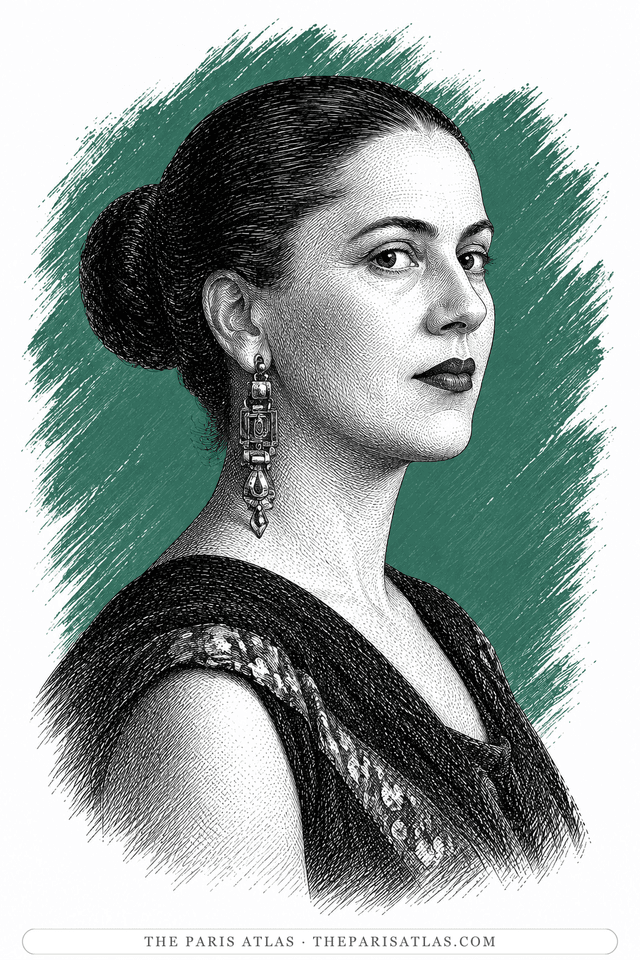
Tarsila do Amaral
Brazilian painter who spent the 1920s moving between São Paulo and Paris, studied Cubism under André Lhote, Albert Gleizes and Fernand Léger, and used what she learned to paint Brazilian towns, railways, plants and bodies. Her 1928 painting Abaporu prompted the manifesto that gave the Anthropophagic movement its name.
View artist
Arman
French-American artist, lifelong friend of Yves Klein, and a founder of New Realism.
View artist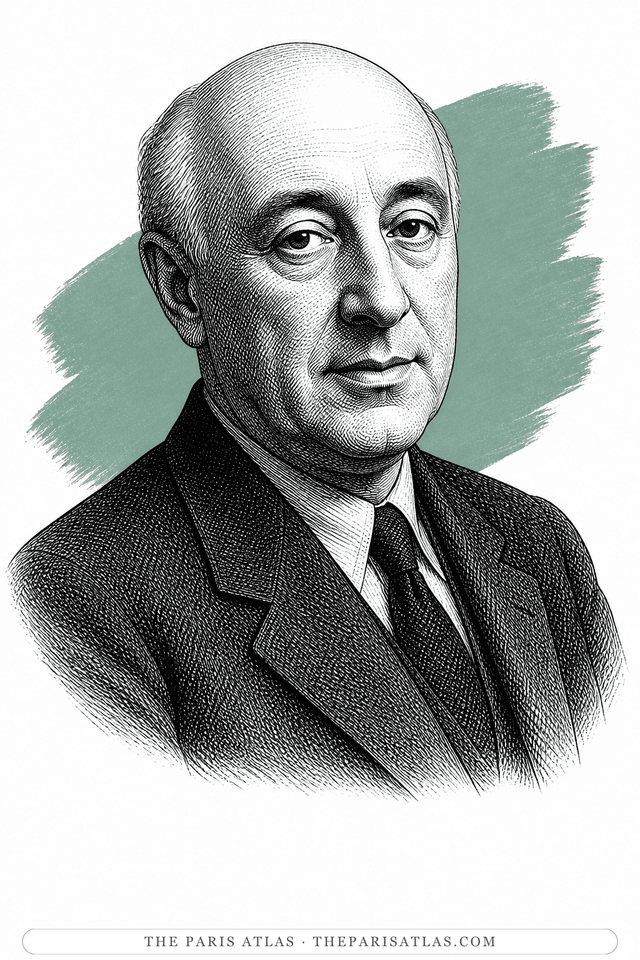
Jean Arp
Strasbourg-born sculptor and poet — Hans in German, Jean in French, both all his life — who co-founded Dada at the Cabaret Voltaire in 1916, composed collages by dropping torn paper 'according to the laws of chance', and settled at Meudon outside Paris in a house his wife Sophie Taeuber-Arp designed.
View artist
References
The sources below include collection records, catalogues, scholarly research, and primary materials that informed this page. They document Daniel in the Lions' Den, its making, and its place in cultural history.


1Daniel in the Lions' Den
WebsiteLos Angeles County Museum of ArtUsed forWeb source consulted for documented facts and historical context presented on the Daniel in the Lions' Den page.
2The Story of an Artist's Life, II: Recognition
MemoirThe World's Work, vol. 18, no. 3 (July 1909), pp. 11769–11775, 1909Used forFirst-person evidence and historical context used in preparing the Daniel in the Lions' Den page.

3Catalogue illustré de peinture et sculpture, Salon de 1896
Exhibition catalogueSociété des artistes français; Ludovic Baschet, Paris, 1896Used forCatalogue scholarship used to verify attribution, provenance, chronology, and interpretive context for Daniel in the Lions' Den.
4Henry Ossawa Tanner
Exhibition cataloguePhiladelphia Museum of Art; Rizzoli International Publications, New York, 1991Used forCatalogue scholarship used to verify attribution, provenance, chronology, and interpretive context for Daniel in the Lions' Den.
5Henry Ossawa Tanner — artist biography
WebsiteNational Gallery of Art, WashingtonUsed forWeb source consulted for documented facts and historical context presented on the Daniel in the Lions' Den page.
These references provide the documented foundation for this work's history and interpretation. Claim-level citations remain attached to the specific claims they support.
 Explore more resources