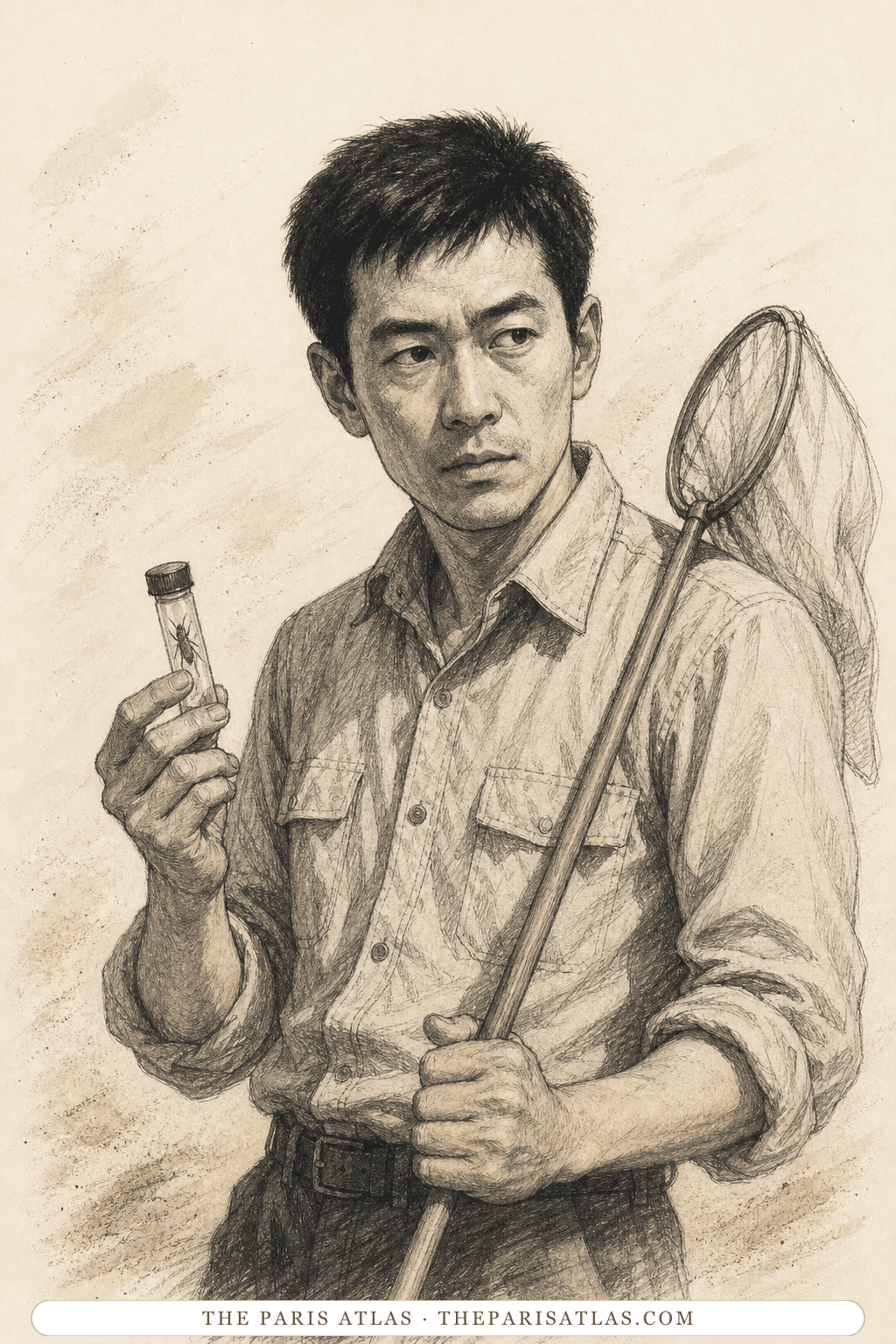
Niki Jumpei
The thirty-one-year-old teacher and insect collector who is trapped in the pit and spends months trying to escape.
To regain control of his life and prove that intelligence can defeat the trap, then later to perfect the water collector he discovered.
The book

At a glance
- Thirty-one
- Schoolteacher
- Amateur entomology and insect collecting
- An unnamed Japanese city
- Declared missing after seven years
Who they are in the book
Spoiler-freeNiki Jumpei is a thirty-one-year-old schoolteacher from the city and an enthusiastic amateur entomologist. He travels to the coast hoping to find an unclassified beetle. The dream is partly scientific and partly personal: if he discovers a new species, his name may be preserved in a catalogue.
Jumpei enters the pit confident that observation and reasoning can solve almost any problem. He studies the movement of sand, measures the villagers' behavior, turns household materials into escape tools, and invents arguments for why his captivity makes no sense. His intelligence is real, but it does not prevent arrogance, cruelty, panic, or self-deception.
The long confinement changes the scale of his life. Water, sleep, skin, tools, sex, and the next night's work become more urgent than his former reputation. His final attachment to the water collector shows that a project he chose for himself can matter more than the freedom he once treated as his only goal.
How Niki Jumpei Is Portrayed
- Thirty-one and city educatedJumpei works as a teacher and approaches the village with the confidence of someone who expects rational explanations to carry authority.
- Equipped to collect insectsHis field gear, specimen containers, and attention to small creatures establish him as an observer before he becomes the object of the villagers' watch.
- Always building a theoryHe explains sand, motives, sex, work, and freedom to himself in long chains of reasoning. A new fact can make him reverse a conclusion without ending the argument.
- Inventive with limited materialsHe makes ropes, hooks, traps, and a water collector from objects available in the house. Practical invention is one of his strongest qualities.
- Physically worn downHeat, thirst, poor sleep, labor, and abrasive sand strip away the distance he once kept between his mind and body.
- A harsh judge of the womanHe repeatedly calls her acceptance foolish because he cannot imagine adaptation as anything but surrender. His view changes, but he never becomes a fully reliable judge of her choices.
Jumpei's most direct escape succeeds only briefly. He climbs out with a handmade rope, runs across the dunes, and becomes trapped in quicksand. Villagers rescue him and return him to the house. Later, his desperation to see the sea leads him to attack the woman when she refuses to have sex for the villagers' entertainment.
His crow trap unexpectedly gathers water from damp sand. The discovery gives him a useful secret and a technical problem he wants to solve. When the woman is removed for medical treatment and the ladder is left in place, Jumpei climbs out but returns to check the device. He postpones escape, and the final legal documents show that he remains missing seven years after his disappearance.
If you like The Woman in the Dunes


If you like Kōbō Abe
Explore authors with a similar voice, perspective, and influence.

Albert Camus
French Algerian novelist, essayist, journalist and playwright who used the absurd and revolt to ask how people should live without false consolation.
View author
Simone de Beauvoir
French writer and philosopher whose novels, memoirs, and social analysis examined freedom, gender, responsibility, aging, and the material conditions that shape a life.
View author
Sylvia Plath
American poet who came to Paris in the spring of 1956, in the middle of her Fulbright year at Cambridge, to find the man she had been in love with for three years — and found he had gone. She had met Ted Hughes weeks before; she married him that June, and the honeymoon came back through Paris.
View author