The Paris AtlasCharting the artists, works, and places worth returning to.
  • Painter
· American · 1960–1988

Jean-Michel Basquiat

American painter, born in Brooklyn in 1960 to a Haitian father and a Puerto Rican mother, who went from spray-painted aphorisms signed SAMO — short for 'same old' — on Lower Manhattan walls to the international art market in about three years, made more than a thousand paintings before he died at twenty-seven, and came to Paris in January 1988 for a gallery show that turned out to be his last there.

Details

Lived
1960–1988
Born
22 December 1960
Birthplace
Brooklyn, New York
Died
12 August 1988 · aged 27
Place of death
New York City
Nationality
American
Profession
Painter and draughtsman
Major works
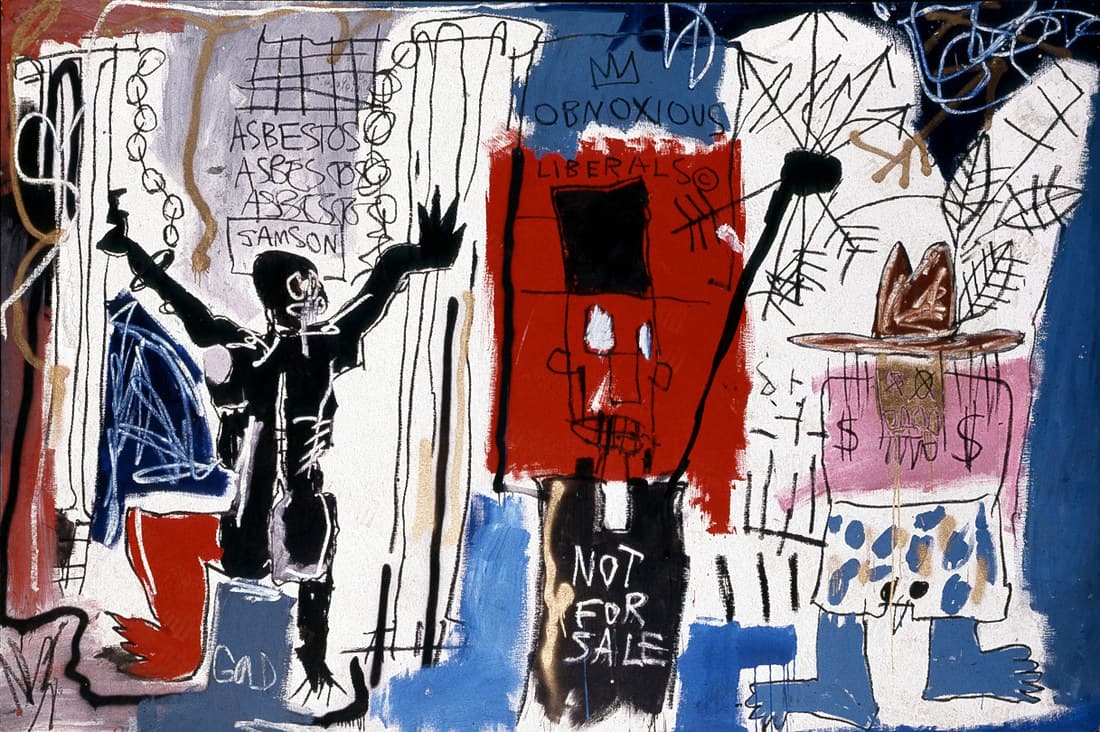
The SAMO tags (1978–79), Irony of Negro Policeman (1981), Untitled (Skull) (1981), Slave Auction (1982), Horn Players (1983), the collaborative canvases with Andy Warhol (1984–85)
Roles
Painter

About Jean-Michel Basquiat

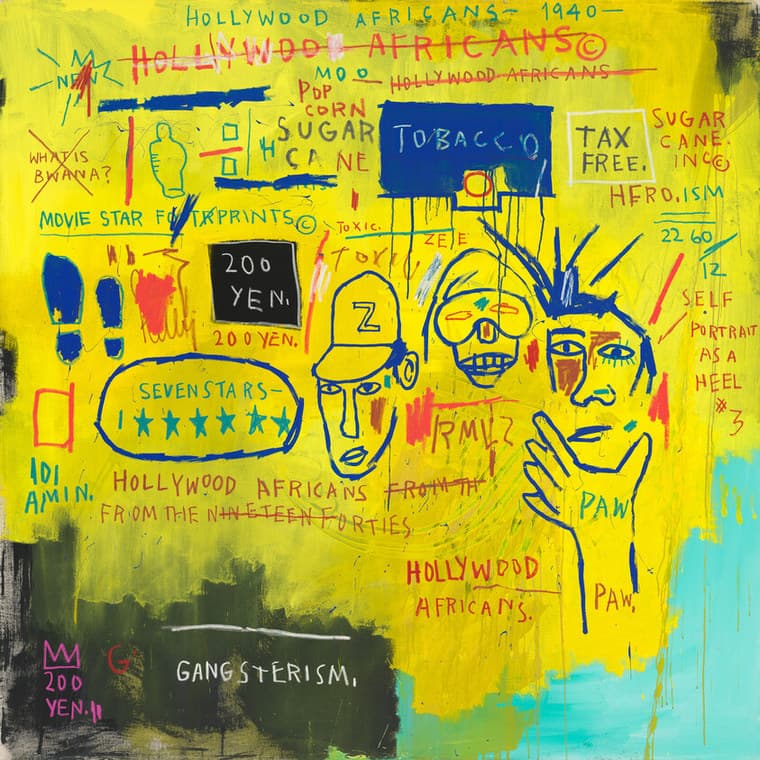
Jean-Michel Basquiat painted in a hurry and died young: over a thousand paintings and more than two thousand drawings in less than a decade, then a heroin overdose at his studio on Great Jones Street in Manhattan on 12 August 1988, aged twenty-seven. The work puts crowns on Black musicians and boxers, copies out anatomical diagrams and lists of commodities, crosses words out so you read them twice, and sets it all in paint applied like handwriting.

New York made him and mostly kept him — the SAMO tags, the spray-painted slogans he signed on the walls of the Lower East Side; the Times Square Show of 1980, the artist-run exhibition that announced his generation; the gallery debut at Annina Nosei's in 1981; the friendship and then the working collaboration with Andy Warhol, the older and far more famous American painter. Paris holds two specific things: the exhibition he flew over for in January 1988, seven months before he died, and Slave Auction, a Basquiat of 1982 that entered the French national collection at the Centre Pompidou — France's national museum of modern art — in 1993. Everything else the city has of him is posthumous, and it started arriving within a year of his death.

SAMO, and three years to fame

Basquiat was born on 22 December 1960 in Park Slope, Brooklyn, to Gérard Basquiat, an accountant from Haiti, and Matilde Andrades, whose parents were Puerto Rican. He read English, French and Spanish, and drew constantly; his mother took him to the Brooklyn Museum. In the late 1970s he and his schoolfriend Al Diaz began spraying cryptic one-line statements on walls around Lower Manhattan — 'Playing Art with Daddy's Money', '9 to 5 Clone' — and signing them SAMO, short for 'same old'.

The tags made him known before any gallery did. In 1980 he showed work in the Times Square Show, an exhibition organized by the artists' groups Colab and Fashion Moda in an empty building near Times Square, and now treated as the founding event of the 1980s downtown scene. In 1981 the critic and poet René Ricard published 'The Radiant Child' in the art magazine Artforum, an essay largely about Basquiat, and the market arrived. His first solo shows — exhibitions given over to his work alone — came the same year, at the Galleria d'Arte Emilio Mazzoli in Modena in Italy and at the Annina Nosei Gallery in New York.

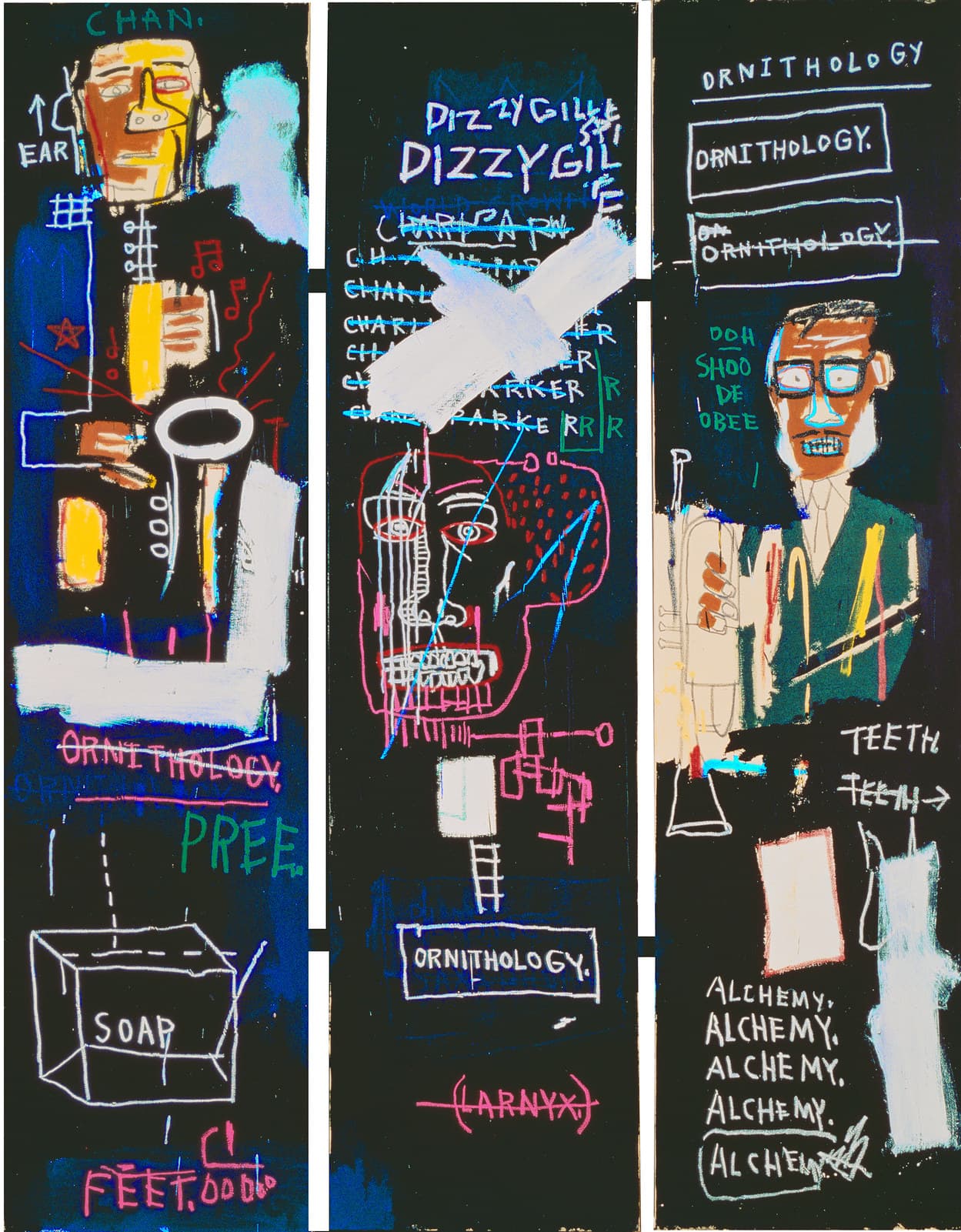
By 1982 galleries in New York, Los Angeles, Rome, Rotterdam and Zurich were all giving him solo shows, and he was painting the work he is now known for: the skulls, the crowned heads, the boxers, the bebop musicians of 1940s jazz, the griots — the West African praise-singers who carry a community's history in memory — and the copied-out lists. The Broad museum in Los Angeles, which owns twelve of his works, holds two of the best known, Horn Players (1983) and Gold Griot (1984).

Warhol

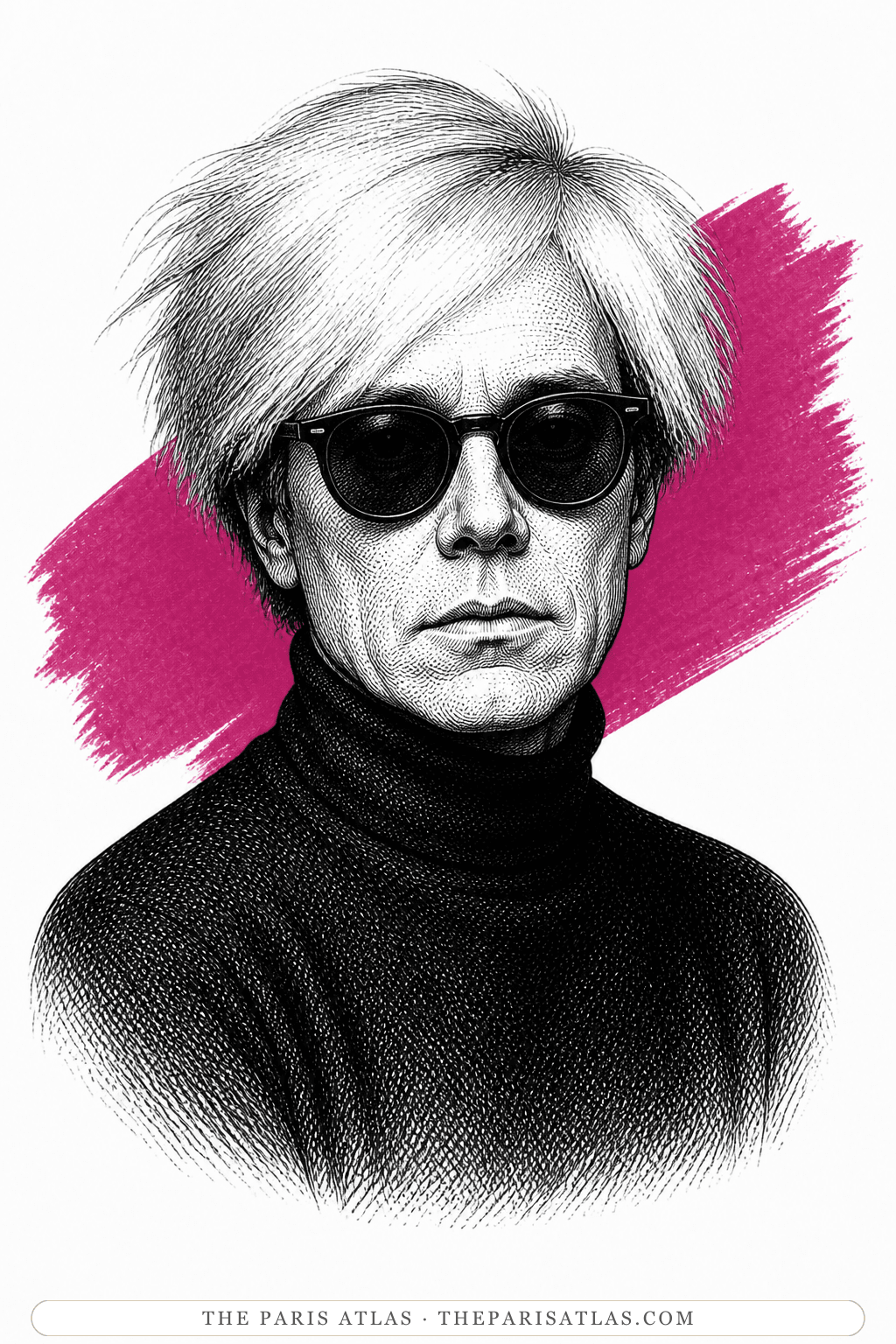
Andy Warhol was thirty-two years older, the most famous artist in America, and by the early 1980s widely written off as a society portraitist. The Swiss dealer Bruno Bischofberger, who handled Warhol's work in Europe, introduced the two men in 1982, and from 1984 they painted together in Warhol's studio, one starting a canvas and the other going over it: Warhol's hand-painted logos and headlines under and around Basquiat's figures and words. The Andy Warhol Museum puts the output at 'over 150 collaborative canvases over a four-year period'.

The joint show at the Tony Shafrazi Gallery in New York in 1985 was reviewed badly — the poster had the two of them in boxing gloves, and the notices treated Basquiat as Warhol's mascot — and the friendship cooled. Warhol died on 22 February 1987 after gallbladder surgery. Basquiat's own drug use worsened after it, and he spent much of his last eighteen months alone.

Paris, January 1988

In January 1988 Basquiat flew to Paris for an exhibition of his work at the Galerie Yvon Lambert, then one of the city's leading contemporary galleries, and went on to the German city of Düsseldorf for a show at the Galerie Hans Mayer. He had shown in Paris before — at the Galerie Daniel Templon, another of the city's leading contemporary dealers, in 1987 — and a second Paris exhibition, at the Galerie Beaubourg, also fell in 1988. In Paris he met the Ivorian painter Ouattara Watts, and the two planned a trip to Watts's home country, Côte d'Ivoire, for that summer.

The trip never happened. After a show at the Vrej Baghoomian Gallery in New York in April, Basquiat went to Maui to get off heroin, came back to New York in July, and died at his Great Jones Street studio on 12 August 1988. He was twenty-seven. The Paris exhibition of January had been the last of his lifetime in the city.

Paris kept showing him afterwards, and quickly: Warhol-Basquiat: Collaborations at Didier Imbert Fine Art in 1989, solo shows at the Galerie Enrico Navarra the same year and at Fabien Boulakia and the Galerie Le Gall Peyroulet in 1990, and a museum exhibition, Peinture, dessin, écriture — 'painting, drawing, writing' — at the Musée-Galerie de la Seita, the Paris exhibition space run by the French state tobacco company, in 1993.

A Basquiat in the French national collection

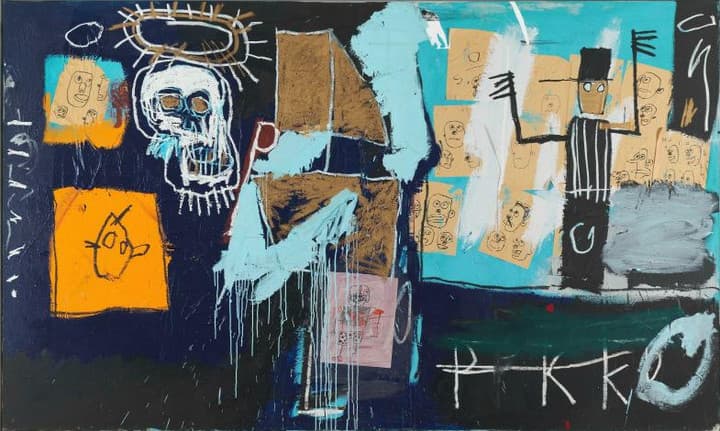
The Centre Pompidou — France's national museum of modern art, in the 4th arrondissement — holds Slave Auction, painted in 1982: a canvas nearly three metres wide made of crumpled paper collage, oil stick — oil paint bound into a thick crayon you draw with directly — and acrylic. The Société des Amis du Musée national d'art moderne, the association of the museum's private supporters, gave it to the collection in 1993. The museum's own note reads the picture as being about 'oppressed minorities and, more directly, the slave trade', with a gilded ship and a skull in a crown of thorns.

Paris institutions now sit at the centre of how his work is shown. When the Brant Foundation, an American private collector's exhibition space, opened its New York rooms in the East Village in March 2019 with a Basquiat exhibition, in the neighbourhood he had worked in thirty years earlier, the show was curated by Dieter Buchhart, the art historian who has organised most of the major Basquiat exhibitions of recent decades, and, in the foundation's own words, 'organized in collaboration with Fondation Louis Vuitton', the museum the architect Frank Gehry built out of curved glass sails in the Bois de Boulogne, the great park on the western edge of Paris.

What the paintings are worth now

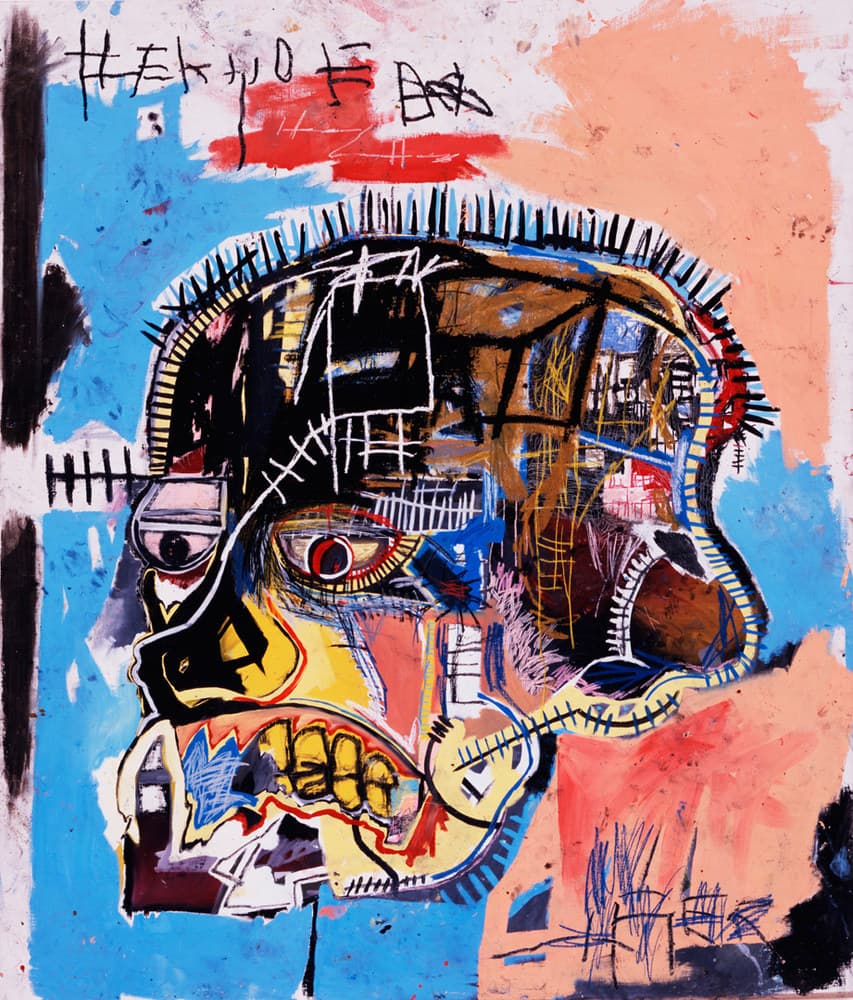
On 18 May 2017 an untitled 1982 painting of a skull sold at the auction house Sotheby's in New York for 110.5 million dollars — 'the highest sum ever paid at auction for a U.S.-produced artwork', as NPR, the American public radio network, reported it the next morning. Basquiat sold well while he was alive. He sold nothing at that order.

He is buried at Green-Wood Cemetery in Brooklyn, which lists him among its notable residents: 'A native of Brooklyn, Jean-Michel Basquiat (1960–1988) revolutionized the art world with his bold and expressive works.'

Life events

  1. 1960

    Born on 22 December in Brooklyn, to a Haitian father and a Puerto Rican mother.

    Jean-Michel Basquiat — artist page and collection holdings

  2. 1978

    With Al Diaz, begins tagging cryptic statements — 'Playing Art with Daddy's Money', '9 to 5 Clone' — signed SAMO around Lower Manhattan.

    Jean-Michel Basquiat — artist page and collection holdings

  3. 1980

    Shows in the Times Square Show, the artist-run exhibition that announced the downtown scene.

    Jean-Michel Basquiat — artist page and collection holdings

  4. 1981

    René Ricard's essay 'The Radiant Child' appears in Artforum; first solo exhibitions follow, in Modena and at the Annina Nosei Gallery in New York.

    Jean-Michel Basquiat — artist page and collection holdings; Jean-Michel Basquiat (6 March – 14 May 2019) — exhibition page with the artist's exhibition chronology

  5. 1982

    Eight solo shows in one year, from New York and Los Angeles to Rome, Rotterdam and Zurich. Paints Slave Auction, now at the Centre Pompidou.

    Jean-Michel Basquiat (6 March – 14 May 2019) — exhibition page with the artist's exhibition chronology; Jean-Michel Basquiat, Slave Auction (1982) — notice d'œuvre, Musée national d'art moderne

  6. 1984

    Begins painting jointly with Andy Warhol; the two produce more than 150 canvases together.

    Andy Warhol's Life — the museum's biography; Andy Warhol—From A to B and Back Again (12 November 2018 – 31 March 2019)

  7. 1985

    Andy Warhol & Jean-Michel Basquiat opens at the Tony Shafrazi Gallery, New York, and is badly reviewed.

    Jean-Michel Basquiat (6 March – 14 May 2019) — exhibition page with the artist's exhibition chronology

  8. 1987

    Shows at the Galerie Daniel Templon in Paris. Warhol dies in New York on 22 February.

    Jean-Michel Basquiat (6 March – 14 May 2019) — exhibition page with the artist's exhibition chronology; Andy Warhol's Life — the museum's biography

  9. 1988

    Travels to Paris in January for his exhibition at the Galerie Yvon Lambert, and on to the Galerie Hans Mayer in Düsseldorf; a second Paris show, at the Galerie Beaubourg, follows the same year.

    Leonhard Emmerling, Jean-Michel Basquiat: 1960–1988 (2003); Jean-Michel Basquiat (6 March – 14 May 2019) — exhibition page with the artist's exhibition chronology

  10. 1988

    Dies of a heroin overdose at his Great Jones Street studio in Manhattan on 12 August, aged 27.

    Jean-Michel Basquiat — artist page and collection holdings

  11. 1989

    Warhol-Basquiat: Collaborations shows at Didier Imbert Fine Art in Paris, the year after his death.

    Jean-Michel Basquiat (6 March – 14 May 2019) — exhibition page with the artist's exhibition chronology

  12. 1993

    Slave Auction (1982) enters the French national collection at the Centre Pompidou, given by the museum's friends' association.

    Jean-Michel Basquiat, Slave Auction (1982) — notice d'œuvre, Musée national d'art moderne

  13. 2017

    An untitled 1982 painting of a skull sells at Sotheby's for $110.5 million, the highest auction price paid for a work by an American artist.

    Colin Dwyer, At $110.5 Million, Basquiat Painting Becomes Priciest Work Ever Sold By A U.S. Artist (2017)

  14. 2019

    The Brant Foundation opens its New York space with a Basquiat exhibition curated by Dieter Buchhart and organized with the Fondation Louis Vuitton in Paris.

    Jean-Michel Basquiat (6 March – 14 May 2019) — exhibition page with the artist's exhibition chronology

People they knew

Documented connections — every one carries its source.

Keith Haring

  • Painter

Met · 1978

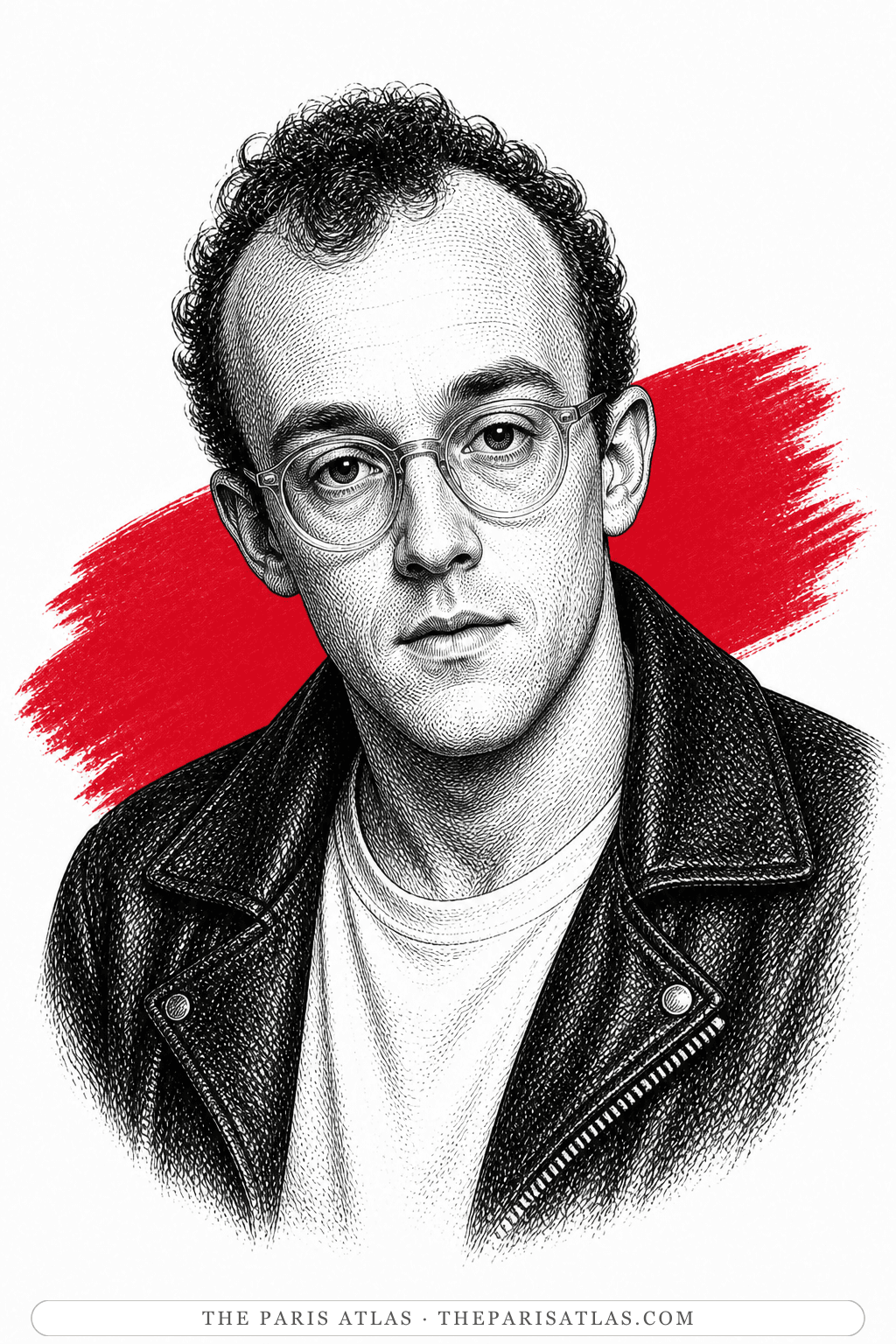
The Keith Haring Foundation's biography places the meeting at the School of Visual Arts and the downtown scene around it: 'Here he became friends with fellow artists Kenny Scharf and Jean-Michel Basquiat, as well as the musicians, performance artists and graffiti writers that comprised the burgeoning art community.'

Keith Haring — official biography

Andy Warhol

  • Painter
  • Filmmaker
  • Publisher

Collaborated with · 1984–1985

The Andy Warhol Museum states that the two artists 'together produced over 150 collaborative canvases over a four-year period' in the mid-1980s. The Whitney Museum's 2018 retrospective showed the results, among them Paramount (1984–85) and Third Eye (1985); the pair exhibited the collaborations together at the Tony Shafrazi Gallery in New York in 1985.

Andy Warhol's Life — the museum's biography; Andy Warhol—From A to B and Back Again (12 November 2018 – 31 March 2019); Jean-Michel Basquiat (6 March – 14 May 2019) — exhibition page with the artist's exhibition chronology

Questions about Jean-Michel Basquiat

Who was Jean-Michel Basquiat?

An American painter, born in Brooklyn in 1960 to a Haitian father and a Puerto Rican mother, who first became known in the late 1970s for spray-painted aphorisms signed SAMO on Lower Manhattan walls, and by 1982 was one of the most sought-after painters in the world. He made over a thousand paintings and more than two thousand drawings before dying of a heroin overdose on 12 August 1988, aged twenty-seven.

What does SAMO mean?

'Same old' — the tag Basquiat and his schoolfriend Al Diaz signed to the cryptic one-line statements they sprayed around downtown New York in the late 1970s, among them 'Playing Art with Daddy's Money' and '9 to 5 Clone'. The SAMO writings were epigrams aimed at the art world and the office world at once, and they made Basquiat known before he had shown a painting anywhere.

Did Jean-Michel Basquiat ever exhibit in Paris?

Yes. Two Paris shows are firmly recorded in his lifetime: one at the Galerie Daniel Templon in 1987, and one at the Galerie Yvon Lambert in 1988, which he flew over for in January of that year, seven months before he died. The exhibition record lists a third, at the Galerie Beaubourg, later in 1988. Paris kept showing him after his death — the Warhol collaborations at Didier Imbert Fine Art in 1989, solo shows in 1989 and 1990, and a museum exhibition at the Musée-Galerie de la Seita in 1993.

Is there a Basquiat in a Paris museum?

Yes. The Centre Pompidou, France's national museum of modern art, holds Slave Auction, painted in 1982 — crumpled-paper collage, oil stick (oil paint in thick crayon form) and acrylic on canvas, 183 by 305.5 centimetres — given to the museum, whose formal name is the Musée national d'art moderne, by its association of private supporters in 1993. The museum reads the picture as being about oppressed minorities and the slave trade, and points to the gilded ship and the skull crowned with thorns.

Where can you see a Basquiat in Paris today?

At the Centre Pompidou, which holds Slave Auction (1982) in the collection of the Musée national d'art moderne — subject to the museum's rotations, since not everything owned is on the wall at once. Paris institutions also shape how his work travels: the Brant Foundation's 2019 Basquiat exhibition in New York was curated by Dieter Buchhart and organized in collaboration with the Fondation Louis Vuitton, the museum Frank Gehry designed in the Bois de Boulogne, the park on the western edge of Paris.

How did Basquiat know Andy Warhol?

They were introduced in 1982 by Bruno Bischofberger, the Swiss dealer who handled Warhol's work in Europe, became close, and from 1984 painted together — the Andy Warhol Museum counts more than 150 collaborative canvases over four years, with Warhol putting down logos and headlines and Basquiat painting over and around them. Their joint show at the Tony Shafrazi Gallery in 1985 was mocked by the critics and the friendship cooled. Warhol died in February 1987; Basquiat, who had few close friends left, died eighteen months after him.

How much are Basquiat paintings worth?

The record is 110.5 million dollars, paid at auction in May 2017 for an untitled 1982 painting of a skull — at the time the highest price ever paid for a work by an American artist. Prices at that level are a phenomenon of the last decade; Basquiat sold well in his lifetime, but nothing like that.

How did Jean-Michel Basquiat die?

Of a heroin overdose, at his studio on Great Jones Street in Manhattan, on 12 August 1988. He was twenty-seven. He had been to Maui in June to try to stop using, and had returned to New York in July. He is buried at Green-Wood Cemetery in Brooklyn.

Sourced claims

Every connection the graph holds for Jean-Michel, with the evidence behind it.

Met · 1978

Keith Haring

The Keith Haring Foundation's biography places the meeting at the School of Visual Arts and the downtown scene around it: 'Here he became friends with fellow artists Kenny Scharf and Jean-Michel Basquiat, as well as the musicians, performance artists and graffiti writers that comprised the burgeoning art community.'

Keith Haring — official biography

Collaborated with · 1984–1985

Andy Warhol

The Andy Warhol Museum states that the two artists 'together produced over 150 collaborative canvases over a four-year period' in the mid-1980s. The Whitney Museum's 2018 retrospective showed the results, among them Paramount (1984–85) and Third Eye (1985); the pair exhibited the collaborations together at the Tony Shafrazi Gallery in New York in 1985.

Andy Warhol's Life — the museum's biography; Andy Warhol—From A to B and Back Again (12 November 2018 – 31 March 2019); Jean-Michel Basquiat (6 March – 14 May 2019) — exhibition page with the artist's exhibition chronology

References

References

The sources below include biographies, scholarly essays, interviews, and primary materials that informed this page. They reflect both the historical record and ongoing critical conversations about Jean-Michel Basquiat and their work.

  1. 1Jean-Michel Basquiat (6 March – 14 May 2019) — exhibition page with the artist's exhibition chronology

    The Brant Foundation Art Study Center, New York

    The foundation's exhibition page and its year-by-year list of Basquiat's shows, including Galerie Yvon Lambert and Galerie Beaubourg in Paris in 1988.

    View source
  2. 2Jean-Michel Basquiat — artist page and collection holdings

    The Broad, Los Angeles

    The Broad's artist page — birth, the SAMO tags with Al Diaz, the 1980 Times Square Show, René Ricard's 'The Radiant Child', and the twelve works the museum owns.

    View source
  3. 3Jean-Michel Basquiat, Slave Auction (1982) — notice d'œuvre, Musée national d'art moderne

    Centre Pompidou

    The Centre Pompidou's notice for Slave Auction (1982), with its medium, dimensions and 1993 donation.

    View source
  4. 4Jean-Michel Basquiat: 1960–1988

    Taschen, 2003

    The Taschen monograph, source for the January 1988 Paris trip and the Düsseldorf show that followed it.

  1. 5Andy Warhol's Life — the museum's biography

    The Andy Warhol Museum, Pittsburgh

    The Andy Warhol Museum's biography, for the collaboration figure of more than 150 canvases and Warhol's death in February 1987.

    View source
  2. 6Andy Warhol—From A to B and Back Again (12 November 2018 – 31 March 2019)

    Whitney Museum of American Art, New York

    The Whitney's Warhol retrospective, which showed the collaborative canvases Paramount (1984–85) and Third Eye (1985).

    View source
  3. 7At $110.5 Million, Basquiat Painting Becomes Priciest Work Ever Sold By A U.S. Artist

    NPR, 2017

    NPR's report on the 2017 Sotheby's sale of the untitled 1982 skull painting for $110.5 million.

    View source
  4. 8Notable Residents — including Jean-Michel Basquiat (1960–1988)

    Green-Wood Cemetery, Brooklyn

    Green-Wood Cemetery in Brooklyn, which lists Basquiat among its notable residents.

    View source
i
Why these sources are here

These references anchor the page in the documented record and in the scholarly conversations around Jean-Michel Basquiat. Every claim on this page traces back to one or more of the works listed here.

Explore more resources