Obnoxious Liberals
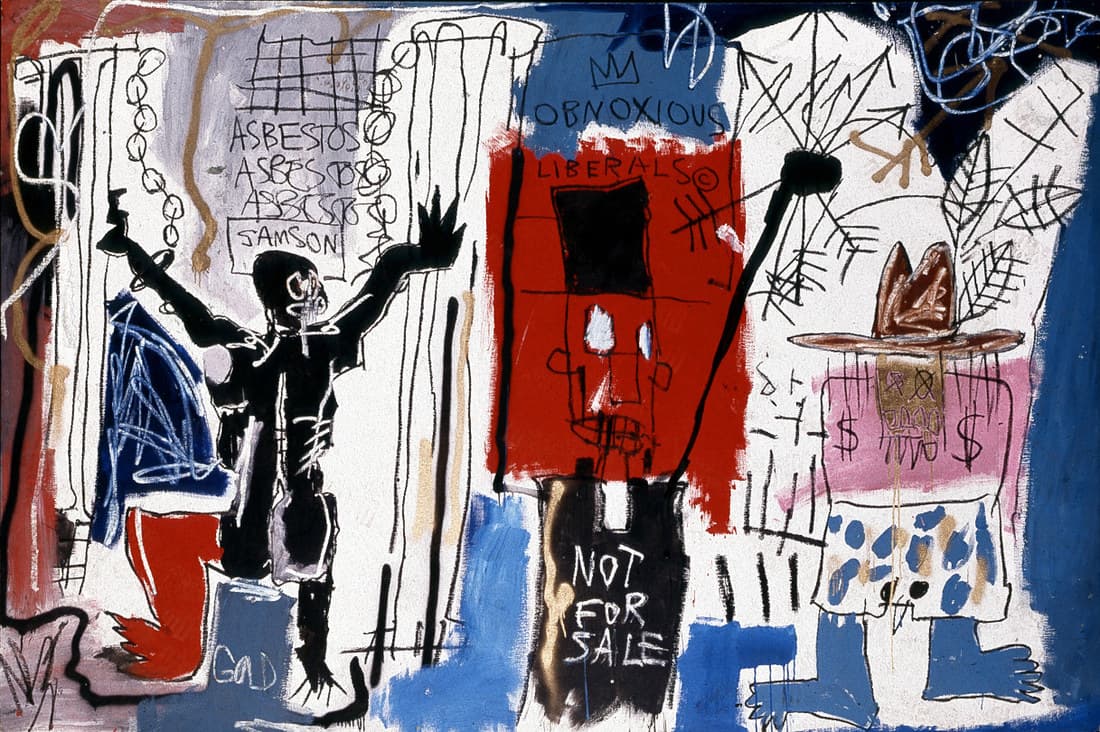
Three figures stand across a canvas two and a half metres wide. A black figure at the left holds both arms out, with white strokes crossing its torso like bindings. A red panel in the middle holds a figure whose lower body carries the words NOT FOR SALE. A figure at the right wears a wide brown hat above a pink band marked with two dollar signs. The word ASBESTOS is written three times at the upper left, degrading each time it is repeated, above a drawn box holding the word SAMSON.
- 1982
- Acrylic, oilstick, and spray paint on canvas
- The BroadLos Angeles, United States
About Jean-Michel Basquiat
What the painting shows
The left third is a white and grey ground scored with drawn vertical lines. On it stands a black figure with both arms out, the left one raised and ending in a heavy black wedge, the right one held level. Its head is black with a white ring round one eye and a drawn mouth, and white strokes cross the torso and the right arm like bindings. A chain of drawn oval links hangs down from above beside the raised arm. A blue form scribbled over in white loops stands to the left of the figure, with a red shape below it.
Above that figure a rough grid is drawn, and under the grid the word ASBESTOS is written three times. The first is clear capital letters. The second is written over itself. The third has collapsed into loops that barely read as letters at all. A drawn box below them holds the word SAMSON.
The middle third is a red rectangle. Above it, on blue, a three-point crown is drawn over the word OBNOXIOUS, with LIBERALS and a copyright symbol below on the red. Inside the red is a figure with a solid black block for a head, two white eyes, a red nose and a drawn mouth. Its body continues below the red as a black column, and on that column the words NOT FOR SALE are painted in white.
The right third holds a figure in a wide brown hat with a peaked crown. Its face is a gold-brown rectangle with crossed-out eyes and a row of drawn teeth, set against a pink band that carries a dollar sign on each side. Below, a garment is spotted in blue and tan, and two hands are drawn at the edges. Radiating black strokes and small crossed grids fill the white around it.
The canvas is 172.72 by 259.08 centimetres, about 68 by 102 inches, in acrylic, oilstick and spray paint.
The words on the canvas
Four pieces of text carry the picture: ASBESTOS three times, SAMSON in a box, OBNOXIOUS LIBERALS with a crown and a copyright symbol, and NOT FOR SALE.
Jean-Michel Basquiat described what he was doing when he obscured writing, in a statement the Whitney Museum of American Art prints on its own Basquiat record: "I cross out words so you will see them more; the fact that they are obscured makes you want to read them." The three ASBESTOS lines work that way without a single crossing-out, by writing the same word into illegibility.
Asbestos was still being litigated across the United States as he painted. Samson is the figure of Judges 13 to 16, whose strength is in his hair and who is blinded and chained by his captors. The Broad publishes no curatorial note for the painting, and neither reference is explained in any institutional record, so what the words are doing together is not settled by any source.
NOT FOR SALE
The phrase is painted in white on the black lower body of the central figure, in the largest lettering on the canvas. No holding institution explains it.
The year it was painted is the year the market closed around him. The Brant Foundation's chronology counts eight solo exhibitions in 1982 alone, in New York, Los Angeles, Rome, Rotterdam and Zurich, when he was twenty-one.
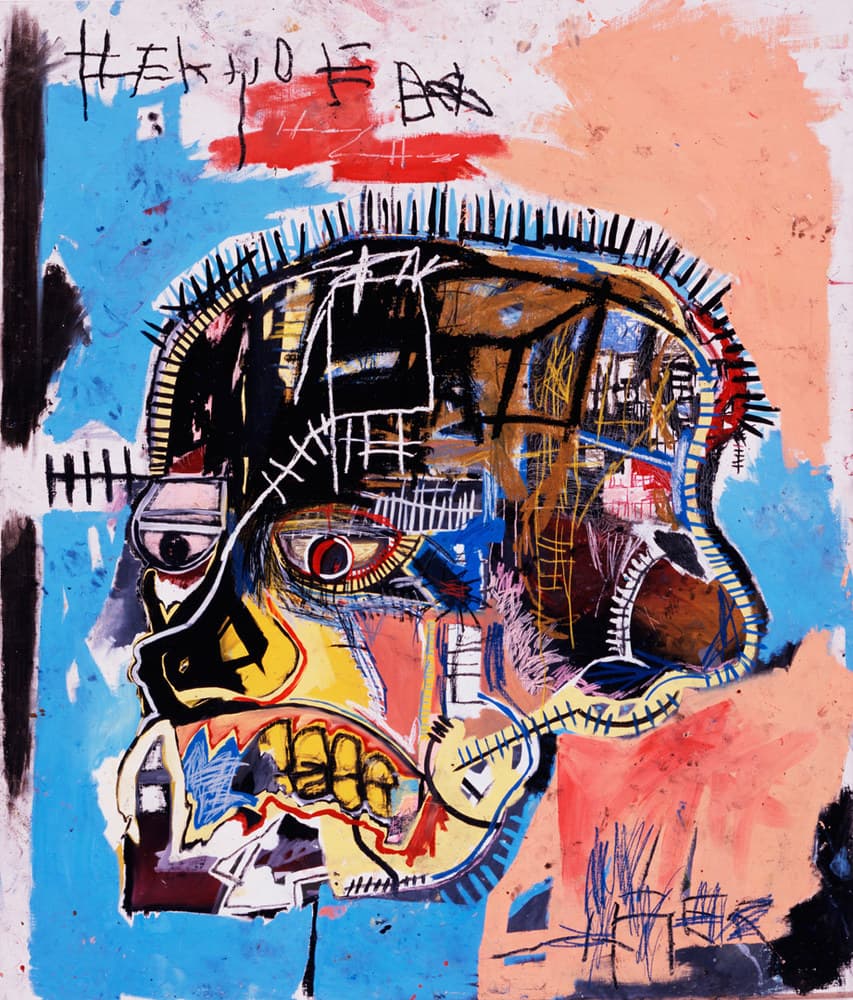
Prices since have gone much further. On 18 May 2017 an untitled painting of a skull from that same year, 1982, sold at Sotheby's in New York for 110.5 million dollars. NPR reported it the next morning as the highest sum ever paid at auction for a work by an American artist.
Where it is
The Broad in Los Angeles owns the painting, with the accession number B-BASQ-2P84.22 and an accession date of 20 April 1984. The museum holds thirteen works by Jean-Michel Basquiat, the largest group in any single collection open to the public.
The painting has no recorded Paris exhibition history. Jean-Michel Basquiat showed in Paris twice in his lifetime that the record fixes firmly: at the Galerie Daniel Templon in 1987, and at the Galerie Yvon Lambert in January 1988. The exhibition chronology lists a third, at the Galerie Beaubourg, later in 1988. That connection is the painter's rather than this canvas's.
Close reading
Reading the work, detail by detail
Three figures and four pieces of writing. Follow the word ASBESTOS as it repeats itself into illegibility, then the boxed SAMSON beneath it, the crowned title, the words NOT FOR SALE on the central body, and the hatted figure between two dollar signs.
1.ASBESTOS, three times
The transcription is ASBESTOS, ASBESTOS, ASBESTOS. Nothing is crossed out. The word is written over itself until the letters close into loops and stop reading, which is the same result as a strikethrough reached by a different means.
2.SAMSON in its box
SAMSON is the only word on the canvas that Jean-Michel Basquiat enclosed. The box is drawn freehand and does not close neatly at the lower left. No museum record explains the name.
3.The crown over OBNOXIOUS
The crown has three points and a flat base, the form that recurs across his work. It sits directly above the first word of the title, and both are drawn on the blue rather than on the red panel below.
4.LIBERALS and the copyright mark
The copyright symbol after LIBERALS is drawn by hand as a spiral inside a circle, not stamped. Jean-Michel Basquiat marks his own title as a piece of property in the act of writing it.
5.NOT FOR SALE
The transcription is NOT FOR SALE, on three lines. It is the largest lettering on the canvas and the only text painted in white. The gold-tan streak beside it runs through the black from top to bottom.
6.The bound figure
The white strokes over the body are laid across it at intervals, which reads as binding rather than clothing. A chain of drawn oval links hangs down from the top of the canvas beside the raised arm without attaching to it.
7.The figure in the hat
The eyes are drawn as crossed lines rather than as shapes, so the face reads as a mask or a skull. The hat is painted in brown paint that has run downward in visible drips over the face below.
8.The two dollar signs
Both dollar signs are drawn at the same size and sit level with each other, one on each side of the figure's body. They are the only currency marks on the canvas, and the pink band they sit on runs behind the figure rather than in front of it.
Timeline
1982
Painted in acrylic, oilstick and spray paint, in a year the Brant Foundation chronology records as holding eight solo exhibitions for Jean-Michel Basquiat.
1984
Enters the Broad collection; The Broad gives the accession date as 20 April 1984 and the number B-BASQ-2P84.22.
1988
Jean-Michel Basquiat dies of a heroin overdose in Manhattan on 12 August, aged twenty-seven.
2017
An untitled 1982 painting of a skull sells at Sotheby's in New York for 110.5 million dollars, the highest auction price then paid for a work by an American artist.
Where to see it
The Broad
Los Angeles, United States
A public viewing address has not yet been confirmed for this holding.
The Broad gives the accession date as 20 April 1984 and does not mark the painting as on view. Check the museum's record before travelling.
Frequently asked questions
What does Obnoxious Liberals show?
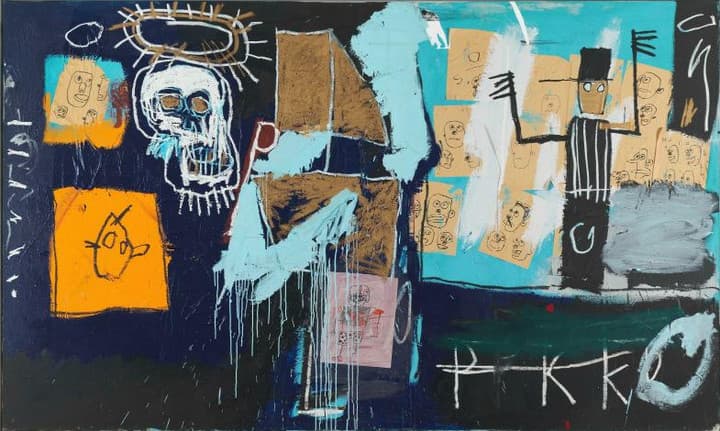
Three figures across a canvas two and a half metres wide. A black figure at the left holds both arms out, one raised and ending in a heavy black wedge, with white strokes crossing its torso like bindings and a chain of drawn links hanging beside it. A figure in the middle stands on a red field with NOT FOR SALE painted in white on its black lower body. A figure at the right wears a wide brown hat above a pink band carrying two dollar signs.
What words are written on Obnoxious Liberals?
ASBESTOS three times at the upper left, each repetition less legible than the last. SAMSON inside a drawn box below them. OBNOXIOUS under a three-point crown, with LIBERALS and a copyright symbol below it. NOT FOR SALE in white on the central figure.
Why did Basquiat cross out words?
To make them more visible. The Whitney Museum of American Art quotes him directly: "I cross out words so you will see them more; the fact that they are obscured makes you want to read them." In Obnoxious Liberals he gets the same effect by writing ASBESTOS over itself until it stops reading as a word.
Where can you see Obnoxious Liberals?
The Broad in Los Angeles, accession number B-BASQ-2P84.22. The Broad's record does not list it as on view, and museums rotate their walls, so check before travelling.
How big is Obnoxious Liberals?
172.72 by 259.08 centimetres, about 68 by 102 inches — wider than it is tall, and one of the larger canvases Jean-Michel Basquiat painted in 1982.
Was Obnoxious Liberals ever shown in Paris?
No exhibition record places it there. Jean-Michel Basquiat himself showed in Paris at the Galerie Daniel Templon in 1987 and the Galerie Yvon Lambert in January 1988, and the Centre Pompidou holds his Slave Auction of 1982. Obnoxious Liberals has been in Los Angeles since 1984.
More by Jean-Michel Basquiat
If you like Jean-Michel Basquiat
Explore painters from the same movements and circles.
Tarsila do Amaral
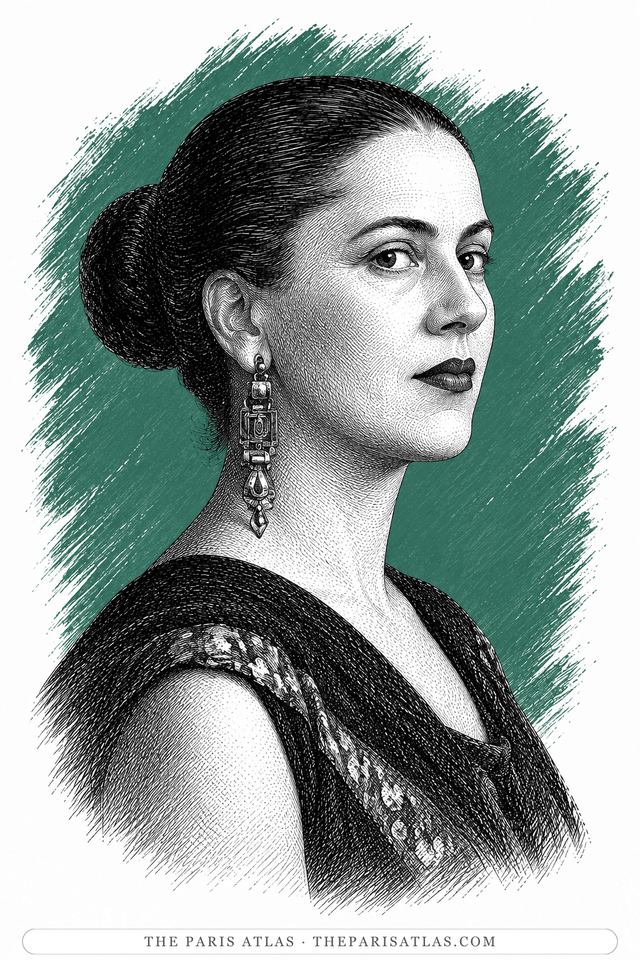
Brazilian painter who spent the 1920s moving between São Paulo and Paris, studied Cubism under André Lhote, Albert Gleizes and Fernand Léger, and used what she learned to paint Brazilian towns, railways, plants and bodies. Her 1928 painting Abaporu prompted the manifesto that gave the Anthropophagic movement its name.
View artist
Arman
French-American artist, lifelong friend of Yves Klein, and a founder of New Realism.
View artist
Jean Arp
Strasbourg-born sculptor and poet — Hans in German, Jean in French, both all his life — who co-founded Dada at the Cabaret Voltaire in 1916, composed collages by dropping torn paper 'according to the laws of chance', and settled at Meudon outside Paris in a house his wife Sophie Taeuber-Arp designed.
View artist
References
The sources below include collection records, catalogues, scholarly research, and primary materials that informed this page. They document Obnoxious Liberals, its making, and its place in cultural history.

1Jean-Michel Basquiat, Obnoxious Liberals (1982) — object record, B-BASQ-2P84.22
WebsiteThe Broad, Los AngelesUsed forThe Broad's object record: title, year, medium, dimensions, accession number and date, and the Artestar credit line.
2Jean-Michel Basquiat, Hollywood Africans (1983) — collection record, 84.23
WebsiteWhitney Museum of American Art, New YorkUsed forThe Whitney's object record, which quotes Jean-Michel Basquiat on why he crossed words out.
3Jean-Michel Basquiat (6 March – 14 May 2019) — exhibition page with the artist's exhibition chronology
WebsiteThe Brant Foundation Art Study Center, New YorkUsed forThe exhibition chronology: eight solo shows in 1982, and the Paris exhibitions of 1987 and 1988.
4At $110.5 Million, Basquiat Painting Becomes Priciest Work Ever Sold By A U.S. Artist
PeriodicalNPR, 2017Used forNPR's report on the 2017 Sotheby's sale of an untitled 1982 skull painting for 110.5 million dollars.
5Jean-Michel Basquiat — artist page of the licensing agency named in the museums' credit lines
WebsiteArtestar, New YorkUsed forArtestar's artist page for Jean-Michel Basquiat, the licensing agent named in the museum credit lines.
These references provide the documented foundation for this work's history and interpretation. Claim-level citations remain attached to the specific claims they support.
 Explore more resources